


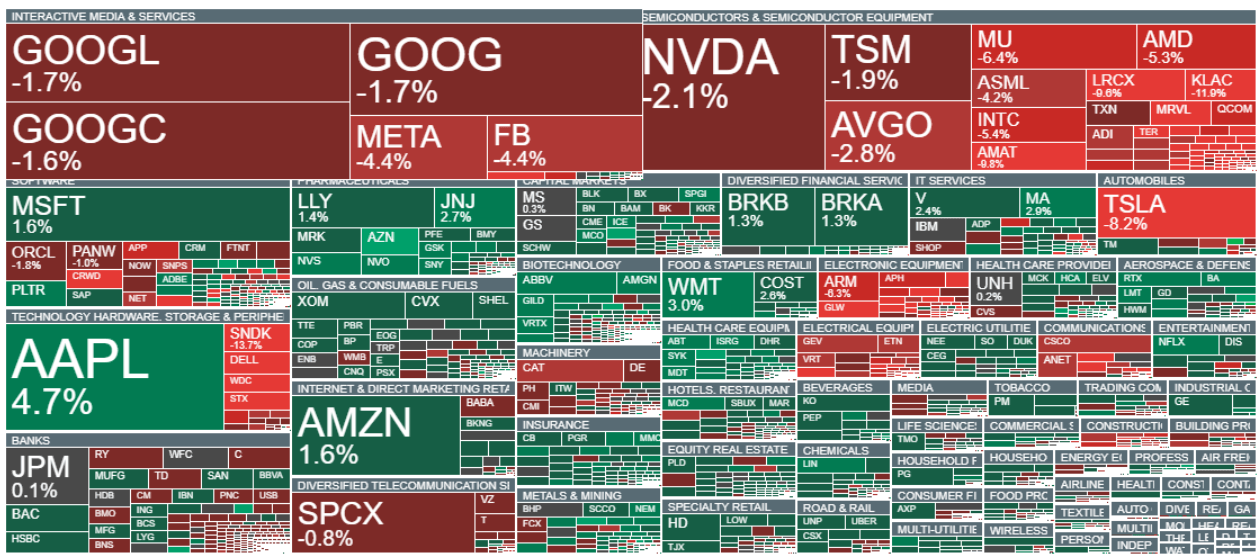
- Semiconductor stocks are under heavy selling pressure, with SanDisk plunging more than 13%.
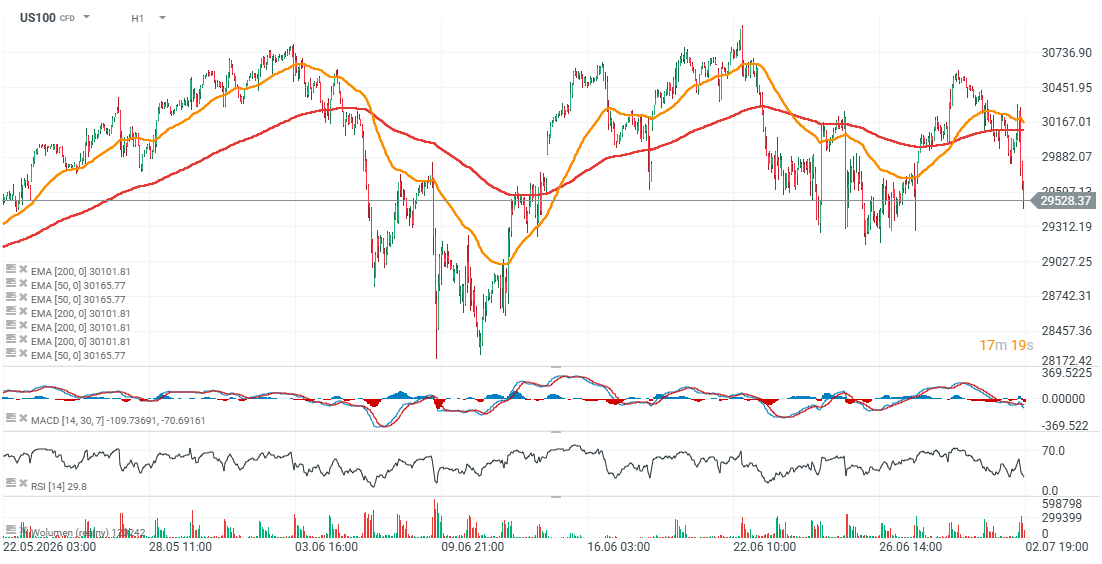
- Nasdaq 100 (US100) futures have fallen by nearly 700 points in less than an hour, extending losses to almost 2%.
- The S&P 500 is down 0.4%, while the Dow Jones Industrial Average gains more than 0.6%, highlighting deteriorating market breadth as "old economy" stocks increasingly outperform the technology sector.
- Pharmaceutical, entertainment, defense, and oil & gas companies are significantly outperforming the broader market amid the technology sell-off.

- Semiconductor stocks are under heavy selling pressure, with SanDisk plunging more than 13%.
- Nasdaq 100 (US100) futures have fallen by nearly 700 points in less than an hour, extending losses to almost 2%.
- The S&P 500 is down 0.4%, while the Dow Jones Industrial Average gains more than 0.6%, highlighting deteriorating market breadth as "old economy" stocks increasingly outperform the technology sector.
- Pharmaceutical, entertainment, defense, and oil & gas companies are significantly outperforming the broader market amid the technology sell-off.
Technology stocks came under heavy selling pressure during Thursday's afternoon session, with semiconductor companies leading the decline. Nvidia and TSMC are down nearly 2%, while Sandisk and Micron have fallen approximately 13% and 6.5%, respectively. Tesla has also dropped more than 8%, as a nearly 25% year-over-year increase in vehicle deliveries failed to sustain bullish sentiment. Meanwhile, Nasdaq 100 futures have unexpectedly fallen by more than 700 points to around 29,500, while some semiconductor names have suffered even steeper losses. Applied Materials (AMAT), for example, has declined by more than 20% since June 29.
- Meta Platforms is down nearly 4.5%, while weakness extends across much of the electronic component supply chain, from Dell to Arm Holdings. On the other hand, Apple is outperforming, gaining nearly 5%, alongside Microsoft, while pharmaceutical, healthcare, IT services, and defense stocks such as Lockheed Martin and RTX Corp. are trading higher.
- Despite today's sell-off, HSBC doubled its price target on Intel to $200 from $100, reiterating its Buy rating. The bank expects stronger server CPU shipments and rising demand for Intel Foundry services, forecasting increased customer commitments from the second half of 2026 that should support earnings growth over the longer term. Nevertheless, Intel shares are down more than 5% today, trading below $120.
- Additional pressure on the semiconductor sector may have come from reports published yesterday suggesting that Apple is considering sourcing memory chips from Chinese manufacturers. Such a move could raise concerns about the long-term competitive position of U.S., South Korean, and Taiwanese memory suppliers. According to Bloomberg, Apple is in discussions with ChangXin Memory Technologies (CXMT) and Yangtze Memory Technologies (YMTC) to diversify its supply chain and ease the effects of the global memory shortage, despite both companies appearing on the Pentagon's blacklist over alleged ties to China's military sector.
- Bloomberg also reported that Apple has sought support from the Trump administration to reduce the potential political consequences of such cooperation. Expanding its supplier base would help Apple secure memory chip availability while reducing the cost pressures that have recently forced the company to raise prices across parts of its product lineup.
S&P 500 volatility
Source: xStation 5
On the hourly timeframe, the US100 RSI has dropped to just below 30, signaling deeply oversold conditions. The index has also failed to sustain trading above both the 50-period and 200-period EMAs, suggesting that bullish momentum has weakened considerably. It is worth noting, however, that semiconductor and memory stocks have delivered gains of several hundred percent over recent months—and, in some cases, more than 1,000% over the past year (including SanDisk and Micron)—while simultaneously reporting record growth in revenue and earnings, in some cases rising by several hundred percent year over year. As a result, the current decline may ultimately prove to be a healthy profit-taking correction rather than the beginning of a long-term bearish trend.
Source: xStation 5
SanDisk and Micron (D1)
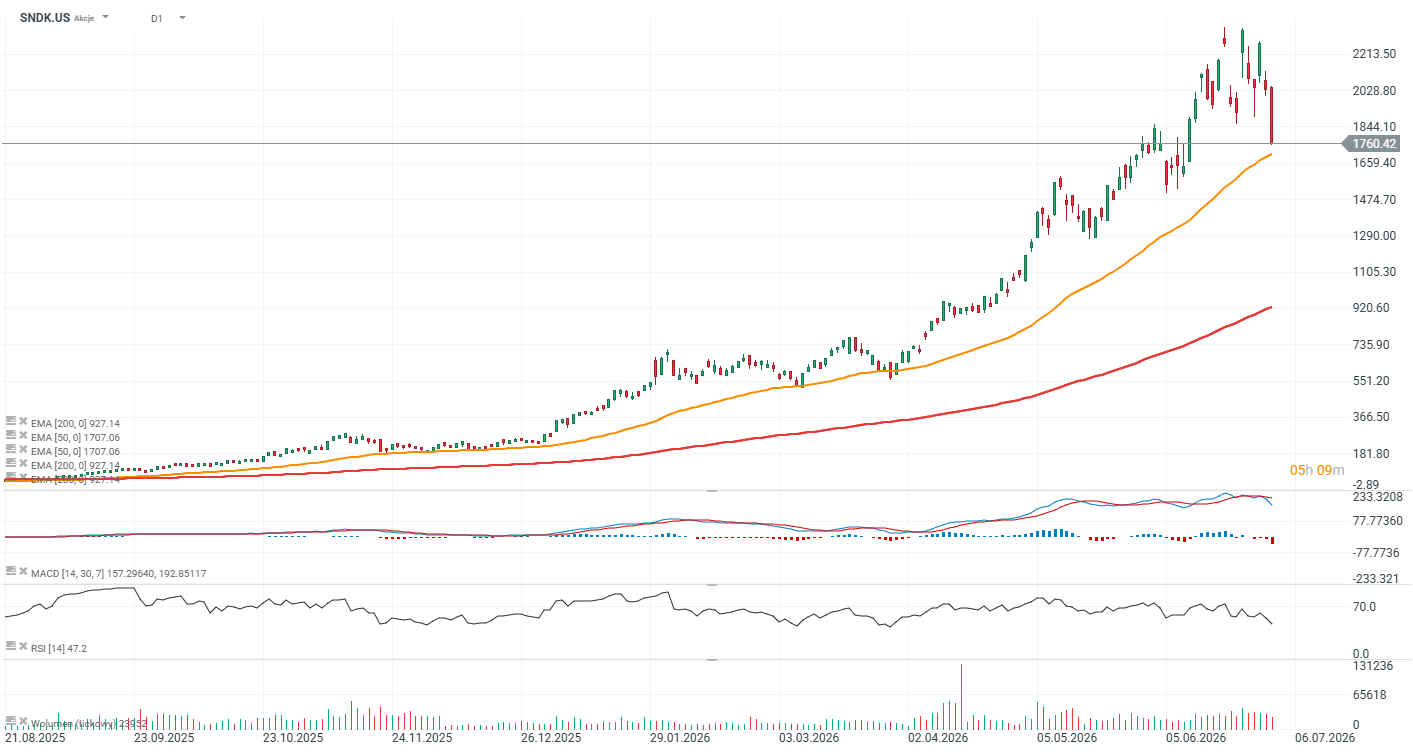
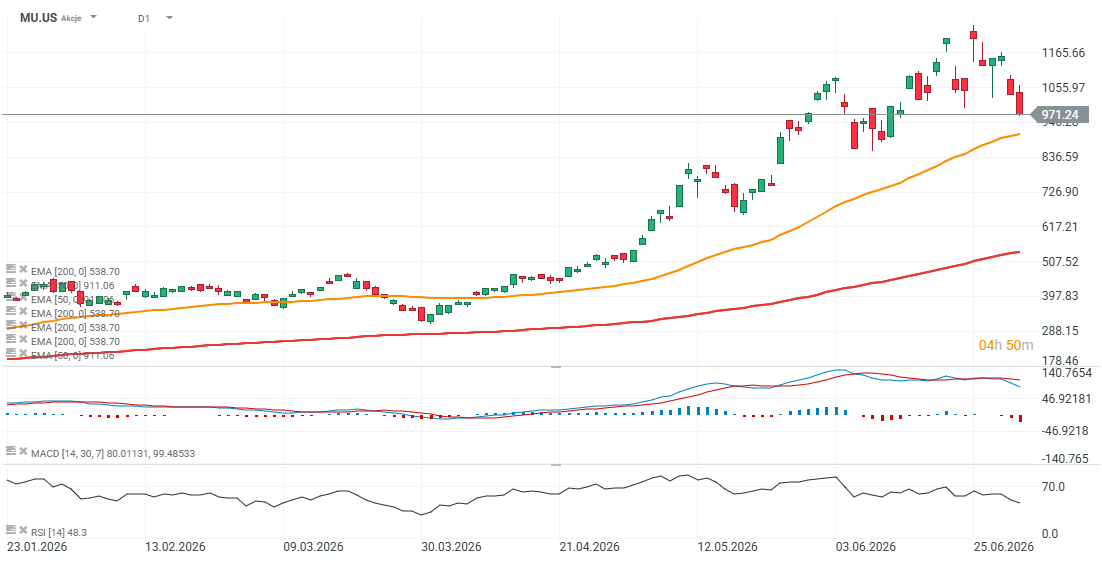
The Roundhill Memory ETF (DRAM), which provides exposure to the memory semiconductor industry, is down nearly 20% during the shortened trading week after an extraordinary rally that saw the ETF almost triple from its April 2 launch to its late-June peak. Over the same period, Micron has fallen almost 15%, while SanDisk has plunged more than 20% in just two trading sessions.
Source: xStation 5
One of the strongest performers in the memory sector is now experiencing a sharp reversal, with profit-taking overwhelming buying interest despite the company recently reporting record quarterly results and substantially raising its forward guidance. The stock has retreated to levels last seen on June 11.
Source: xStation 5
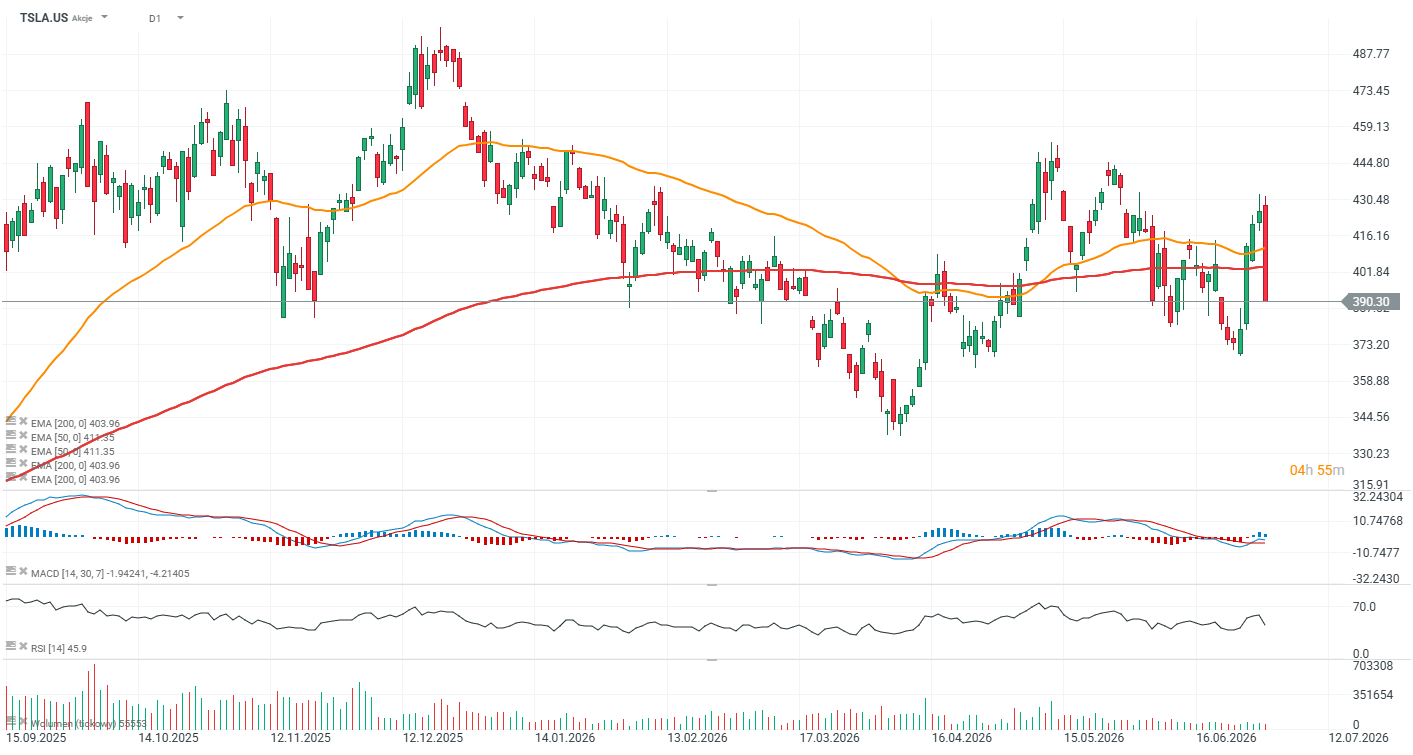
Tesla under pressure as shares fall 7%
Tesla is down more than 7% despite reporting exceptionally strong second-quarter delivery figures. The company delivered 480,126 vehicles, well above Wall Street's consensus estimate of 406,600, while production reached 451,758 units. The negative market reaction may reflect profit-taking after Tesla shares had rallied more than 13% over the previous four trading sessions. In addition, although Tesla's energy storage deployments improved to 13.5 GWh, the result fell short of William Blair's 20.6 GWh forecast.
From a technical perspective, Tesla shares have fallen below the 200-day EMA (red line). If the stock closes below $403, it could confirm a bearish trend reversal.
Source: xStation 5


Daily summary 📈 Precious metals and stock indices rebound as Treasury yields fall


Oil gains as U.S. crude inventories fall


U.S. indices attempt to rebound after recent losses


US Open: Nasdaq 100 extends losses 🚩 AI stocks under pressure, CoreWeave falls 8%
The content of this report has been created by XTB S.A., with its registered office in Warsaw, at Prosta 67, 00-838 Warsaw, Poland, (KRS number 0000217580) and supervised by Polish Supervision Authority ( No. DDM-M-4021-57-1/2005). This material is a marketing communication within the meaning of Art. 24 (3) of Directive 2014/65/EU of the European Parliament and of the Council of 15 May 2014 on markets in financial instruments and amending Directive 2002/92/EC and Directive 2011/61/EU (MiFID II). Marketing communication is not an investment recommendation or information recommending or suggesting an investment strategy within the meaning of Regulation (EU) No 596/2014 of the European Parliament and of the Council of 16 April 2014 on market abuse (market abuse regulation) and repealing Directive 2003/6/EC of the European Parliament and of the Council and Commission Directives 2003/124/EC, 2003/125/EC and 2004/72/EC and Commission Delegated Regulation (EU) 2016/958 of 9 March 2016 supplementing Regulation (EU) No 596/2014 of the European Parliament and of the Council with regard to regulatory technical standards for the technical arrangements for objective presentation of investment recommendations or other information recommending or suggesting an investment strategy and for disclosure of particular interests or indications of conflicts of interest or any other advice, including in the area of investment advisory, within the meaning of the Trading in Financial Instruments Act of 29 July 2005 (i.e. Journal of Laws 2019, item 875, as amended). The marketing communication is prepared with the highest diligence, objectivity, presents the facts known to the author on the date of preparation and is devoid of any evaluation elements. The marketing communication is prepared without considering the client’s needs, his individual financial situation and does not present any investment strategy in any way. The marketing communication does not constitute an offer of sale, offering, subscription, invitation to purchase, advertisement or promotion of any financial instruments. XTB S.A. is not liable for any client’s actions or omissions, in particular for the acquisition or disposal of financial instruments, undertaken on the basis of the information contained in this marketing communication. In the event that the marketing communication contains any information about any results regarding the financial instruments indicated therein, these do not constitute any guarantee or forecast regarding the future results.