



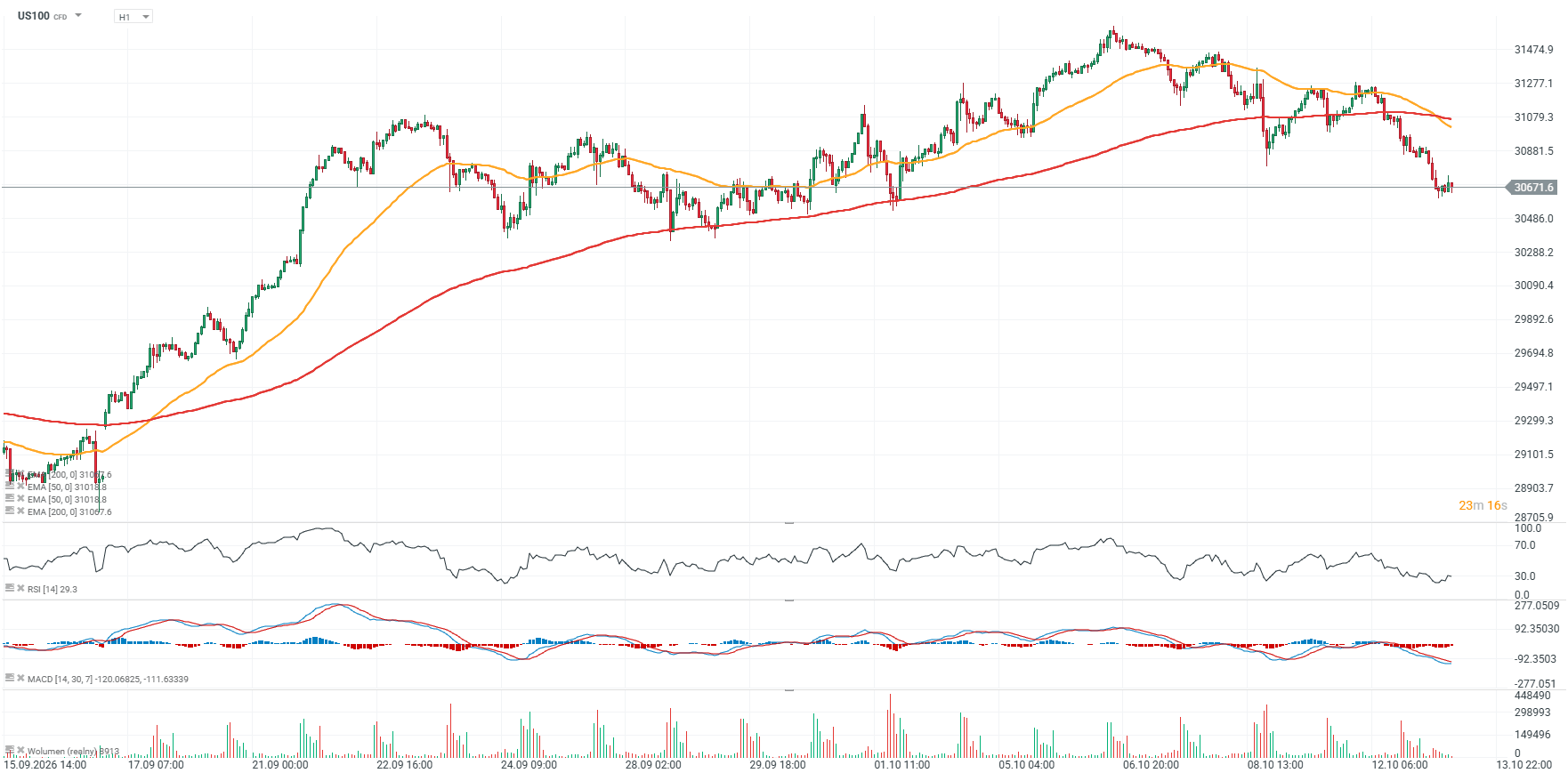
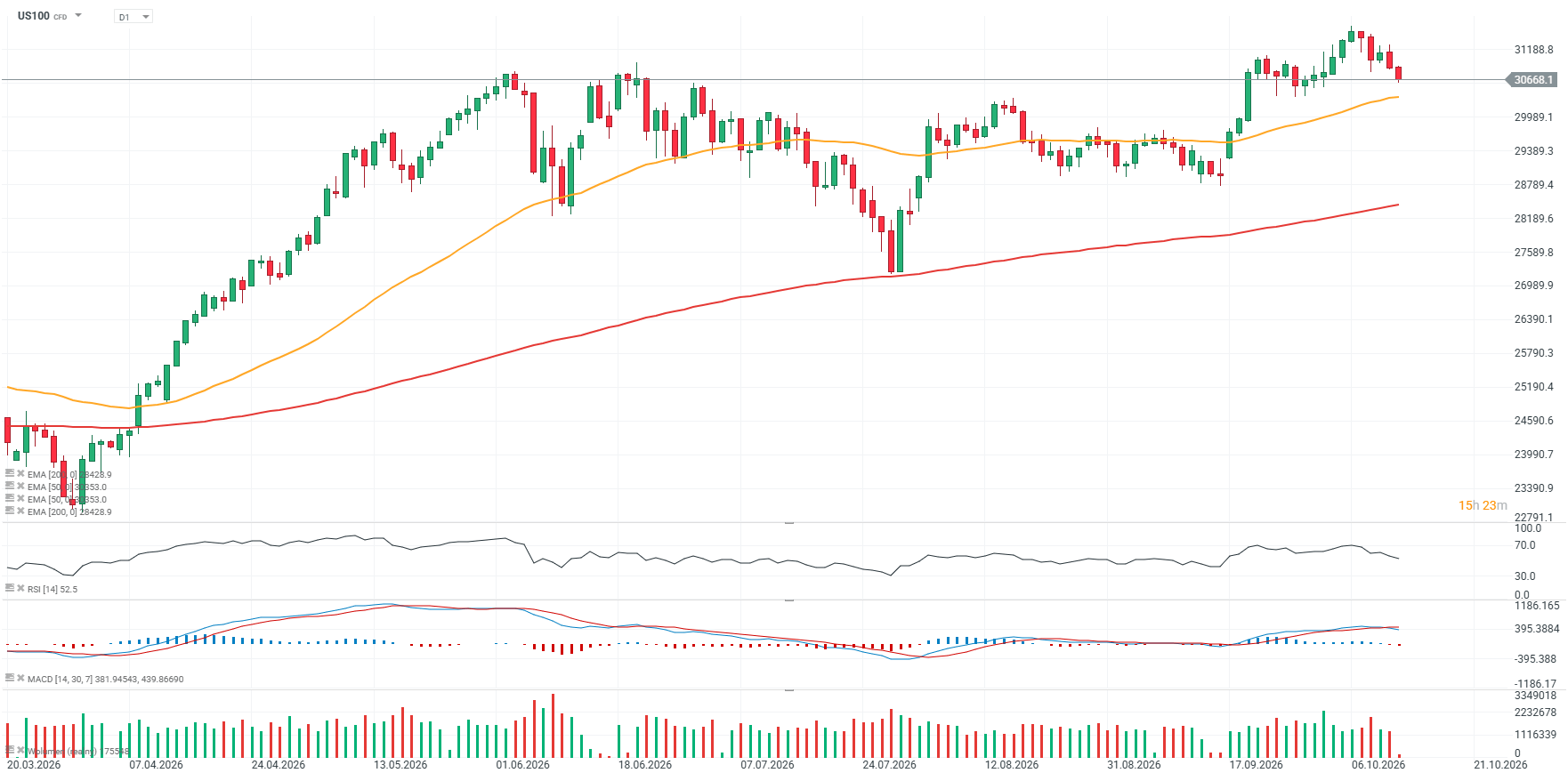
Sentiment across global equity markets is deteriorating, with Nasdaq 100 futures (US100) extending their sell-off for a second consecutive session and giving back nearly all of October's gains, which had pushed the contract to an all-time high on October 6. The selling pressure is concentrated primarily in the technology sector, and several factors appear to be contributing to the weakness.
-
First, Brent crude futures have risen by approximately 10% since the beginning of the month, reaching around $105 per barrel, while the broader macroeconomic backdrop remains challenging. Bond yields are hovering near multi-decade highs, putting pressure on risk asset valuations and credit markets. Equities are also reacting to developments specific to the technology sector.
-
China's Changxin Memory Technologies (CXMT) is rapidly gaining market share in the memory industry, which until recently was dominated largely by SK Hynix, Samsung and Micron. CXMT already accounts for approximately 9–10% of the DRAM market and is reportedly preparing to announce significant advances in its chip architecture. These developments have weighed on shares of leading memory chipmakers amid concerns about intensifying competition. Adding fuel to the fire, Elon Musk commented that when Chinese companies begin producing something at scale, they typically become exceptionally competitive, as demonstrated by lithium-ion batteries and solar panels. Importantly, however, CXMT has yet to establish a meaningful presence in the high-margin HBM segment, which supplies advanced memory used in AI systems.
-
Meanwhile, Broadcom CEO Hock Tan, speaking at a conference in Singapore, noted that OpenAI's $50 billion in annual revenue may demonstrate the existence of a substantial business, but says relatively little about its long-term financial sustainability while the company remains loss-making and continues to incur significant costs associated with expanding its AI models and computing capacity. At the same time, credit default swap (CDS) spreads on Broadcom and Nvidia have reportedly reached record highs following a temporary decline in the second half of September. These instruments reflect the market price of protection against credit default and can serve as indicators of perceived credit risk, although they should not be interpreted as direct probabilities of business failure.
-
Broadcom's CEO also highlighted another challenge: financing, which could become an even more significant bottleneck for AI development than access to hardware components. Tan also compared some of the behavior in the AI market to that of "investors in a casino," remarks that investors interpreted as a warning sign.
-
Against this backdrop, investors are also becoming increasingly concerned about electricity availability and grid connection constraints in the United States. However, a closer look at the technology sector suggests that weakness in semiconductor-related stocks may be partially offset by a somewhat more positive attitude toward software companies. While memory manufacturers and optical technology suppliers such as Lumentum, Coherent and Ciena suffered particularly sharp declines yesterday, ranging from around 7% to nearly 10%, software stocks could potentially benefit not only from capital rotation but also from declining AI infrastructure costs.
-
Two semiconductor industry bellwethers, ASML and Taiwan Semiconductor Manufacturing Company (TSMC), are scheduled to report quarterly earnings this week, potentially providing an important test of AI-driven demand amid the recent technology sell-off. ASML will release its results on Wednesday, October 14, followed by TSMC on Thursday, October 15. Despite weakening market sentiment, analysts still expect substantial earnings growth, with ASML's quarterly EPS projected to rise approximately 89% year-over-year and revenue by 51%, while TSMC is expected to deliver EPS growth of 55% and revenue growth of 41%. Both companies have exceeded earnings expectations in each of the past four quarters, although investors will likely focus more on order books, capital expenditure trends and forward guidance to assess whether the AI infrastructure investment cycle remains sustainable.
The US earnings season kicks off today with results from major American banks, including JPMorgan, Wells Fargo and Goldman Sachs. Over the coming weeks, investors will focus on whether corporate earnings can justify continued exposure to equities, particularly as elevated Treasury yields make government bonds an increasingly competitive alternative.
 Source: xStation5
 Source: xStation5


🖥️Chart of the Day - US100: Is the KOSPI crash a foretaste of Nasdaq's troubles?



Economic Calendar - Start of Wall Street Earnings Season, Hawkish RBA, and Middle East Tensions (13.10.2026)



Morning Wrap: Tech Crash in Asia and Hawkish Central Banks in the Shadow of an Oil Shock (13.10.2026)



Daily Summary: Investors Concerns Rise Ahead of Earnings Season
The content of this report has been created by XTB S.A., with its registered office in Warsaw, at Prosta 67, 00-838 Warsaw, Poland, (KRS number 0000217580) and supervised by Polish Supervision Authority ( No. DDM-M-4021-57-1/2005). This material is a marketing communication within the meaning of Art. 24 (3) of Directive 2014/65/EU of the European Parliament and of the Council of 15 May 2014 on markets in financial instruments and amending Directive 2002/92/EC and Directive 2011/61/EU (MiFID II). Marketing communication is not an investment recommendation or information recommending or suggesting an investment strategy within the meaning of Regulation (EU) No 596/2014 of the European Parliament and of the Council of 16 April 2014 on market abuse (market abuse regulation) and repealing Directive 2003/6/EC of the European Parliament and of the Council and Commission Directives 2003/124/EC, 2003/125/EC and 2004/72/EC and Commission Delegated Regulation (EU) 2016/958 of 9 March 2016 supplementing Regulation (EU) No 596/2014 of the European Parliament and of the Council with regard to regulatory technical standards for the technical arrangements for objective presentation of investment recommendations or other information recommending or suggesting an investment strategy and for disclosure of particular interests or indications of conflicts of interest or any other advice, including in the area of investment advisory, within the meaning of the Trading in Financial Instruments Act of 29 July 2005 (i.e. Journal of Laws 2019, item 875, as amended). The marketing communication is prepared with the highest diligence, objectivity, presents the facts known to the author on the date of preparation and is devoid of any evaluation elements. The marketing communication is prepared without considering the client’s needs, his individual financial situation and does not present any investment strategy in any way. The marketing communication does not constitute an offer of sale, offering, subscription, invitation to purchase, advertisement or promotion of any financial instruments. XTB S.A. is not liable for any client’s actions or omissions, in particular for the acquisition or disposal of financial instruments, undertaken on the basis of the information contained in this marketing communication. In the event that the marketing communication contains any information about any results regarding the financial instruments indicated therein, these do not constitute any guarantee or forecast regarding the future results.