



Despite the recent pullbacks, the S&P 500 remains close to its all-time highs, so the natural question is whether the market has already gone too far. The problem is that index levels alone do not tell the full story. In recent quarters, earnings and earnings expectations have been improving fast enough that the market rally cannot be explained solely by valuation expansion.
- S&P 500 earnings rose by nearly 50.4% y/y in the latest quarter, compared with earlier expectations of 23.2%. This was the strongest growth rate since Q3 2021. Part of this result, however, came from Alphabet and Amazon, where gains related to SpaceX and Anthropic were recognized. Excluding these effects, earnings growth would have been closer to 32% y/y, still around 10 percentage points above the increase in the S&P 500 itself.
- This was already the second consecutive quarter with earnings growth above 20% and the seventh straight quarter of double-digit growth. Revenue growth is also accelerating, rising by around 15% y/y, the strongest pace since Q4 2021. Even excluding energy and technology, revenue growth would have been around 9.7%.
- The improvement is not limited to the largest technology companies. As many as 8 of the 11 S&P 500 sectors are posting double-digit earnings growth. Energy earnings are up by around 135% y/y, while communication services and consumer discretionary are growing by nearly 110%. This weakens the argument that the entire bull market is being driven solely by a handful of megacaps.
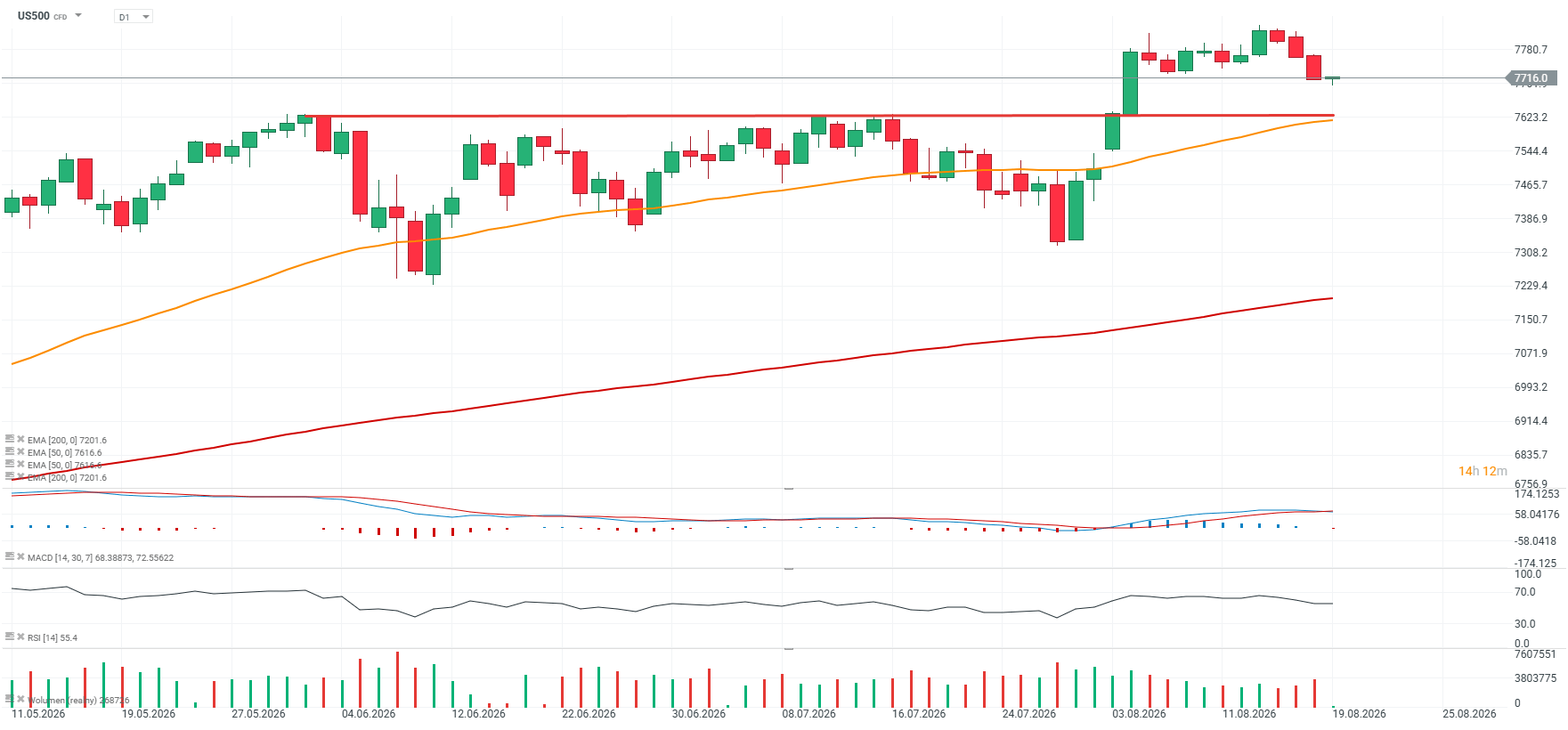
US500 chart (D1 interval)
Looking at the S&P 500 contract (US500), the key price-action support is located around 7,620 points and is additionally reinforced by the 50-session EMA50 (orange line). The key resistance levels are 7,800 and 8,000 points.
 Source: xStation5
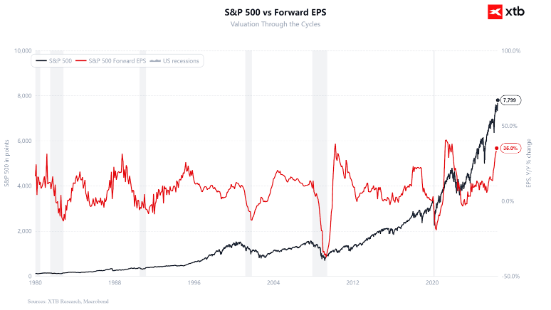
The growth rate of the 12-month forward EPS forecast for S&P 500 companies has risen to around 35% y/y (even though there was no recession last year!), confirming clear fundamental support.
Source: XTB Research
The S&P 500 is expensive, but not extremely expensive
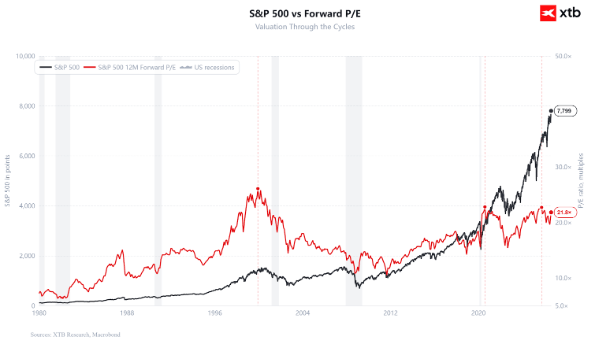
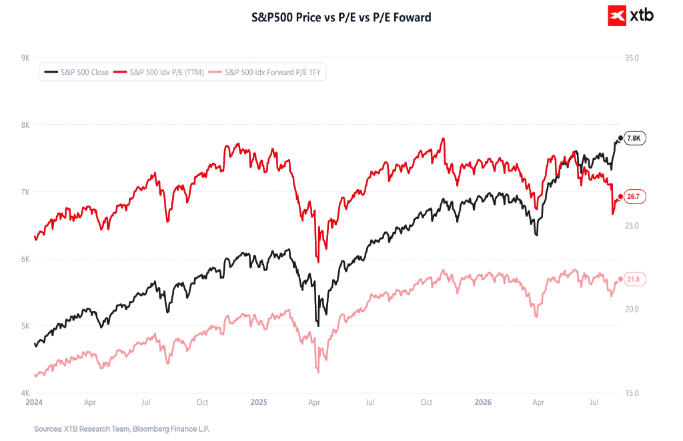
With the index trading close to record highs, valuations remain elevated, but they are still not comparable with the most extreme periods in history. The 12-month forward P/E stands at around 21.8x. This is clearly above most of the levels seen since 1980, but still below the extremes reached during the dot-com bubble or the post-pandemic rebound.
More important, however, is the relationship between the index level and earnings expectations. The S&P 500 is rising, while the forward P/E is not increasing at the same pace. This means that part of the index gains is being absorbed by rising EPS expectations, rather than being driven only by investors' willingness to pay higher valuation multiples.
This is an important distinction. The market may remain expensive in absolute terms, but if earnings forecasts rise faster than share prices, its relative valuation stops deteriorating. The current setup therefore looks more like a market supported by improving fundamentals than a classic phase of pure multiple expansion.
Source: XTB Research
Earnings revisions are breaking historical patterns
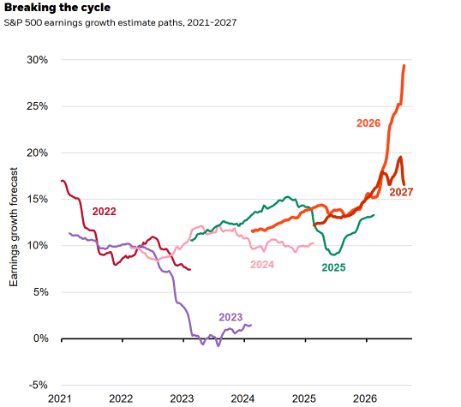
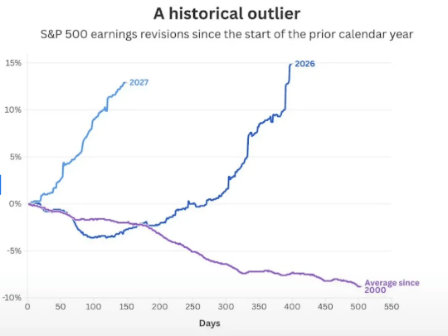
This is even more visible in analysts' earnings forecasts. Historically, S&P 500 earnings estimates usually start the year relatively high and are then gradually revised down. On average since 2000, revisions have fallen by around 9%.
In 2026, the opposite is happening. Forecast earnings growth is approaching 30%, while expectations have already been raised by around 15% since the beginning of the year. Such strong positive revisions are a historical outlier rather than a standard feature of the cycle.
2027 is also expected to remain strong, although revenue growth should gradually normalize from current levels. Analysts expect index revenues to increase by around 11.3% y/y in Q2 and 10.9% in Q4 2026. In 2027, the pace is expected to slow to around 8.4%.
This still points to a very solid growth scenario. At the same time, it raises the question of whether the bar has already been set so high that it will become increasingly difficult to raise expectations further in the coming quarters.
Source: LSEG, BlackRock, Truist, FactSet
AI CAPEX keeps rising and continues to support the cycle
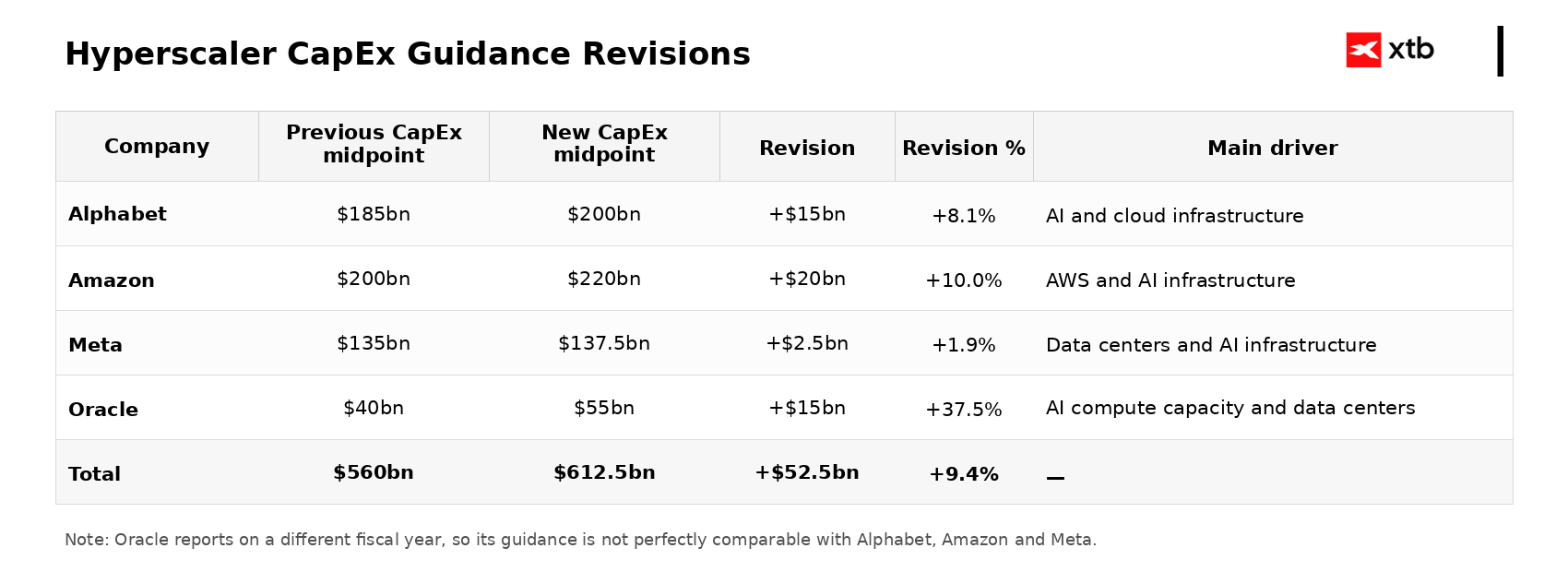
Hyperscalers are not behaving as though they expect a meaningful slowdown in demand for AI infrastructure. Combined projected CAPEX for Alphabet, Amazon, Meta and Oracle has increased from around USD 560 billion to USD 612.5 billion. That is an increase of USD 52.5 billion, or around 9.4%.
Alphabet raised its guidance from USD 185 billion to USD 200 billion, Amazon from USD 200 billion to USD 220 billion, Meta from USD 135 billion to USD 137.5 billion, while Oracle increased its outlook from USD 40 billion to USD 55 billion. In Oracle's case, this represents a revision of as much as 37.5%.
On a quarterly basis, this means roughly another USD 50 billion in additional AI-related spending. This matters for the entire infrastructure chain, from data centers and cloud computing to semiconductors. Big Tech continues to deliver solid results in cloud businesses as well, while rising investment suggests that the largest companies still see no reason to step away from the current cycle.
At the same time, expectations for semiconductors are exceptionally high. Forecast EPS growth for the S&P 500 semiconductor sector over the next 12 months stands at around 143% y/y. This highlights both the scale of potential growth and the scale of expectations that companies will need to meet.
 Source: XTB Research
The market is paying for future earnings, not the past
The difference between trailing P/E and forward P/E is also noteworthy. The multiple based on historical earnings remains much more stretched, while forward P/E is relatively more stable.
The market is therefore clearly assuming that the coming quarters will bring further earnings improvement. As long as EPS forecasts continue to be revised higher, this valuation setup remains internally consistent. The problem would emerge if revisions started to slow while share prices remained elevated.
This is one of the most important elements of the current market environment. The risk today is not only the high P/E level itself, but also the extent to which that P/E depends on a very strong earnings-growth scenario.
Source: XTB Research
Wall Street is expensive, but fundamentals remain solid
It is difficult to reduce the current market environment to the simple conclusion that the S&P 500 is at record highs and therefore must be overvalued. Fundamentals are stronger than in previous quarters, the breadth of earnings growth is improving, revisions are exceptionally positive, and AI-related CAPEX continues to rise. At the same time, this is not a market with a large margin for error. Investors are already pricing in further EPS improvement, sustained high investment levels and continued AI monetization. If these elements continue to be delivered, the index may keep rising without a significant expansion in valuation multiples.
If, however, the pace of earnings revisions starts to weaken, the current 21–22x forward earnings multiple could quickly become less comfortable. Wall Street therefore remains expensive, but current valuations are being supported more by earnings than by investor optimism alone. The key question for the coming quarters is no longer whether earnings will be good, but whether they will be strong enough to lift expectations that are already set at a very high level.



Daily Summary: SpaceX and the tech sector drive Wall Street, oil retreats sharply below $97


US OPEN: Preparations for Tesla's mega-merger with SpaceX. Diplomatic stalemate with Iran cools Wall Street's enthusiasm


RBA turns increasingly hawkish as markets reprice November rate hike expectations ⚔️



Daily Summary: Buyers Refuse to Give In
The content of this report has been created by XTB S.A., with its registered office in Warsaw, at Prosta 67, 00-838 Warsaw, Poland, (KRS number 0000217580) and supervised by Polish Supervision Authority ( No. DDM-M-4021-57-1/2005). This material is a marketing communication within the meaning of Art. 24 (3) of Directive 2014/65/EU of the European Parliament and of the Council of 15 May 2014 on markets in financial instruments and amending Directive 2002/92/EC and Directive 2011/61/EU (MiFID II). Marketing communication is not an investment recommendation or information recommending or suggesting an investment strategy within the meaning of Regulation (EU) No 596/2014 of the European Parliament and of the Council of 16 April 2014 on market abuse (market abuse regulation) and repealing Directive 2003/6/EC of the European Parliament and of the Council and Commission Directives 2003/124/EC, 2003/125/EC and 2004/72/EC and Commission Delegated Regulation (EU) 2016/958 of 9 March 2016 supplementing Regulation (EU) No 596/2014 of the European Parliament and of the Council with regard to regulatory technical standards for the technical arrangements for objective presentation of investment recommendations or other information recommending or suggesting an investment strategy and for disclosure of particular interests or indications of conflicts of interest or any other advice, including in the area of investment advisory, within the meaning of the Trading in Financial Instruments Act of 29 July 2005 (i.e. Journal of Laws 2019, item 875, as amended). The marketing communication is prepared with the highest diligence, objectivity, presents the facts known to the author on the date of preparation and is devoid of any evaluation elements. The marketing communication is prepared without considering the client’s needs, his individual financial situation and does not present any investment strategy in any way. The marketing communication does not constitute an offer of sale, offering, subscription, invitation to purchase, advertisement or promotion of any financial instruments. XTB S.A. is not liable for any client’s actions or omissions, in particular for the acquisition or disposal of financial instruments, undertaken on the basis of the information contained in this marketing communication. In the event that the marketing communication contains any information about any results regarding the financial instruments indicated therein, these do not constitute any guarantee or forecast regarding the future results.