

- Alphabet reported revenue of $119.8 billion, beating expectations of $117.0 billion, while earnings per share came in at $2.26, above the consensus estimate of $2.24.
- Tesla generated revenue of $28.2 billion, slightly below the expected $28.3 billion, while adjusted earnings per share came in at $0.33, ahead of the consensus forecast of $0.32.
- Tesla announced that the first Optimus production lines are being installed at Gigafactory Texas, with first-generation production scheduled to begin later this year.

- Alphabet reported revenue of $119.8 billion, beating expectations of $117.0 billion, while earnings per share came in at $2.26, above the consensus estimate of $2.24.
- Tesla generated revenue of $28.2 billion, slightly below the expected $28.3 billion, while adjusted earnings per share came in at $0.33, ahead of the consensus forecast of $0.32.
- Tesla announced that the first Optimus production lines are being installed at Gigafactory Texas, with first-generation production scheduled to begin later this year.
Alphabet and Tesla released their quarterly results after Wednesday's U.S. market close. Alphabet once again delivered exceptionally strong AI-driven growth and raised its full-year capital expenditure guidance, while Tesla posted mixed results but announced further progress on its Optimus humanoid robot and Robotaxi initiatives. In after-hours trading, Tesla shares fell nearly 2.5%, while Alphabet traded modestly lower.
Key facts
- Alphabet reported revenue of $119.8 billion versus expectations of $117.0 billion, while earnings per share came in at $2.26 compared with the consensus estimate of $2.24.
- Google Cloud revenue increased to $24.8 billion, comfortably ahead of expectations of $24.1 billion, while the company raised its full-year capital expenditure (CAPEX) guidance to $44.9 billion.
- Tesla generated revenue of $28.2 billion versus expectations of $28.3 billion, while adjusted earnings per share reached $0.33, slightly above the $0.32 consensus.
- Tesla announced that the first Optimus production lines are being installed at Gigafactory Texas, with production scheduled to begin later this year.
Alphabet once again demonstrates the strength of its AI business
Alphabet exceeded Wall Street expectations on both revenue and earnings for another consecutive quarter. Google Cloud delivered one of the strongest performances, with revenue climbing to $24.8 billion and beating market forecasts.
The company also continues to invest aggressively in AI infrastructure. Full-year capital expenditures are now expected to reach approximately $44.9 billion, above the market consensus of $44.2 billion, confirming Alphabet's commitment to expanding its data center footprint and computing capacity for artificial intelligence.
Google Cloud remains the engine of AI growth
Google Cloud was by far Alphabet's strongest business segment during the quarter. Revenue surged 82% year over year to $24.8 billion, comfortably exceeding analysts' expectations of $22.4 billion. The company's cloud backlog reached $514 billion, highlighting sustained demand for AI infrastructure and cloud computing services. Meanwhile, Google Search revenue increased 17% to $63.3 billion, while YouTube advertising revenue rose 13% to $11.1 billion, also beating Wall Street expectations.
Alphabet doubles down on AI investment
Alphabet's capital expenditures doubled year over year to $44.9 billion, slightly exceeding market expectations. The company continues to expand its AI infrastructure and global data center network to meet rapidly growing demand for computing capacity. CEO Sundar Pichai said that AI investments are transforming virtually every part of Google's business. The Gemini app has now reached approximately 950 million active users, while API token processing capacity increased from 16 billion to 22 billion tokens per minute in just one quarter.
Waymo and investment gains strengthen Alphabet's long-term outlook
Alphabet is also expanding businesses beyond advertising and cloud computing. Waymo remains the leader in the U.S. autonomous ride-hailing market, operating commercial services across 11 metropolitan areas while testing in another 21 cities, including London and Tokyo. In Texas alone, Waymo has 677 registered robotaxis compared with 175 for Tesla, underscoring its lead in commercial autonomous driving. Meanwhile, Alphabet's reported net income received a significant boost from approximately $99 billion in gains on equity investments, primarily related to Anthropic and SpaceX, contributing to a record quarterly profit.
Tesla: mixed financial results but greater focus on AI
Tesla reported mixed quarterly results. Revenue came in slightly below market expectations, while adjusted earnings per share modestly exceeded analyst forecasts.
However, investors focused primarily on the company's AI and robotics strategy. Elon Musk confirmed that the first production lines for the Optimus humanoid robot are currently being installed at Gigafactory Texas, with first-generation production expected to begin later this year.
Tesla also announced that:
- Robotaxi is now operating across seven major U.S. metropolitan areas.
- Semi production has been postponed until 2026.
- The energy storage business has returned to growth.
- The Austin factory is preparing to ramp up semiconductor production.
Although Tesla's automotive segment remains under pressure, the company is increasingly emphasizing that its long-term growth will be driven by autonomous driving, robotics, and artificial intelligence rather than vehicle sales alone.
Tesla's AI ambitions continue to drive investment
Beyond the quarterly results, investors focused primarily on Tesla's long-term AI strategy. The company confirmed that production of the first-generation Optimus humanoid robot remains on track to begin later this year. The initial units will be deployed internally through the "Optimus Academy" to collect training data and further improve the robot's capabilities before a broader rollout.
Tesla also announced that its Robotaxi service is now operating across seven major U.S. metropolitan areas following the expansion of unsupervised operations in Austin and launches in Miami, Orlando, and Tampa. The company added that testing, regulatory approvals, and first-responder training are continuing as it prepares to expand Robotaxi into additional U.S. cities.
Heavy AI spending weighs on cash flow as the automotive business recovers
Tesla continues to invest aggressively across several strategic initiatives, including Optimus production, AI computing infrastructure, and the Cybercab platform. As a result, free cash flow (FCF) totaled negative $1.09 billion during the second quarter. However, this was substantially better than analysts' expectations for a negative $3.64 billion, suggesting that cash burn remains more manageable than investors had feared.
At the same time, Tesla's core automotive business is beginning to recover. Second-quarter vehicle deliveries increased 25% year over year to 480,126 units, comfortably exceeding market expectations, while energy storage deployments reached 13.5 GWh, more than 50% higher than in the previous quarter. Demand has been supported by the full production ramp of the new Model Y, stronger sales momentum in Europe and China, and improving sentiment toward the brand. Nevertheless, U.S. vehicle sales continue to face pressure following the expiration of the federal EV tax credit.
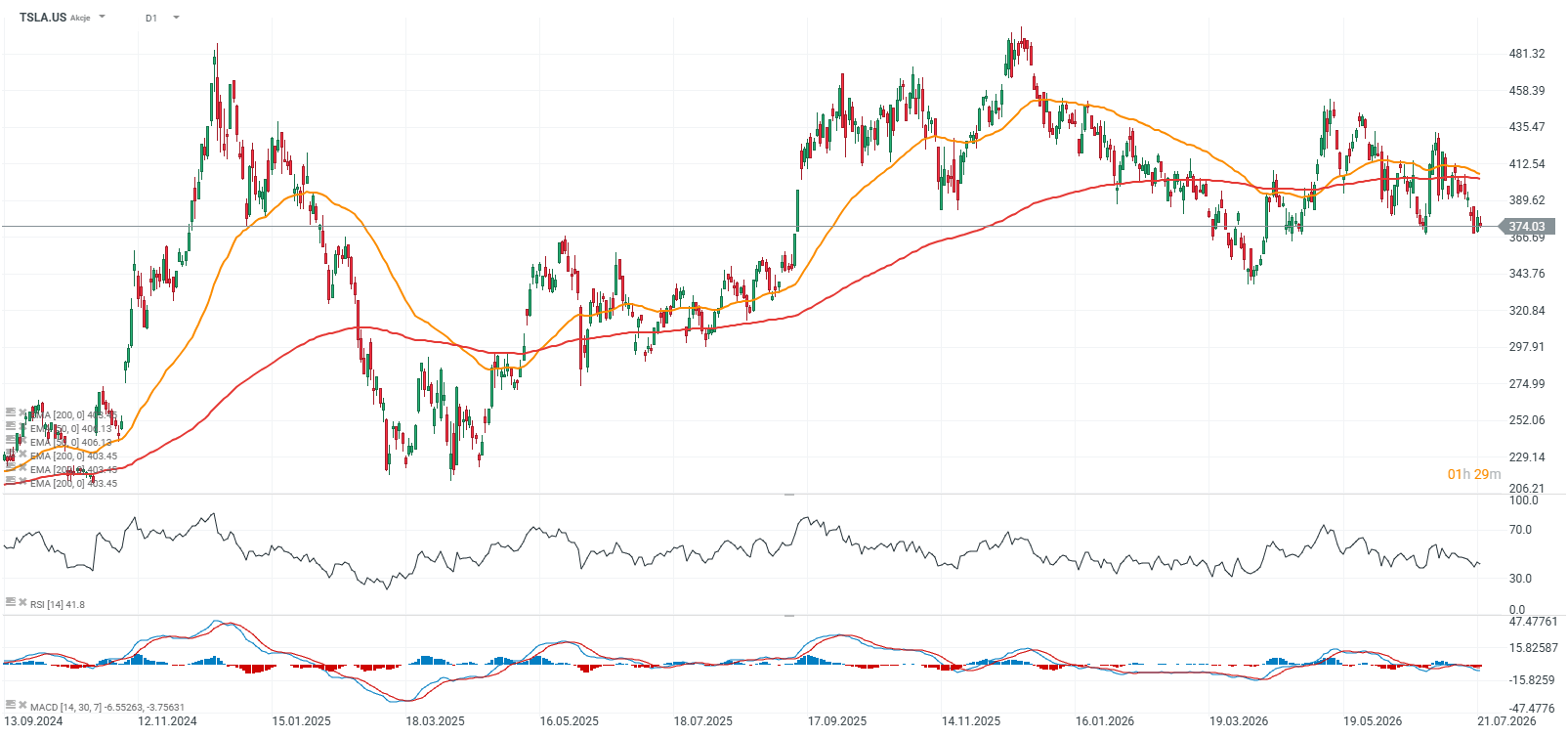
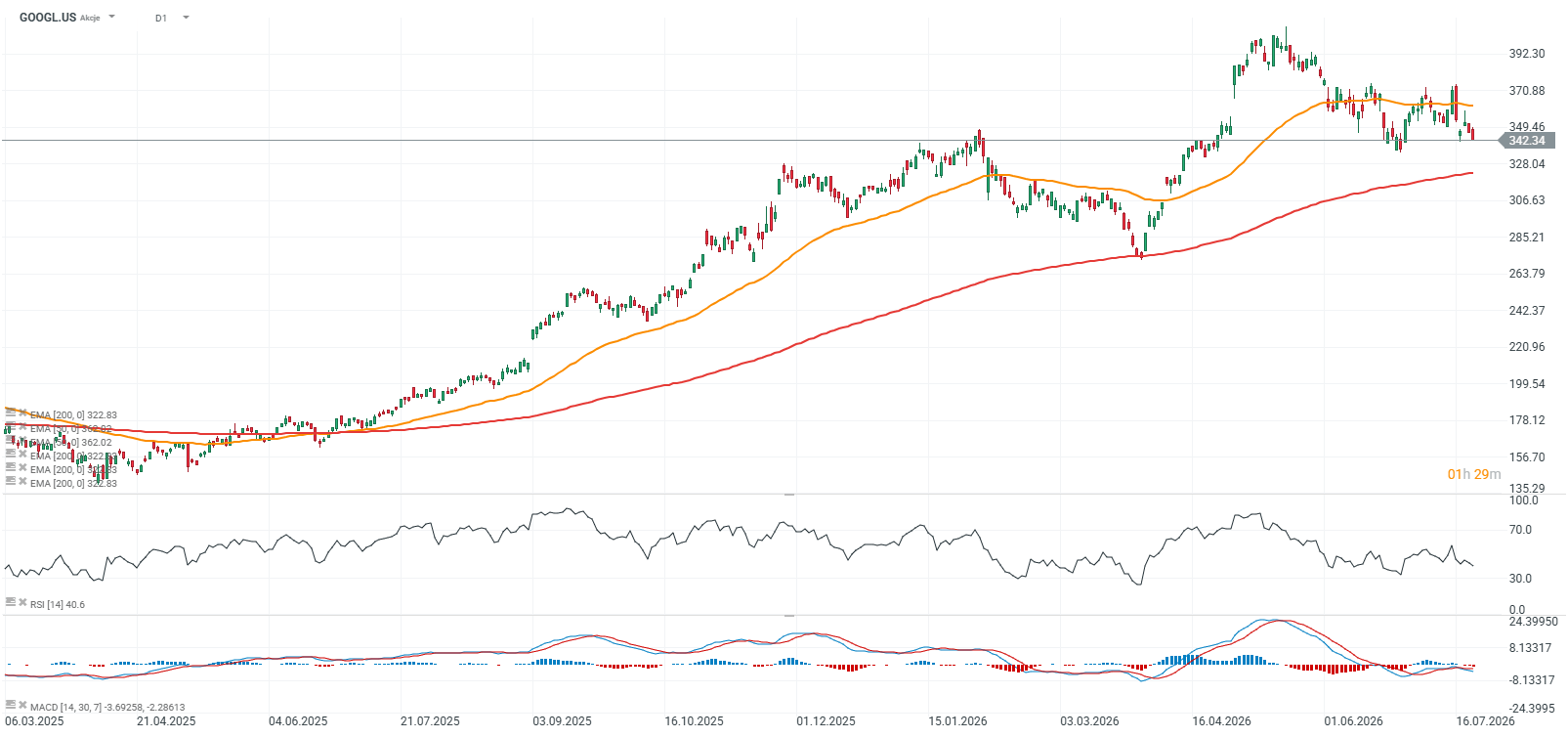
Tesla and Alphabet share price charts (D1 timeframe)
 Source: xStation5
 Source: xStation5
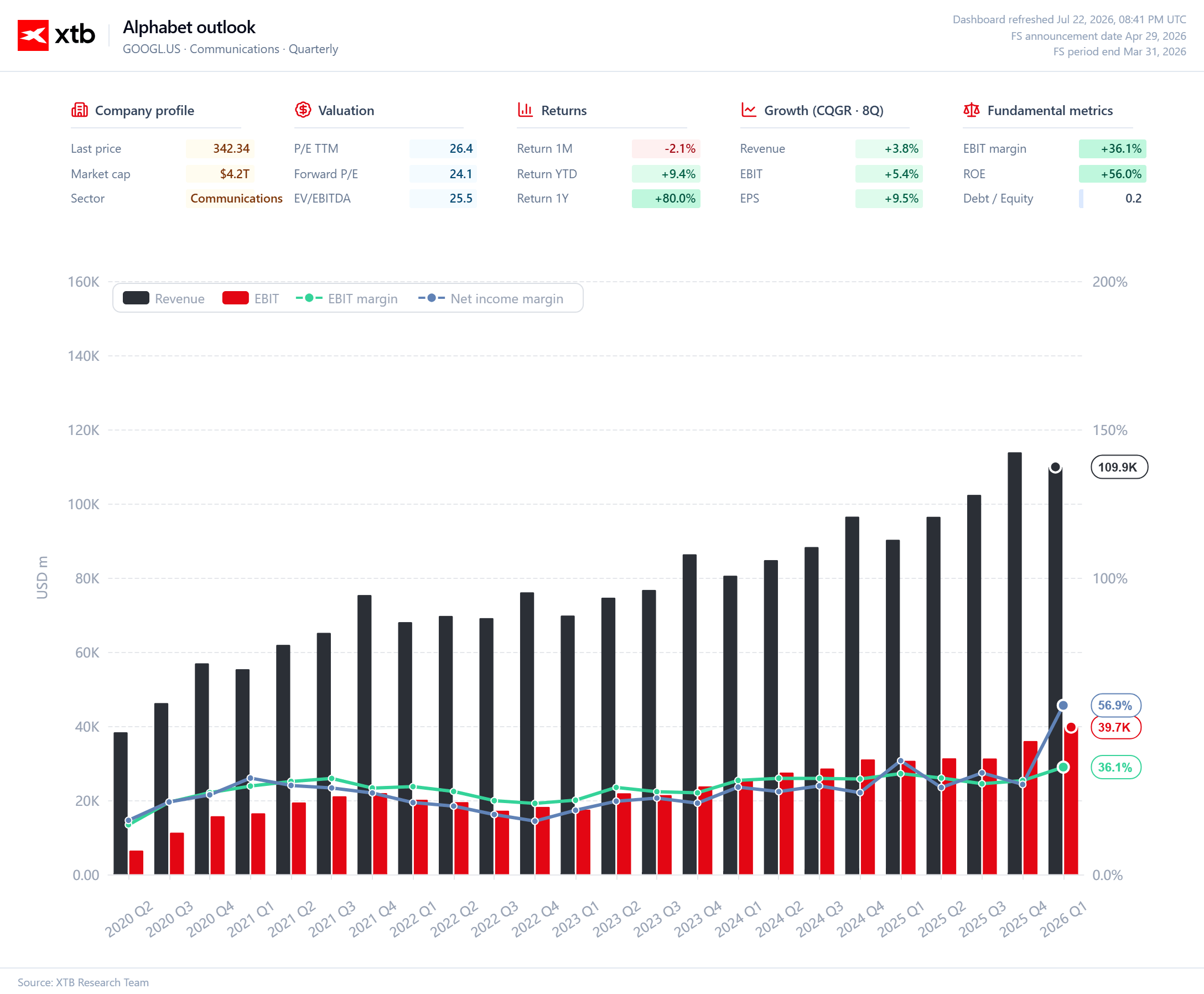
Alphabet and Tesla financial dashboards
Alphabet remains one of the fundamentally strongest technology companies in the world, combining exceptionally high profitability with robust revenue growth and an outstanding balance sheet. Second-quarter results confirmed that the company's investments in artificial intelligence are not eroding profitability but instead are accelerating growth in Google Cloud while strengthening its core advertising business. Despite doubling capital expenditures to nearly $45 billion, Alphabet continues to generate an EBIT margin above 36%, highlighting the scalability of its business model. Compared with other hyperscalers, Alphabet also stands out for its relatively reasonable valuation, with a forward P/E ratio of around 24, well below the multiples assigned to many companies benefiting directly from the AI boom. Over the longer term, projects such as Waymo could become an additional source of shareholder value, while continued investment in Gemini and data centers is expected to reinforce Google's position in the race for leadership in generative AI. From a fundamental perspective, Alphabet remains one of the best-positioned companies to monetize the long-term expansion of global AI spending.
Source: XTB Research Team
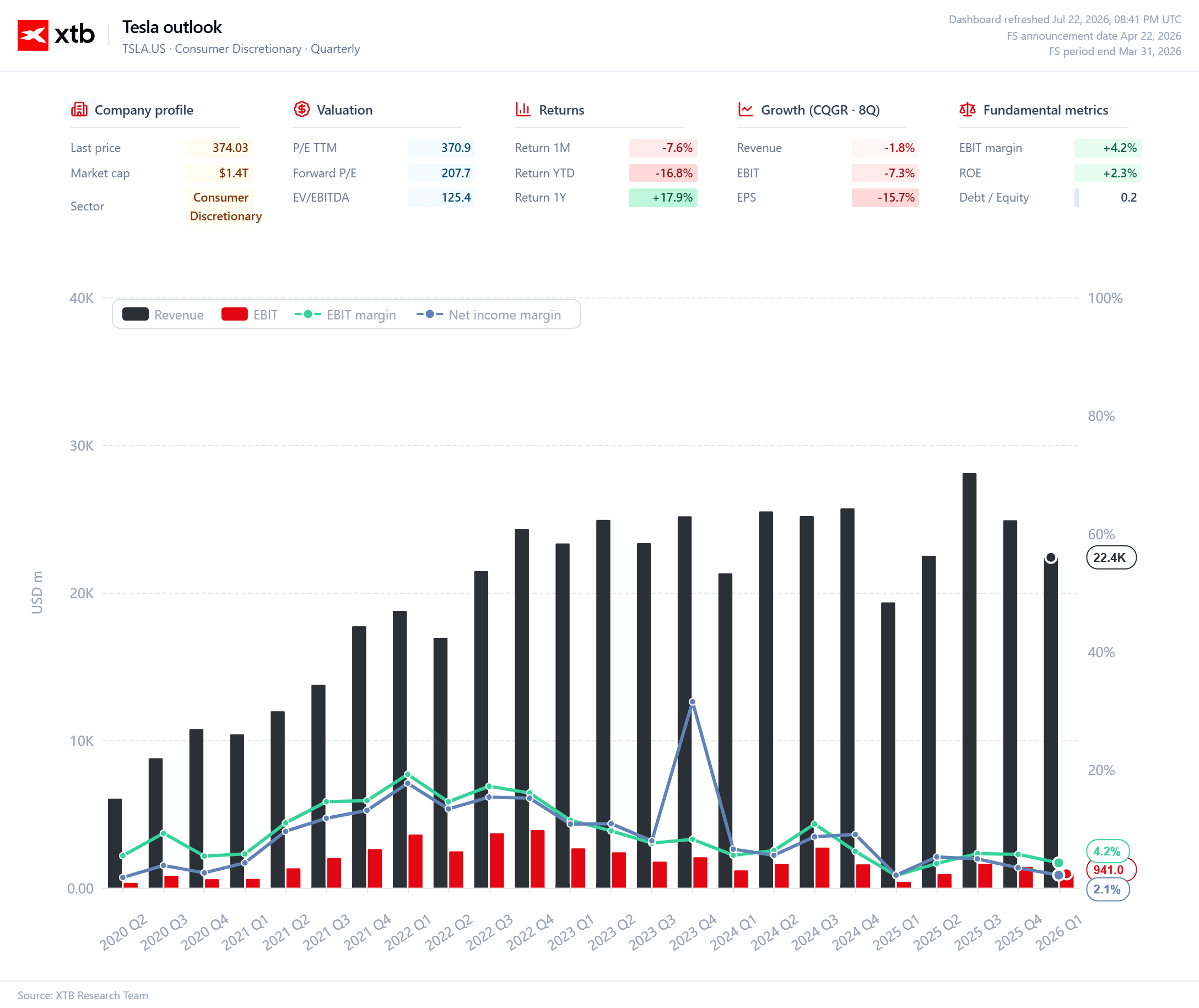
Tesla's latest results illustrate that the company is currently navigating a transition from a mature automotive manufacturer toward an AI-driven technology platform. Although revenue has rebounded after a weaker start to the year, operating profitability remains well below the levels seen in 2022 and 2023, reflecting aggressive investment spending and ongoing pricing pressure in the electric vehicle market. Free cash flow also remains negative as Tesla simultaneously funds Optimus, Robotaxi, AI computing infrastructure, and the Cybercab platform. Valuation continues to be demanding, with a trailing P/E above 370 and a forward P/E exceeding 200, suggesting that investors are primarily pricing in Tesla's long-term AI potential rather than the current profitability of its automotive operations. At the same time, the company's fundamentals indicate a gradual recovery in vehicle demand, supported by stronger deliveries and rapid growth in the energy storage business. For investors, the key question is whether Tesla's investments in autonomous driving and robotics will ultimately justify the substantial valuation premium the market continues to assign to the company.
Source: XTB Research Team


ASML disappoints on revenue but delivers stronger profits and raises guidance 🍳 What’s next for the AI sector?


Daily Summary: Earnings Season Kicks Off on Wall Street Amid Mixed Sentiment


SpaceX Wants to Fly Starship Almost Every Day. Musk’s Business Empire Is Betting on It

Micron Expands Share Buybacks to $35 Billion!
The content of this report has been created by XTB S.A., with its registered office in Warsaw, at Prosta 67, 00-838 Warsaw, Poland, (KRS number 0000217580) and supervised by Polish Supervision Authority ( No. DDM-M-4021-57-1/2005). This material is a marketing communication within the meaning of Art. 24 (3) of Directive 2014/65/EU of the European Parliament and of the Council of 15 May 2014 on markets in financial instruments and amending Directive 2002/92/EC and Directive 2011/61/EU (MiFID II). Marketing communication is not an investment recommendation or information recommending or suggesting an investment strategy within the meaning of Regulation (EU) No 596/2014 of the European Parliament and of the Council of 16 April 2014 on market abuse (market abuse regulation) and repealing Directive 2003/6/EC of the European Parliament and of the Council and Commission Directives 2003/124/EC, 2003/125/EC and 2004/72/EC and Commission Delegated Regulation (EU) 2016/958 of 9 March 2016 supplementing Regulation (EU) No 596/2014 of the European Parliament and of the Council with regard to regulatory technical standards for the technical arrangements for objective presentation of investment recommendations or other information recommending or suggesting an investment strategy and for disclosure of particular interests or indications of conflicts of interest or any other advice, including in the area of investment advisory, within the meaning of the Trading in Financial Instruments Act of 29 July 2005 (i.e. Journal of Laws 2019, item 875, as amended). The marketing communication is prepared with the highest diligence, objectivity, presents the facts known to the author on the date of preparation and is devoid of any evaluation elements. The marketing communication is prepared without considering the client’s needs, his individual financial situation and does not present any investment strategy in any way. The marketing communication does not constitute an offer of sale, offering, subscription, invitation to purchase, advertisement or promotion of any financial instruments. XTB S.A. is not liable for any client’s actions or omissions, in particular for the acquisition or disposal of financial instruments, undertaken on the basis of the information contained in this marketing communication. In the event that the marketing communication contains any information about any results regarding the financial instruments indicated therein, these do not constitute any guarantee or forecast regarding the future results.