



Bitcoin surged from around $63,000 to roughly $82,000 in early September, but a sharp rise in bond yields, oil approaching $100 a barrel, uncertainty over future Fed policy and growing concerns about rate-hiking cycles at other central banks continue to weigh on its outlook.
Bitcoin price subdued ahead of Friday’s CPI release
As a result, BTC has pulled back once again to $78,000, shortly after reclaiming the $80,000 area. Sentiment across other cryptocurrencies remains weaker. On-chain activity has improved, but ETF inflows have slowed over the past few sessions. A key test for cryptocurrencies will be the US CPI data for August, due at 2:30 p.m. CEST on Friday. A higher-than-expected reading could send Bitcoin back below $70,000, while a softer-than-forecast release would likely help BTC stabilize above $80,000, turning that level from resistance into important support.
The prospect of crypto-friendly regulation in the US is taking a back seat for now, as Republicans trail Democrats in polls ahead of the congressional midterm elections. The future of the Crypto Clarity Act appears uncertain, and the legislation may not be signed into law until mid-2027. If oil prices fall and the US Treasury continues actively purchasing debt securities, this could support Bitcoin, as well as gold and, more broadly, assets negatively correlated with the dollar.
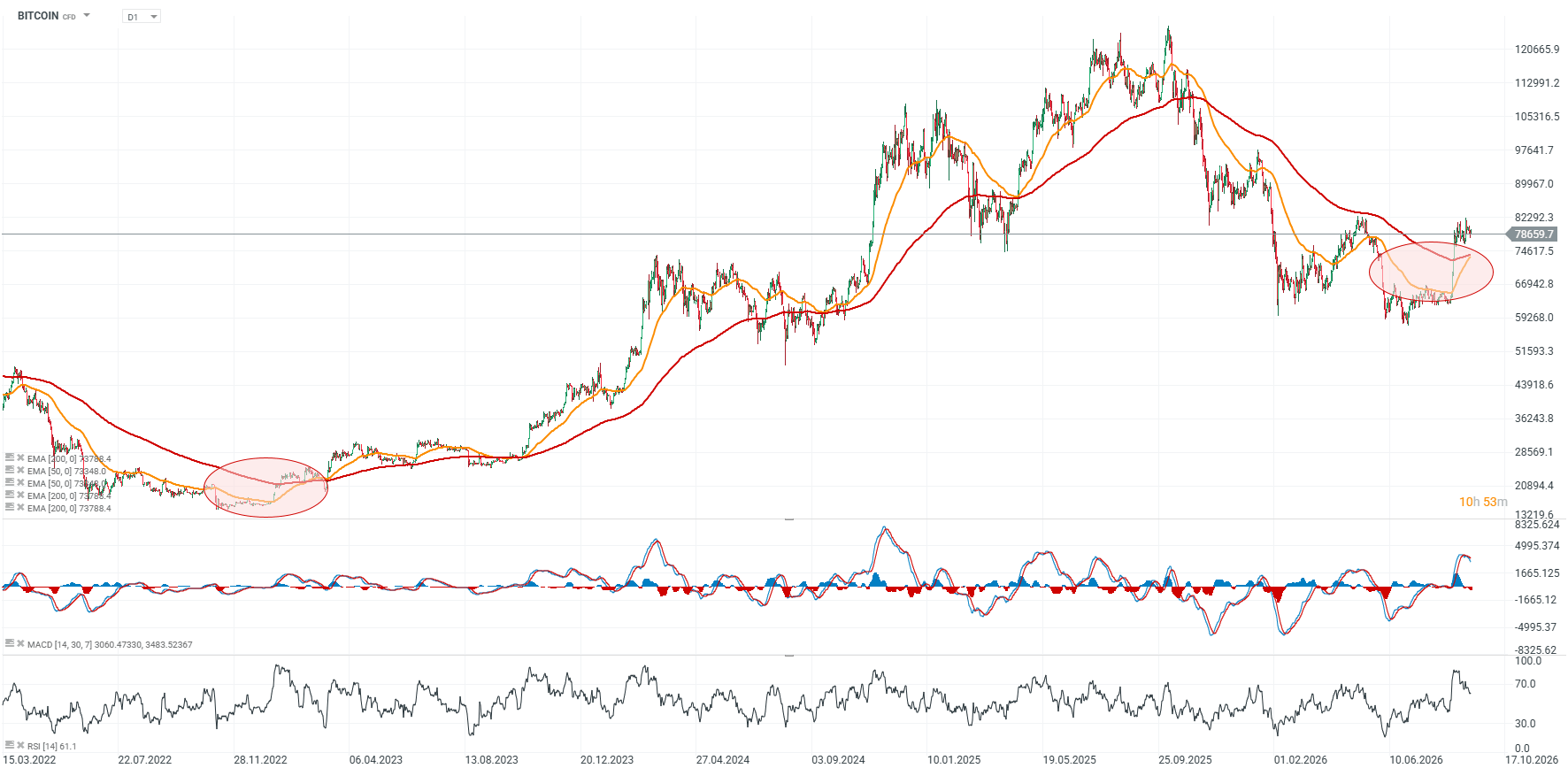
Bitcoin price chart (D1 timeframe)
The largest cryptocurrency retains its momentum, although the RSI has cooled to around 61 and the MACD is showing a potentially bearish crossover. The 200-day exponential moving average (EMA200) is near $74,000, but the $60,000–$70,000 range appears to be a more “natural” support zone should the rebound lose steam. Key resistance lies around $81,500–$82,000, where the latest advance stalled and where strong price reactions marked local highs this spring. Meanwhile, the area around $77,000 provides important short-term support.
Source: xStation5
Bitcoin near $80,000 without a surge in large exchange deposits
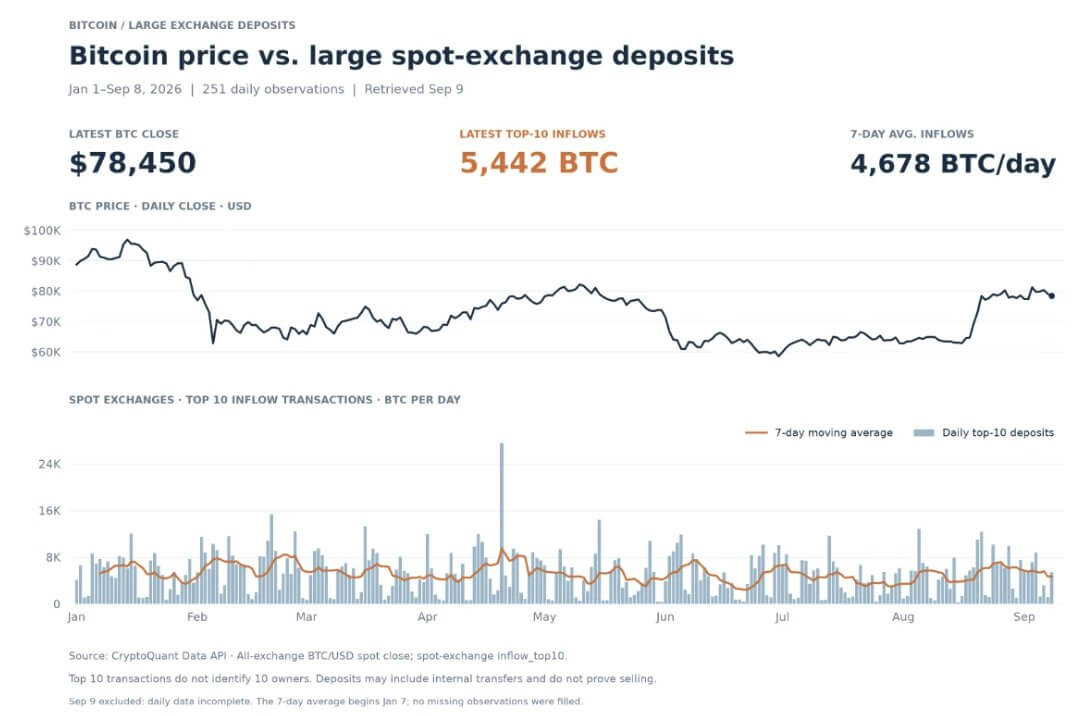
Interestingly, despite the substantial rebound, large deposits to spot exchanges have not shown a comparable increase in recent weeks. According to CryptoQuant, the combined volume of the 10 largest deposits to spot exchanges reached 5,442 BTC on September 8, just 5% above the preceding 30-day average. The seven-day average stood at approximately 4,670 BTC. So far, the price recovery has not coincided with unusually elevated large-deposit activity. It is worth monitoring whether average inflows begin to rise persistently while prices weaken.
Source: CryptoQuant
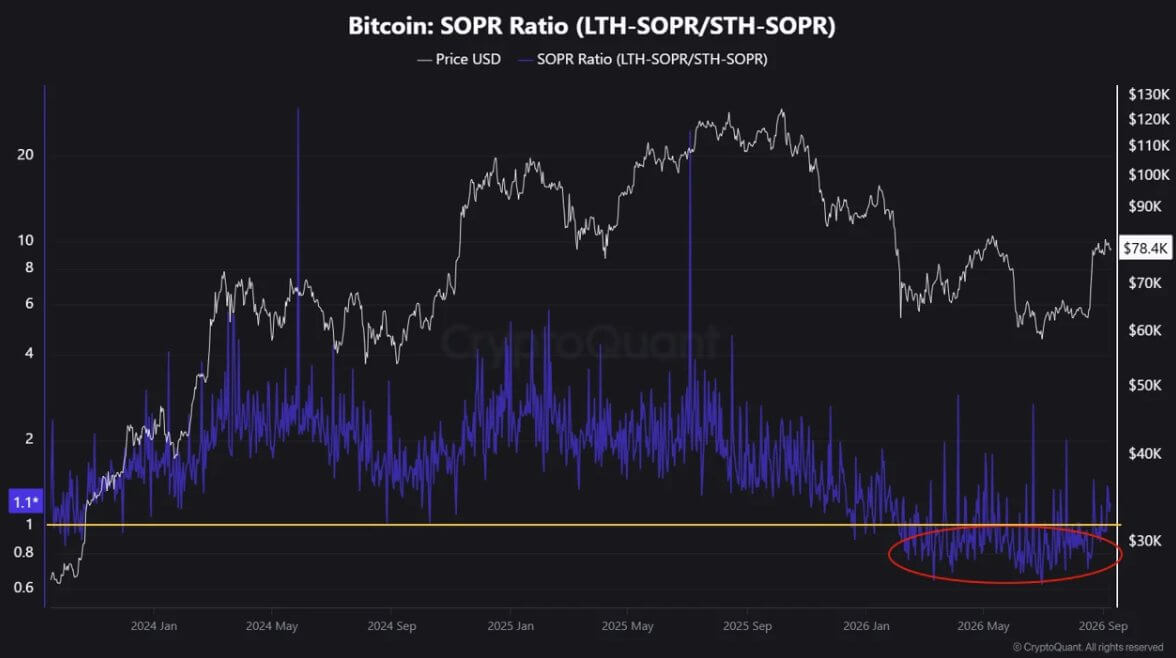
Long-term holders are selling at a loss
Periods when even medium- and long-term investors consistently sold Bitcoin at a loss have most often proved to be good opportunities for long-term accumulation. Those were the periods when SOPR fell below 1. In most cases, market participants’ interest also hit rock bottom at the same time. If this measure is taken as a meaningful indicator of sentiment, Bitcoin still appears relatively cheap.
Source: CryptoQuant
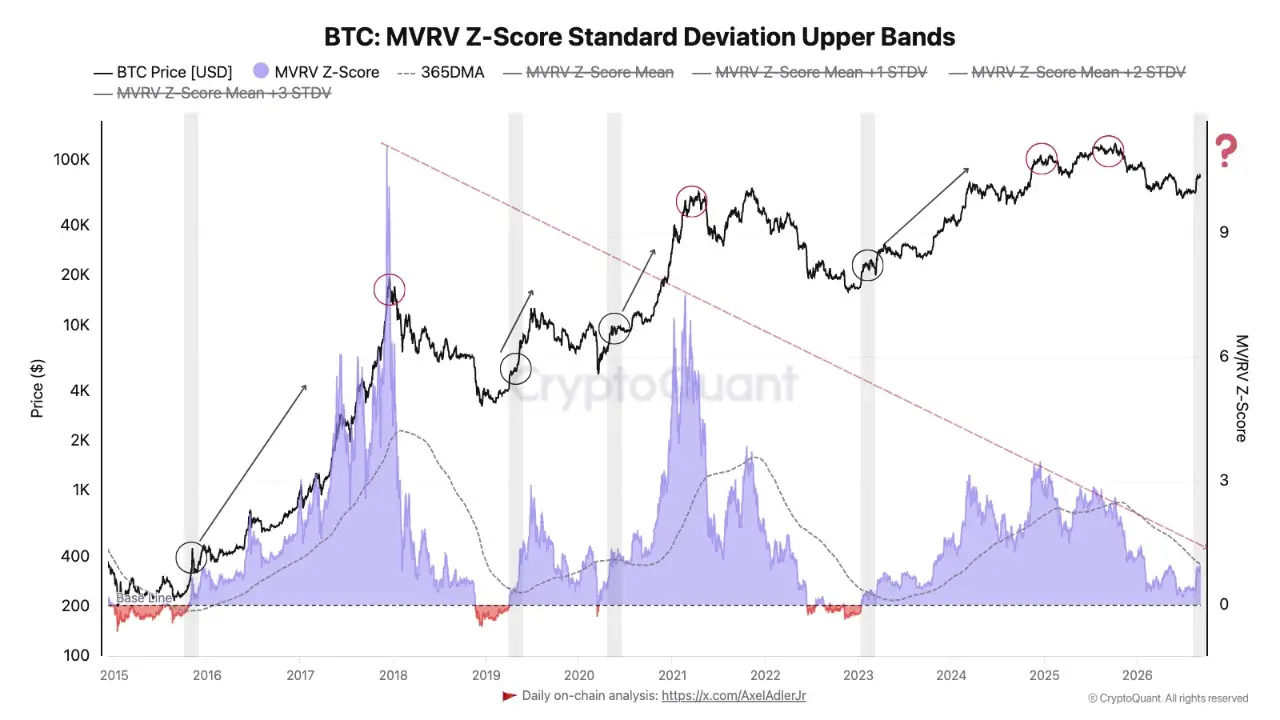
MVRV is approaching a regime test. Not a bull signal yet
Bitcoin has yet to reach either a level that historically marked the start of bull markets or one that signaled their end. The on-chain metric known as the MVRV Z-Score is approaching one of the key levels used to identify the market regime: its one-year moving average. Historically, sustained moves back above this average have signaled a transition from a recovery phase into a bull market. According to CryptoQuant, the reclaim in 2015–2016 preceded the 2017 bull market, while a similar move in 2020 preceded the 2020–2021 rally. Moreover, the return above the moving average in 2023 accompanied the latest bull market.
MVRV remains below its 365-day moving average, so the market has not yet confirmed a return to an uptrend. A rejection in this area would suggest that Bitcoin investors’ aggregate profitability is too low to support a rebound. A sustained move back above the average would point to a recovery in unrealized gains. There is another important difference: in previous cycles, market bottoms coincided with the Z-Score falling below zero into the undervaluation zone, whereas the current bear market has not produced such a move. In summary, either Bitcoin is undergoing a structurally shallower correction, or it has yet to experience capitulation on the scale seen at previous long-term lows.
Source: CryptoQuant



Daily Summary: Buyers Refuse to Give In

US Natural gas extends declines 🔥📉



US OPEN: The wave of AI concerns is building again, oil returns near highs


Daily Summary: Nasdaq and AI Stocks Rebound Ahead of Big Tech Earnings 🚀
The content of this report has been created by XTB S.A., with its registered office in Warsaw, at Prosta 67, 00-838 Warsaw, Poland, (KRS number 0000217580) and supervised by Polish Supervision Authority ( No. DDM-M-4021-57-1/2005). This material is a marketing communication within the meaning of Art. 24 (3) of Directive 2014/65/EU of the European Parliament and of the Council of 15 May 2014 on markets in financial instruments and amending Directive 2002/92/EC and Directive 2011/61/EU (MiFID II). Marketing communication is not an investment recommendation or information recommending or suggesting an investment strategy within the meaning of Regulation (EU) No 596/2014 of the European Parliament and of the Council of 16 April 2014 on market abuse (market abuse regulation) and repealing Directive 2003/6/EC of the European Parliament and of the Council and Commission Directives 2003/124/EC, 2003/125/EC and 2004/72/EC and Commission Delegated Regulation (EU) 2016/958 of 9 March 2016 supplementing Regulation (EU) No 596/2014 of the European Parliament and of the Council with regard to regulatory technical standards for the technical arrangements for objective presentation of investment recommendations or other information recommending or suggesting an investment strategy and for disclosure of particular interests or indications of conflicts of interest or any other advice, including in the area of investment advisory, within the meaning of the Trading in Financial Instruments Act of 29 July 2005 (i.e. Journal of Laws 2019, item 875, as amended). The marketing communication is prepared with the highest diligence, objectivity, presents the facts known to the author on the date of preparation and is devoid of any evaluation elements. The marketing communication is prepared without considering the client’s needs, his individual financial situation and does not present any investment strategy in any way. The marketing communication does not constitute an offer of sale, offering, subscription, invitation to purchase, advertisement or promotion of any financial instruments. XTB S.A. is not liable for any client’s actions or omissions, in particular for the acquisition or disposal of financial instruments, undertaken on the basis of the information contained in this marketing communication. In the event that the marketing communication contains any information about any results regarding the financial instruments indicated therein, these do not constitute any guarantee or forecast regarding the future results.