



Bitcoin has pulled back to around $66,000 and in recent days has failed to recover its losses, despite a rebound attempt in equity indices. Cryptocurrencies are being weighed down by a strong US dollar and a surge in US Treasury yields, which is draining liquidity from risk assets.
- BTC fell from around $76,000 in March to $66,000, marking a decline of approximately 15%. The improvement in spot market activity and a cautious (positive) inflow into ETFs did not provide sufficient support.
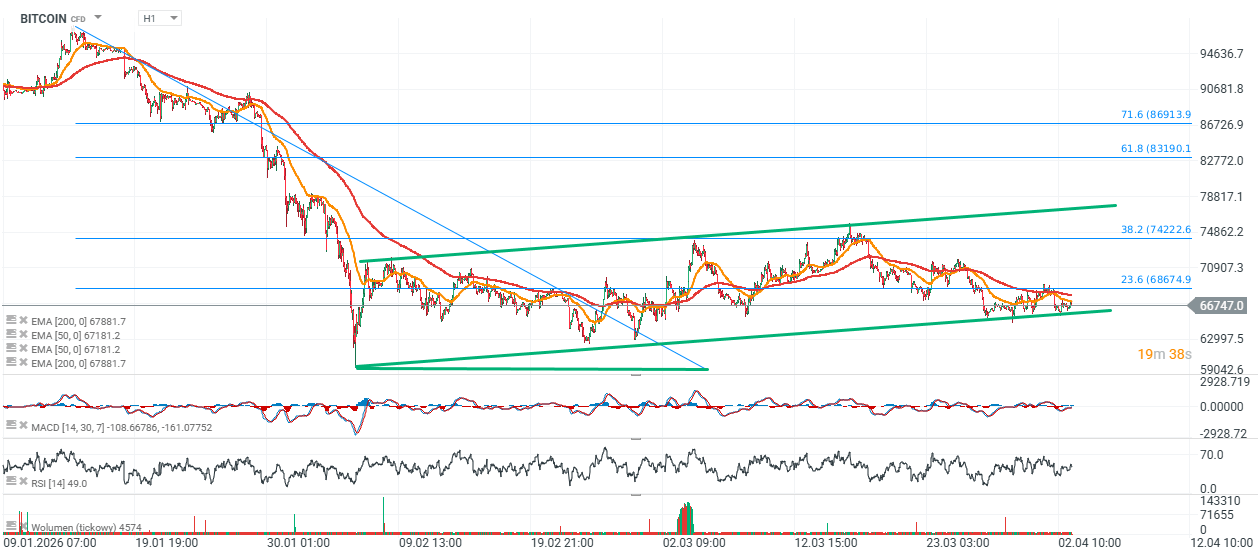
- Following the drop from around $94,000 in January, the $74,000–$76,000 zone has already twice acted as resistance, and this area continues to serve as the main technical barrier.
- At the same time, Bitcoin has twice reacted with declines near the 38.2% Fibonacci retracement of the recent downward impulse, which is located around $74,000.
- Currently, the price is trading in the lower range of an ascending price channel, with higher lows still being formed. A break below $66,000 could signal significant weakness and increased selling pressure—a downside breakout.
- The current pattern resembles a flag formation, which is typically a trend continuation pattern—in this case, suggesting continuation of the downward trend.
A drop toward $65,000 could potentially open the way for a deeper selling impulse, while a move back above $70,000 (the first psychological resistance level, further reinforced by price action) could pave the way toward $74,000 and a possible upside breakout from the ascending channel, which would require a move above the $77,000–$78,000 area.
Bitcoin (H1 timeframe)
Source: xStation5


Chart of the Day: NATGAS - Are there chances for a seasonal rebound amid warm weather?


Oil gains as U.S. crude inventories fall


U.S. indices attempt to rebound after recent losses


Hot inflation data from the US🔥📈 PPI and retail sales are rising!
The content of this report has been created by XTB S.A., with its registered office in Warsaw, at Prosta 67, 00-838 Warsaw, Poland, (KRS number 0000217580) and supervised by Polish Supervision Authority ( No. DDM-M-4021-57-1/2005). This material is a marketing communication within the meaning of Art. 24 (3) of Directive 2014/65/EU of the European Parliament and of the Council of 15 May 2014 on markets in financial instruments and amending Directive 2002/92/EC and Directive 2011/61/EU (MiFID II). Marketing communication is not an investment recommendation or information recommending or suggesting an investment strategy within the meaning of Regulation (EU) No 596/2014 of the European Parliament and of the Council of 16 April 2014 on market abuse (market abuse regulation) and repealing Directive 2003/6/EC of the European Parliament and of the Council and Commission Directives 2003/124/EC, 2003/125/EC and 2004/72/EC and Commission Delegated Regulation (EU) 2016/958 of 9 March 2016 supplementing Regulation (EU) No 596/2014 of the European Parliament and of the Council with regard to regulatory technical standards for the technical arrangements for objective presentation of investment recommendations or other information recommending or suggesting an investment strategy and for disclosure of particular interests or indications of conflicts of interest or any other advice, including in the area of investment advisory, within the meaning of the Trading in Financial Instruments Act of 29 July 2005 (i.e. Journal of Laws 2019, item 875, as amended). The marketing communication is prepared with the highest diligence, objectivity, presents the facts known to the author on the date of preparation and is devoid of any evaluation elements. The marketing communication is prepared without considering the client’s needs, his individual financial situation and does not present any investment strategy in any way. The marketing communication does not constitute an offer of sale, offering, subscription, invitation to purchase, advertisement or promotion of any financial instruments. XTB S.A. is not liable for any client’s actions or omissions, in particular for the acquisition or disposal of financial instruments, undertaken on the basis of the information contained in this marketing communication. In the event that the marketing communication contains any information about any results regarding the financial instruments indicated therein, these do not constitute any guarantee or forecast regarding the future results.