



Shares of iconic German automaker BMW fell today to their lowest level since autumn 2020 after the company released surprisingly weak results and sharply downgraded its outlook. Despite the magnitude of the sell-off, there are still few signs of meaningful buying interest emerging, while Germany’s automotive sector continues to weigh on the broader DAX index.
BMW has delivered a warning that has clearly unsettled investors: weakening Chinese demand, the conflict in the Middle East, and a sharp deterioration in profitability are all weighing on the company’s outlook. As a result, BMW’s valuation has fallen to its lowest level in more than five years.
The biggest guidance cut in years
The most concerning aspect of BMW’s announcement is the scale of the deterioration in profitability expectations.
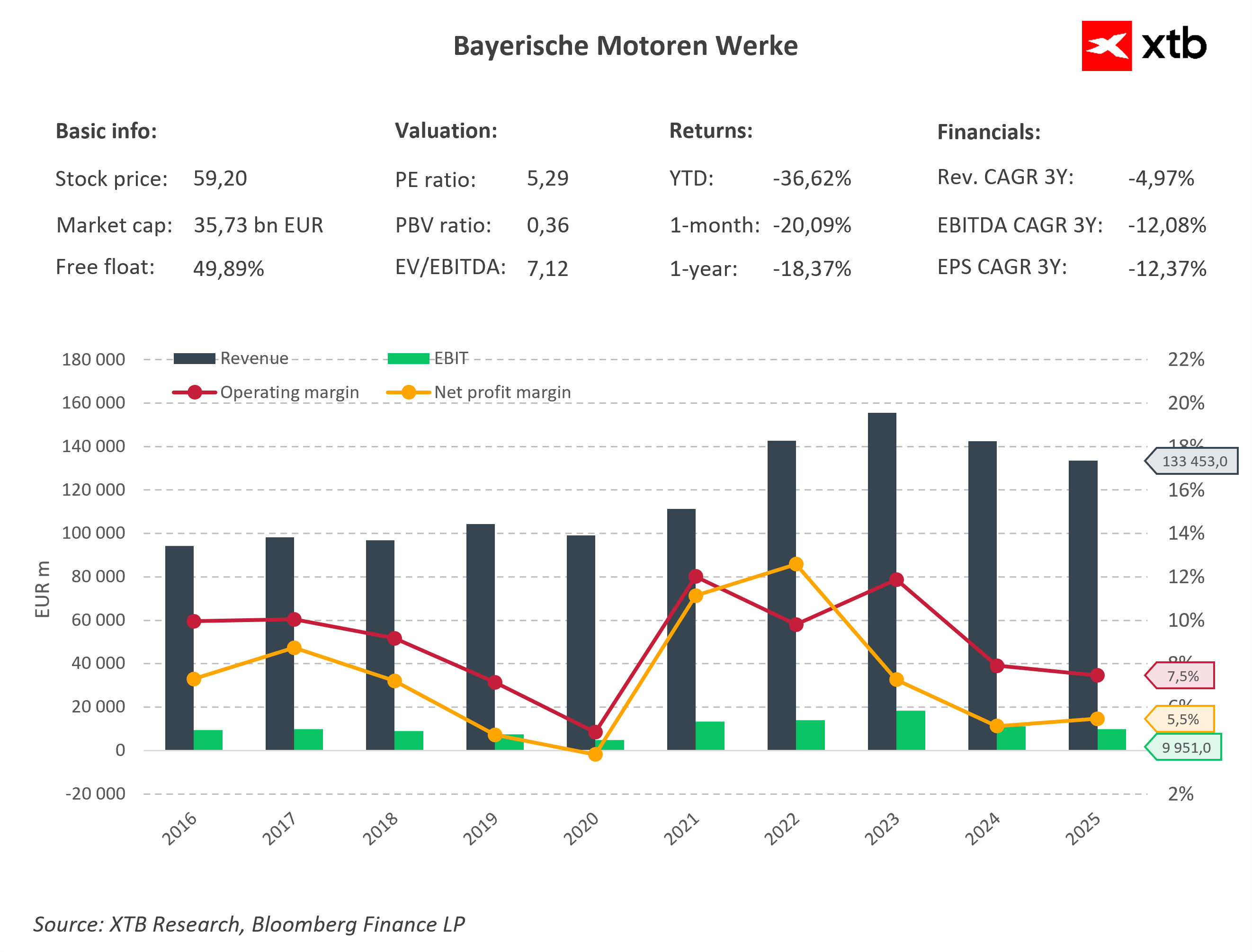
The company stated that earnings before tax (EBT) will decline “significantly” in 2026 compared with 2025, when EBT reached €10.2 billion. Until recently, management had guided only for a moderate decline in earnings.
Even more alarming is the revision of key profitability metrics:
-
Automotive EBIT margin guidance was cut from 4–6% to just 1–3%.
-
Return on capital employed (ROCE) guidance was reduced from 6–10% to 1–5%.
Such deep cuts suggest that the issue extends beyond lower vehicle sales volumes and increasingly reflects BMW’s ability to maintain the premium profitability levels that have historically supported its valuation. For a luxury automaker, margins remain one of the most important investment considerations, which explains the severity of the market reaction.
The Iran conflict is adding cost pressure
A second major challenge stems from the geopolitical situation in the Middle East.
According to BMW, the conflict involving Iran has proven significantly more costly than anticipated just a few months ago. Persistently elevated energy prices are increasing operating costs while simultaneously weakening consumers’ willingness to make large discretionary purchases.
Management emphasized that stronger sales growth in Europe and the United States is currently insufficient to offset weaker demand across Asia, particularly in China.
Cost-cutting efforts are accelerating
BMW also announced an acceleration of its restructuring initiatives and efficiency programs.
According to Milan Nedeljković, Member of the Board of Management of BMW AG, the company must adapt its structures and processes to what he described as a “drastic deterioration in market conditions.” Management intends to intensify ongoing cost-saving initiatives and implement additional efficiency measures.
Paradoxically, this will create even more pressure on earnings in the short term. BMW stated that the implementation of new restructuring measures will have a one-off negative impact on profits during the second half of 2026.
What remains a bright spot — and is the valuation attractive?
Despite the worsening outlook, BMW has not abandoned its shareholder return strategy.
The company still expects to generate more than €2.5 billion in automotive free cash flow. In addition, management reaffirmed:
-
A dividend payout ratio of 30–40% of net income attributable to BMW AG shareholders.
-
The continuation of its ongoing share buyback program.
These factors provide some support for shareholders. However, the market is currently focused primarily on the deterioration in BMW’s operating fundamentals — and rightly so.
BMW’s warning does not look like a temporary one-quarter setback. The company is simultaneously facing weakness in its most important foreign market, rising costs linked to geopolitical tensions, and increasing structural competition from Chinese manufacturers.
While BMW’s relatively low valuation (currently trading at roughly 5x earnings) may attract value-oriented investors, there is no obvious catalyst for a turnaround at this stage. Until demand in China stabilizes and profitability begins to recover, the stock could remain under pressure despite its attractive valuation multiples.
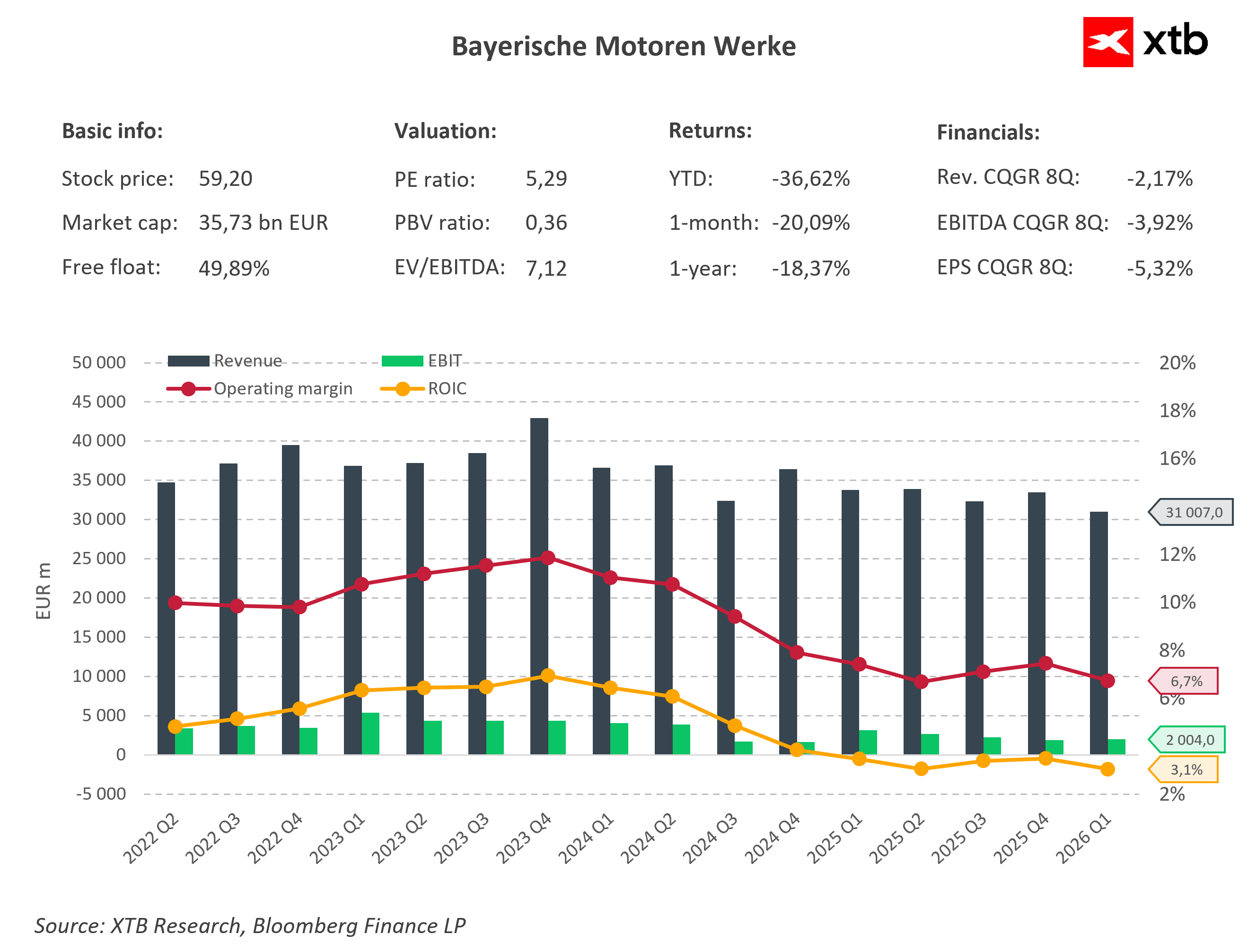
Perhaps the most concerning signal is the continuing decline in revenue, which suggests that BMW’s challenges are extending beyond margins and into the company’s core growth profile.
Source: XTB Research, Bloomberg Finance LP
Source: XTB Research, Bloomberg Finance LP
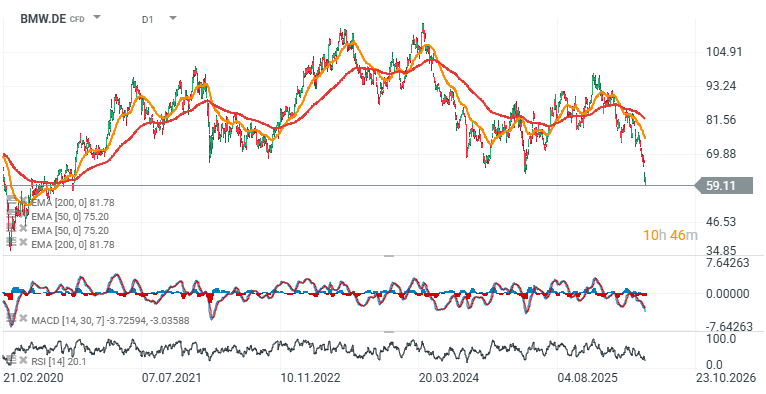
BMW.DE (D1 timeframe)
BMW shares are currently trading approximately 40% below their 200-day exponential moving average (EMA200, red line), highlighting the depth of the ongoing bear market and the sharp deterioration in investor confidence. The downtrend accelerated throughout 2026 as higher energy prices in Europe, tighter ECB monetary policy, and persistent weakness in China combined to create a highly unfavorable backdrop not only for BMW, but for the German automotive sector as a whole.
Source: xStation5
Eryk Szmyd Financial Markets Analyst, XTB


Supermicro Raises Forecast by $4 Billion as AI Server Demand Once Again Surprises the Market


SpaceX Results: Can Starlink Carry the AI Revolution?


Netflix results: An advertising setback


Daily Summary: Buyers Refuse to Give In
The content of this report has been created by XTB S.A., with its registered office in Warsaw, at Prosta 67, 00-838 Warsaw, Poland, (KRS number 0000217580) and supervised by Polish Supervision Authority ( No. DDM-M-4021-57-1/2005). This material is a marketing communication within the meaning of Art. 24 (3) of Directive 2014/65/EU of the European Parliament and of the Council of 15 May 2014 on markets in financial instruments and amending Directive 2002/92/EC and Directive 2011/61/EU (MiFID II). Marketing communication is not an investment recommendation or information recommending or suggesting an investment strategy within the meaning of Regulation (EU) No 596/2014 of the European Parliament and of the Council of 16 April 2014 on market abuse (market abuse regulation) and repealing Directive 2003/6/EC of the European Parliament and of the Council and Commission Directives 2003/124/EC, 2003/125/EC and 2004/72/EC and Commission Delegated Regulation (EU) 2016/958 of 9 March 2016 supplementing Regulation (EU) No 596/2014 of the European Parliament and of the Council with regard to regulatory technical standards for the technical arrangements for objective presentation of investment recommendations or other information recommending or suggesting an investment strategy and for disclosure of particular interests or indications of conflicts of interest or any other advice, including in the area of investment advisory, within the meaning of the Trading in Financial Instruments Act of 29 July 2005 (i.e. Journal of Laws 2019, item 875, as amended). The marketing communication is prepared with the highest diligence, objectivity, presents the facts known to the author on the date of preparation and is devoid of any evaluation elements. The marketing communication is prepared without considering the client’s needs, his individual financial situation and does not present any investment strategy in any way. The marketing communication does not constitute an offer of sale, offering, subscription, invitation to purchase, advertisement or promotion of any financial instruments. XTB S.A. is not liable for any client’s actions or omissions, in particular for the acquisition or disposal of financial instruments, undertaken on the basis of the information contained in this marketing communication. In the event that the marketing communication contains any information about any results regarding the financial instruments indicated therein, these do not constitute any guarantee or forecast regarding the future results.