



harma giant Eli Lilly (LLY.US), best known for its diabetes drug Mounjaro, delivered excellent results for Q4 2025. The stock is up more than 7% pre-market ahead of the Wall Street open and is likely to move back toward record highs today.
- Adjusted EPS: $7.54 vs. $6.73 expected
- Revenue: $19.29bn vs. $18.01bn expected (+43% y/y)
- Mounjaro revenue: $7.41bn vs. $6.75bn expected
- Zepbound revenue: $4.26bn vs. $3.8bn expected
What did the results show? Lilly is “pulling away” from Novo
The company not only beat Wall Street expectations on both revenue and profit, but also issued 2026 guidance that reads like a signal: “demand is still right around the corner — and we’re still riding the wave.” Lilly is positioning itself at the center of one of the biggest shifts in pharma in decades: the boom in GLP-1 drugs for obesity and diabetes.
- This market is starting to look like a new consumer category, not just another line item in a revenue table. In the U.S., revenue increased to $12.9bn, which the company attributed to a 50% increase in volume, largely driven by Mounjaro and Zepbound.
- Two products are carrying that narrative: Mounjaro (diabetes) and Zepbound (obesity). Global Mounjaro revenue rose 110% y/y, and in the U.S. it increased 57% y/y (to $4.1bn). Meanwhile, U.S. Zepbound sales totaled $4.2bn, with total sales up 122% y/y.
The company’s assumptions are clear:
-
2026 revenue: $80–83bn (the market expected ~ $77.6bn)
-
2026 adjusted EPS: $33.50–35.00 (the market ~ $33.2)
In the background is an issue investors aren’t ignoring: U.S. drug pricing is increasingly becoming a “political problem.” And when something becomes a political problem, sooner or later someone tries to regulate it, cut it, or at least limit it. Lilly’s message, however, is straightforward: even if pricing pressure rises, demand and market scale may act as a shock absorber.
- A few days earlier, Lilly CEO Dave Ricks pointed to something the market may not be fully pricing in yet: the potential expansion of Medicare coverage for obesity treatment. If this materializes, the pool of patients who can legally and financially access therapy would expand meaningfully.
- In practice, that means the market could become less constrained by patients’ wallets and more by healthcare system capacity. For Lilly, that could raise the U.S. sales ceiling.
- The contrast with Novo Nordisk is notable: around the same time, Novo delivered more cautious guidance and warned of declining sales and profits in 2026.
- The reasons cited were U.S. pricing pressure and the expiration of exclusivity in selected regions. At this stage of the cycle, Lilly looks like the company with the stronger near-term trajectory and better control over revenue dynamics.
There’s also the broader political thread around agreements with Donald Trump’s administration. According to reports, Lilly and Novo agreed to lower drug prices for Medicare and Medicaid beneficiaries in 2026, and to sell directly to consumers at a discount via a direct-to-consumer platform (TrumpRx, not yet launched). In return, both companies are expected to receive a three-year tariff exemption. Meanwhile, Novo is signaling a strong launch of an oral version of Wegovy in the U.S. Lilly, on the other hand, is counting on approval of its own oral weight-loss drug (orforglipron) later this year.
Key questions for investors now
-
How fast do U.S. prices fall — and can volume offset the impact?
-
Will Medicare meaningfully expand access to obesity therapy?
-
How will the market respond to the rollout of oral GLP-1 versions?
-
Can Lilly maintain dominance despite regulatory pressure?
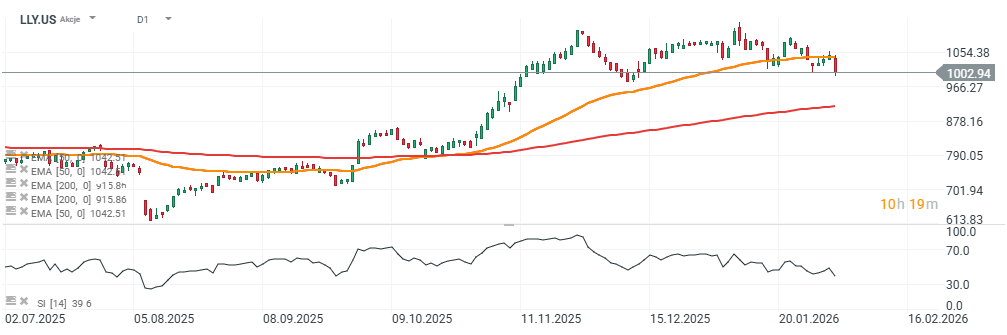
Eli Lilly stock (D1 interval)
Shares pulled back yesterday below the EMA50 (orange line), but if the rebound continues after the U.S. market opens, the price will likely climb back above $1,050 per share.
Source: xStation5



Daily Summary: Valuations Under Pressure, Capital Moves Away From Technology


US OPEN: Earnings misses and rising oil push indexes lower

Market Wrap: "Decent" results are not enough – tech stocks fall further; oil highest since May (22.10.2026)


Lam Research: Strong Numbers, Limited Upside Surprise
The content of this report has been created by XTB S.A., with its registered office in Warsaw, at Prosta 67, 00-838 Warsaw, Poland, (KRS number 0000217580) and supervised by Polish Supervision Authority ( No. DDM-M-4021-57-1/2005). This material is a marketing communication within the meaning of Art. 24 (3) of Directive 2014/65/EU of the European Parliament and of the Council of 15 May 2014 on markets in financial instruments and amending Directive 2002/92/EC and Directive 2011/61/EU (MiFID II). Marketing communication is not an investment recommendation or information recommending or suggesting an investment strategy within the meaning of Regulation (EU) No 596/2014 of the European Parliament and of the Council of 16 April 2014 on market abuse (market abuse regulation) and repealing Directive 2003/6/EC of the European Parliament and of the Council and Commission Directives 2003/124/EC, 2003/125/EC and 2004/72/EC and Commission Delegated Regulation (EU) 2016/958 of 9 March 2016 supplementing Regulation (EU) No 596/2014 of the European Parliament and of the Council with regard to regulatory technical standards for the technical arrangements for objective presentation of investment recommendations or other information recommending or suggesting an investment strategy and for disclosure of particular interests or indications of conflicts of interest or any other advice, including in the area of investment advisory, within the meaning of the Trading in Financial Instruments Act of 29 July 2005 (i.e. Journal of Laws 2019, item 875, as amended). The marketing communication is prepared with the highest diligence, objectivity, presents the facts known to the author on the date of preparation and is devoid of any evaluation elements. The marketing communication is prepared without considering the client’s needs, his individual financial situation and does not present any investment strategy in any way. The marketing communication does not constitute an offer of sale, offering, subscription, invitation to purchase, advertisement or promotion of any financial instruments. XTB S.A. is not liable for any client’s actions or omissions, in particular for the acquisition or disposal of financial instruments, undertaken on the basis of the information contained in this marketing communication. In the event that the marketing communication contains any information about any results regarding the financial instruments indicated therein, these do not constitute any guarantee or forecast regarding the future results.