



Lululemon Athletica (NASDAQ: LULU) shares fell around 12% after the company released its fiscal first-quarter 2026 results. While revenue and earnings per share came in broadly in line with market expectations, investors were concerned by the retailer’s lowered full-year guidance and further signs of weakening demand in North America.
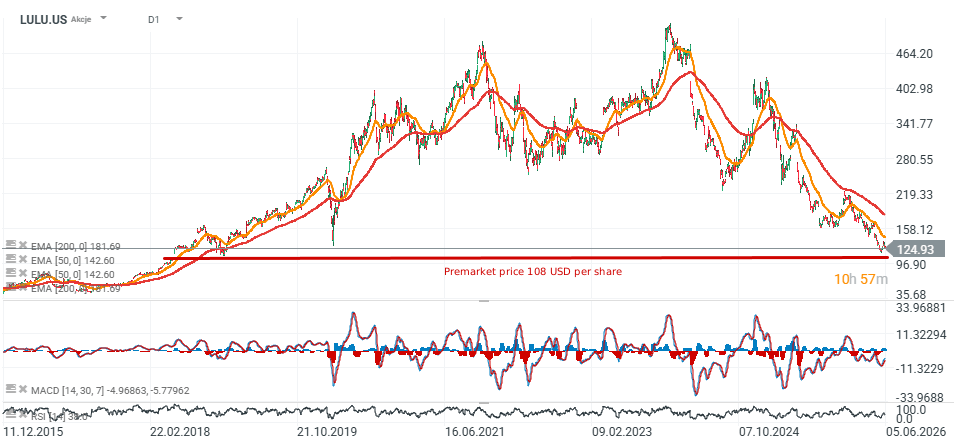
The market is increasingly questioning whether the company’s challenges — particularly its struggle to reignite growth in the U.S. market — are temporary in nature or reflect a deeper deterioration in the positioning of one of the world’s most recognizable premium athletic apparel brands. The stock has fallen to its lowest level since May 2018, and its weakness is weighing on sentiment across the broader athletic apparel sector, including rival Nike, whose shares are trading near their lowest levels in 15 years.
Key Takeaways
-
Revenue increased 4% year-over-year to $2.47 billion
-
Net income fell from $314.5 million to $195 million (-38% YoY)
-
EPS declined from $2.60 to $1.69
-
Gross margin contracted by 410 basis points to 54.2%
-
Operating margin declined by 730 basis points to 11.2%
-
Comparable sales increased 1%
-
Comparable sales in the Americas fell 5%
-
International comparable sales rose 13%
-
Revenue in Mainland China increased 30%
-
The company lowered its FY2026 EPS guidance to $10.95–$11.15 from $12.10–$12.30
-
Revenue guidance was cut to $11.0–$11.15 billion from $11.35–$11.50 billion
Results Met Expectations, but Profitability Continues to Deteriorate
From a top-line perspective, Lululemon delivered results that were broadly in line with Wall Street expectations. The company generated $2.47 billion in revenue versus analyst estimates of $2.44 billion, while earnings per share came in exactly at the consensus forecast of $1.69.
However, the underlying earnings picture was considerably weaker. Operating income declined 37% year-over-year, while net income dropped 38%. At the same time, gross margin narrowed to 54.2%, highlighting rising cost pressures and weakening pricing power.
This trend is particularly important for investors because Lululemon has historically commanded a premium valuation thanks to its ability to maintain industry-leading margins and strong brand equity.
China Remains a Growth Engine, but North America Continues to Weigh on Performance
The strongest aspect of the quarter remained the company’s international business. Revenue outside North America increased 22%, while international comparable sales rose 13%.
China stood out as the key growth driver. Revenue in Mainland China climbed 30%, while comparable sales advanced 20%, reinforcing the market’s importance within Lululemon’s long-term growth strategy.
In contrast, North America remains under pressure. Revenue in the region declined 3%, while comparable sales fell 5%. This segment continues to be the primary source of concern for investors and analysts alike.
Lowered Guidance Triggered the Sharp Sell-Off
The biggest disappointment came from management’s outlook for the coming quarters.
For the second quarter, Lululemon expects revenue between $2.45 billion and $2.47 billion and EPS of $1.76–$1.81, both below Wall Street expectations.
More importantly, the company significantly reduced its full-year guidance. Management now expects fiscal 2026 EPS of $10.95–$11.15, nearly 10% below its previous forecast.
The guidance cut suggests a more challenging consumer environment and a slower recovery trajectory than management had anticipated only a few months ago.
According to the company, macroeconomic uncertainty and cautious discretionary spending continue to pressure demand across key markets.
Analysts Cut Price Targets as the Chart Signals Persistent Weakness
Following the earnings release, several major brokerages lowered their price targets on Lululemon shares. Stifel reduced its target price from $176 to $134 while maintaining a Hold rating. The firm noted that the company’s core North American business deteriorated further during April and May and now expects comparable sales to remain negative through the first half of fiscal 2027.
Other analysts have expressed similar concerns. Wells Fargo cut its target price to $110, Jefferies lowered its target to $115, and BofA Securities reduced its valuation to $140.
The common theme across these revisions is weakening North American demand, ongoing margin pressure, and concerns about market share erosion. Some analysts are also beginning to question whether the company is facing a broader brand issue rather than merely a temporary product-cycle challenge.
From a technical perspective, the stock’s decline to eight-year lows reinforces the negative narrative surrounding the name. The breakdown reflects not only weaker earnings expectations but also growing uncertainty regarding the sustainability of Lululemon’s premium positioning.
Despite these challenges, the company continues to post strong international growth and has expanded its global store base to 816 locations. In addition, former Nike executive Heidi O’Neill is set to take over as CEO in the coming months, a leadership change that investors hope will help restore growth momentum. The next several quarters will likely determine whether Lululemon is experiencing a temporary operational slowdown or facing a more structural challenge to its brand and long-term growth story.
Source: xStation5



Market Wrap: A 4% surge in oil prices weighs on indices (08.10.2026)


🚩 Caterpillar shares extend decline, down 30% from record high


Webull shares down 20% amid fears over potential China ties



US Open: Wall Street in the Red 🚩 Nasdaq Falls 1% From Record Highs, Constellation Brands Back at March 2020 Level
The content of this report has been created by XTB S.A., with its registered office in Warsaw, at Prosta 67, 00-838 Warsaw, Poland, (KRS number 0000217580) and supervised by Polish Supervision Authority ( No. DDM-M-4021-57-1/2005). This material is a marketing communication within the meaning of Art. 24 (3) of Directive 2014/65/EU of the European Parliament and of the Council of 15 May 2014 on markets in financial instruments and amending Directive 2002/92/EC and Directive 2011/61/EU (MiFID II). Marketing communication is not an investment recommendation or information recommending or suggesting an investment strategy within the meaning of Regulation (EU) No 596/2014 of the European Parliament and of the Council of 16 April 2014 on market abuse (market abuse regulation) and repealing Directive 2003/6/EC of the European Parliament and of the Council and Commission Directives 2003/124/EC, 2003/125/EC and 2004/72/EC and Commission Delegated Regulation (EU) 2016/958 of 9 March 2016 supplementing Regulation (EU) No 596/2014 of the European Parliament and of the Council with regard to regulatory technical standards for the technical arrangements for objective presentation of investment recommendations or other information recommending or suggesting an investment strategy and for disclosure of particular interests or indications of conflicts of interest or any other advice, including in the area of investment advisory, within the meaning of the Trading in Financial Instruments Act of 29 July 2005 (i.e. Journal of Laws 2019, item 875, as amended). The marketing communication is prepared with the highest diligence, objectivity, presents the facts known to the author on the date of preparation and is devoid of any evaluation elements. The marketing communication is prepared without considering the client’s needs, his individual financial situation and does not present any investment strategy in any way. The marketing communication does not constitute an offer of sale, offering, subscription, invitation to purchase, advertisement or promotion of any financial instruments. XTB S.A. is not liable for any client’s actions or omissions, in particular for the acquisition or disposal of financial instruments, undertaken on the basis of the information contained in this marketing communication. In the event that the marketing communication contains any information about any results regarding the financial instruments indicated therein, these do not constitute any guarantee or forecast regarding the future results.