


- Wall Street is set to open Monday’s session at regular hours following the Good Friday market closure. Sentiment has improved on reports suggesting a potential de-escalation of the Middle East conflict and ongoing US–Iran negotiations. Investors have cautiously rotated back into equities, supporting gains in selected markets, although the move remains limited in scope. Beyond geopolitical developments, markets will focus on US ISM data due at 16:00 CET.
- According to media reports, the United States, Iran, and a group of regional mediators are discussing terms for a potential 45-day ceasefire. Markets would likely interpret such a scenario as an initial step toward a broader de-escalation. Over the weekend, Donald Trump set a deadline of 1:00 GMT Tuesday 7 April, for Iran to decide on reopening the Strait of Hormuz, warning of “total destruction” otherwise.
- Additional support for sentiment comes from increased vessel traffic through the Strait of Hormuz, easing concerns about immediate disruptions to global oil and energy supply. However, escalation risks remain elevated. Iran has threatened not only retaliation against US allies in the event of an attack but also the potential closure of the Bab al-Mandab Strait near the Gulf of Aden. Combined with Hormuz, these routes account for roughly 25% of global oil shipments.
- S&P 500 futures have recovered earlier losses and are up حوالي 0.3%, indicating that markets are beginning to price in a partial de-escalation scenario. The MSCI Asia Pacific Index gained 0.4%, with a relatively balanced distribution of advancers and decliners. Technology stocks outperformed, suggesting a selective return of capital into higher-beta assets.
- At the same time, the political backdrop remains highly fragile. Donald Trump has intensified his rhetoric toward Iran, threatening strikes on civilian infrastructure if no agreement is reached. He also announced a press conference and reiterated a specific deadline, without providing operational details.
- In commodities, earlier gains in crude oil have been fully reversed, suggesting that investors are scaling back the geopolitical risk premium, at least in the near term. Gold declined by around 0.6% to approximately $4,650 per ounce. Since the conflict began in late February, bullion has fallen by roughly 12%.
- The decline in gold can be linked to shifting monetary policy expectations. Rising energy costs have reinforced inflation concerns, reducing the likelihood of near-term rate cuts, which typically support non-yielding assets such as gold.
US100 (D1)
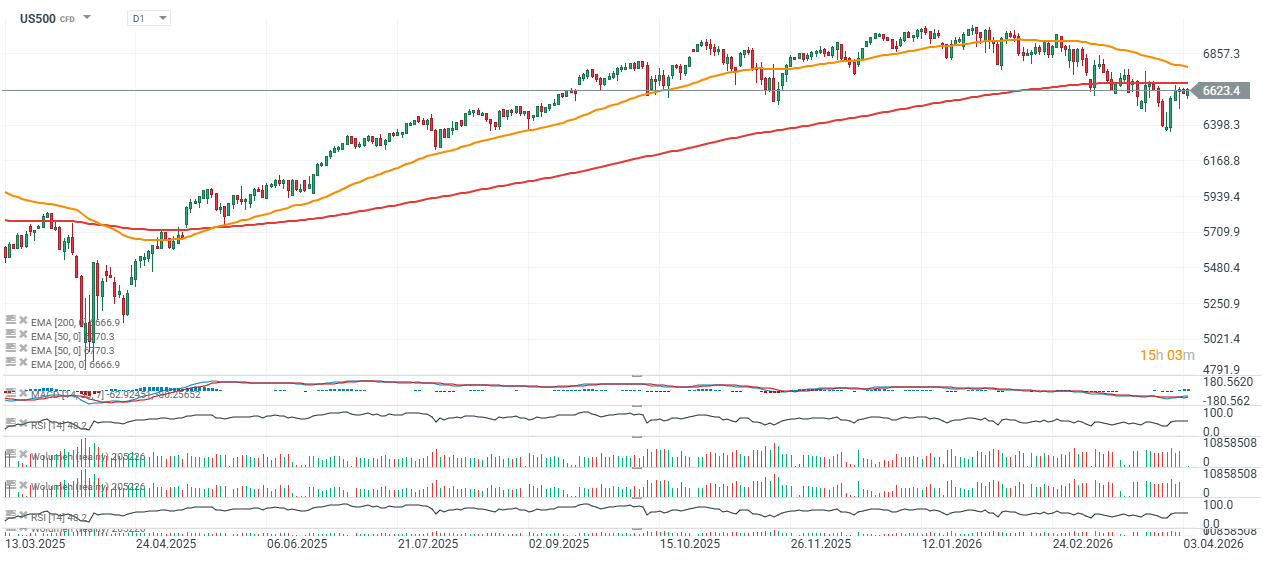
Source: xStation5


Daily Summary: Trump and OpenAI keep the market on a roller coaster💡



U.S. attacks on Iran suspended 💥


Market Wrap: A 4% surge in oil prices weighs on indices (08.10.2026)

EURUSD falls below 1.12 amid hawkish Fed's Waller remarks
The content of this report has been created by XTB S.A., with its registered office in Warsaw, at Prosta 67, 00-838 Warsaw, Poland, (KRS number 0000217580) and supervised by Polish Supervision Authority ( No. DDM-M-4021-57-1/2005). This material is a marketing communication within the meaning of Art. 24 (3) of Directive 2014/65/EU of the European Parliament and of the Council of 15 May 2014 on markets in financial instruments and amending Directive 2002/92/EC and Directive 2011/61/EU (MiFID II). Marketing communication is not an investment recommendation or information recommending or suggesting an investment strategy within the meaning of Regulation (EU) No 596/2014 of the European Parliament and of the Council of 16 April 2014 on market abuse (market abuse regulation) and repealing Directive 2003/6/EC of the European Parliament and of the Council and Commission Directives 2003/124/EC, 2003/125/EC and 2004/72/EC and Commission Delegated Regulation (EU) 2016/958 of 9 March 2016 supplementing Regulation (EU) No 596/2014 of the European Parliament and of the Council with regard to regulatory technical standards for the technical arrangements for objective presentation of investment recommendations or other information recommending or suggesting an investment strategy and for disclosure of particular interests or indications of conflicts of interest or any other advice, including in the area of investment advisory, within the meaning of the Trading in Financial Instruments Act of 29 July 2005 (i.e. Journal of Laws 2019, item 875, as amended). The marketing communication is prepared with the highest diligence, objectivity, presents the facts known to the author on the date of preparation and is devoid of any evaluation elements. The marketing communication is prepared without considering the client’s needs, his individual financial situation and does not present any investment strategy in any way. The marketing communication does not constitute an offer of sale, offering, subscription, invitation to purchase, advertisement or promotion of any financial instruments. XTB S.A. is not liable for any client’s actions or omissions, in particular for the acquisition or disposal of financial instruments, undertaken on the basis of the information contained in this marketing communication. In the event that the marketing communication contains any information about any results regarding the financial instruments indicated therein, these do not constitute any guarantee or forecast regarding the future results.