



Novartis (NOVN.CH) reported its first-quarter 2026 results, which disappointed investors and analysts.
- Net sales totaled $13.11 billion, representing a 1% year-over-year decline and falling short of the analysts' consensus estimate of $13.40 billion.
- Core operating profit fell by 12% to $4.9 billion, while the market had expected around $5.1 billion.
- The key reason for the poor results is the loss of patent exclusivity for three flagship drugs: the heart medication Entresto, whose sales plummeted by 42% to $1.31 billion; the blood disorder medication Promacta, which saw a 66% decline; and the leukemia medication Tasigna, which saw a 59% decline.
- The total revenue gap resulting from generic expansion is estimated at approximately $4 billion for the full year 2026.
Despite a difficult start to the year, the company’s management is maintaining its full-year forecasts, projecting low single-digit growth in net sales and a low single-digit decline in core operating income. CFO Mukul Mehta emphasized that Q1 results were in line with the company’s internal expectations, and growth is expected to return in the second half of the year. The company is counting on an acceleration in sales of new priority drugs such as Kisqali, Pluvicto, Kesimpta, Scemblix, and Leqvio, which will partially offset generic erosion. Furthermore, Novartis signaled the possibility of raising its medium- and long-term growth forecasts once data from several key clinical trials becomes available in the second half of 2026. The company had previously updated its 2025–2030 target, projecting annual revenue growth of 5% to 6% in constant currencies.
A significant additional risk factor remains the Trump administration’s pricing policy, specifically the Most Favored Nation mechanism, which links drug prices in the U.S. to prices in other wealthy countries. CEO Vas Narasimhan warned that the industry will fully feel the impact of this policy over the next 18 months, and that its effect is currently limited mainly to the Medicaid segment, which accounts for 5 to 10% of sales. Novartis shares reacted to the Q1 results with a nearly 4% decline and are now trading virtually unchanged year-to-date, reflecting the market’s cautious approach to the company during this period of product portfolio transformation.
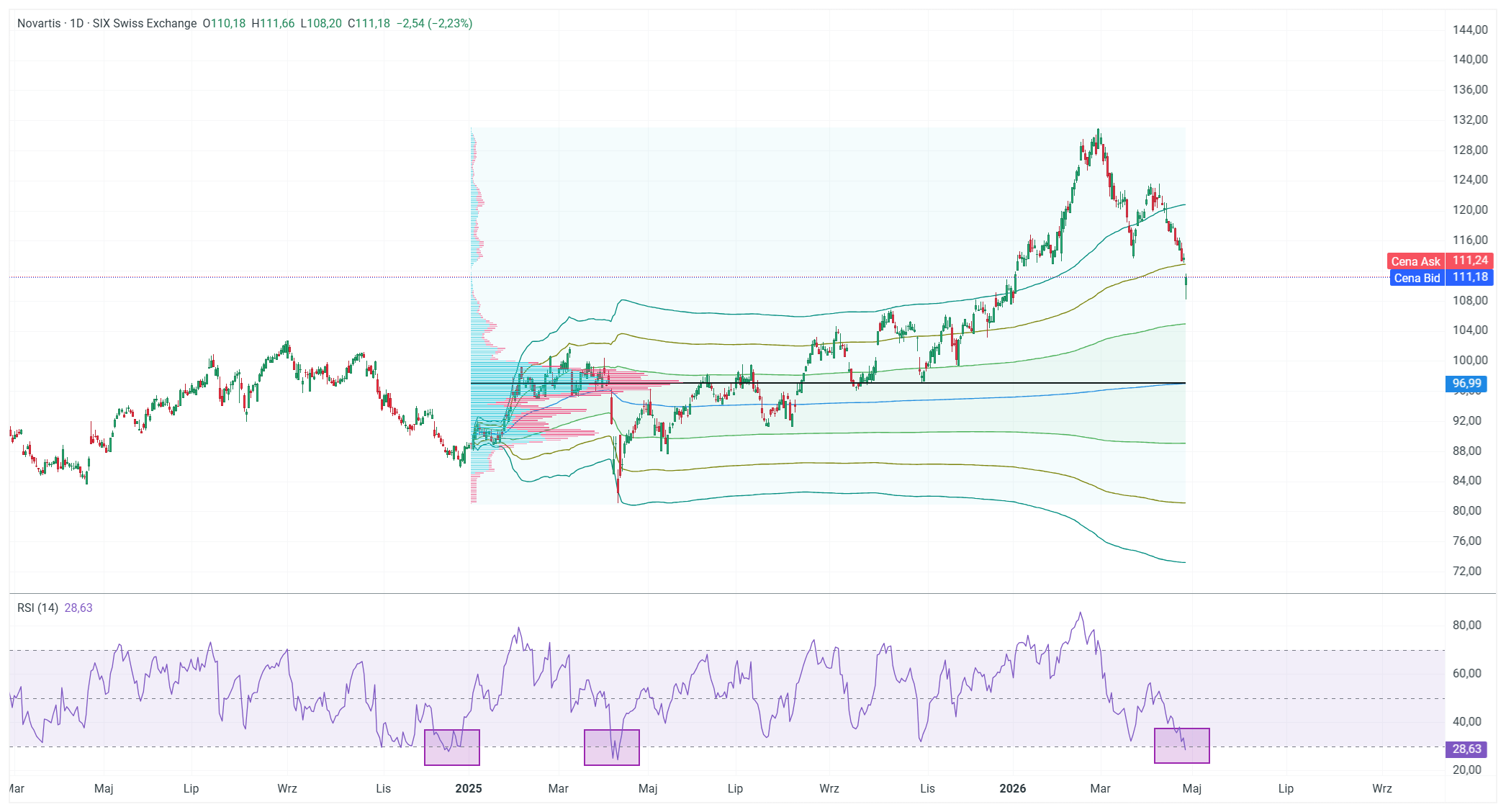
The D1 chart for Novartis shares shows a clear slowdown in the multi-month uptrend, which drove the price from around CHF 88 to a peak above CHF 132 reached in early 2026. Today’s session brought a sharp breakout below the previous consolidation zone, bringing the price down to 111.18 CHF, which represents a break of several support lines from the VWAP channel pattern visible on the chart. The most important technical signal comes from the RSI(14) oscillator, which fell to 28.63, entering deep into the oversold zone below 30—a level that, historically on this chart, has twice preceded a potential upward rebound (marked by purple rectangles in February and April 2025). The key support level remains the horizontal demand zone around 97 CHF, defined by the Volume Profile and the black trend line, where significant activity was concentrated prior to the breakout in mid-2025. The nearest technical support is around CHF 108, while any potential rebound will face resistance at the CHF 116 level, where the upper channel bands and the recent consolidation zone converge.
Source: xStation


Market wrap: European indices rebound 🔼 Defence stocks on the rise


TSMC in Talks with Elon Musk Over Terafab


Daily summary 📈 Precious metals and stock indices rebound as Treasury yields fall


US Open: Nasdaq 100 extends losses 🚩 AI stocks under pressure, CoreWeave falls 8%
The content of this report has been created by XTB S.A., with its registered office in Warsaw, at Prosta 67, 00-838 Warsaw, Poland, (KRS number 0000217580) and supervised by Polish Supervision Authority ( No. DDM-M-4021-57-1/2005). This material is a marketing communication within the meaning of Art. 24 (3) of Directive 2014/65/EU of the European Parliament and of the Council of 15 May 2014 on markets in financial instruments and amending Directive 2002/92/EC and Directive 2011/61/EU (MiFID II). Marketing communication is not an investment recommendation or information recommending or suggesting an investment strategy within the meaning of Regulation (EU) No 596/2014 of the European Parliament and of the Council of 16 April 2014 on market abuse (market abuse regulation) and repealing Directive 2003/6/EC of the European Parliament and of the Council and Commission Directives 2003/124/EC, 2003/125/EC and 2004/72/EC and Commission Delegated Regulation (EU) 2016/958 of 9 March 2016 supplementing Regulation (EU) No 596/2014 of the European Parliament and of the Council with regard to regulatory technical standards for the technical arrangements for objective presentation of investment recommendations or other information recommending or suggesting an investment strategy and for disclosure of particular interests or indications of conflicts of interest or any other advice, including in the area of investment advisory, within the meaning of the Trading in Financial Instruments Act of 29 July 2005 (i.e. Journal of Laws 2019, item 875, as amended). The marketing communication is prepared with the highest diligence, objectivity, presents the facts known to the author on the date of preparation and is devoid of any evaluation elements. The marketing communication is prepared without considering the client’s needs, his individual financial situation and does not present any investment strategy in any way. The marketing communication does not constitute an offer of sale, offering, subscription, invitation to purchase, advertisement or promotion of any financial instruments. XTB S.A. is not liable for any client’s actions or omissions, in particular for the acquisition or disposal of financial instruments, undertaken on the basis of the information contained in this marketing communication. In the event that the marketing communication contains any information about any results regarding the financial instruments indicated therein, these do not constitute any guarantee or forecast regarding the future results.