


Nvidia enters Wednesday’s earnings report in a situation where strong results have ceased to be enough to drive the stock higher. For many quarters now, the company has delivered results that would have seemed almost unimaginable not long ago, yet the shares have still managed to fall following the releases. Nvidia’s last four earnings reports all resulted in a decline in the stock price afterward, despite the company consistently beating expectations.
This time, the bar is set even higher. The market no longer wants to see just another consensus beat. Nvidia needs to deliver very strong results, a significantly better outlook for the next quarter, and, above all, evidence that the current AI infrastructure boom does not end with Blackwell. Investors will want concrete information on demand, orders, deployment of the latest chips, and the timeline for the transition to the next generation, Vera Rubin.
The future may ultimately prove more important than the second quarter itself. At Nvidia’s current scale, the company no longer needs to prove that AI is generating enormous demand. The market already knows that. The question is whether that demand will be large enough to justify several more years of exceptionally strong growth.
Key Financial Expectations
-
Revenue: approx. $92.2 billion
-
EPS: approx. $2.09
-
Data Center revenue: approx. $85.7 billion
-
Data Center revenue growth: more than 100% YoY
-
Full-year Vera Rubin revenue: consensus of approx. $45.3 billion
-
FY2027 Data Center revenue: consensus of approx. $368.8 billion
-
Market expectations for Q3: approx. $103.7 billion
-
More aggressive expectations: as much as $107–108 billion in Q3 revenue
The numbers alone show the scale of the challenge. Consensus calls for revenue of more than $92 billion, nearly twice the level recorded a year earlier. Data Center is expected to generate around $85.7 billion. This segment accounts for the overwhelming majority of Nvidia’s growth story and remains the most important reference point for the entire AI market.
Data Center Needs to Impress Again
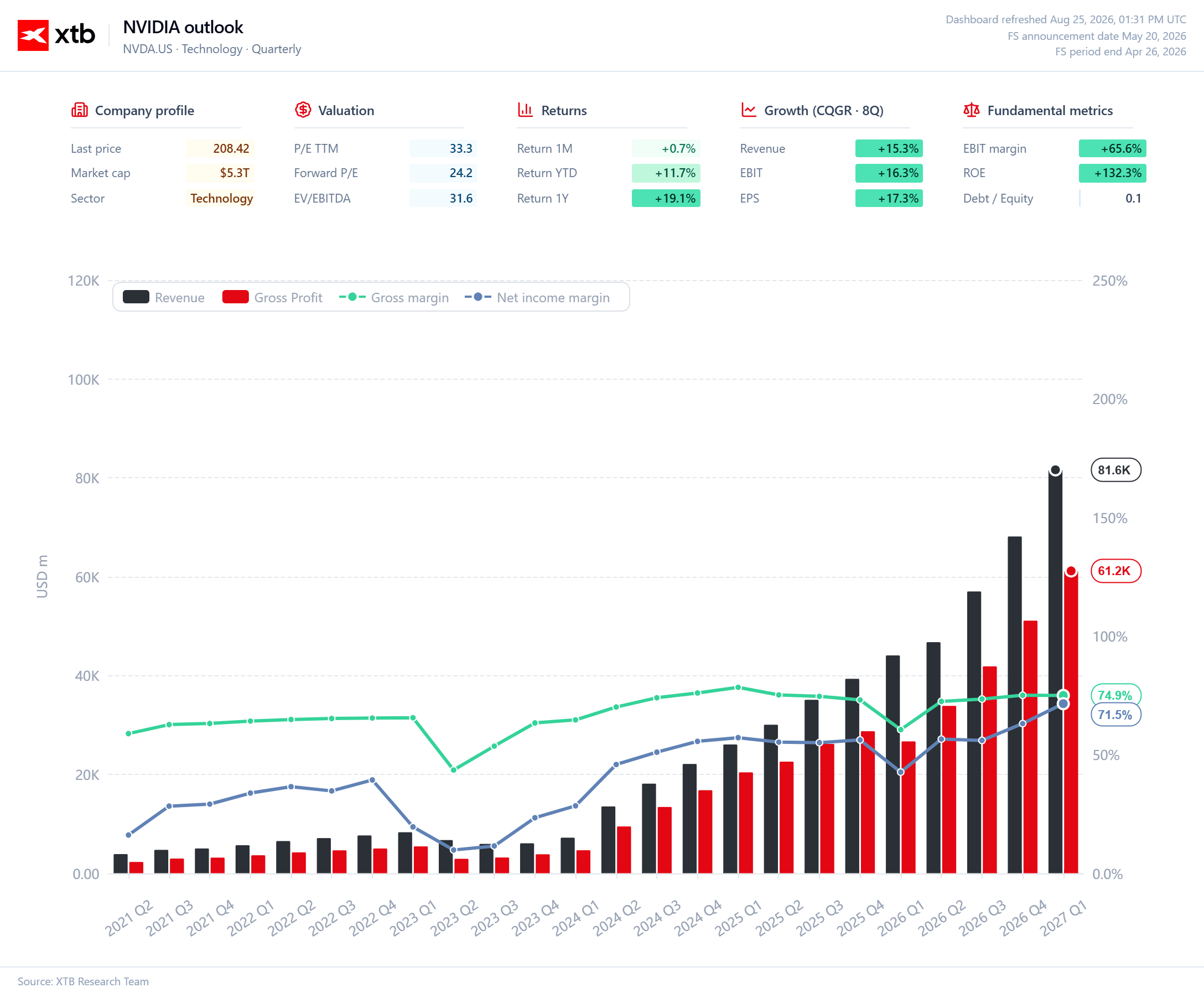
There is no doubt that Data Center will be at the heart of the earnings report. Expectations for the segment have been raised over the past year to levels that would have seemed unrealistic not long ago. Consensus for the second quarter has risen from around $56.4 billion in June 2025 to the current $85.7 billion. This is a very important signal. Nvidia continues to grow at a pace that dominates the entire sector, but the market is beginning to ask a more difficult question: how much further can expectations realistically be raised?
That is why even a result in the $92–93 billion range could prove insufficient if it is not accompanied by very strong commentary about the coming quarters. Expectations are already emerging that Nvidia could generate around $95 billion in revenue in the current quarter. If the company delivers only a result slightly above consensus, investors may treat it as a disappointment, even if it technically represents another record quarter.
Blackwell Is Already the Present. Rubin Needs to Show the Future
The key question will no longer be simply whether Blackwell is selling well. The market knows that demand for this generation remains very strong. What matters now is how long that demand can remain elevated and how smoothly Nvidia can transition to the next stage of its development.
Vera Rubin could be even more important. Consensus currently assumes around $45.3 billion in Rubin revenue for the full year, and the market will want to know exactly when large-scale deployment of the new systems will begin.
If Nvidia confirms this timeline, the market will receive something much more valuable than another earnings beat. It will get evidence that growth is not tied to a single product cycle, but that the company is capable of consistently delivering successive generations of AI infrastructure and smoothly converting them into revenue.
Orders Will Matter More Than the Results Themselves
In Nvidia’s case, information beyond the income statement is becoming increasingly important. Investors will want to know what the order book looks like, what the largest customers are planning, and how quickly new chips are reaching data centers.
This is particularly important for Rubin. Simply announcing a new architecture will no longer be enough. The market will expect specifics: who is buying, when deliveries are starting, the scale of orders, and whether customers are prepared to increase spending as they transition to the new generation.
Nvidia therefore needs to demonstrate not only demand today, but also revenue visibility for the coming quarters. That could ultimately determine whether the current valuation still has room for further expansion.
AI Still Needs Nvidia, but Nvidia Must Prove That AI Will Need It Even More
The entire Nvidia investment story is now based on one core assumption: spending on AI infrastructure will continue to increase, while Nvidia will remain the leading supplier of the hardware needed to support that spending.
Market data continues to confirm very strong demand. In the previous quarter, Nvidia generated $81.6 billion in revenue, representing 85.2% YoY growth, while Data Center revenue reached $75.2 billion, up 92%. The problem is that, at Nvidia’s current scale, maintaining that pace is becoming increasingly difficult. Every quarter requires the company to add tens of billions of dollars to an already enormous revenue base.
That is why Wednesday’s report will also serve as a test for the broader AI market. If Nvidia delivers strong growth, raises its outlook, and confirms enormous demand for future generations of chips, it will signal that investments by Microsoft, Amazon, Alphabet, Meta, and other technology giants still have room to expand further.
If, however, order growth begins to stabilize and guidance comes in only marginally above consensus, the market may start asking much tougher questions about the returns on the entire AI investment cycle.
Margins Will Also Be Under the Microscope
Nvidia has built exceptionally high profitability over the years, while its technological advantage and CUDA ecosystem have allowed it to maintain very strong margins. However, as architectures change and entire systems become increasingly complex, questions are emerging about how those margins will evolve.
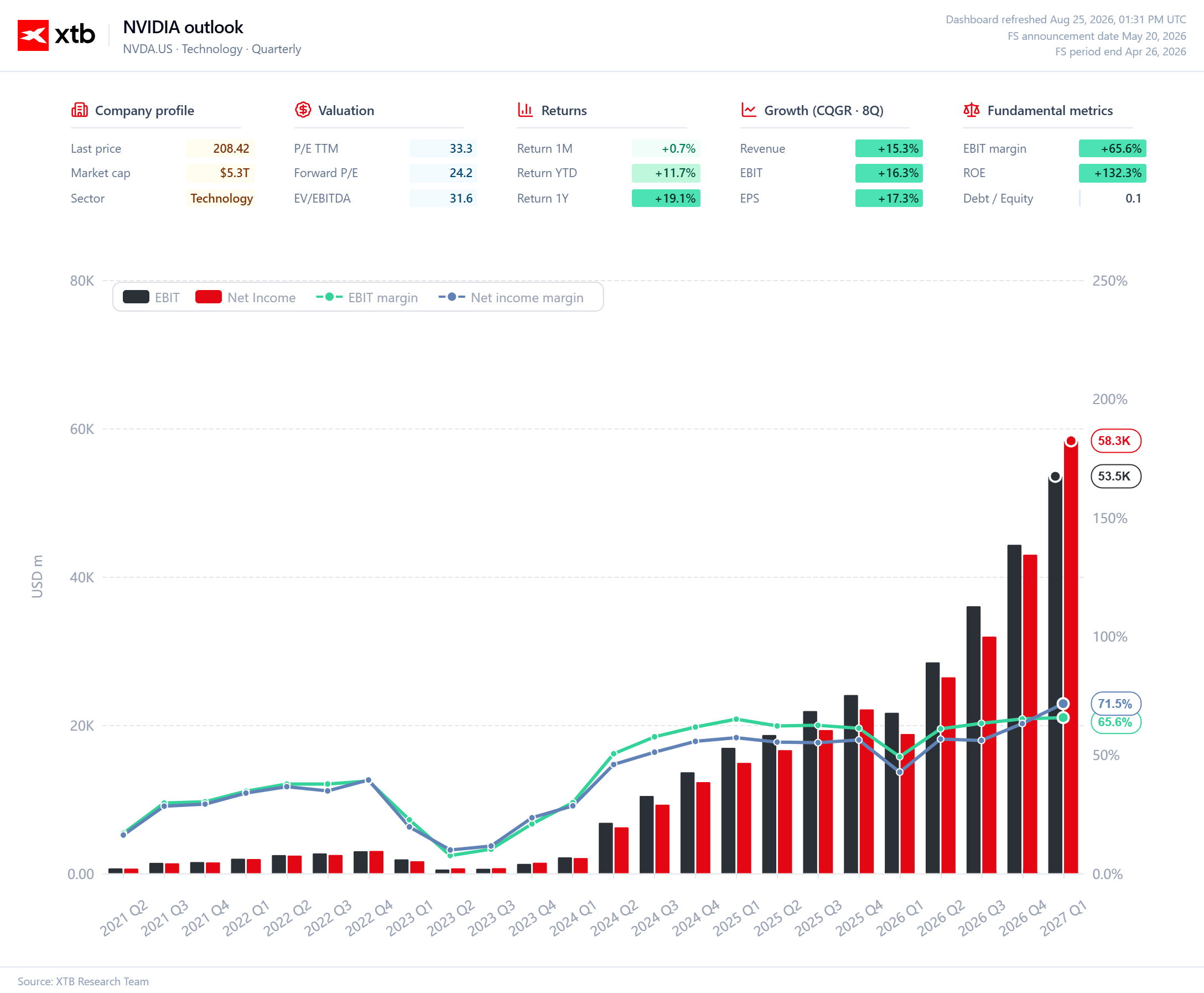
Nvidia can no longer simply grow. It must also maintain high profitability. Consensus assumes gross margins will remain very strong, although some decline from historical levels is expected in the coming years. For FY2027, Data Center gross margin is currently projected at around 76.6%.
This will be an important part of the report. If Nvidia simultaneously delivers very rapid revenue growth, maintains high margins, and continues investing heavily in product development, the market will have far fewer reasons to question the quality of that growth.
Nvidia Is Increasingly Expanding Beyond the Chip Business
The report will also provide an opportunity to assess Nvidia’s broader strategy. The company is increasingly positioning itself as a provider of complete AI infrastructure, spanning GPUs, CPUs, networking, server systems, and CUDA software.
Vera CPU could become another piece of this puzzle. According to the cited forecasts, CPU revenue could reach around $20 billion this year, with an estimated addressable market of roughly $200 billion.
This does not change the fact that GPUs remain the absolute center of Nvidia’s investment story. However, it shows that the company’s ambition is to control an increasingly large share of the infrastructure required to build “AI factories.” The more components customers purchase from a single supplier, the harder it becomes to later replace the entire architecture with solutions from AMD, Intel, or internally developed chips.
The Biggest Risk Is the Height of Expectations
Nvidia does not need to prove today that it is the leader in AI. The market already knows that. It needs to prove that its advantage will be large enough to sustain extraordinary growth in the years ahead.
That is why an ordinary beat could turn into a disappointment.
If Nvidia reports $92–93 billion in revenue but provides guidance for the next quarter that is only marginally above expectations, investors may conclude that the company delivered exactly what the market was already expecting. If, on the other hand, we see a result closer to $95 billion, very strong guidance around $107–108 billion, and concrete information on Rubin orders and deployment timelines, the situation will be very different.
That is why Nvidia needs to do more than simply beat expectations this time. It needs to beat them by enough to create new expectations for the future.
Key Takeaways
Nvidia faces one of the most important earnings reports of the entire current earnings season. Not because the market is worried about weak results. Quite the opposite: investors almost universally expect another record quarter. The problem is that a record quarter has become standard for Nvidia.
The bar has been set so high that a good result could be interpreted as a disappointment. Nvidia needs a very significant consensus beat, a clear upward revision to its outlook for the next quarter, and concrete information on orders and deployments of its latest chip generations.
Blackwell needs to confirm the strength of the current cycle, but Rubin must answer the question of what comes next. The market will want to see that the transition between generations is smooth, customers are already preparing for deployments, and Nvidia has enough orders to maintain its growth trajectory through 2027 and 2028.
Wednesday’s report, therefore, will be less of a test of whether Nvidia is still growing and more of a test of whether it can continue growing faster than the market has already priced in.
And that is precisely why, in Nvidia’s case, an ordinary beat could be a disappointment.
Source: xStation5


🚩 Caterpillar shares extend decline, down 30% from record high


Webull shares down 20% amid fears over potential China ties



US Open: Wall Street in the Red 🚩 Nasdaq Falls 1% From Record Highs, Constellation Brands Back at March 2020 Level



Market Wrap: Oil rises again, French fiscal concerns weigh on euro (07.10.2026)
The content of this report has been created by XTB S.A., with its registered office in Warsaw, at Prosta 67, 00-838 Warsaw, Poland, (KRS number 0000217580) and supervised by Polish Supervision Authority ( No. DDM-M-4021-57-1/2005). This material is a marketing communication within the meaning of Art. 24 (3) of Directive 2014/65/EU of the European Parliament and of the Council of 15 May 2014 on markets in financial instruments and amending Directive 2002/92/EC and Directive 2011/61/EU (MiFID II). Marketing communication is not an investment recommendation or information recommending or suggesting an investment strategy within the meaning of Regulation (EU) No 596/2014 of the European Parliament and of the Council of 16 April 2014 on market abuse (market abuse regulation) and repealing Directive 2003/6/EC of the European Parliament and of the Council and Commission Directives 2003/124/EC, 2003/125/EC and 2004/72/EC and Commission Delegated Regulation (EU) 2016/958 of 9 March 2016 supplementing Regulation (EU) No 596/2014 of the European Parliament and of the Council with regard to regulatory technical standards for the technical arrangements for objective presentation of investment recommendations or other information recommending or suggesting an investment strategy and for disclosure of particular interests or indications of conflicts of interest or any other advice, including in the area of investment advisory, within the meaning of the Trading in Financial Instruments Act of 29 July 2005 (i.e. Journal of Laws 2019, item 875, as amended). The marketing communication is prepared with the highest diligence, objectivity, presents the facts known to the author on the date of preparation and is devoid of any evaluation elements. The marketing communication is prepared without considering the client’s needs, his individual financial situation and does not present any investment strategy in any way. The marketing communication does not constitute an offer of sale, offering, subscription, invitation to purchase, advertisement or promotion of any financial instruments. XTB S.A. is not liable for any client’s actions or omissions, in particular for the acquisition or disposal of financial instruments, undertaken on the basis of the information contained in this marketing communication. In the event that the marketing communication contains any information about any results regarding the financial instruments indicated therein, these do not constitute any guarantee or forecast regarding the future results.