



Nvidia (NVDA.US) shares were down almost 2% after the earnings release, but gain almost 4% 1 hour and 10 minutes after the report as the company clearly beat expectations on both revenue and earnings per share and issued Q3 guidance above consensus. The report remains very strong. Markets also reacted positively to guidance from Nvidia CFO Colette Kress, who said the company expects revenue to grow by around 70% in fiscal 2028, corresponding to calendar 2027, compared with roughly 44% growth currently expected by investors.
Key facts from fiscal Q2 2027 results (Nvidia’s fiscal year is shifted by one year versus the calendar year) include:
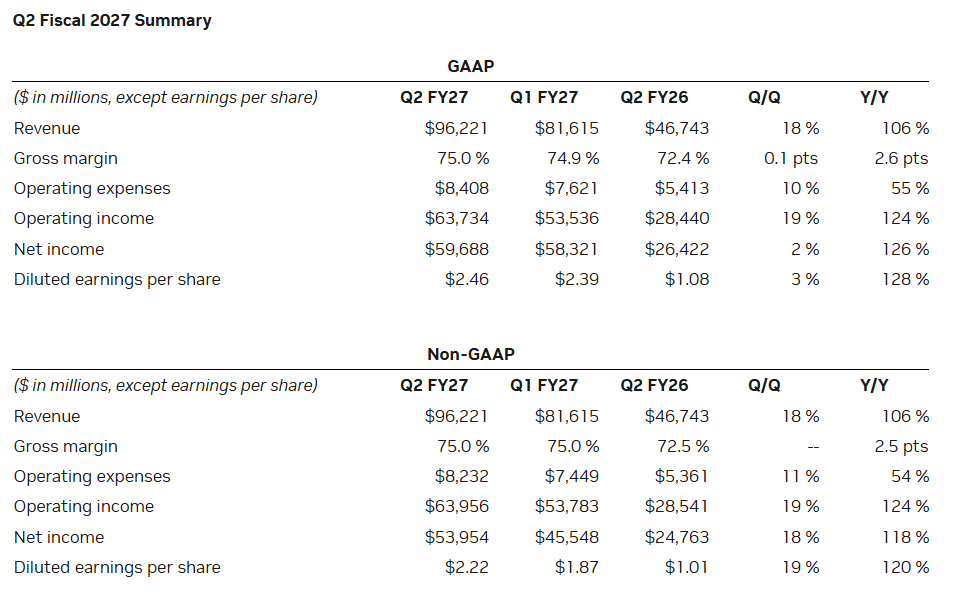
- Q2 revenue came in at $96.2 billion versus $92.2 billion expected, representing 106% y/y growth, while adjusted EPS reached $2.22 versus the $2.10 consensus and increased 120% y/y.
- Data Center revenue totaled $89 billion versus $85.8 billion expected, up 117% y/y, while Edge Computing generated $7.2 billion, rising 27% y/y.
- Adjusted gross margin came in at 75%, in line with consensus, compared with 72.4% a year ago, while adjusted operating income rose 124% y/y to $64 billion; adjusted net income reached $54 billion, up 118% from a year earlier.
- Nvidia expects Q3 revenue of $108.0 billion versus the $104.2 billion consensus and sees adjusted gross margin at 74% plus or minus 0.5 percentage points; operating expenses are expected to be around $9.0 billion.
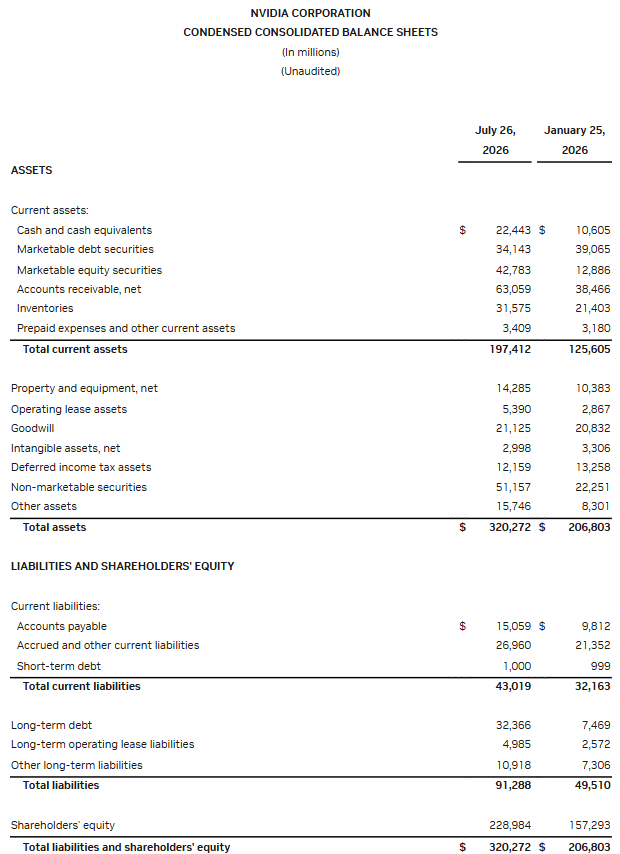
- Free cash flow reached $21.3 billion, cash and cash equivalents stood at $22.4 billion, while short-term and long-term debt amounted to $1 billion and $32.4 billion, respectively.
- Nvidia returned around $26 billion to shareholders in Q2, while approximately $99 billion remains authorized under its capital return program.
- Vera Rubin is already ramping into full production, with the first racks operating at partners; management also stressed that the AI infrastructure buildout remains in full swing and should continue to be one of the main drivers of the company’s next growth phase.
- Nvidia increased its purchase commitments from $119 billion to $279 billion, mainly for memory, as it moves to secure the components needed to meet demand over the coming years.
- The company assumes no Data Center compute revenue from China in its Q3 outlook, meaning the guidance is effectively based almost entirely on demand from other markets.
- At the end of Q2, Nvidia still had around $99 billion remaining under its authorized share repurchase program and will pay its next quarterly dividend of $0.25 per share on October 1, 2026, to shareholders of record as of September 10.
- GPUs for Ports-Pike, a massive planned data-center and AI infrastructure campus in Ohio being developed with OpenAI, could represent around $150–200 billion in revenue, while the project’s total infrastructure could include approximately 1.5 million GPUs.
- Nvidia expects to transfer some Data Center leases to third parties, while Data Center lease agreements typically have terms of around 15 years. Net gains from equity securities amounted to $7.8 billion.
What do the results and management commentary tell us?
Nvidia continues to stand out for the scale of its operating leverage: revenue grew 106% y/y, but operating income increased by as much as 124% and net income by 126%, showing that additional sales are translating into earnings faster than costs are rising. Gross margin remained around 75%, virtually unchanged q/q despite the enormous scale of growth, while also coming in roughly 2.5–2.6 percentage points higher than a year ago, confirming a still-strong product mix and pricing power.
Operating expenses are still worth watching, however, as they are rising by more than 50% y/y. For now, they are easily absorbed by explosive revenue growth, but in a slowdown they could begin to weigh on margins. Gross margin increased year over year, helped in part by Blackwell Ultra. Nvidia also said it will be shipping both Blackwell and Rubin systems in the coming quarters, although it is still experiencing “certain supply constraints.”
The company also disclosed that in August it signed memoranda of understanding with major capital providers to create independent financing platforms aimed at mobilizing more than $500 billion of third-party capital for AI infrastructure. The further expansion of Nvidia’s ecosystem is therefore increasingly based not only on selling chips, but also on financing entire data-center projects. At the same time, the company recorded a $0.4 billion charge in the first half of the year related to excess H200 inventory and purchase obligations after demand weakened. Customer concentration is another factor worth monitoring: three direct customers accounted for 44% of total revenue, which remains a meaningful risk at this scale.
Nvidia and Amazon Web Services plan to deploy an additional 2 million Nvidia GPUs across AWS’s global infrastructure in 2027 and 2028, primarily for agentic and physical AI. The cooperation is also expected to include data centers for the U.S. government, with 100,000 GPUs running on “secure AWS infrastructure.” Nvidia expects its so-called neocloud partners to end the year with around 8 GW of total installed capacity, enough to power roughly 6 million households.
Source: Nvidia Q2 Fiscal 2027 Earnings Report
Looking at the balance sheet, the most striking feature is the enormous increase in assets: total assets rose from $206.8 billion to $320.3 billion in just six months, mainly due to higher receivables, inventories and securities, showing how rapidly Nvidia is scaling the business and, to some extent, tying up more capital in operations. At the same time, long-term debt increased from $7.5 billion to $32.4 billion, but with shareholders’ equity of around $229 billion and very strong liquidity, this does not currently look problematic. Inventories increased from $21.4 billion to $31.6 billion, while receivables rose from $38.5 billion to $63.1 billion. If sales growth were to slow, these are likely to be among the first areas where signs of weaker cash-flow quality could emerge.
Source: Nvidia Q2 Fiscal 2027 Earnings Report
Nvidia’s earnings and revenue keep growing, and they have been doing so for years
Nvidia is now operating at a scale that would have been difficult to imagine just a few years ago: revenue rose 106% y/y to $96.2 billion, Data Center revenue increased 117% to $89.0 billion, and hyperscaler revenue jumped nearly 29% q/q, confirming that the largest cloud platforms are still aggressively expanding AI infrastructure. At the same time, the company is not only growing, but doing so at even higher profitability. Gross margin reached 75% and operating margin 66.2%, with both improving year over year. Revenue is growing much faster than operating expenses, highlighting Nvidia’s powerful operating leverage and still very strong pricing power.
The increase in purchase commitments, from roughly $120 billion to around $280 billion, mainly related to memory, means the company is effectively reserving a huge portion of its future supply chain well in advance. This does not represent an immediate cash outflow, but over the coming quarters it should translate into higher payments to suppliers, greater working-capital requirements and potentially weaker conversion of earnings into free cash flow if revenue growth were to slow. Ultimately, however, Nvidia’s results confirm that the AI investment boom still rests on strong business fundamentals and remains firmly intact, even if chip stocks and related sectors have recently lost some momentum.
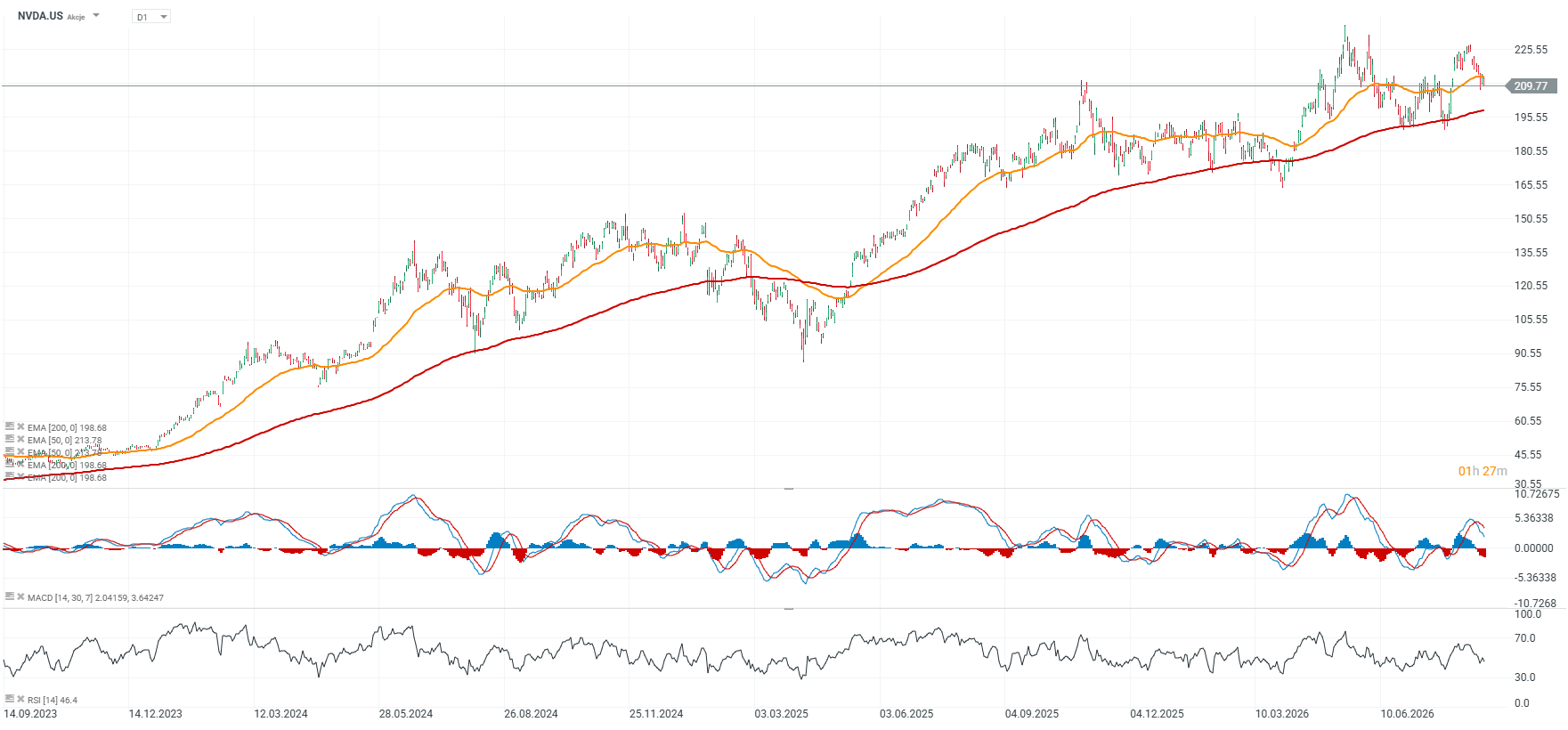
Nvidia stock chart (NVDA.US, D1 interval)
Nvidia shares are trading back near $220 after the earnings release, reversing an initial decline of almost 2%. About 1 hour and 10 minutes after the report, the stock has moved into positive territory, although the final market reaction is still far from settled. From a technical perspective, the setup remains somewhat challenging for bulls unless the stock can decisively break above the $214–215 area tomorrow, while the region around $226 may still form a potential double top. The price had previously struggled to hold above the 50-day EMA, so a renewed sell-off could bring the 200-day EMA, located around $198–200, back into focus. On the other hand, a sustained move above $215 would improve the technical picture and could reopen the path toward a retest of the all-time high.
Source: xStation5
Free cash flow, inventories, ROIC and Nvidia’s valuation
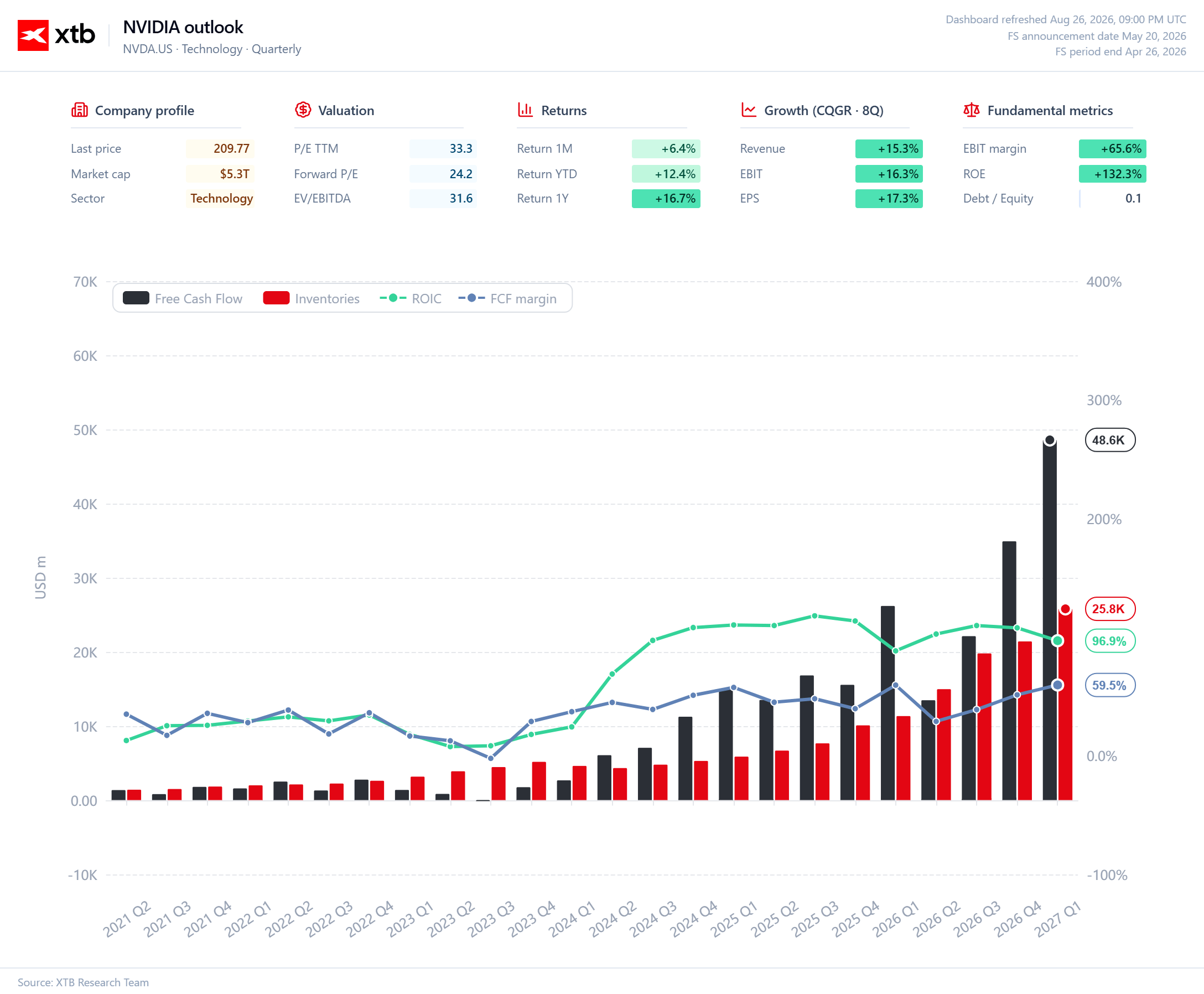
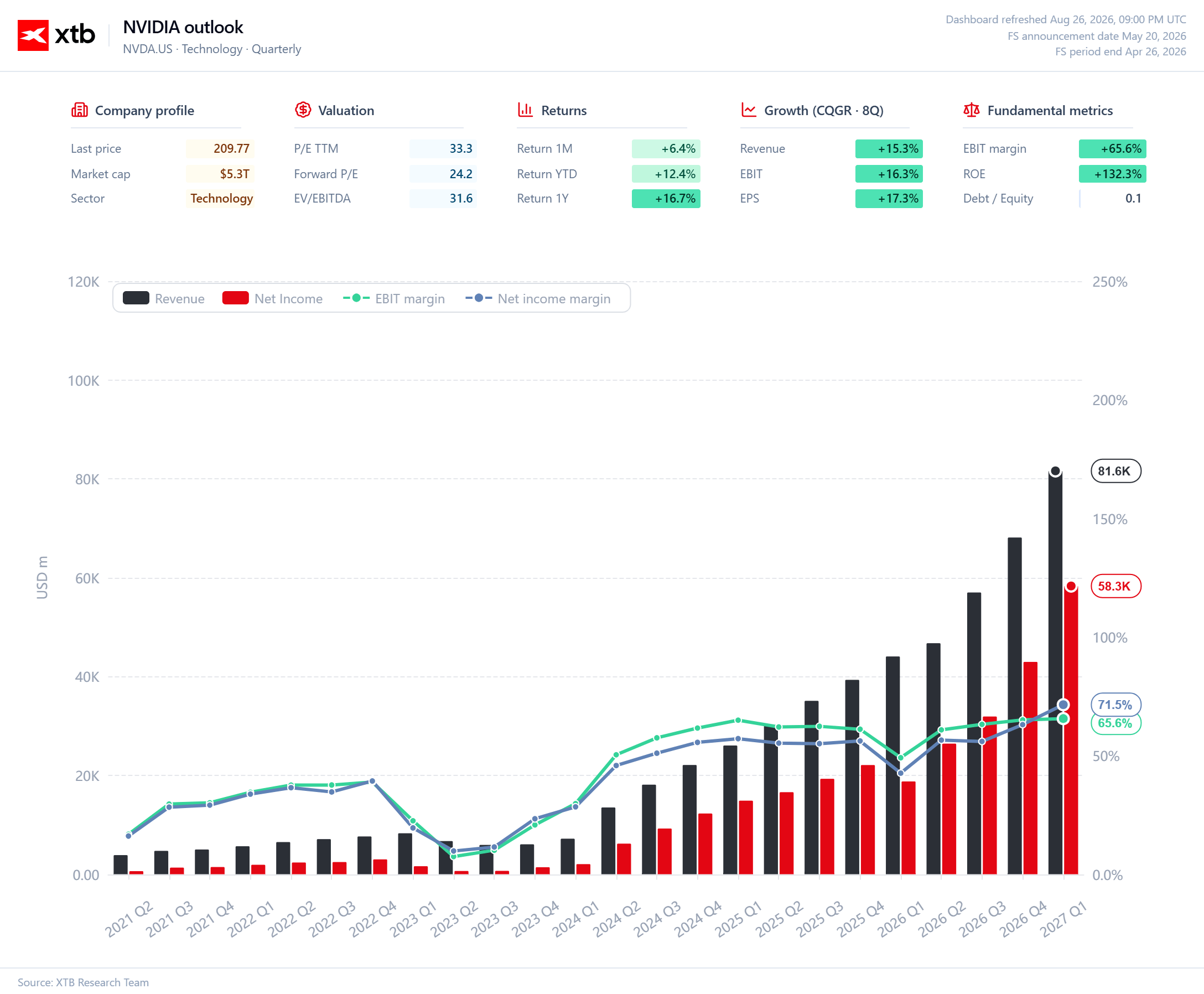
The key point is that Nvidia is now generating enormous free cash flow while maintaining an exceptionally high ROIC of around 97%, highlighting the efficiency with which it deploys capital. FCF has risen to around $48.6 billion and the FCF margin to roughly 59.5%, even as inventories increased to about $25.8 billion alongside the rapid scaling of the business. Inventory growth is not yet a problem, but in the event of slower sales it could weigh on working capital and weaken earnings-to-cash conversion. Valuation remains demanding: trailing P/E stands at around 33.3x, while forward P/E is about 24.2x, slightly above the Nasdaq 100 average, with EV/EBITDA at roughly 31.6x, meaning the market is still pricing in very strong earnings growth. Fundamentally, Nvidia remains an exceptionally strong business, but it must not only continue growing, it also needs to sustain very high margins and returns on capital. So far, it is doing exactly that.
Source: XTB Research
Revenue, net income and margins
The second chart shows that Nvidia’s rising valuation has been driven primarily by an explosion in actual financial performance, rather than simply by multiple expansion. Revenue and net income have grown exceptionally quickly in recent years, while the EBIT margin stands at around 65.6%, an unusually high level for a hardware business. This reflects a combination of strong pricing power, massive demand for AI accelerators and significant operating leverage. At the same time, such high profitability becomes a risk in itself, as the room for further margin expansion is limited and even modest margin compression could have a meaningful impact on future earnings. The key question today is therefore not whether Nvidia is an exceptional business, but how long it can sustain this level of growth and profitability.
Source: XTB Research
Eryk Szmyd XTB Financial Markets Analyst


🚩 Caterpillar shares extend decline, down 30% from record high


Webull shares down 20% amid fears over potential China ties



US Open: Wall Street in the Red 🚩 Nasdaq Falls 1% From Record Highs, Constellation Brands Back at March 2020 Level



Market Wrap: Oil rises again, French fiscal concerns weigh on euro (07.10.2026)
The content of this report has been created by XTB S.A., with its registered office in Warsaw, at Prosta 67, 00-838 Warsaw, Poland, (KRS number 0000217580) and supervised by Polish Supervision Authority ( No. DDM-M-4021-57-1/2005). This material is a marketing communication within the meaning of Art. 24 (3) of Directive 2014/65/EU of the European Parliament and of the Council of 15 May 2014 on markets in financial instruments and amending Directive 2002/92/EC and Directive 2011/61/EU (MiFID II). Marketing communication is not an investment recommendation or information recommending or suggesting an investment strategy within the meaning of Regulation (EU) No 596/2014 of the European Parliament and of the Council of 16 April 2014 on market abuse (market abuse regulation) and repealing Directive 2003/6/EC of the European Parliament and of the Council and Commission Directives 2003/124/EC, 2003/125/EC and 2004/72/EC and Commission Delegated Regulation (EU) 2016/958 of 9 March 2016 supplementing Regulation (EU) No 596/2014 of the European Parliament and of the Council with regard to regulatory technical standards for the technical arrangements for objective presentation of investment recommendations or other information recommending or suggesting an investment strategy and for disclosure of particular interests or indications of conflicts of interest or any other advice, including in the area of investment advisory, within the meaning of the Trading in Financial Instruments Act of 29 July 2005 (i.e. Journal of Laws 2019, item 875, as amended). The marketing communication is prepared with the highest diligence, objectivity, presents the facts known to the author on the date of preparation and is devoid of any evaluation elements. The marketing communication is prepared without considering the client’s needs, his individual financial situation and does not present any investment strategy in any way. The marketing communication does not constitute an offer of sale, offering, subscription, invitation to purchase, advertisement or promotion of any financial instruments. XTB S.A. is not liable for any client’s actions or omissions, in particular for the acquisition or disposal of financial instruments, undertaken on the basis of the information contained in this marketing communication. In the event that the marketing communication contains any information about any results regarding the financial instruments indicated therein, these do not constitute any guarantee or forecast regarding the future results.