


- The RBNZ kept the OCR rate at 2.25%, but the message was clearly more hawkish than in February.
- Inflation is already at 3.1%, and the central bank forecasts 3.0% in Q1 2026 and a rise to 4.2% in Q2 2026, mainly due to higher fuel and transport costs.
- At the same time, economic growth in New Zealand remains weak, with GDP increasing only 0.2% in Q4 2025, so the bank is trying to avoid tightening monetary policy too early.
- NZDUSD was also influenced by geopolitical developments, including the US–Iran ceasefire, which weakened the dollar and supported pro-cyclical currencies such as the NZD.

- The RBNZ kept the OCR rate at 2.25%, but the message was clearly more hawkish than in February.
- Inflation is already at 3.1%, and the central bank forecasts 3.0% in Q1 2026 and a rise to 4.2% in Q2 2026, mainly due to higher fuel and transport costs.
- At the same time, economic growth in New Zealand remains weak, with GDP increasing only 0.2% in Q4 2025, so the bank is trying to avoid tightening monetary policy too early.
- NZDUSD was also influenced by geopolitical developments, including the US–Iran ceasefire, which weakened the dollar and supported pro-cyclical currencies such as the NZD.
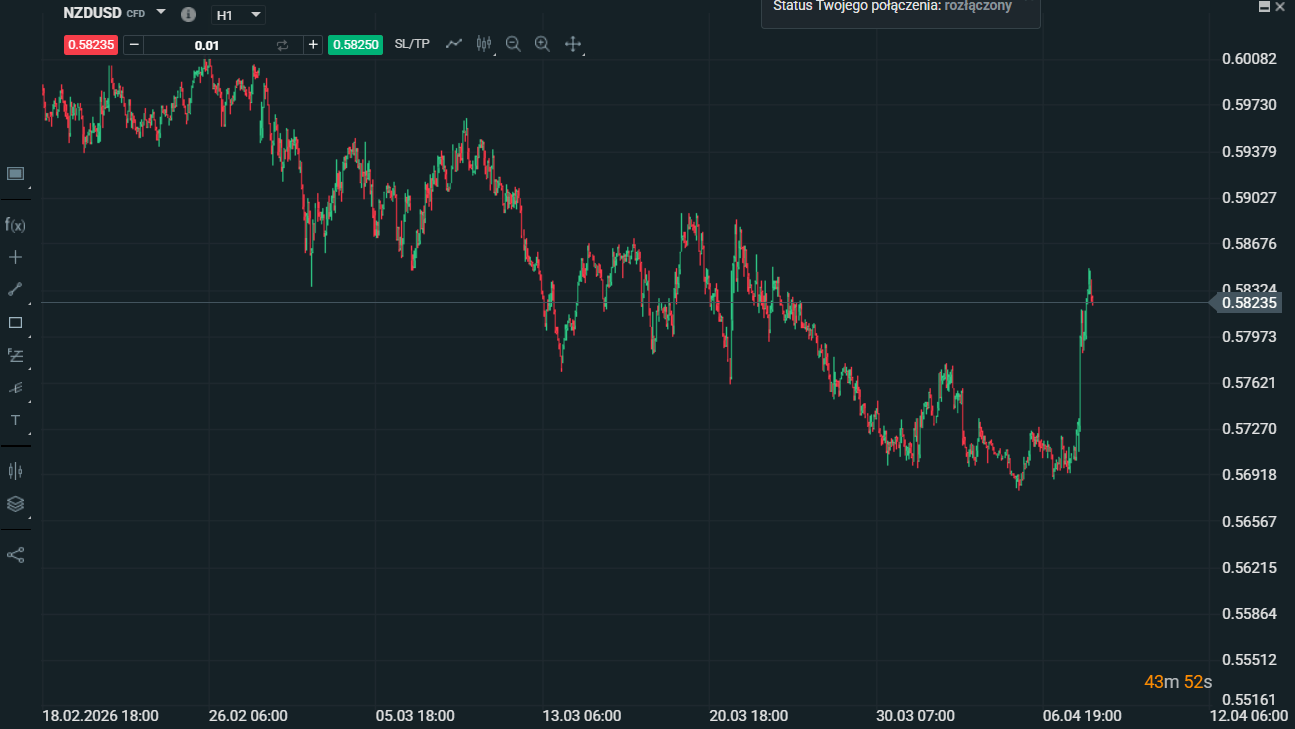
NZDUSD gained as much as 2.00% following the RBNZ decision, supported both by the more hawkish tone of the central bank and the global move after the de-escalation of US–Iran tensions. The kiwi reached around 0.5844 (currently 0.5824). Investors interpreted the decision as a hawkish pause. The RBNZ emphasized that if inflationary pressure spreads beyond energy and begins to affect wages, pricing behavior, or inflation expectations, decisive and rapid rate hikes may be necessary.
The core message from the RBNZ is that the inflation outlook has worsened, even if growth conditions have not improved. The bank indicated that the conflict in the Middle East has significantly altered the outlook through supply chain disruptions and rising oil and fuel prices, which will translate into higher inflation in the short term. Official forecasts point to inflation at 3.0% in March and 4.2% in June, above the 1–3% target range, with key transmission channels including transport, airfares, and food.
At the same time, the RBNZ does not want to overreact to what may be a temporary supply shock. The bank stressed that the situation differs from 2022, as demand in the economy is currently much weaker and spare capacity should limit second-round inflation effects. This is important because domestic activity remains weak: GDP growth is minimal, financial conditions have tightened, and mortgage rates have increased. In other words, the RBNZ faces a difficult trade-off between rising inflation and a still fragile recovery.
Therefore, the decision was perceived as hawkish despite no rate hike. The committee considered more preemptive action to prevent inflation expectations from becoming unanchored but ultimately chose to wait for more data. There are also growing expectations that July could be the first possible timing for rate hikes if inflation pressures persist.
The market backdrop further strengthened the NZD move. The two-week US–Iran ceasefire triggered a strong risk-on move — US500 futures rose around 2.5%, oil prices declined, and the dollar weakened. This supported cyclical currencies, with the NZD standing out thanks to an additional domestic catalyst. At the time of writing, NZDUSD is gaining 1.67%.



Daily Summary: Investors Concerns Rise Ahead of Earnings Season


European gas at its highest level in 3 years🚨


US OPEN: Wall Street under pressure from oil and semiconductors


📊Market Wrap: Europe Rebouns Despite Higher Oil and Dollar (12.10.2026)
The content of this report has been created by XTB S.A., with its registered office in Warsaw, at Prosta 67, 00-838 Warsaw, Poland, (KRS number 0000217580) and supervised by Polish Supervision Authority ( No. DDM-M-4021-57-1/2005). This material is a marketing communication within the meaning of Art. 24 (3) of Directive 2014/65/EU of the European Parliament and of the Council of 15 May 2014 on markets in financial instruments and amending Directive 2002/92/EC and Directive 2011/61/EU (MiFID II). Marketing communication is not an investment recommendation or information recommending or suggesting an investment strategy within the meaning of Regulation (EU) No 596/2014 of the European Parliament and of the Council of 16 April 2014 on market abuse (market abuse regulation) and repealing Directive 2003/6/EC of the European Parliament and of the Council and Commission Directives 2003/124/EC, 2003/125/EC and 2004/72/EC and Commission Delegated Regulation (EU) 2016/958 of 9 March 2016 supplementing Regulation (EU) No 596/2014 of the European Parliament and of the Council with regard to regulatory technical standards for the technical arrangements for objective presentation of investment recommendations or other information recommending or suggesting an investment strategy and for disclosure of particular interests or indications of conflicts of interest or any other advice, including in the area of investment advisory, within the meaning of the Trading in Financial Instruments Act of 29 July 2005 (i.e. Journal of Laws 2019, item 875, as amended). The marketing communication is prepared with the highest diligence, objectivity, presents the facts known to the author on the date of preparation and is devoid of any evaluation elements. The marketing communication is prepared without considering the client’s needs, his individual financial situation and does not present any investment strategy in any way. The marketing communication does not constitute an offer of sale, offering, subscription, invitation to purchase, advertisement or promotion of any financial instruments. XTB S.A. is not liable for any client’s actions or omissions, in particular for the acquisition or disposal of financial instruments, undertaken on the basis of the information contained in this marketing communication. In the event that the marketing communication contains any information about any results regarding the financial instruments indicated therein, these do not constitute any guarantee or forecast regarding the future results.