



Salesforce (CRM.US) shares gained around 12% in after-hours trading following results that highlighted two key trends: the core SaaS business is still growing, while AI is becoming an increasingly meaningful contributor to revenue. The company slightly beat revenue expectations, significantly exceeded the EPS consensus and raised its full-year guidance. Even more importantly, Agentforce is growing faster than it was a quarter ago, while backlog remains elevated. For months, the market has been debating whether generative AI could undermine traditional software business models. For now, this report suggests that Salesforce is trying to use AI to expand its own ecosystem rather than becoming a victim of the technological shift. That said, the improvement in operations should be separated from one-off investment effects, as part of the jump in profit came from Salesforce’s stake in Anthropic.
- Fiscal Q2 revenue came in at $11.35 billion versus $11.32 billion expected and rose 11% y/y.
- Adjusted EPS reached $5.90 versus the $3.27 consensus, while net income increased 87% y/y to $3.53 billion.
- Salesforce booked a $2.6 billion gain on strategic investments, mainly due to the increase in value of its Anthropic stake.
- Free cash flow rose 81% y/y to $1.10 billion versus roughly $643 million expected by the market.
- Annualized revenue from Agentforce exceeded $1.5 billion and grew 240% y/y.
- Current remaining performance obligations came in at $33.5 billion versus $33.22 billion expected.
- For Q3, Salesforce expects revenue of $11.42–11.50 billion and adjusted EPS of $3.42–3.44, both slightly above consensus.
- Full-year revenue guidance was raised to $46.1–46.4 billion from the previous $45.9–46.2 billion range.
AI is becoming a measurable business for Salesforce
The most important part of the report, in my view, is Agentforce. Annualized revenue from Salesforce’s AI products exceeded $1.5 billion and grew 240% year over year, faster than in the previous quarter. It is still a relatively small part of the overall Salesforce business, but the growth rate is strong enough to change how investors may think about the company.
What is even more interesting is that Salesforce is not trying to build everything on its own. The new Claude plugin is designed to allow Anthropic’s AI agents to draft emails, update records and use data stored inside Salesforce systems. This could become an important strategic direction: instead of competing directly with foundation models, Salesforce is trying to make its CRM platform the data and workflow layer on which those models operate.
Benioff said directly that he does not see any “SaaSpocalypse.” For now, the numbers give him some support. Revenue is still growing at a double-digit rate, backlog remains solid and the AI business is accelerating, although management also acknowledged that integration and analytics products are still facing some “headwinds and volatility.”
Results and guidance are strong, but the profit figure requires some caution
The largest beat came on EPS, but this is where the numbers need to be interpreted carefully. Salesforce earned around $2.6 billion from strategic investments, mainly because of the rising value of its Anthropic stake, so part of the improvement in profitability did not come directly from the core operating business. On the other hand, free cash flow increased as much as 81% to $1.10 billion, which means the improvement in business quality is not simply an accounting effect caused by asset revaluation. For me, cash flow is a more important signal than the headline EPS figure because it shows that Salesforce is still generating more cash even while investing in AI and new products.
Backlog also remains strong. Current RPO reached $33.5 billion and exceeded expectations, suggesting that subscription demand remains relatively stable. This is not the kind of growth seen among AI infrastructure companies, but for a large and mature software company it is still a solid result. Salesforce raised its full-year revenue outlook to $46.1–46.4 billion, with the midpoint implying growth of around 11%. For Q3, management expects revenue of $11.42–11.50 billion and adjusted EPS of $3.42–3.44, both modestly above Wall Street forecasts.
This could matter a lot for sentiment because, before the report, Salesforce shares were down around 22% year to date, while the S&P 500 was up roughly 12%. The market had been pricing in the risk that generative AI would weaken traditional SaaS businesses and erode their pricing power. This report points to the opposite scenario: Salesforce may be able to use AI to increase the value of its platform and improve monetization across its existing customer base.
There are also new contracts and acquisitions to consider. The company won a $1.6 billion contract from the U.S. Department of Veterans Affairs, while the $3.6 billion acquisition of Fin is now expected to close earlier than originally planned. These developments do not change the investment case overnight, but they strengthen the picture of a company that is still able to add new growth drivers. The key question now is whether AI can help Salesforce reaccelerate growth after years of maturation in the traditional SaaS model.
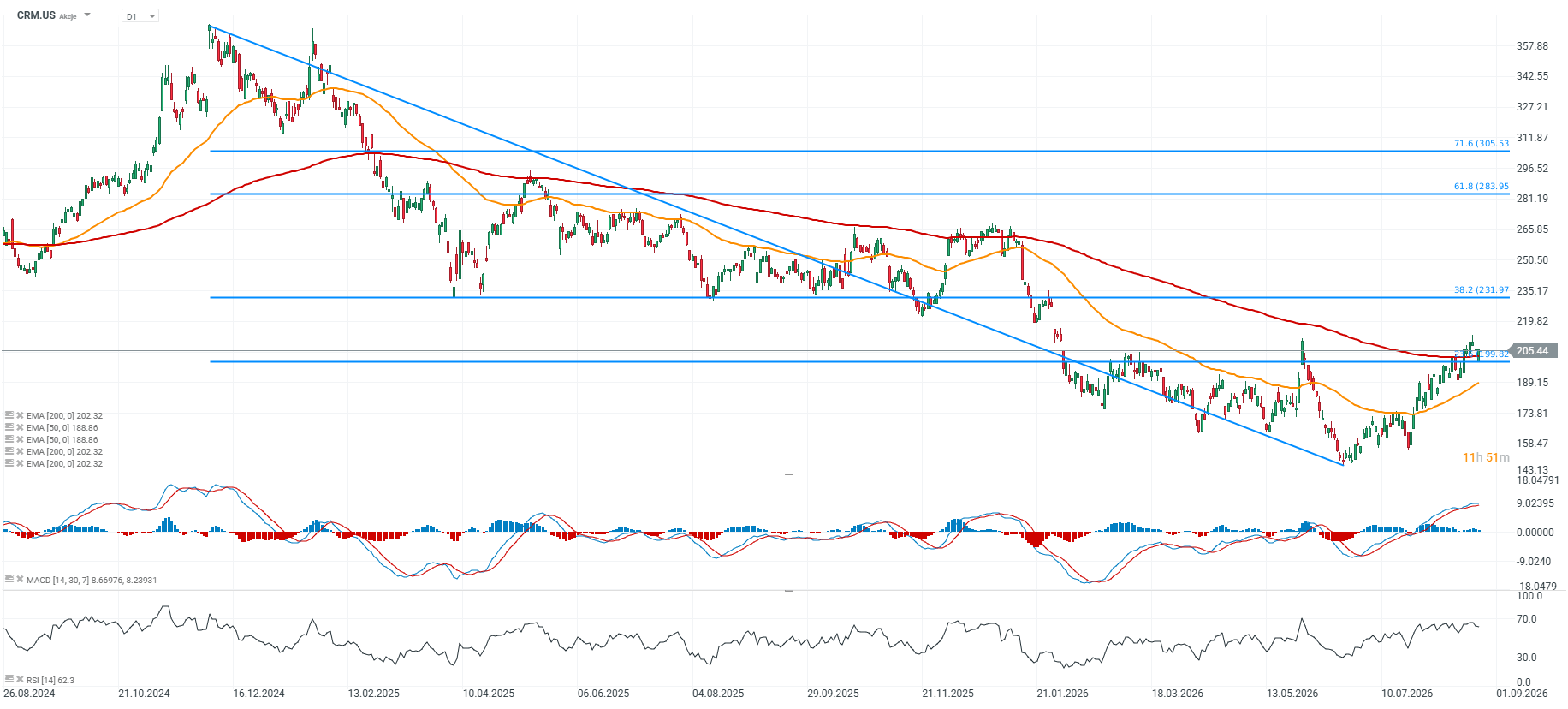
Salesforce stock chart (D1 interval)
Looking at Salesforce shares, the stock had been “fighting” with the 200-day EMA before earnings, trying to break above it and reverse the broader downtrend. After the report, the stock is trading near $226, suggesting a return of buyers and a possible trend reversal if shares manage to close today above $205. That level is also supported by the 23.6% Fibonacci retracement of the latest downward impulse.
 Source: xStation5
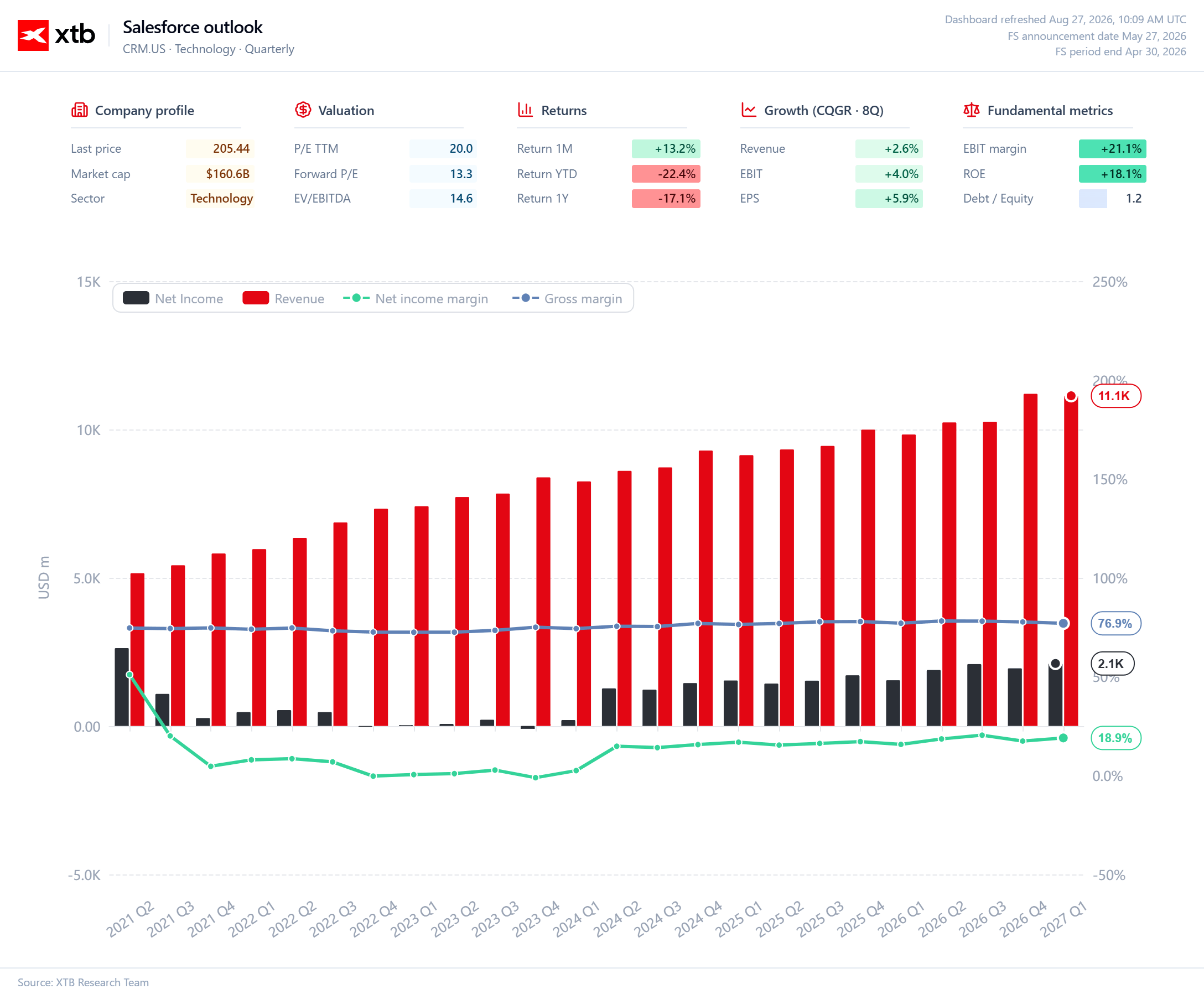
Revenue, net income, margins and valuation
Salesforce remains a much slower-growth business than the leaders of the AI infrastructure boom, but it is increasingly improving the quality of its earnings and profitability. Revenue continues to grow steadily, while net income has accelerated faster than sales in recent quarters, reflected in the gradual improvement in net margin to around 18.9% and the maintenance of a high gross margin near 76.9%. This matters because, in a maturing SaaS model, further value creation increasingly depends on margin expansion, cost discipline and better monetization of the existing customer base rather than top-line growth alone. Valuation also looks relatively reasonable: trailing P/E is around 20x, while forward P/E is approximately 13.3x, suggesting that the market expects further earnings growth but is not assigning Salesforce the kind of multiples typically seen in the most aggressive high-growth technology names. The gap between forward and trailing P/E is especially important because it shows that consensus expectations point to a meaningful improvement in earnings over the next 12 months. If Agentforce can genuinely accelerate AI monetization without damaging margins, the current valuation may prove less demanding than the stock’s weak year-to-date performance would suggest.
 Source: XTB Research
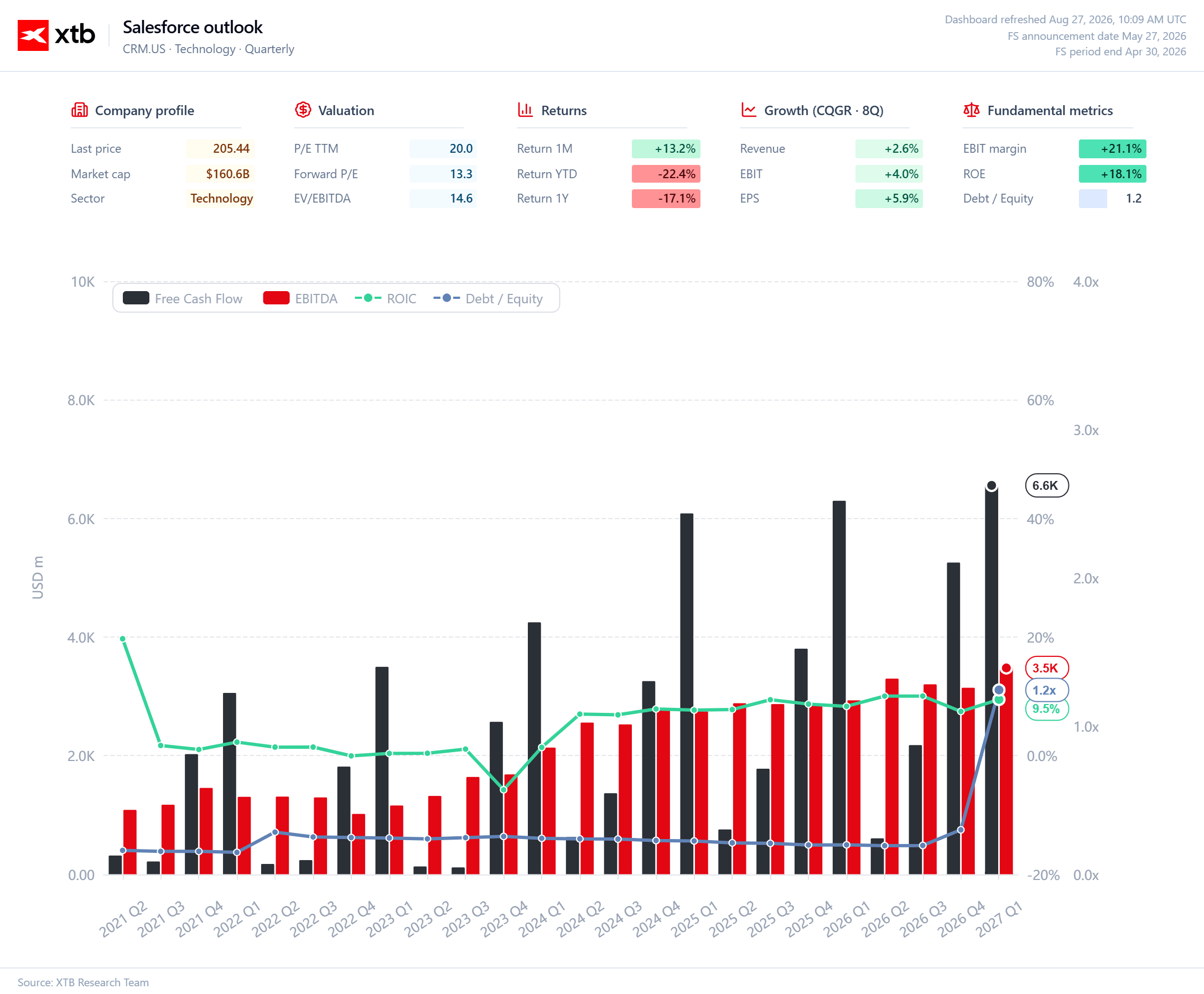
Free cash flow, EBITDA, ROIC and debt
The second chart shows that one of Salesforce’s biggest strengths remains its ability to generate large and growing cash flows even with only moderate revenue growth. Free cash flow stands at around $6.6 billion, while EBITDA has risen to roughly $3.5 billion, confirming better operating efficiency and stronger conversion of the business into cash. ROIC at around 9.5% is not spectacular, but it is more stable than it was several years ago and suggests that the company is gradually improving capital efficiency after a period of large acquisitions. Debt/Equity at around 1.2x is worth watching, however, as leverage is now meaningfully higher than a few quarters ago and limits some balance-sheet flexibility. With a forward P/E of around 13.3x and EV/EBITDA of approximately 14.6x, the market is not valuing Salesforce as a high-growth company, but rather as a mature software business with an option for renewed acceleration through AI. For investors, the key issue will therefore be not only continued FCF growth, but also whether Agentforce and the Anthropic integration can lift ROIC and revenue growth without requiring another aggressive increase in leverage.
Source: XTB Research


🚩 Caterpillar shares extend decline, down 30% from record high


Webull shares down 20% amid fears over potential China ties



US Open: Wall Street in the Red 🚩 Nasdaq Falls 1% From Record Highs, Constellation Brands Back at March 2020 Level



Market Wrap: Oil rises again, French fiscal concerns weigh on euro (07.10.2026)
The content of this report has been created by XTB S.A., with its registered office in Warsaw, at Prosta 67, 00-838 Warsaw, Poland, (KRS number 0000217580) and supervised by Polish Supervision Authority ( No. DDM-M-4021-57-1/2005). This material is a marketing communication within the meaning of Art. 24 (3) of Directive 2014/65/EU of the European Parliament and of the Council of 15 May 2014 on markets in financial instruments and amending Directive 2002/92/EC and Directive 2011/61/EU (MiFID II). Marketing communication is not an investment recommendation or information recommending or suggesting an investment strategy within the meaning of Regulation (EU) No 596/2014 of the European Parliament and of the Council of 16 April 2014 on market abuse (market abuse regulation) and repealing Directive 2003/6/EC of the European Parliament and of the Council and Commission Directives 2003/124/EC, 2003/125/EC and 2004/72/EC and Commission Delegated Regulation (EU) 2016/958 of 9 March 2016 supplementing Regulation (EU) No 596/2014 of the European Parliament and of the Council with regard to regulatory technical standards for the technical arrangements for objective presentation of investment recommendations or other information recommending or suggesting an investment strategy and for disclosure of particular interests or indications of conflicts of interest or any other advice, including in the area of investment advisory, within the meaning of the Trading in Financial Instruments Act of 29 July 2005 (i.e. Journal of Laws 2019, item 875, as amended). The marketing communication is prepared with the highest diligence, objectivity, presents the facts known to the author on the date of preparation and is devoid of any evaluation elements. The marketing communication is prepared without considering the client’s needs, his individual financial situation and does not present any investment strategy in any way. The marketing communication does not constitute an offer of sale, offering, subscription, invitation to purchase, advertisement or promotion of any financial instruments. XTB S.A. is not liable for any client’s actions or omissions, in particular for the acquisition or disposal of financial instruments, undertaken on the basis of the information contained in this marketing communication. In the event that the marketing communication contains any information about any results regarding the financial instruments indicated therein, these do not constitute any guarantee or forecast regarding the future results.