



One of the key investors and presumed beneficiaries of the AI boom, Japan’s SoftBank, has published its results for Q2 2026.
Despite revenue growth above expectations, the share price fell clearly after the release, with losses exceeding 4%. The reason was a significant deterioration not only in headline profits, but also in their quality.
SoftBank technical analysis (D1)
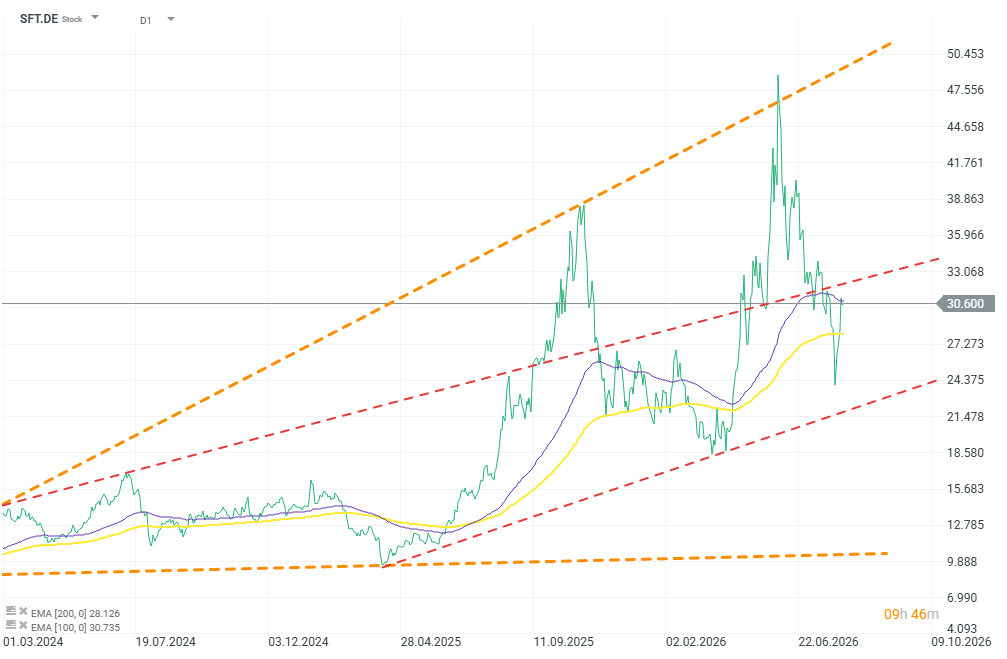
Despite very volatile valuations, the uptrend has been maintained. Demand managed to return quickly above the EMA200 during the last two corrections. Source: xStation5
Financial data
- Revenue: JPY 2.02 trillion vs. expectations of about JPY 1.92 trillion. Over 10% YoY growth.
- Gross profit: Increased to JPY 1.05 trillion, above expectations of ~JPY 955 billion, also up by about 10% YoY.
- Net profit: This is where the company showed weakness, and more than once. It fell to JPY 347.3 billion from JPY 421.8 billion a year earlier, a decline of more than 17%.
The devil is in the details
Valuation and estimating “true” profit relative to valuation are particularly difficult for investment companies such as SoftBank. The fact that the company invests in, or at least tries to gain exposure to, “AI” does not make this task any easier.
Even so, breaking the result down into components tells a story of increasingly poorer-quality profits.
The biggest issue is a massive increase in selling/administrative costs and in expenses related to currency moves. Selling and administrative costs rose nearly 70% YoY to as much as JPY 1.28 trillion, while financial costs doubled to JPY 328 billion.
SoftBank’s profits are currently caught in the crossfire:
- On one side, the company bears the full burden of its business strategy, including rising costs in the “AI Computing” segment.
- On the other side, due to extreme yen volatility, hedging costs are pressuring margins and returns. This is reflected in revenue in the segment mentioned above, which rose as much as 30% in USD terms, but only 17% in yen.
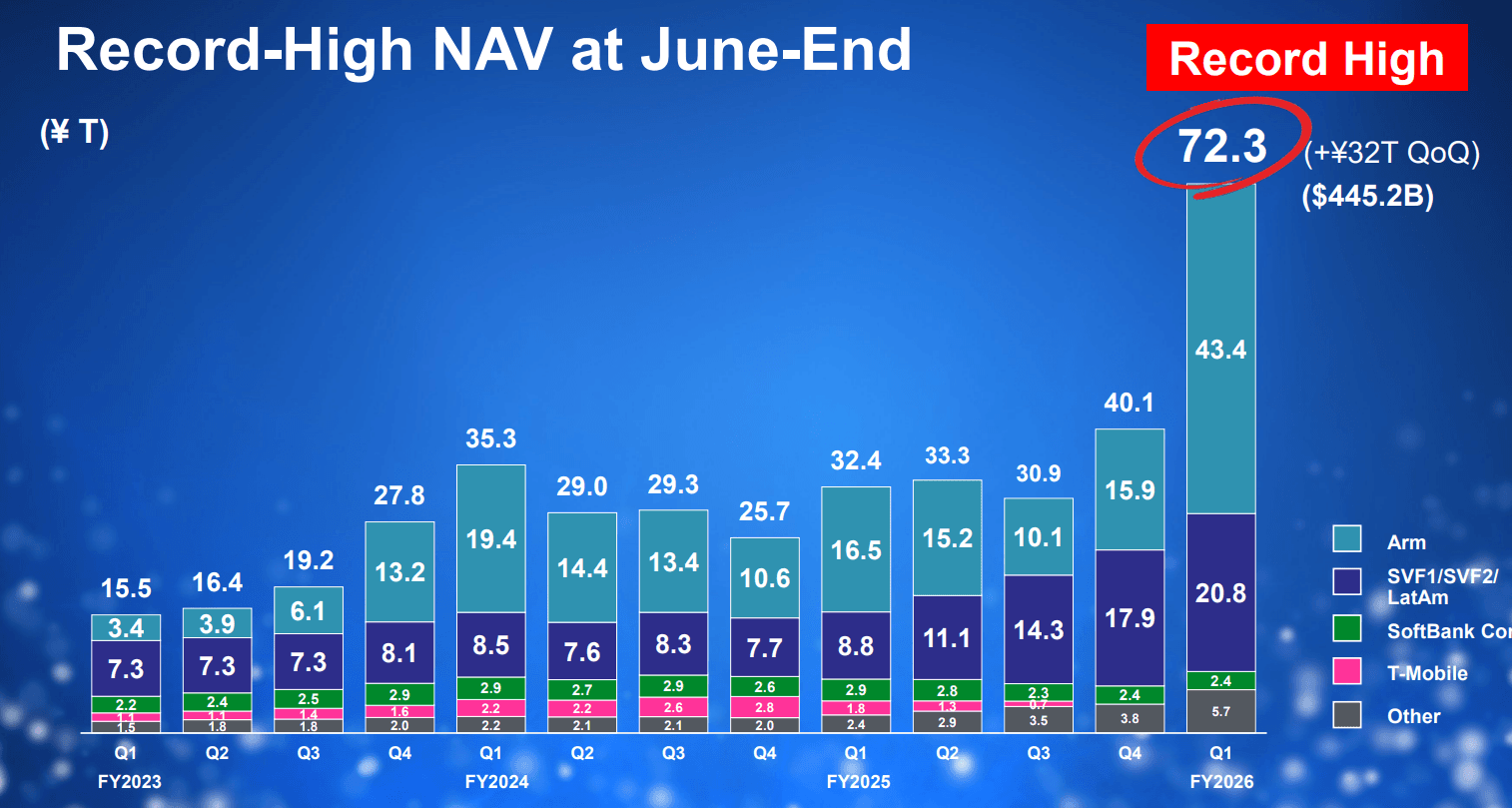
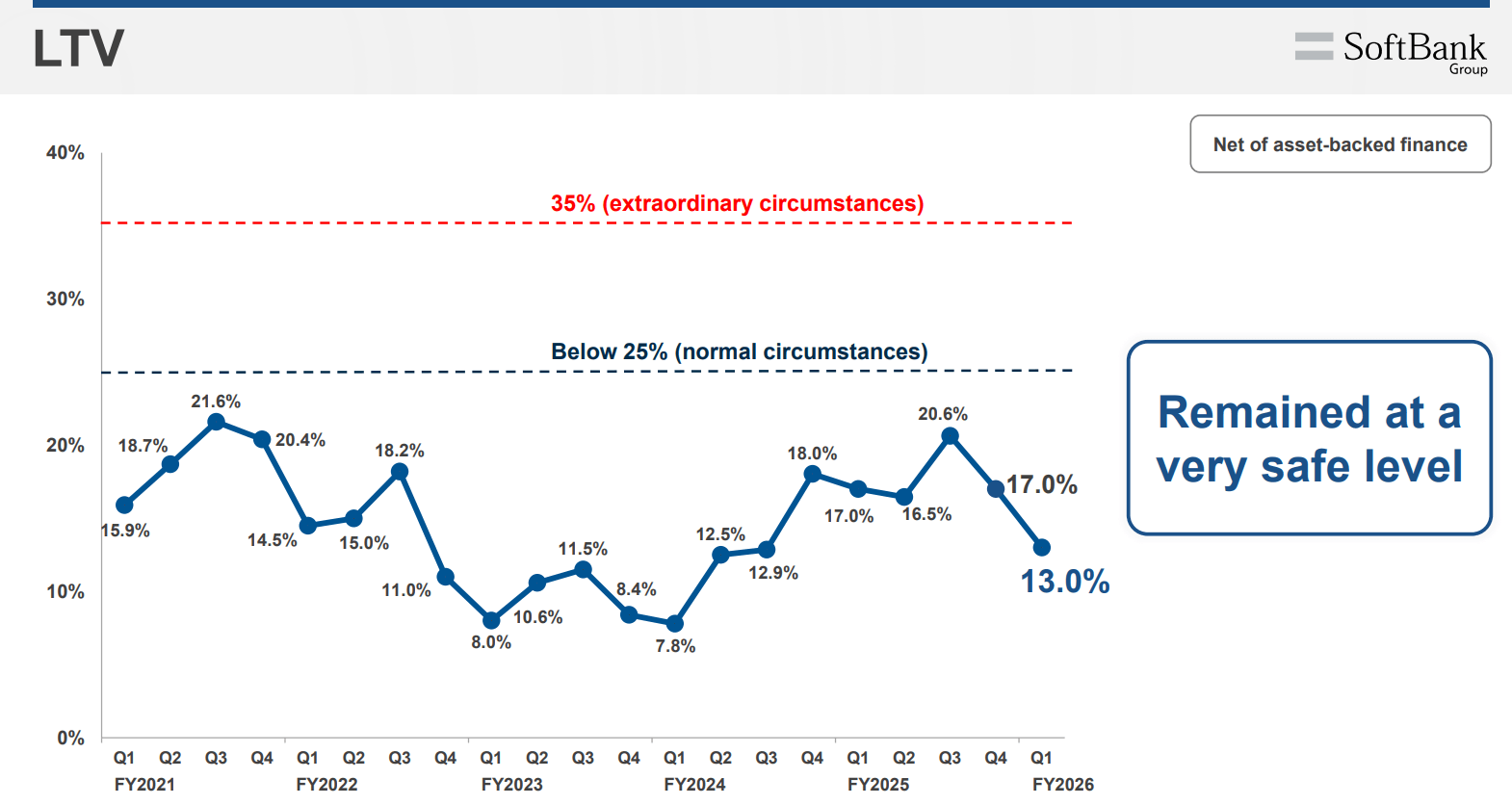
Two key metrics for an investment company, net asset value (NAV) and the loan-to-value (LTV) ratio, do not show profit, but they suggest that many claims about tension among lenders to AI companies are not supported by the data.
Source: SoftBank Group Corp.
NAV has nearly doubled since the end of Q3 2025, to around JPY 70 trillion. At the same time, LTV fell from a local peak of ~20% to around 13%. This means that despite asset growth, leverage remains low.
All of this shows that despite the huge increase in the value of the company’s investments, it is not translating into real profits for the firm, quite the opposite.
Is this bad for the industry?
Weak, or at least disappointing, SoftBank results do not have to mean failure for AI itself, or even for SoftBank.
SoftBank’s weaker results may be the consequence of specific investment decisions unique to the company and its portfolio, rather than the entire industry. SoftBank’s weak performance may indicate misallocation by SoftBank, an allocation that may be wrong not only directionally, but may also be affected by excessive concentration for which SoftBank itself is responsible.
Even in SoftBank’s case, a decline in profitability does not necessarily mean the investment thesis has failed. Investment companies typically have a longer time horizon and a higher tolerance for episodic lack of profitability, provided the investment strategy is fundamentally justified.



The US100 gets back on track and gains 1%📈



Market Wrap: Renewed confidence in AI drives stock market recovery (27.10.2026)


US OPEN: Anthropic filing and Iran talks support the market

Anthropic files prospectus ahead of IPO with "ANT" ticker on Nasdaq. The launch date and price remain a mystery
The content of this report has been created by XTB S.A., with its registered office in Warsaw, at Prosta 67, 00-838 Warsaw, Poland, (KRS number 0000217580) and supervised by Polish Supervision Authority ( No. DDM-M-4021-57-1/2005). This material is a marketing communication within the meaning of Art. 24 (3) of Directive 2014/65/EU of the European Parliament and of the Council of 15 May 2014 on markets in financial instruments and amending Directive 2002/92/EC and Directive 2011/61/EU (MiFID II). Marketing communication is not an investment recommendation or information recommending or suggesting an investment strategy within the meaning of Regulation (EU) No 596/2014 of the European Parliament and of the Council of 16 April 2014 on market abuse (market abuse regulation) and repealing Directive 2003/6/EC of the European Parliament and of the Council and Commission Directives 2003/124/EC, 2003/125/EC and 2004/72/EC and Commission Delegated Regulation (EU) 2016/958 of 9 March 2016 supplementing Regulation (EU) No 596/2014 of the European Parliament and of the Council with regard to regulatory technical standards for the technical arrangements for objective presentation of investment recommendations or other information recommending or suggesting an investment strategy and for disclosure of particular interests or indications of conflicts of interest or any other advice, including in the area of investment advisory, within the meaning of the Trading in Financial Instruments Act of 29 July 2005 (i.e. Journal of Laws 2019, item 875, as amended). The marketing communication is prepared with the highest diligence, objectivity, presents the facts known to the author on the date of preparation and is devoid of any evaluation elements. The marketing communication is prepared without considering the client’s needs, his individual financial situation and does not present any investment strategy in any way. The marketing communication does not constitute an offer of sale, offering, subscription, invitation to purchase, advertisement or promotion of any financial instruments. XTB S.A. is not liable for any client’s actions or omissions, in particular for the acquisition or disposal of financial instruments, undertaken on the basis of the information contained in this marketing communication. In the event that the marketing communication contains any information about any results regarding the financial instruments indicated therein, these do not constitute any guarantee or forecast regarding the future results.