



Uber has announced a deal that is historic by the company’s standards, yet for the moment the share price has remained unmoved. Is the market right to treat the company’s strategic purchase with indifference, or are Nvidia’s results and the upcoming Jackson Hole event diverting attention away from a company that is “average” by developed market standards?
The transaction
Uber is set to buy around EUR 13 billion worth of Delivery Hero shares at a price of EUR 41.5 per share. It is worth noting that Uber is buying the company at aprox. 18% premium to the market price, and many analysts do not rule out an increase in the offer price.
Also important, this is not an abrupt pivot or an impulsive purchase. Uber already owns about 53% of Delivery Hero shares, both directly and through various financial and investment vehicles.
A lot about the market’s reaction to the transaction can be inferred not so much from Uber’s share-price reaction (or lack of it), but also from Delivery Hero’s valuation itself. DHER is still trading at a discount to Uber’s offer price, which in practice means the market is pricing in a fairly meaningful discount due to likely regulatory hurdles.
A merger of companies of this size may clearly concern representatives of, among others, antitrust authorities.
What Uber gets out of it
The core of Uber’s expansion strategy is to build a so-called super app. Even today, Uber handles a wide range of passenger transport services and has a developed business as an intermediary in restaurant meal delivery.
The scale would be enormous. After the merger, the companies would operate in as many as 99 countries, and the number of markets with full integration of transport and delivery services would increase from 34 to 58. The scale of expansion here could, hypothetically, be much greater than a mere linear increase implied by taking over the other company’s market share, due to scale effects and synergies.
Sector implications
If Uber’s purchase of Delivery Hero goes through, it would signal significant expansion and an acceleration of the consolidation trend among ride-hailing and delivery operators. Consolidation is good for companies, though not necessarily for consumers.
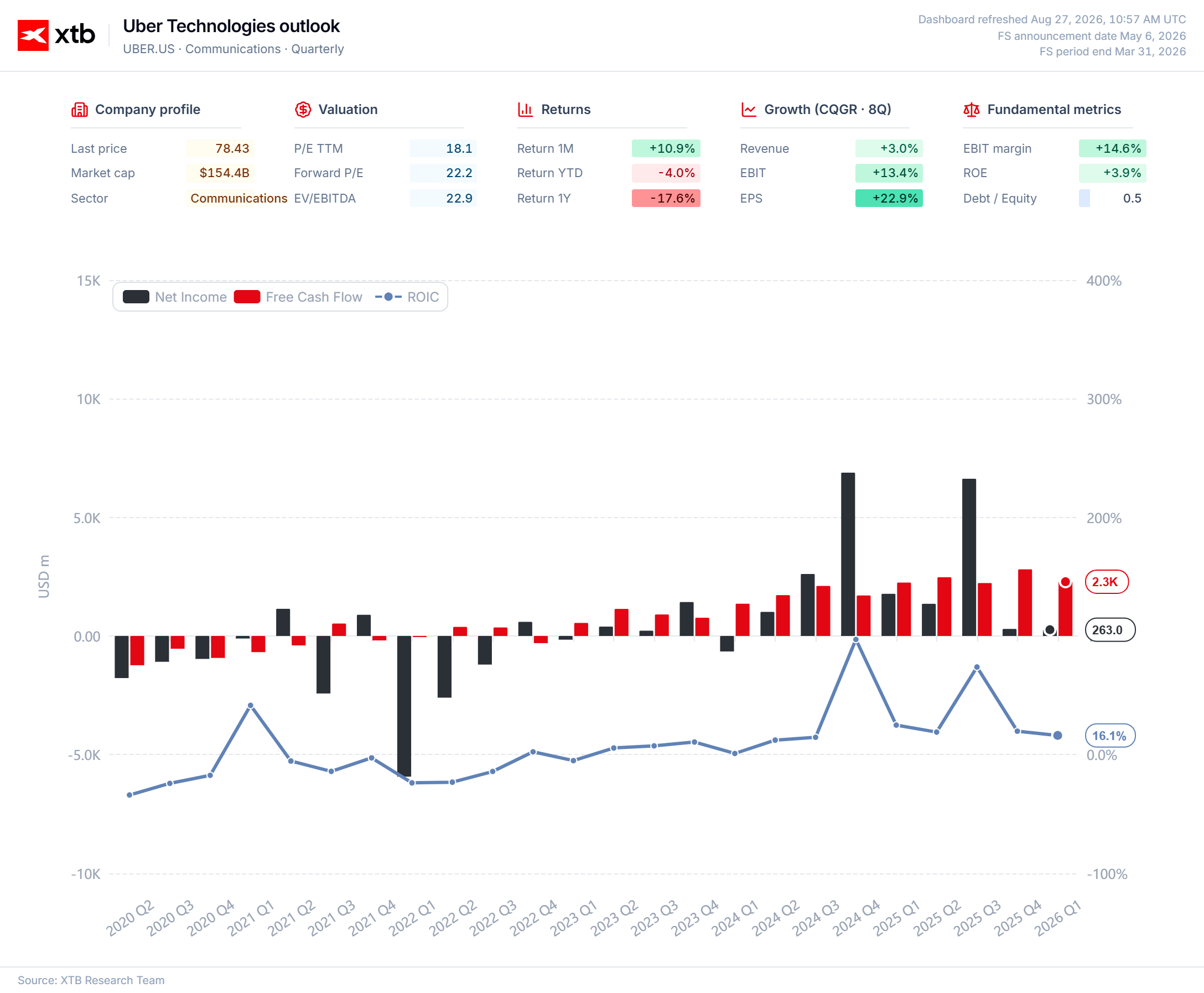
The consolidation happening today was, in a way, the industry’s goal from the very beginning, when investors tolerated many years of losses before companies were able to even break even, justified by future profits. This was the case, for example, with Uber itself.
Further market consolidation will reduce competition, enabling higher margins which, over time, may fund additional acquisitions and or shareholder payouts.
Technical analysis: Uber (D1)
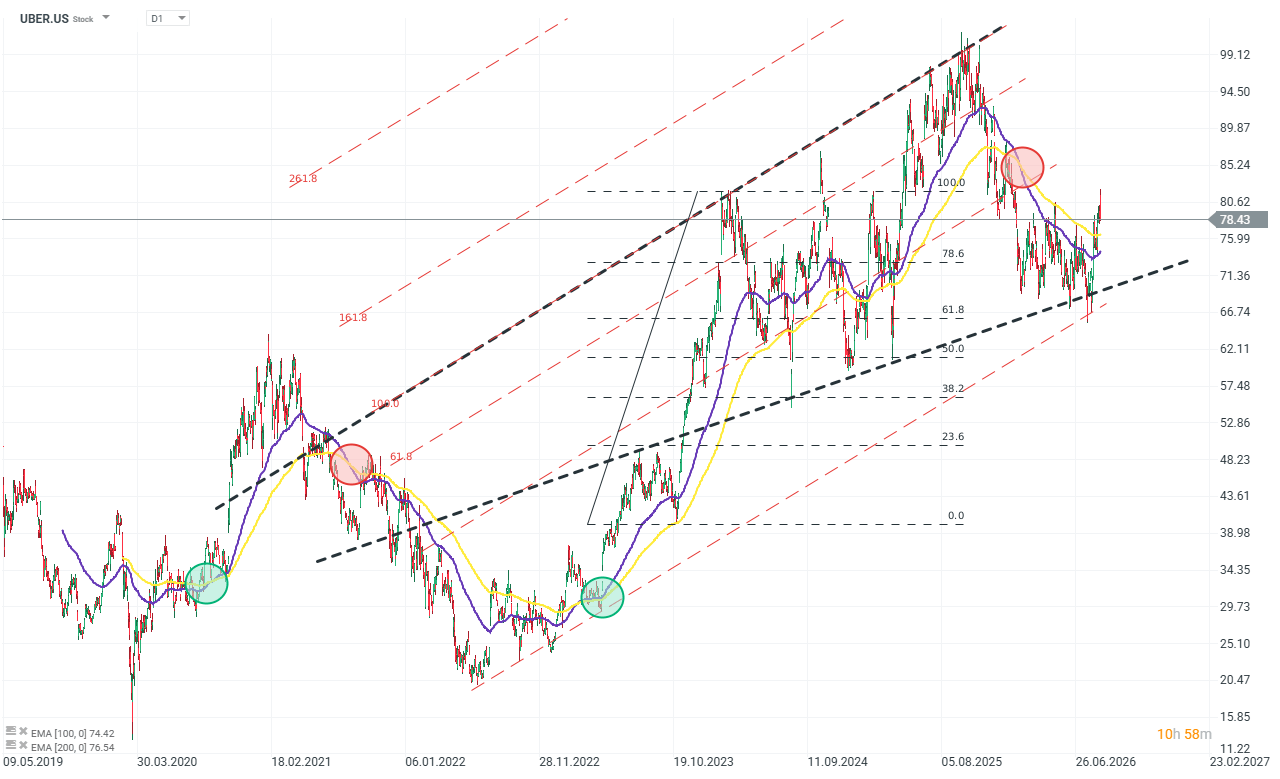
The share price has experienced a significant correction from the most recent peak, reaching roughly 35%. Even so, the defense of a key rising trendline around $65 suggests that the lower end of the ongoing correction may (but does not have to) be behind us. On the other hand, concern may be raised by the “death cross” from late 2025, which turned out to be merely a trigger for further declines. Overall, the company’s technical picture remains mixed, and the relationship between the EMA100 and EMA200 will be key to monitor. Source: xStation5


🚩 Caterpillar shares extend decline, down 30% from record high


Webull shares down 20% amid fears over potential China ties



US Open: Wall Street in the Red 🚩 Nasdaq Falls 1% From Record Highs, Constellation Brands Back at March 2020 Level



Market Wrap: Oil rises again, French fiscal concerns weigh on euro (07.10.2026)
The content of this report has been created by XTB S.A., with its registered office in Warsaw, at Prosta 67, 00-838 Warsaw, Poland, (KRS number 0000217580) and supervised by Polish Supervision Authority ( No. DDM-M-4021-57-1/2005). This material is a marketing communication within the meaning of Art. 24 (3) of Directive 2014/65/EU of the European Parliament and of the Council of 15 May 2014 on markets in financial instruments and amending Directive 2002/92/EC and Directive 2011/61/EU (MiFID II). Marketing communication is not an investment recommendation or information recommending or suggesting an investment strategy within the meaning of Regulation (EU) No 596/2014 of the European Parliament and of the Council of 16 April 2014 on market abuse (market abuse regulation) and repealing Directive 2003/6/EC of the European Parliament and of the Council and Commission Directives 2003/124/EC, 2003/125/EC and 2004/72/EC and Commission Delegated Regulation (EU) 2016/958 of 9 March 2016 supplementing Regulation (EU) No 596/2014 of the European Parliament and of the Council with regard to regulatory technical standards for the technical arrangements for objective presentation of investment recommendations or other information recommending or suggesting an investment strategy and for disclosure of particular interests or indications of conflicts of interest or any other advice, including in the area of investment advisory, within the meaning of the Trading in Financial Instruments Act of 29 July 2005 (i.e. Journal of Laws 2019, item 875, as amended). The marketing communication is prepared with the highest diligence, objectivity, presents the facts known to the author on the date of preparation and is devoid of any evaluation elements. The marketing communication is prepared without considering the client’s needs, his individual financial situation and does not present any investment strategy in any way. The marketing communication does not constitute an offer of sale, offering, subscription, invitation to purchase, advertisement or promotion of any financial instruments. XTB S.A. is not liable for any client’s actions or omissions, in particular for the acquisition or disposal of financial instruments, undertaken on the basis of the information contained in this marketing communication. In the event that the marketing communication contains any information about any results regarding the financial instruments indicated therein, these do not constitute any guarantee or forecast regarding the future results.