PLATINUM

Trade PLATINUM CFD

Past performance or future forecasts does not constitute a reliable indicator of future performance.

Fees

Less cost, more investments

Competitive fees

Trade with leverage and keep costs low

Free deposits/withdrawals

Manage your funds. Take advantage of free deposits and withdrawals.

No custody fees

No custody fees up to 250,000 EUR. After that, 0.02% per annum, minimum £10.

Learn

What is CFD trading?

New to CFDs? Learn how CFD trading works and how you can trade on both rising and falling prices without owning the underlying asset. We explain the basics, financial leverage, potential benefits and risks in simple terms.

Read the Beginner’s Guide

Create an account

Open your XTB account in just a few simple steps. Get access to global markets and a wide range of investment opportunities.

Make a deposit

Add funds to your account using one of the available payment methods. Once your funds are available, you’re ready to start investing.

Trade PLATINUM

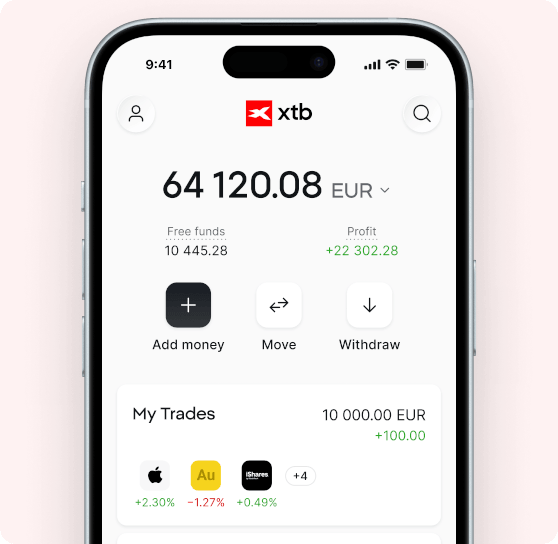
Find PLATINUM in XTB App, choose how much you want to invest and place your order. Start building your portfolio on your terms.

And make your money work in many ways

Explore more ways to put your money to work - from global stocks and ETFs to more. Discover Investment Plans and earn interest on uninvested funds while you wait for your next investment opportunity.

Popular in the markets

Most traded CFDs

Discover where CFD traders are most active. Explore some of the most traded CFDs across global markets and see which instruments are in focus.

News

Keep your finger on the pulse with our latest market news

We are regulated by leading financial regulatory authorities across multiple markets worldwide.

About instrument

Invest in PLATINUM CFD

Platinum is one of the most precious and valuable metals globally, renowned for its rarity, durability, and extensive industrial applications. It plays a vital role in various industries, including automotive, jewellery, and electronics. Platinum's resistance to corrosion, excellent catalytic properties, and high melting point make it an essential material for many high-tech and industrial processes.

With XTB's platform, traders can invest in platinum using contracts for difference (CFDs). Platinum instrument prices are based on spot interbank market price data. This dynamic investment method allows exposure to platinum price movements with a fraction of the capital required for direct investment. However, the volatility of platinum necessitates careful market analysis and risk management. Due to financial leverage, CFDs instruments are risky.

Global Platinum Market Dynamics

Platinum's price is influenced by several key factors, including global supply and demand, mining production, and geopolitical events. A primary driver of platinum pricing is its extensive use in industrial applications, particularly in the automotive industry for catalytic converters. Economic cycles and technological advancements also significantly impact platinum prices.

Factors Influencing Platinum 

  1. Global Supply and Demand: The balance between mining production and industrial consumption directly affects prices.
  2. Automotive Industry Trends: Changes in vehicle production and emission standards influence platinum demand for catalytic converters.
  3. Geopolitical Events: Political instability, trade policies, and regulations can disrupt supply chains.
  4. Dollar Strength: Platinum prices, like other commodities, are affected by fluctuations in the US dollar.
  5. Gold and Silver Price Action: Often, platinum prices correlate with gold (and silver) influenced by similar macroeconomic factors.

Platinum - The Most Important Data

  1. World Platinum Investment Council (WPIC) Report: Provides comprehensive data on global platinum supply, demand, and investment trends.
  2. Johnson Matthey PGM Market Report: Offers insights into production, consumption, and market trends for platinum group metals.
  3. London Bullion Market Association (LBMA) Platinum Prices: Tracks platinum price benchmarks crucial for market participants.
  4. South African Mineral Resources Report: Essential for understanding the largest platinum producer's mining activities and policies.
  5. International Monetary Fund (IMF) Commodity Market Reports: Provides macroeconomic analysis impacting commodity markets, including platinum.

Factors Influencing Platinum Prices

  1. Global Supply and Demand: Balance between mining production and industrial consumption affects prices.
  2. Automotive Industry Trends: Changes in vehicle production and emission standards influence platinum demand for catalytic converters.
  3. Geopolitical Events: Political instability, trade policies, and regulations can disrupt supply chains.
  4. Dollar Strength: Platinum prices, like other commodities, are affected by fluctuations in the US dollar.
  5. Gold Price Action: Often, platinum prices correlate with gold, influenced by similar macroeconomic factors.

Comparing Platinum to Gold and Silver

Platinum, gold, and silver are all precious metals with unique industrial applications and historical price correlations. Platinum's primary industrial use is in automotive catalytic converters, whereas gold is extensively used in jewelry and as a store of value. Silver has significant applications in electronics and photovoltaics. Historically, platinum has traded at a premium to gold due to its industrial demand, but economic downturns can cause greater volatility in platinum prices compared to gold and silver.


 

Margin

10%

Leverage

10

Commission

-

Market hours

12:00 am - 11:00 pm

Interesting Facts

What to know before investing in PLATINUM

Ancient Origins

Platinum has been valued for thousands of years, with evidence of its use by ancient civilisations in South America and Egypt. Modern refining techniques developed centuries later transformed platinum into one of the world's most important precious and industrial metals.

South Africa Leads Production

South Africa accounts for around 70% of global platinum mine production, making it the world's largest supplier. Mining activity, labour disputes and electricity shortages in the region can all influence global supply and contribute to movements in platinum prices.

A Precious and Industrial Metal

Unlike gold, platinum has a dual role as both an investment asset and an industrial metal. Demand from sectors such as automotive manufacturing, jewellery, chemical processing and clean energy means its price often reflects broader economic activity.

Essential for Modern Manufacturing

Platinum is widely used in catalytic converters, chemical production, medical equipment and electronics because of its durability and catalytic properties. These diverse industrial applications help support long-term demand across multiple sectors of the global economy.

Concentrated Global Supply

Most of the world's platinum is mined in just a handful of countries, including South Africa, Russia and Zimbabwe. This concentrated supply means geopolitical events, operational disruptions or changes in mining output can significantly influence global platinum prices.

Sensitive to Economic Conditions

Platinum prices are influenced by industrial demand, automotive production, investment flows and broader macroeconomic conditions. Because it combines characteristics of both precious and industrial metals, its price behaviour can differ from gold and silver.

FAQ

Do you have more questions?

Find answers to our most commonly asked questions. Still have a question? Please contact our customer support team.

It is not possible to determine the "best" commodity to invest in, as the performance of different commodities can vary significantly depending on a wide range of factors. Some common commodities that are traded on the financial markets include oil, gold, and agricultural products.

Yes, individuals can invest in commodities through e.g. commodity based instruments - such as CFDs and futures contracts or purchasing physical meterials.

It is not possible to determine a "top" commodity, as it depends on a wide range of factors, but top five commodities by global trade volume are: Oil, Natural Gas, Gold, Silver and Copper. However, the popularity of different commodities can vary depending on regional and global economic conditions.