


Markets rise, markets fall — and then they rise again. But what if these movements weren’t as random as they seem?
Welcome to the world of economic cycles — the invisible rhythm behind recessions, recoveries, booms, and busts. Whether you're a long-term investor or just getting started, understanding economic cycles can give you a powerful edge in anticipating market trends and making smarter decisions.
This isn’t just academic theory. It’s about recognizing patterns, adapting strategies, and avoiding costly mistakes
Markets rise, markets fall — and then they rise again. But what if these movements weren’t as random as they seem?
Welcome to the world of economic cycles — the invisible rhythm behind recessions, recoveries, booms, and busts. Whether you're a long-term investor or just getting started, understanding economic cycles can give you a powerful edge in anticipating market trends and making smarter decisions.
This isn’t just academic theory. It’s about recognizing patterns, adapting strategies, and avoiding costly mistakes
What Are Economic Cycles?
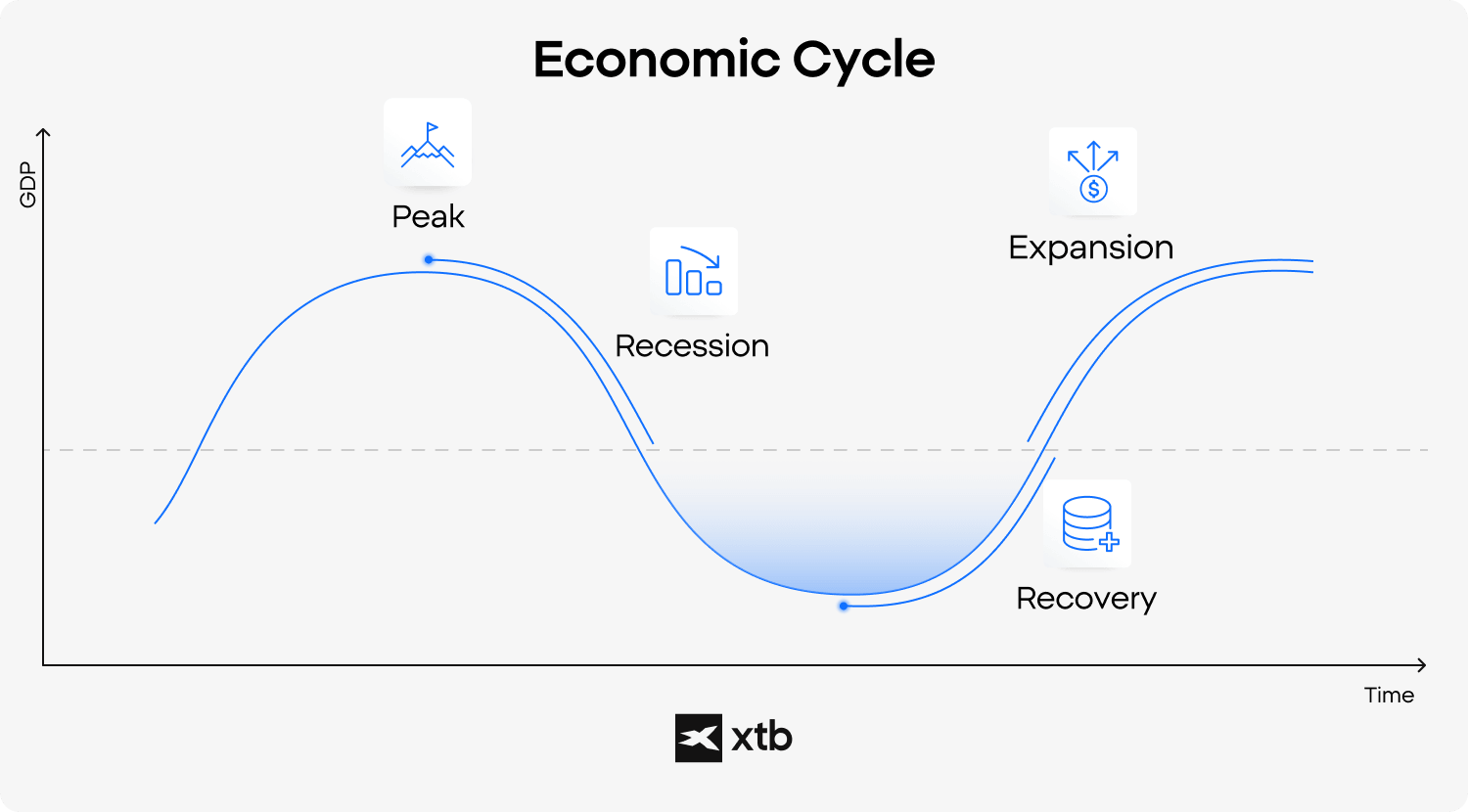
Economic cycles, also known as business cycles, describe the natural fluctuation of the economy between periods of growth (expansion) and decline (contraction). They’re driven by changes in output, employment, consumption, credit, and confidence.
📈 Expansion → Jobs grow, production rises, spending increases.
📉 Contraction → Job losses, declining investment, slower consumer demand.
These aren’t random events. They’re predictable patterns that repeat — though not always on the same timeline.
Think of them like the seasons of the economy:
- Spring: Recovery 🌱
- Summer: Expansion ☀️
- Autumn: Peak 🍂
- Winter: Recession ❄️
Types of Economic Cycles
Not all cycles are created equal. Let’s break down the main types investors should know:
1. 🏭 The Business Cycle
The most widely known cycle. It includes:
- Expansion
- Peak
- Recession
- Trough
Governments and central banks try to moderate this cycle using tools like interest rates and fiscal policy.
2. The Credit Cycle
Driven by lending and borrowing activity.
- Easy credit → borrowing → growth
- Tight credit → defaults → contraction
Highly relevant to banking stocks and bond markets.
3. 🧮 The Inventory Cycle
Occurs over a shorter timeframe (2–4 years) and is tied to manufacturing and inventory restocking.
When businesses overproduce → inventories pile up → production slows → economy contracts.
4. 🌊 The Kondratiev Wave (Long Wave)
A super cycle spanning 45–60 years, related to technological innovation and structural shifts.
Examples: the rise of railroads, the internet revolution, AI boom.
5. 🏘️ Real Estate & Debt Super cycles
These long-term cycles are tied to housing markets and debt accumulation.
They’re slow-burning but can trigger massive financial disruptions (e.g., 2008 global crisis).
Pro Tip: While short-term cycles affect traders, long-term super cycles are critical for strategic investors planning for decades.
What Do Economists Really Think About Market Cycles?

Ask ten economists about economic cycles, and you’ll get eleven opinions. While there's general agreement that economies move in predictable waves of expansion and contraction, the “why” and “how” still spark heated debate.
📚 Key Schools of Thought
- Austrian economists argue that business cycles are caused by central bank manipulation of interest rates and credit. According to them, every boom fuelled by easy money leads inevitably to a painful bust.
- Keynesian economists, by contrast, see cycles as a natural byproduct of demand-side fluctuations — suggesting governments should intervene with stimulus and spending during downturns.
- Monetarists, like Milton Friedman, believe that bad monetary policy — too much or too little money — is the root cause of economic volatility.
- Neo-Schumpeterians look to innovation cycles, arguing that new technologies spark waves of investment, growth, and disruption. This view closely aligns with Kondratiev’s long-wave theory.
Whether you believe in government-managed stability or the inevitability of crashes following credit bubbles, one thing is clear:
Market cycles are as much about ideas as they are about numbers.
Understanding these lenses can help investors better interpret macro trends.
The Most Abstract Theories Behind Economic Cycles
Most people accept that economic cycles are driven by credit, policy, or innovation. But some theories venture into far more cosmic territory — literally.
Here are the most abstract and oddly captivating ideas about what might influence economic booms and busts.
1. ☀️ Solar Activity and Economic Cycles
Yes, you read that right. Some researchers claim that solar cycles — particularly sunspot activity — align with economic trends. The theory? Increased sunspot activity boosts agricultural yields and overall productivity, leading to growth.
Reduced activity = lower output = slowdown.
In the early 20th century, Alexander Chizhevsky, a Russian scientist later living in New York, conducted pioneering research suggesting that solar activity directly influences human behaviour.
He theorized that sunspot peaks correlated with mass social unrest, wars, and revolutions — arguing that solar cycles may affect not just agriculture or weather, but even human emotion and collective psychology.
Though controversial, his work laid the foundation for a niche but persistent school of thought:
that cosmic forces may subtly shape economic and societal cycles — far beyond what traditional economists consider.
2. 🌗 Lunar Phases and Investor Sentiment
Another fringe theory suggests that full moons influence investor behaviour and trading patterns — linking human psychology to cosmic cycles. While often dismissed, some hedge funds quietly monitor these patterns.
4. 🌀 Chaos Theory & Complex Systems
Some modern theorists suggest that economies behave like chaotic systems, where tiny changes (e.g. a trade dispute) lead to massive outcomes. This echoes the famous “butterfly effect” — making prediction nearly impossible, but cycles inevitable.
How Economic Cycles Affect Financial Markets
Economic cycles aren’t just for economists or central banks to worry about. For investors, they can mean the difference between a bull run and a brutal correction. Let’s break it down sector by sector:
Stock Market Performance
- During Expansion: Corporate profits tend to grow, confidence is high, and stock prices climb.
- At the Peak: Markets often overshoot. Valuations are stretched. Risk builds quietly.
- During Recession: Earnings shrink, job losses grow, and stock indices usually decline.
- In Recovery: Markets often rebound before the economy does, anticipating better times ahead.
🔍 Pro insight: Stocks are forward-looking — they start falling before a recession hits and rising before a recovery becomes official.
Bonds & Interest Rates
- In expansions, interest rates rise to cool overheating. That hurts bond prices.
- In recessions, central banks cut rates to boost the economy, lifting bond prices.
📌 Bonds thrive in downturns. Stocks lead in upturns.
Real Estate
- Expansion = 📈 rising demand, higher property prices.
- Recession = 📉 tighter credit, fewer buyers, falling prices.
Real estate follows the credit cycle closely — especially mortgage lending.
Commodities
- Commodities (oil, metals, agriculture) rally during expansions when industrial demand is strong.
- Recessions hit them hard, but certain safe-haven assets like gold may shine during crises.
🪙 Cryptocurrencies
Often act like high-beta tech stocks — booming in liquidity-driven bull markets, crashing hard in contractions.
Sentiment-driven, and extremely cyclical. Panics and manias are frequent.
⚠️ Not for the faint-hearted. Timing matters a lot here.
Investor Emotions: Panic and Euphoria

It’s not just GDP or interest rates driving markets — it’s human nature. Economic cycles create fertile ground for psychological cycles too.
Market Panic: The Downturn
- Fear of recession → sell-offs
- Media headlines turn doomsday
- Volatility spikes
- Retail investors often sell at the worst time
Market Euphoria: The Boom
- Everyone’s getting rich
- FOMO kicks in
- Speculative assets outperform
- “This time it’s different” becomes common thinking
The Cycle of Emotion
“Markets are driven by greed and fear — and economic cycles are the stage where this drama unfolds.”
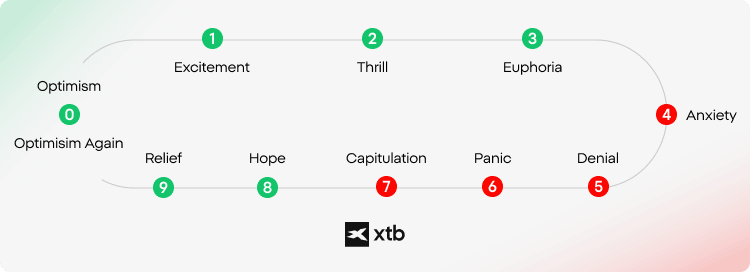
Smart investors recognize where we are in the cycle — and prepare accordingly.
How to Navigate the Economic Cycle as an Investor

The key to successful investing isn’t just “buy low, sell high.” It’s knowing what to buy, when to hold, and sometimes... when to sit on your hands.
Let’s break it down, phase by phase.
1. Recession Strategy
- Focus on defensive stocks (utilities, consumer staples, healthcare)
- Increase exposure to bonds (especially government and high-quality corporates)
- Avoid overleveraged businesses and highly cyclical sectors (like travel or luxury)
- Build cash reserves — dry powder for opportunities
2. Recovery Strategy
- Gradually rotate into cyclical stocks (industrials, financials, discretionary)
- Small-cap and emerging market equities often outperform
- Commodities begin rebounding — energy and metals in particular
- Tech and crypto may start gaining traction again
💡 Be early, but don’t go all in. Look for confirmation in earnings, credit growth, and job data.
3. Expansion Strategy
- Ride the wave: growth stocks, tech, consumer discretionary, even some speculation
- Diversify across sectors but stay nimble
- Real estate often picks up — REITs can shine
- Monitor inflation and interest rate trends
Don’t get greedy. Market euphoria often feels like a “new normal.”
4. Peak Strategy
- Rebalance. Lock in gains. Reduce exposure to riskier assets
- Rotate into value stocks and income-generating assets (dividend aristocrats)
- Increase bond allocation (especially short-term)
- Prepare mentally for a correction — they always come
The best investors become cautious when everyone else is overly confident.
Timing vs. Positioning: What Really Matters?
Trying to time the top or bottom?
Even pros get it wrong.
Instead, focus on positioning your portfolio to perform through the cycle:
- Diversify across assets
- Think in decades, not days
- Accept that downturns are temporary — and recoveries are inevitable
Long-term success often comes down to staying calm when others don’t.
Why “Time in the Market” Often Beats “Timing the Market”
“Far more money has been lost by investors preparing for corrections than in the corrections themselves.” — Peter Lynch
Consistent investing, especially through dollar-cost averaging, tends to outperform short-term tinkering.
Summary
Economic cycles are the heartbeat of the financial system. They rise and fall — just like markets, businesses, and even investor emotions.
Understanding where we are in the cycle can help investors:
- Make smarter decisions
- Avoid emotional mistakes
- Identify long-term opportunities before the crowd
Whether you’re navigating a bear market or riding the wave of a bull run, remember:
“Markets move in cycles — not in straight lines.”
The best investors don’t fear the cycle — they study it, respect it, and use it.
FAQ
It varies, but most business cycles span 5–10 years. Some last longer, depending on policy, innovation, or shocks (e.g. pandemics).
A mix of monetary policy, consumer confidence, credit flow, and external shocks (like wars or supply chain disruptions).
A recession is a short-term decline (usually two quarters), while a depression is a prolonged and severe economic downturn.
Not always — and often they bottom before the economy officially recovers.
Not precisely, but using leading indicators like unemployment, manufacturing, and interest rates can offer solid clues.
No. Growth stocks, real estate, and crypto are highly sensitive, while defensive stocks, bonds, and gold are more resilient.
Inverted yield curve, declining consumer confidence, rising unemployment, and tighter credit conditions.
Not necessarily. Timing the market is risky. Always consider adjusting exposure and focusing on quality and analyze defensive assets.
They use interest rates and liquidity tools to cool overheated economies or stimulate growth in downturns.
Yes! Downturns offer some of the best buying opportunities — for those with cash, patience, and courage.

Advantages and disadvantages of long term investing

How to Save Money Each Month: Practical Tips

Dry January Challenge: Save Money by Resisting Alcohol and Cutting Spending
This content has been created by XTB S.A. This service is provided by XTB S.A., with its registered office in Warsaw, at Prosta 67, 00-838 Warsaw, Poland, entered in the register of entrepreneurs of the National Court Register (Krajowy Rejestr Sądowy) conducted by District Court for the Capital City of Warsaw, XII Commercial Division of the National Court Register under KRS number 0000217580, REGON number 015803782 and Tax Identification Number (NIP) 527-24-43-955, with the fully paid up share capital in the amount of PLN 5.869.181,75. XTB S.A. conducts brokerage activities on the basis of the license granted by Polish Securities and Exchange Commission on 8th November 2005 No. DDM-M-4021-57-1/2005 and is supervised by Polish Supervision Authority.