


Apple will report its fiscal third-quarter 2026 results today after the market closes. The market is approaching the report with high expectations. After a period in which investors questioned whether Apple could accelerate growth again, the company now has a chance to deliver one of its strongest sales quarters in some time.
Consensus estimates point to revenue of nearly $109 billion, approximately 16% higher than a year earlier. The main growth driver is expected to be the iPhone, supported by a successful product cycle and customers’ growing willingness to replace older devices.
At first glance, the outlook appears highly favorable. New models are attracting users, iPhone sales remain strong, the Services segment continues to grow, and Apple may even be gaining share in the global smartphone market.
Beneath the surface, however, a problem is emerging that could dominate today’s earnings call.
A global memory shortage is pushing up the prices of key components. Apple, which produces hundreds of millions of devices and uses enormous volumes of memory across iPhones, Macs, and iPads, cannot fully avoid the impact of rising costs.
The company may therefore report very strong revenue while simultaneously facing pressure on margins. Today’s report will not only be a test of demand for the iPhone. It will also be a test of whether Apple can maintain high profitability in an environment of rising component costs.
The key question is: will the strength of iPhone sales be sufficient to offset the pressure created by increasingly expensive memory?
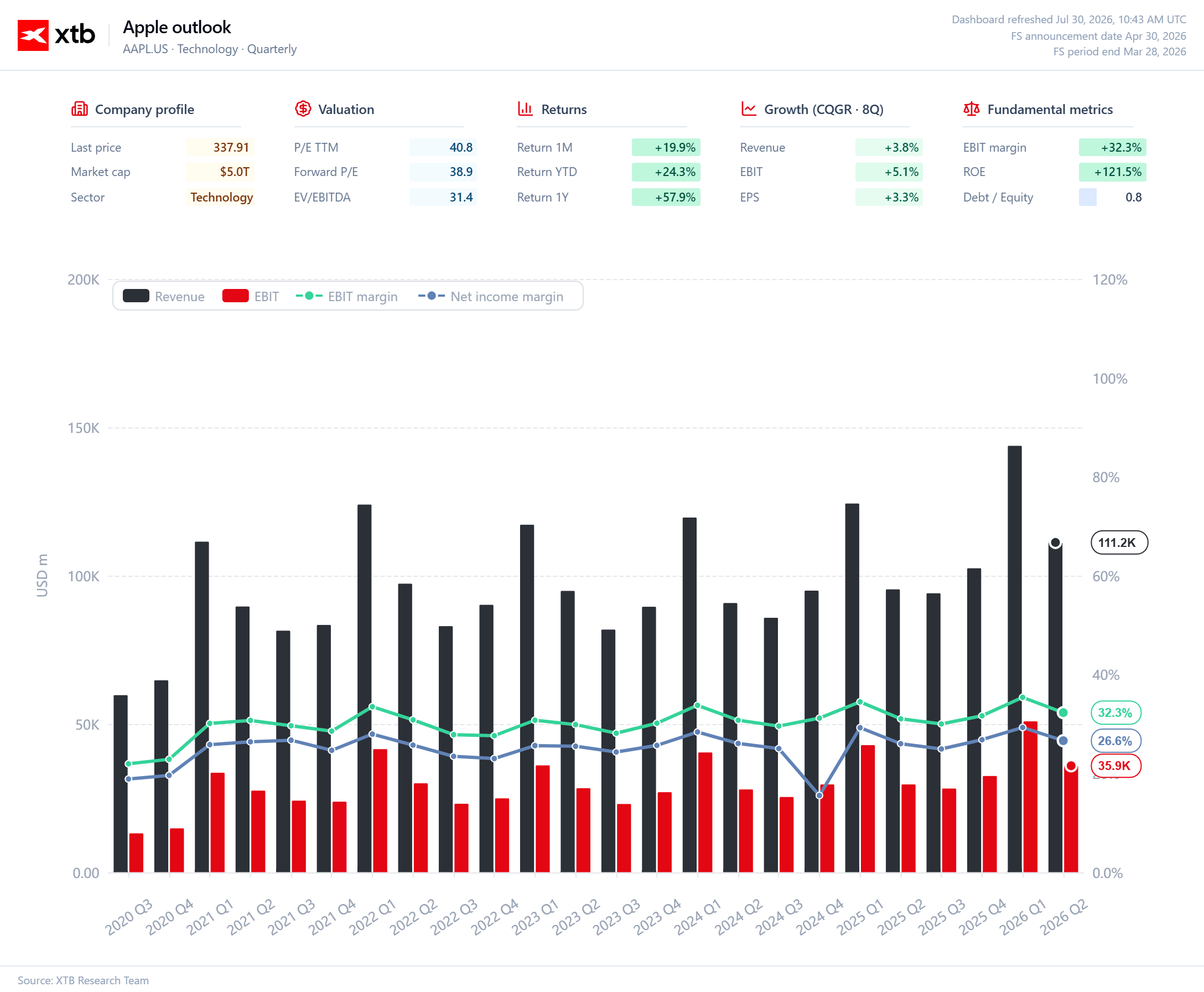
Key Financial Expectations
-
Revenue: $108.85 billion
-
Product revenue: $77.25 billion
-
iPhone revenue: $53.60 billion
-
Services revenue: $31.36 billion
-
Mac revenue: $8.62 billion
-
iPad revenue: $6.89 billion
-
Americas revenue: $45.42 billion
-
Europe revenue: $27.58 billion
-
China revenue: $19.58 billion
-
Japan revenue: $7.49 billion
-
EPS: $1.89
-
Gross profit: $52.13 billion
-
Operating expenses: $18.96 billion
-
Research and development spending: $11.57 billion
-
Cash and cash equivalents: $53.15 billion
-
Estimated full-year CapEx: $12.33 billion
The iPhone Is Set to Take Center Stage Again
According to the Bloomberg consensus, Apple is expected to generate approximately $108.9 billion in revenue, compared with $94 billion a year earlier. This would represent growth of around 16% and confirm that the current product cycle is delivering very strong results for the company.
The iPhone is expected to account for the largest share of that growth. Consensus estimates point to approximately $53.6 billion in smartphone revenue, once again demonstrating that despite the growing importance of Services and the broader Apple ecosystem, the iPhone remains the heart of the company’s business.
New iPhone models may encourage users to replace older devices. For Apple, the upgrade cycle is enormously important. The company has hundreds of millions of active users, meaning that even a modest reduction in the average device replacement cycle can translate into billions of dollars in additional revenue. Strong sales of new models may also indicate that Apple is not only benefiting from its own product cycle but is beginning to take customers away from competitors.
Potential market-share gains could therefore be one of the most important positive elements of the report. The smartphone market is already mature, so higher sales volumes are not driven solely by expanding demand across the industry. Increasingly, they mean gaining market share at the expense of other manufacturers. If Apple demonstrates that it is growing sales while simultaneously strengthening its market position, investors may view the current product cycle as significantly stronger than previously expected.
Apple May Grow Faster Without Raising Prices
One reason Apple may be gaining market share is its decision to maintain smartphone prices despite rising component costs. Such a strategy supports demand and allows the company to remain competitive, particularly in the premium segment. Apple may therefore attract customers who are considering devices from other manufacturers.
On the other hand, every decision not to pass higher costs on to consumers creates greater pressure on profitability. Apple therefore faces a classic dilemma. It can raise prices and partially protect margins, but risk weakening demand. Alternatively, it can maintain prices, increase sales, and gain market share, while absorbing a larger portion of rising costs.
For now, the market appears to assume that Apple is choosing the second scenario. If the company can increase sales without a meaningful deterioration in margins, it may demonstrate very high-quality growth. If, however, market-share gains come at the cost of a clear decline in profitability, investors may assess the strength of the current cycle differently.
Services Remain the Quiet Pillar of Earnings
While the iPhone attracts the most attention, the Services segment continues to strengthen Apple’s financial foundations. Consensus estimates point to Services revenue of approximately $31.4 billion. The segment, which includes the App Store, subscriptions, digital services, and payments, has become one of the company’s most important sources of stable growth.
Services also have strategic importance for profitability. The services business generates higher margins than hardware sales, meaning that a growing share of Services in the revenue mix may partially cushion cost pressure associated with device production.
This is where a natural balance may emerge. The iPhone provides scale and drives revenue growth, while Services help maintain the high profitability of the broader ecosystem. If both segments exceed expectations, Apple may demonstrate not only rapid growth but also strong growth quality. If Services momentum weakens, however, the market may focus much more heavily on rising memory costs.
The Memory Shortage Is Becoming a Test of Margins
The biggest challenge for Apple may currently be the situation in the memory market.
The global race to develop artificial intelligence is increasing demand for advanced chips used in data centers and computing systems. Demand from AI infrastructure providers is growing rapidly, while limited supply is pushing memory prices higher.
For Apple, the issue is particularly important because of the scale of its operations. The company requires enormous volumes of memory to manufacture iPhones, Macs, iPads, and its other devices. Even a small increase in the cost of an individual component can translate into billions of dollars in additional expenses at Apple’s scale.
Apple has already raised the prices of certain products, citing rising memory costs. Investors will nevertheless want to know whether the measures taken so far will be sufficient to limit the impact of more expensive components on profitability. According to conservative estimates, higher memory costs could materially reduce Apple’s gross margin.
This means that today’s report may be a test not only of sales but, above all, of Apple’s ability to protect margins. The market will analyze whether cost pressure will bottom out as early as this quarter or persist for longer and continue weighing on results in future periods. This is precisely why the company’s margin outlook may prove more important than simply beating the revenue consensus.
Chinese Memory Could Solve One Problem and Create Another
Apple is reportedly considering sourcing memory from Chinese manufacturers, including CXMT and YMTC. From a business perspective, such a move would be understandable.
Diversifying its supplier base could increase component availability, reduce the risk of shortages, and improve Apple’s negotiating position with existing suppliers. At a time when memory prices are rising and availability remains limited, every additional supplier could have strategic importance.
At the same time, the potential use of Chinese chips has drawn opposition from some U.S. senators. Concerns have emerged regarding national security, technology transfers, and the risk that one of America’s most important companies could become dependent on entities linked to China. Apple could therefore find itself caught between the need to secure its supply chain and growing political pressure.
It is worth emphasizing that there is currently no confirmation that Chinese memory will be used in Apple devices. The reports concern discussions and the potential sourcing of components. If the issue is raised during the earnings call, investors will be looking for answers as to whether Apple is genuinely planning to expand its supplier base and how it intends to limit the impact of the memory shortage on costs.
Margins May Determine the Market Reaction
Apple may report very strong revenue growth. Robust iPhone sales, growing Services revenue, and potential market-share gains create a highly favorable picture.
The market reaction, however, will depend on how much of that growth remains in the company’s financial results after accounting for rising component costs.
The key factors will therefore be:
-
the level of gross margin,
-
the margin outlook for the next quarter,
-
the impact of higher memory prices,
-
the company’s ability to pass costs on to customers,
-
the growth rate of the Services segment,
-
the scale of iPhone sales,
-
information regarding market share,
-
commentary on the security and resilience of memory supplies.
This quarter, revenue alone may not be sufficient to assess the quality of Apple’s results conclusively. The company may increase sales and gain market share while simultaneously paying more and more for components. The market will therefore try to determine whether growth remains profitable and sustainable.
Three Possible Scenarios
The bullish scenario assumes a clear beat of consensus expectations, very strong iPhone sales, continued growth in Services, and a stable margin outlook. An additional positive signal would be confirmation that Apple is gaining share in the global smartphone market. In that case, rising memory costs could be viewed as a temporary problem that the company can manage thanks to its scale, brand strength, and the high profitability of its services business.
The neutral scenario assumes results broadly in line with expectations, strong iPhone sales, but a cautious margin outlook. Such a report would confirm the strength of demand while also showing that rising component costs are beginning to limit the quality of growth.
The bearish scenario includes weaker iPhone sales, clear pressure on margins, and a deterioration in guidance due to high memory prices. Such a combination could increase concerns that the current product cycle is not strong enough to offset rising costs.
Apple Faces a Test of Growth Quality
Apple enters its earnings release with very high expectations.
The iPhone is expected to drive sales, Services to support profitability, and the current product cycle may allow the company to gain market share. At the same time, the memory shortage is creating a new risk that could affect production costs and constrain margins.
Today’s report will answer several key questions:
-
Will iPhone sales exceed expectations?
-
Is Apple gaining share in the global smartphone market?
-
Are customers replacing their devices faster than before?
-
How quickly is the Services segment growing?
-
What impact are higher memory prices having on margins?
-
Will Apple continue to raise product prices?
-
How long could cost pressure persist?
-
Will the company further diversify its sources of memory supply?
Apple may report very strong revenue growth today. To convince the market, however, it will have to demonstrate that growth remains profitable despite rising component costs.
Key Takeaways
Apple enters its earnings release with expected revenue of approximately $108.9 billion. The iPhone is expected to be the main growth driver, supported by a strong product cycle and customers’ growing willingness to replace their devices.
Strong sales may allow Apple not only to increase revenue but also to gain share in the global smartphone market.
The Services segment remains the second pillar of the company’s results. Its high profitability may partially offset rising device-production costs.
The biggest risk, however, remains the memory shortage. Rising component prices may weigh on margins, meaning that the company’s profitability outlook for the coming quarters could be more important than simply beating the revenue consensus.
Apple is also considering expanding its sources of memory supply, including the possibility of sourcing components from Chinese manufacturers. Such a move could reduce the risk of shortages but would also increase political, regulatory, and strategic risks.
Today’s results will therefore be a test of more than just demand for the iPhone.
Above all, they will be a test of growth quality — whether Apple can increase sales, gain market share, and at the same time protect its high profitability in an environment of rising memory costs.
Source: xStation5



Three markets to watch next week (23.10.2026)



Daily Summary: Oil at five-month highs, indices under pressure (23.10.2026)

US Open: Further declines on Wall Street, Brent above 111 USD, AI correction continues (14.10.2026)



Morning Wrap: AI profitability concerns spark market Sell-Off
This content has been created by XTB S.A. This service is provided by XTB S.A., with its registered office in Warsaw, at Prosta 67, 00-838 Warsaw, Poland, entered in the register of entrepreneurs of the National Court Register (Krajowy Rejestr Sądowy) conducted by District Court for the Capital City of Warsaw, XII Commercial Division of the National Court Register under KRS number 0000217580, REGON number 015803782 and Tax Identification Number (NIP) 527-24-43-955, with the fully paid up share capital in the amount of PLN 5.869.181,75. XTB S.A. conducts brokerage activities on the basis of the license granted by Polish Securities and Exchange Commission on 8th November 2005 No. DDM-M-4021-57-1/2005 and is supervised by Polish Supervision Authority.