

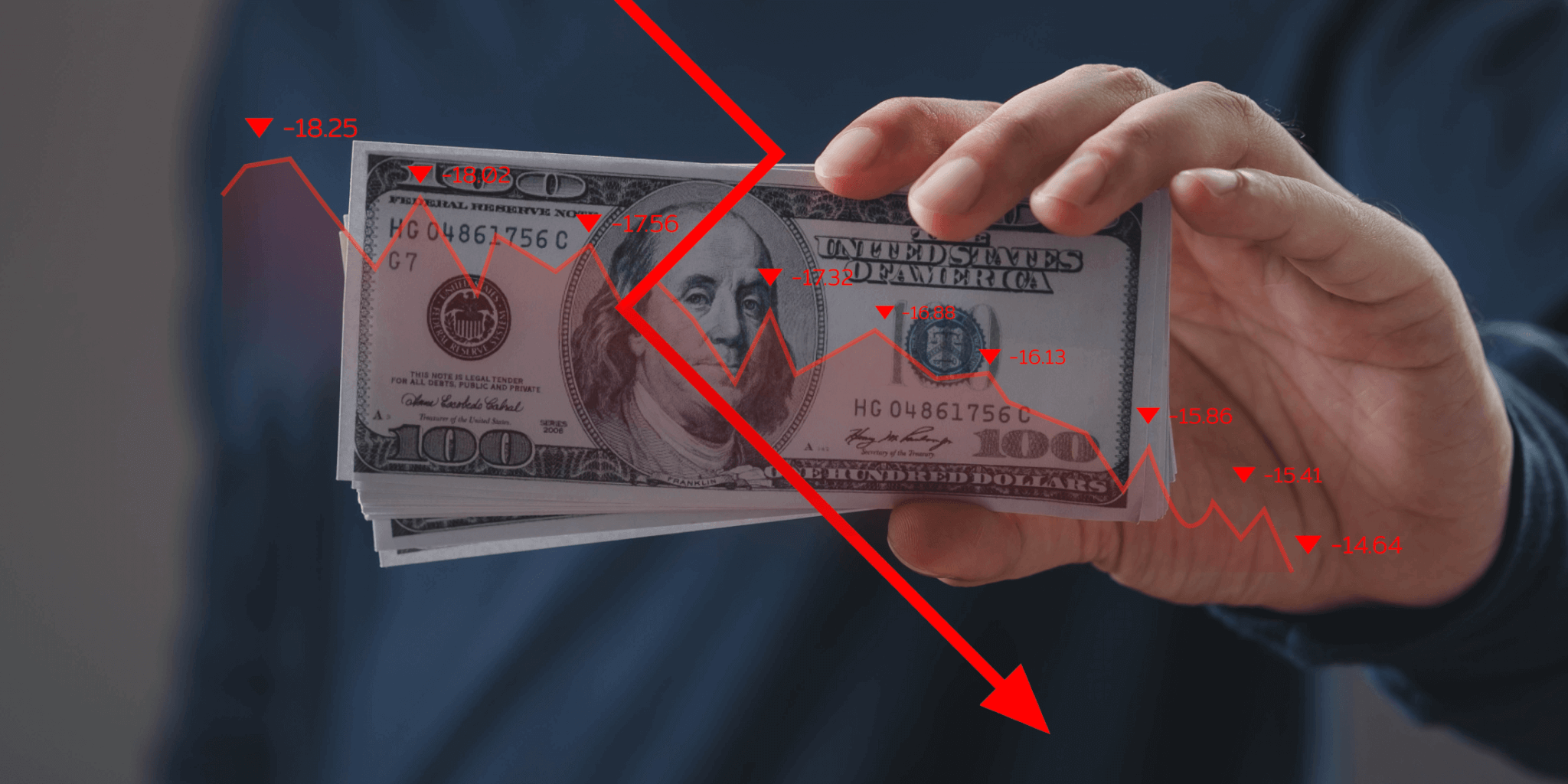

Donald Trump’s announcement on January 9, 2026 triggered a huge wave of anxiety on Wall Street, even though it seemed investors had already learned how to navigate a market shaken by declarations from the White House.
This time, it is banks and the financial sector that are in trouble. The president proposed introducing a cap on the maximum interest rate on credit cards at 10%, effective January 20. However, he provided neither a legal pathway nor an enforcement mechanism. Many analysts try not to take this proposal seriously, but dismissing Donald Trump’s determination may be unwise.
Markets, however, do not need to wait for details after such declarations. Within a few days of the announcement, the financial sector lost tens of billions of dollars in market capitalization. The hardest hit were institutions most dependent on credit cards: Capital One recorded a double-digit share price drop, while Citigroup and American Express lost around 7%. The spillover also reached payment giants such as Visa and Mastercard, where losses reached about 5%.
V.US (D1)

Source: xStation5
Currently, average credit card interest rates in the US exceed 20%, and for premium customers the lowest rates are approaching about 12%. Trump’s proposal would therefore mean an administrative cut in the price of credit by half in a segment that generates roughly $160 billion in annual interest income. Total US credit card debt has already surpassed $1.2 trillion, and the share of non-performing loans continues to rise.
It is difficult to list all the problems with this declaration. First and foremost, it should be noted that the president has no legislative route to take such a step legally. Such a controversial proposal will never pass Congress, and an executive order would be challenged almost immediately and, over time, most likely overturned. Donald Trump has, however, clearly shown that even if a policy is impossible to enforce, illegal, or harmful to everyone involved, that does not constitute a barrier for the current administration.
Whats next?
The market remains at an impasse. No one can predict how genuine the administration’s intentions are, or in what format it intends to force a reduction in interest rates.
The CEO of JPMorgan Chase points to the heart of the problem. He warned that a price cap could lead to reduced credit availability, especially for the poorest customers, and over the longer term, raise financing costs across the economy. Credit interest rates are not an arbitrary number, but a complex and optimized function of profit and risk. To lower rates, you need to change the market’s fundamentals; an attempt to set rates from the top down could end with restricted access to capital or even a financial crisis.
The most endangered segment is customers with weak credit histories. Industry estimates suggest that as many as tens of millions of Americans could completely lose access to credit cards or see their limits drastically reduced. For banks, this would mean having to close the riskiest portfolios, because at a 10% interest rate they cannot compensate for losses from unpaid obligations. At the same time, and this is important, an increasing share of consumer spending is financed by credit cards. Lowering interest rates will not improve these people’s situation; it will instead deprive them of the means to get by.
From the perspective of financial institutions, the potential hit to profitability is significant. Analysts estimate the cap could cut as much as half of the profits generated by credit cards, and for specialized issuers it could mean a lasting undermining of the business model.
A sharp restriction in access to this instrument could reduce economic growth by as much as a few tenths of a percentage point per year, especially during a slowdown. There is also a risk of pushing borrowers toward much more expensive and less regulated forms of financing, such as payday loans or asset-backed loans. In such a scenario, consumers the cap was meant to protect would end up in even more costly and risky sources of debt.
If Trump decides to impose the cap by force, through political pressure or an attempt to bypass Congress, the result will likely be years of litigation and a further freeze in investment decisions in the financial sector.
For the economy, this would mean not so much cheaper credit, but more expensive capital, lower risk appetite, weaker consumption and additional systemic risks.
As a result, the biggest threat is not the 10% figure itself, but the signal that the rules of the game can be changed overnight, and that is what financial markets always price most highly.


Economic Calendar - Start of Wall Street Earnings Season, Hawkish RBA, and Middle East Tensions (13.10.2026)



Morning Wrap: Tech Crash in Asia and Hawkish Central Banks in the Shadow of an Oil Shock (13.10.2026)



📊Market Wrap: Europe Rebouns Despite Higher Oil and Dollar (12.10.2026)


Chart of the Day: Will the RBI's bold regulatory package rescue the rupee? (12.10.2026)
This content has been created by XTB S.A. This service is provided by XTB S.A., with its registered office in Warsaw, at Prosta 67, 00-838 Warsaw, Poland, entered in the register of entrepreneurs of the National Court Register (Krajowy Rejestr Sądowy) conducted by District Court for the Capital City of Warsaw, XII Commercial Division of the National Court Register under KRS number 0000217580, REGON number 015803782 and Tax Identification Number (NIP) 527-24-43-955, with the fully paid up share capital in the amount of PLN 5.869.181,75. XTB S.A. conducts brokerage activities on the basis of the license granted by Polish Securities and Exchange Commission on 8th November 2005 No. DDM-M-4021-57-1/2005 and is supervised by Polish Supervision Authority.