


Exactly one year ago, following the decline in Arabica coffee prices below 300 cents per pound, we could discuss the end of high prices in the coffee market. Although prices in stores and cafes remained high, the outlook regarding changing global fundamentals gave consumers hope that the situation would improve. Last October, we observed another peak near 440 cents per pound, but since then, the price dived to 250 cents per pound at the turn of May and June in anticipation of record harvests in Brazil. Now, however, the weather is once again dictating the market narrative, pushing coffee prices up to as much as 350 cents per pound, hitting nearly the highest levels this year. On July 6, the price of coffee recorded its largest daily increase since 2000, amounting to over 15%. Are we facing another wave of high prices in the coffee market and other agricultural commodities?
Weather Roller Coaster and the Specter of "Super El Niño"
The main director of the whole confusion is, as always, the weather, which can deal cards on agricultural markets in a ruthless way. In the key Brazilian region of Minas Gerais, responsible for a lion's share of global Arabica production, powerful June downpours appeared first. In the week ending June 28, rainfall was nearly 2000% higher than the historical norm, which completely prevented machinery from entering fields and severely worsened bean quality, delaying harvests to 52% (compared to 60% a year earlier and 55% against the 5-year average). As if that wasn't enough, there was a drastic turn in the other direction immediately after, with an absolute lack of rainfall (a clean 0 mm) at the beginning of July. Coffee crops really dislike variable weather, which is why such a 180-degree turn can cause harvest prospects for this and the next season to change drastically.
The price effect on exchanges was immediate and textbook:
- During the July 6 session, September Arabica contracts saw a spectacular one-day jump of nearly 18%, ending the session with a 15% increase, breaking the 350 cents per pound barrier for the first time since January. It was the largest single-day price movement since 2000.
- The cheaper and stronger coffee variety, Robusta, didn't stay behind, rising by 8% and crossing the 4100 USD per ton level.
It is worth emphasizing that the El Niño weather phenomenon affects the weather in Brazil in a mixed way, but has an unambiguous meaning for coffee production in Southeast Asia. Severe droughts cause Robusta production to clearly fall.
In response to changing weather prospects, investment funds began scrambling to cover short positions, reacting to the official formation of the El Niño weather anomaly in the Pacific. Meteorologists currently give a 67% chance for the arrival of a devastating version of "Super El Niño," which threatens the proper flowering of coffee trees.
Fertilizers, Labor Costs, and Empty Warehouses
If you are counting on distributors and cafe owners taking these hikes on their own shoulders, let's face the truth, as market fundamentals are ruthless to consumers:
- Certified Arabica stocks monitored by the ICE exchange have shrunk to their lowest level in over 2 years. There is simply a shortage of physical goods on the market. Although USDA data shows a surplus for several years, global stocks are constantly decreasing.
- In Vietnam (a key Robusta producer), farmers are fighting early drought and drastic annual cost pressure. Fertilizer and fuel prices there have jumped by 30% year-on-year, and labor costs by another 33%.
- Historical analyses from recent years show that August is often one of the best months for coffee prices in the year, and the growth potential based on the 5-year average can persist until the end of the year.
The Whole Menu is Getting More Expensive, meaning not just coffee
To complete the bleak picture of the market, it's worth looking at other soft commodities, because coffee is not an isolated island of high prices. Sweet-tooth lovers must also prepare their wallets. Cocoa, which after a spectacular price rise in 2024 saw a deep crash in early April 2026 to the level of 3000 USD per ton (caused by massive demand destruction and modification of recipes by manufacturers), suddenly shot up at the turn of June and July, noting the highest levels since January. Exactly during the same hot session of July 6, the September cocoa contract in New York rose by about 13–14%, reaching a 6-month peak at the level of 5700 USD per ton. The reason? Almost identical: excessive rains in West Africa, which flooded transport routes and caused tree disease epidemics, and additionally had a negative impact on previously unsold cocoa, which now may not be suitable for any deliveries.
It seems that after a momentary spring break, consumers must prepare for the return of high prices. The combination of unpredictable weather anomalies associated with El Niño, relentless pressure on production costs (expensive fertilizers, fuels, labor), and drastically shrinking stocks means that our daily moment of pleasure with a cup of our favorite drink in the near future may turn out to be a luxury good. It's time to get used to the thought that we will have to pay much more for our morning awakening in the coming months.
The chart presents the weekly behavior of coffee prices.
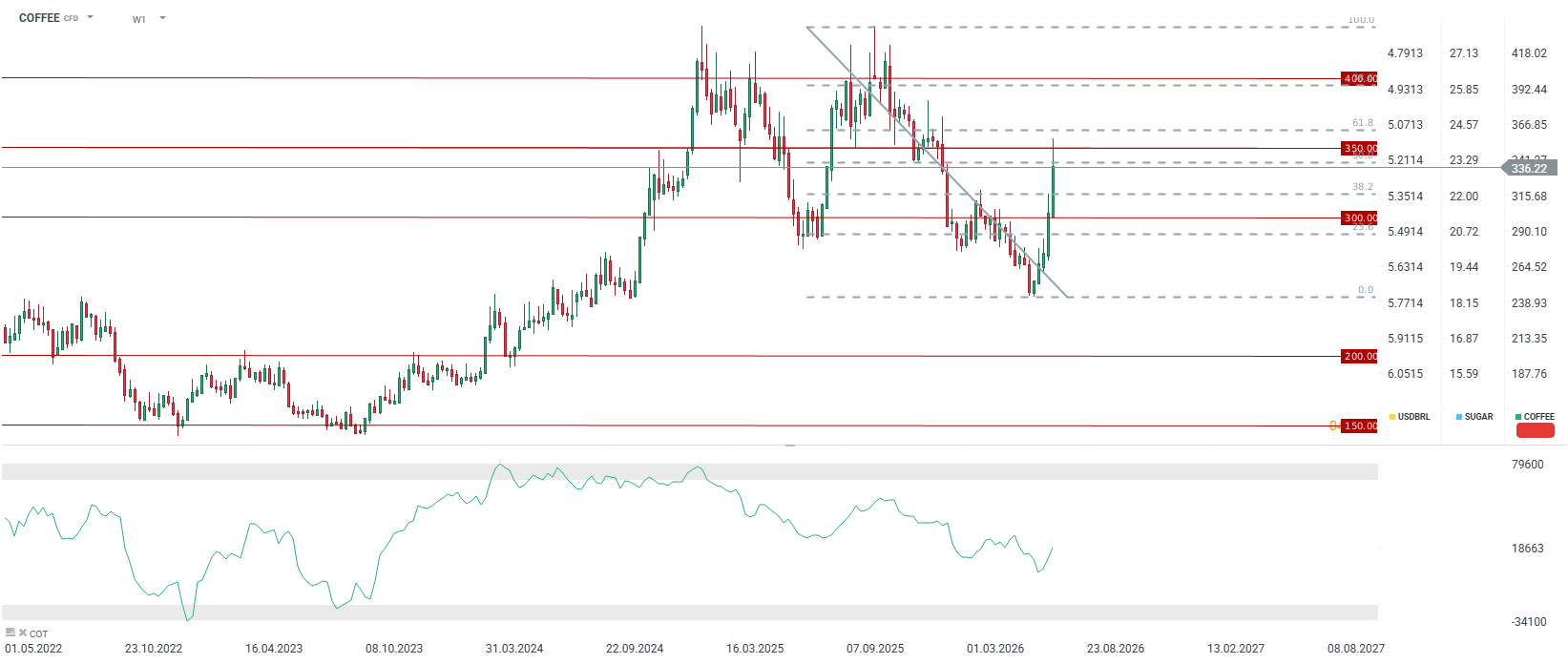 In just 5 weeks, coffee recovered almost 8 months of losses. Source: xStation5



Daily Summary: SpaceX and the tech sector drive Wall Street, oil retreats sharply below $97


📉NATGAS loses 6% ahead of rollover


Russia is selling off gold reserves. Why, to whom, and does it matter for the market?

BREAKING: US oil inventories fall more than expected, but distillate build cools enthusiasm
This content has been created by XTB S.A. This service is provided by XTB S.A., with its registered office in Warsaw, at Prosta 67, 00-838 Warsaw, Poland, entered in the register of entrepreneurs of the National Court Register (Krajowy Rejestr Sądowy) conducted by District Court for the Capital City of Warsaw, XII Commercial Division of the National Court Register under KRS number 0000217580, REGON number 015803782 and Tax Identification Number (NIP) 527-24-43-955, with the fully paid up share capital in the amount of PLN 5.869.181,75. XTB S.A. conducts brokerage activities on the basis of the license granted by Polish Securities and Exchange Commission on 8th November 2005 No. DDM-M-4021-57-1/2005 and is supervised by Polish Supervision Authority.