


- BOE expected to remain concerned about inflation
- How does it balance weak jobs with a strengthening economic outlook?
- What next for the pound?
- ECB to maintain flexibility
- Strong euro could be area of concern

- BOE expected to remain concerned about inflation
- How does it balance weak jobs with a strengthening economic outlook?
- What next for the pound?
- ECB to maintain flexibility
- Strong euro could be area of concern
The Bank of England and the ECB will announce their latest policy decisions on Thursday. Neither bank is expected to change interest rates, however the focus will be on when or if they signal that further rate cuts are coming down the line.
Bank of England: how to balance stronger growth outlook with weakening jobs market
Looking at the Bank of England first, there are currently 1.4 rate cuts priced in by the overnight index swaps market. The next rate cut is not expected until June, it was previously April, however, stronger than expected inflation data for December has pushed rate cut expectations further into the future. Interest rates are expected to end this year at approximately 3.35%, which suggests that, for now, the neutral interest rate for the UK is above 3%.
Investors want to see how the BOE balances a noticeably weaker jobs market with signs that the growth outlook is improving for the UK. Business activity is notably stronger in the last two months. The January composite PMI has risen to its highest level since August 2024, and has made a strong recovery since a period of weakness in Q3. The services PMI reading also picked up and has nearly eroded last year’s period of weakness.
The Citi economic surprise index for the UK has also improved, however there is still room for improvement and we expect the BOE to flag this. Consumer confidence has picked up but remains at a low level and business confidence is showing some signs of improvement. However, we think that growth prospects for the UK are not strong enough for the BOE to rule out further rate cuts.
Inflation concerns
Inflation will also be up for discussion. The MPC is divided between members who believe that inflation is still too high, and those who think that the rising unemployment rates will help to moderate inflation pressures down the line. In the year to November, there were 155,000 fewer payrolled employees and redundancy rates have also crept up.
The BOE is expected to confirm that it expects inflation to fall back to target, the question is, will they point to that happening this year or next? In their last Monetary Policy Report in November, the BOE expected inflation to fall to the 2% target rate over the next year, but it said that scenario was not assured and the Bank needed to see more evidence that inflation was moderating.
The moderation in private sector wage growth, wages moderated to 3.6% in the 3 months to November, down from 3.9%, could give the BOE some confidence about the outlook for price growth. It will be interesting to see how the Bank reacts to this news and whether it will be enough to persuade some of the ardent hawks that the outlook for inflation is improving.
Also worth noting will be any commentary about AI adoption. Tech stocks have swooned after Anthropic launched its latest Claude Cowork plugin. A rapid adoption of AI tools like this could boost productivity and potentially bring down inflation pressures in the UK and elsewhere. If the Bank mentions this as a possibility for the UK, we could see a reduction in long-term bond yields and interest rate expectations.
Analysts expect a 7-2 split at the MPC in favour of maintaining interest rates at 3.75%, with two members voting for a second consecutive cut. While we think that most MPC members will want to see the inflation picture improve further before committing to further rate cuts, one member could be swayed to vote for a cut on Thursday, and this might be seen as dovish.
How political turmoil could delay rate cuts
Another factor to consider is the political turmoil surrounding the Prime Minister. The Daily Telegraph reported that former MPC member Michael Saunders warned that a Labour leadership coup risks keeping interest rates in the UK higher for longer, especially if Angela Raynor or Andy Burnham take over as PM. This could shift the UK’s economic policies even further to the left, with more tax and spend policies, which would require monetary policy staying tighter for longer. While we don’t expect the BOE governor to wade into political debate on Thursday, this may be a consideration for the committee down the line.
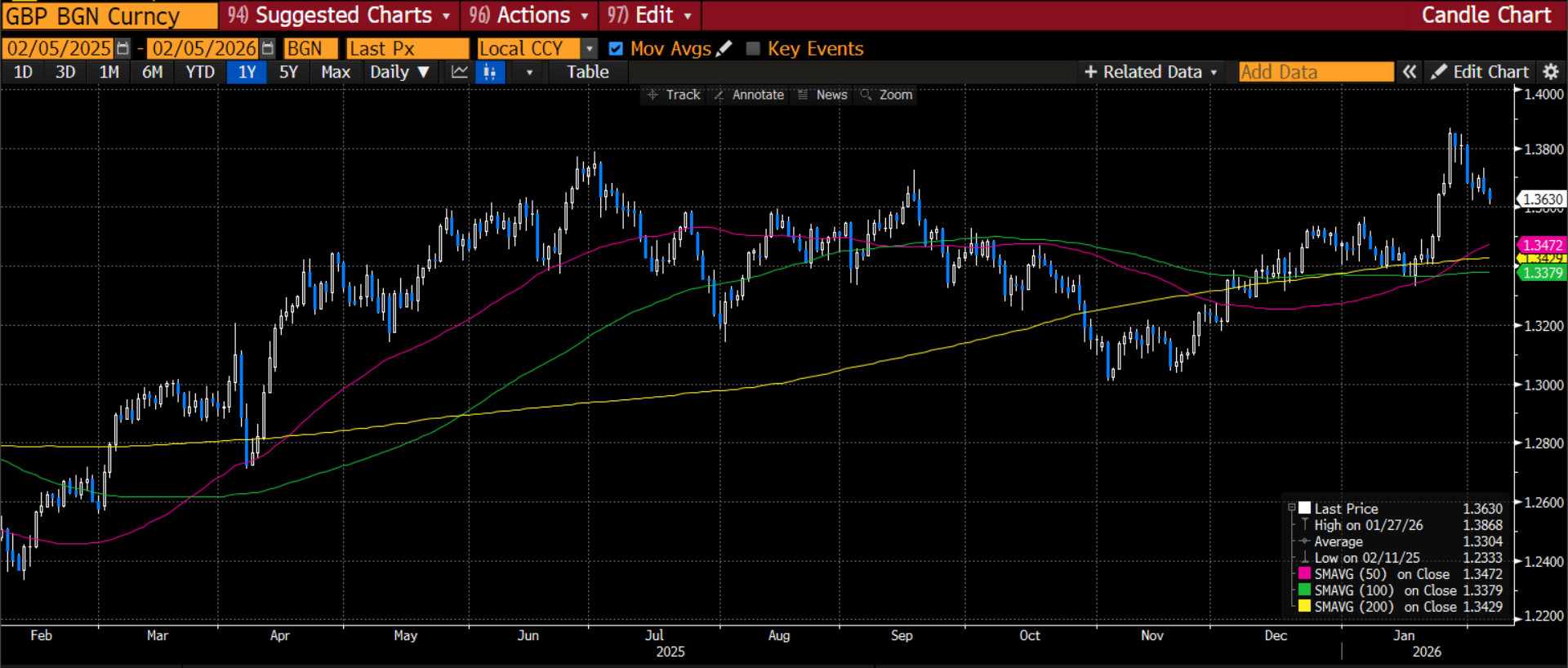
The pound has strengthened vs, the dollar since the start of this year and is higher by nearly 1.5%. However, it is moving sideways into this meeting. GBP/USD has lost the $1.37 handle as we lead up to this meeting. With short term momentum to the downside, any signs of a dovish BOE could push GBP lower, with a move back towards $1.35 possible.
Chart 1: GBP/USD daily chart
Source: XTB and Bloomberg
The ECB: Will ECB remain in a good place if inflation keeps falling?
The ECB is expected to keep rates on hold when they meet on Thursday for the fifth consecutive meeting. The ECB said that it would keep total flexibility when it comes to future rate decisions at its meeting in December. This month, the focus will be on how the ECB reacts to weaker than expected inflation in the currency bloc.
Price growth in the Eurozone fell to 1.7% last month on an annual basis, and prices dropped month on month in January by 0.5%. There was some variance across the 21 states, German inflation was 2.1%, while French CPI fell to a 5-year low at 0.4%. There is a minority of doves at the ECB who are worried that inflation will continue to undershoot the ECB’s inflation target, which could lead to deflation gripping the bloc. Combined with weak inflation, Donald Trump’s tariff threat earlier this year, although reversed, highlights the risks to the Eurozone’s rosy growth forecast for this year of 1.2%.
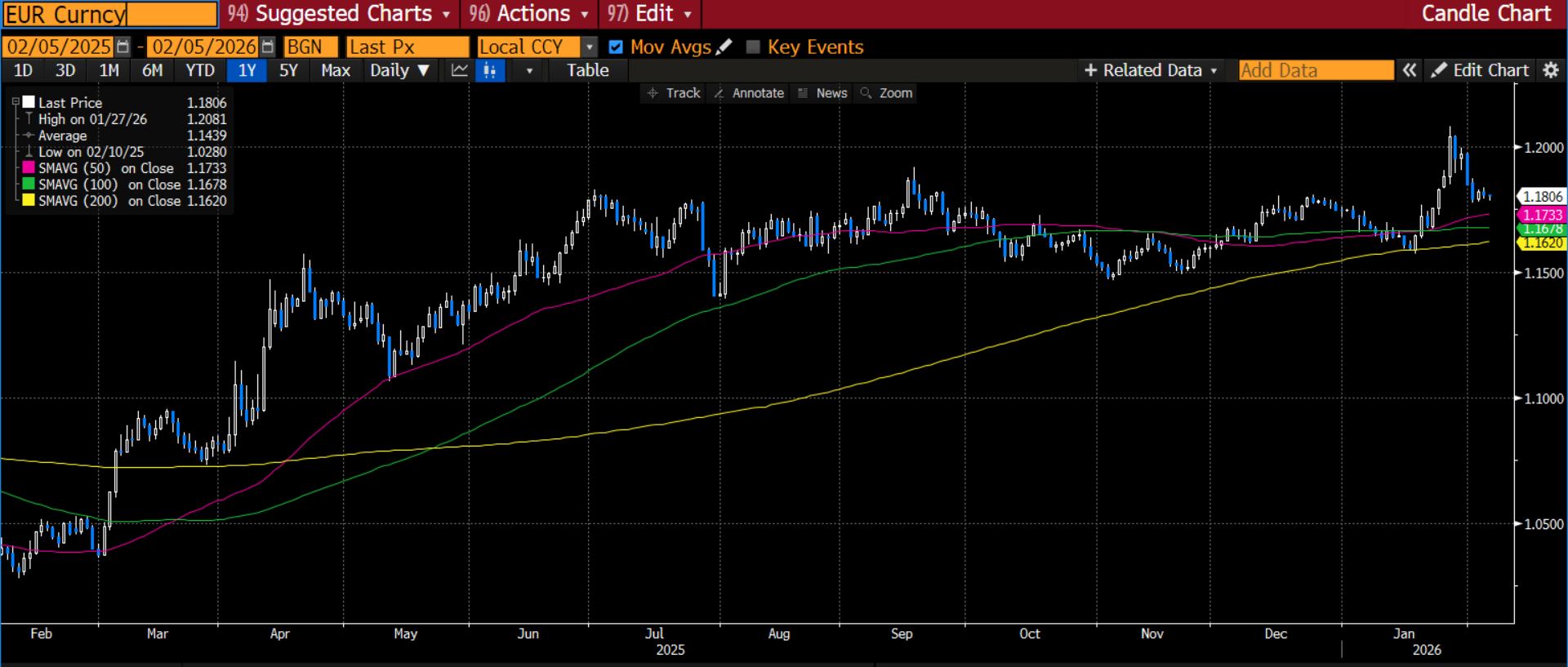
The doves will likely call for rate cuts in the coming months, especially as a strong euro poses another deflationary risk. EUR/USD reached its highest level since 2021 in January. Although it has pulled back from this level, it remains elevated and is above the 5-year average rate of $1.1050. This comes at a bad time for exporters as tariff threats remain a real and present danger. If Christine Lagarde talks down the euro or suggests that the euro has become untethered from fundamentals, then we could see further weakness for the single currency. There are a cluster of SMAs between $1.620 - $1.1730, which could act as decent support if there is further downside for the euro that stems from today’s ECB meeting.
Chart 1: EUR/USD daily chart
Source: XTB and Bloomberg



Inflation data causes market havoc


US inflation concerns rise

US CPI above expectations!🔥📈



Market Wrap: ASML lifts tech sentiment, EU yields pull back
This content has been created by XTB S.A. This service is provided by XTB S.A., with its registered office in Warsaw, at Prosta 67, 00-838 Warsaw, Poland, entered in the register of entrepreneurs of the National Court Register (Krajowy Rejestr Sądowy) conducted by District Court for the Capital City of Warsaw, XII Commercial Division of the National Court Register under KRS number 0000217580, REGON number 015803782 and Tax Identification Number (NIP) 527-24-43-955, with the fully paid up share capital in the amount of PLN 5.869.181,75. XTB S.A. conducts brokerage activities on the basis of the license granted by Polish Securities and Exchange Commission on 8th November 2005 No. DDM-M-4021-57-1/2005 and is supervised by Polish Supervision Authority.