



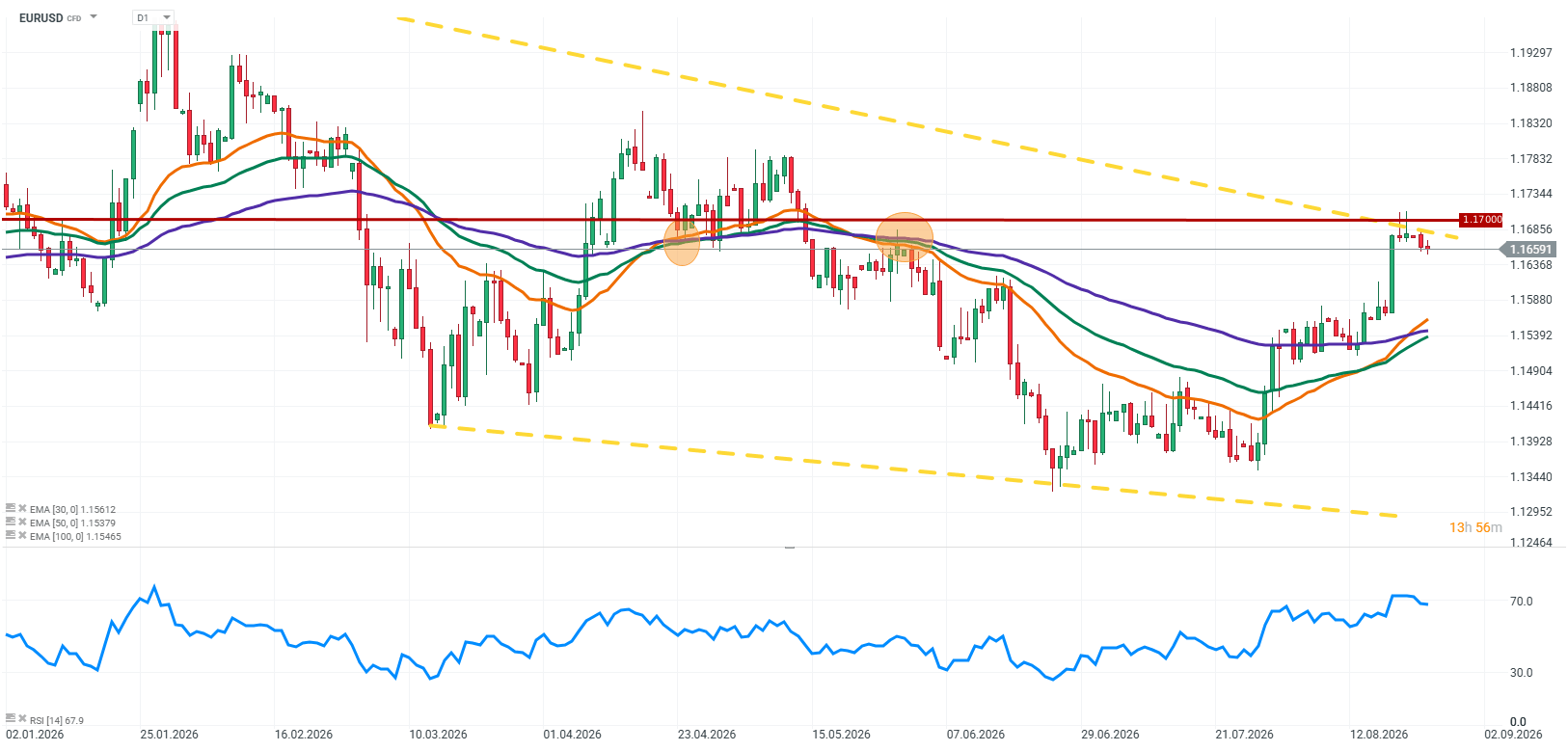
Tuesday’s EURUSD session is seeing the dollar strengthen slightly, but the situation in the foreign exchange market remains much more complicated than it was just a few days ago. The euro-dollar pair has pulled back from around 1.17, but a number of developments are emerging in the background that could have a much greater impact on the US currency over the coming weeks.
One of the most important issues is the activity of the US Treasury Department, led by Scott Bessent, in the bond market. The Treasury has decided to double the size of its quarterly buyback operations for longer-term bonds. At the same time, Bessent announced that the regular schedule of US debt auctions would remain unchanged. The first larger operations are expected to begin in September.
Bessent’s actions could become one of the most important themes for the dollar. The Treasury is attempting to reduce pressure on long-term yields, while the US bond market continues to grapple with high debt levels, substantial borrowing needs and elevated debt-servicing costs.
At the same time, tomorrow we will receive the latest US PCE inflation data, the consumer inflation measure preferred by the Federal Reserve. The market currently expects core PCE inflation to remain around 3.3% year over year, unchanged from June.
In Europe, meanwhile, today’s German data attracted attention. Gross domestic product rose by 0.3% quarter over quarter in the second quarter, stronger than the previous estimate had indicated.
All of this leaves EURUSD at a particularly interesting juncture. On the dollar side, there is short-term support coming from high bond yields and geopolitical uncertainty, but there are also growing questions surrounding US Treasury policy and the situation in the debt market. On the euro side, the picture of the German economy has improved somewhat, while expectations for a more restrictive monetary policy from the European Central Bank remain in place.
Source: xStation5
Factors currently shaping EURUSD
Scott Bessent is becoming increasingly important for the dollar market
In recent days, the US bond market has become one of the most important themes in financial markets. The yield on 30-year US Treasury bonds had previously risen to its highest level since 2007. In response, the Treasury Department decided to increase the scale of its buyback operations for longer-term debt.
Bessent is seeking to improve market liquidity and reduce pressure on the long end of the yield curve. At the same time, the Treasury does not intend to reduce regular bond auctions, which is significant given that the US government still requires enormous amounts of financing.
This is particularly interesting from the perspective of EURUSD. The Treasury’s actions show that high bond yields have become a sufficiently serious issue for US authorities to actively attempt to influence market functioning.
This does not mean, of course, that Treasury bond buybacks are equivalent to the quantitative easing conducted by the Federal Reserve. These are operations related to debt management and market liquidity. Their significance lies in the fact that they demonstrate the growing sensitivity of the US administration to the level of long-term yields.
If investors conclude that the Treasury’s actions are effective, yields could decline and pressure on the dollar could increase. If, however, the market decides that buybacks do not solve the problem of high debt levels and enormous US borrowing needs, long-term yields could move higher again.
Markets await US PCE inflation data
Another major event will be Wednesday’s release of PCE inflation data from the United States.
In June, core PCE inflation stood at 3.3% year over year, compared with 3.4% in May. Current market expectations point to the figure remaining around 3.3% in July.
Such a reading would not be a major surprise, but it would also mean that inflation remains well above the Federal Reserve’s 2% target. This is important because the market currently has to reconcile two different signals coming from the US economy.
On the one hand, weaker labor market data have reduced expectations for further monetary tightening. On the other hand, inflation has still not returned to a level that would allow the Federal Reserve to focus entirely on supporting the labor market.
If PCE comes in below expectations, US Treasury yields could come under pressure and the dollar could lose some of its strength again. For EURUSD, this would be a positive signal.
A stronger-than-expected reading would have the opposite effect. In such a scenario, markets could once again price in a greater likelihood of interest rates remaining elevated in the US, providing additional support for the dollar.
German GDP gives the euro another argument
On the euro side, today’s German data were somewhat better than previously expected.
German GDP increased by 0.3% quarter over quarter in the second quarter and by 1% year over year. The previous estimate had pointed to quarterly growth of 0.2%. This is not yet evidence of a strong recovery in the German economy. However, the data suggest that the situation is somewhat better than previously assumed.
For the euro, this is also important in the context of European Central Bank policy. If the economy of the euro area’s largest country begins to show greater resilience, the arguments for a more cautious approach to interest-rate cuts become stronger.
The market still expects the ECB could decide to raise interest rates in September.
In addition, the Ifo index is being released today, providing insight into how German companies assess current conditions and the economic outlook. This is another important piece of the puzzle for the euro.
The Fed and Treasury are becoming equally important to the market
This is currently one of the most interesting aspects of the EURUSD story.
Until recently, the main issue for the dollar was the difference between Federal Reserve and European Central Bank policy. The situation is now more complicated. Markets must simultaneously assess Federal Reserve policy, the US fiscal situation and the actions of the Treasury Department.
High bond yields are a problem for both the US government and the broader economy. On the one hand, they increase the cost of servicing government debt; on the other, they raise financing costs for businesses and households.
This is why Bessent’s actions also matter for the foreign exchange market. If the Treasury becomes increasingly active in trying to limit the rise in yields, this could weaken one of the dollar’s important advantages stemming from high interest rates and elevated US Treasury yields.
At the same time, the Treasury’s actions are raising more questions about Bessent’s credibility and the effectiveness of the measures being taken. The market initially reacted positively to the news of the buyback operations, but yields subsequently began rising again.
This could be an important signal for the dollar. If investors begin to believe that US authorities have limited ability to influence the long end of the yield curve, elevated yields could remain one of the key themes for the US currency.
Jackson Hole could be another turning point
The list of events that matter for EURUSD does not end there.
On Friday, markets will focus on a speech by Federal Reserve Chair Kevin Warsh at the Jackson Hole symposium. It will be particularly important because investors are looking for clues about the future direction of monetary policy.
Warsh faces a difficult balancing act. Inflation remains above the Federal Reserve’s target, long-term bond yields are high, while the labor market is showing weaker signals.
Another issue is the growing importance of fiscal policy and Treasury actions. Markets will therefore pay attention not only to what Warsh says about interest rates, but also to his views on inflation, bond yields and the independence of the Federal Reserve.
If Warsh adopts a more hawkish tone, the dollar could receive additional support. If, on the other hand, he signals a greater willingness to ease monetary policy, pressure on the US currency could increase.
Key takeaways
-
Scott Bessent’s actions in the US Treasury market are becoming one of the more important themes for the dollar.
-
The Treasury has doubled the size of its quarterly buyback operations for longer-term bonds, increasing the minimum value of each operation from $2 billion to at least $4 billion.
-
At the same time, the Treasury does not intend to reduce regular debt auctions, highlighting the scale of the US government’s financing needs.
-
Tomorrow, markets will receive the latest PCE inflation data, with core PCE currently expected to remain around 3.3% year over year.
-
A higher-than-expected PCE reading could increase expectations that US interest rates will remain elevated and support the dollar.
-
A weaker-than-expected reading could push bond yields lower again and increase pressure on the dollar.
-
German GDP grew by 0.3% quarter over quarter in the second quarter, stronger than the previous estimate of 0.2%, providing the euro with another fundamental argument.
-
On Friday, markets will focus on Kevin Warsh’s speech at Jackson Hole, which could be crucial for expectations surrounding the future course of Federal Reserve policy.
-
The key question for EURUSD is currently not only what the Federal Reserve will do, but also whether Treasury actions will be able to reduce pressure on the US debt market.



Daily Summary: Wall Street Rises Ahead of Tomorrow's Fed Meeting💡



The US100 gets back on track and gains 1%📈



Gold Falls Below $4,000


Chart of the Day: USDJPY Caught in a Trap. Tokyo Intervention and a Hawkish BoJ Loom
This content has been created by XTB S.A. This service is provided by XTB S.A., with its registered office in Warsaw, at Prosta 67, 00-838 Warsaw, Poland, entered in the register of entrepreneurs of the National Court Register (Krajowy Rejestr Sądowy) conducted by District Court for the Capital City of Warsaw, XII Commercial Division of the National Court Register under KRS number 0000217580, REGON number 015803782 and Tax Identification Number (NIP) 527-24-43-955, with the fully paid up share capital in the amount of PLN 5.869.181,75. XTB S.A. conducts brokerage activities on the basis of the license granted by Polish Securities and Exchange Commission on 8th November 2005 No. DDM-M-4021-57-1/2005 and is supervised by Polish Supervision Authority.