



USDJPY remains one of the key topics in the foreign exchange market following the recent reaction by Japanese authorities to the sharp depreciation of the yen. The pair has once again come under selling pressure and moved toward the 158 area, falling below the 160 level, which has repeatedly been described by Japanese government officials as a level requiring particular attention.
The currency market intervention delivered a short-term effect. The yen strengthened significantly, and USDJPY moved away from the psychological 160 level. However, the key question that remains is whether this move can be sustained. History shows that currency intervention can effectively limit sharp exchange-rate movements, but without a change in the fundamental factors behind a currency’s weakness, its impact is often limited in duration.
In the short term, USDJPY may continue declining and move toward the 157 level. From a technical perspective, the market has received a signal that the area around 160 remains a level where Japanese authorities are prepared to respond decisively. In the longer term, however, the outlook for the yen remains challenging, as the main factor influencing the exchange rate — the interest rate differential between the United States and Japan — continues to work against the Japanese currency.
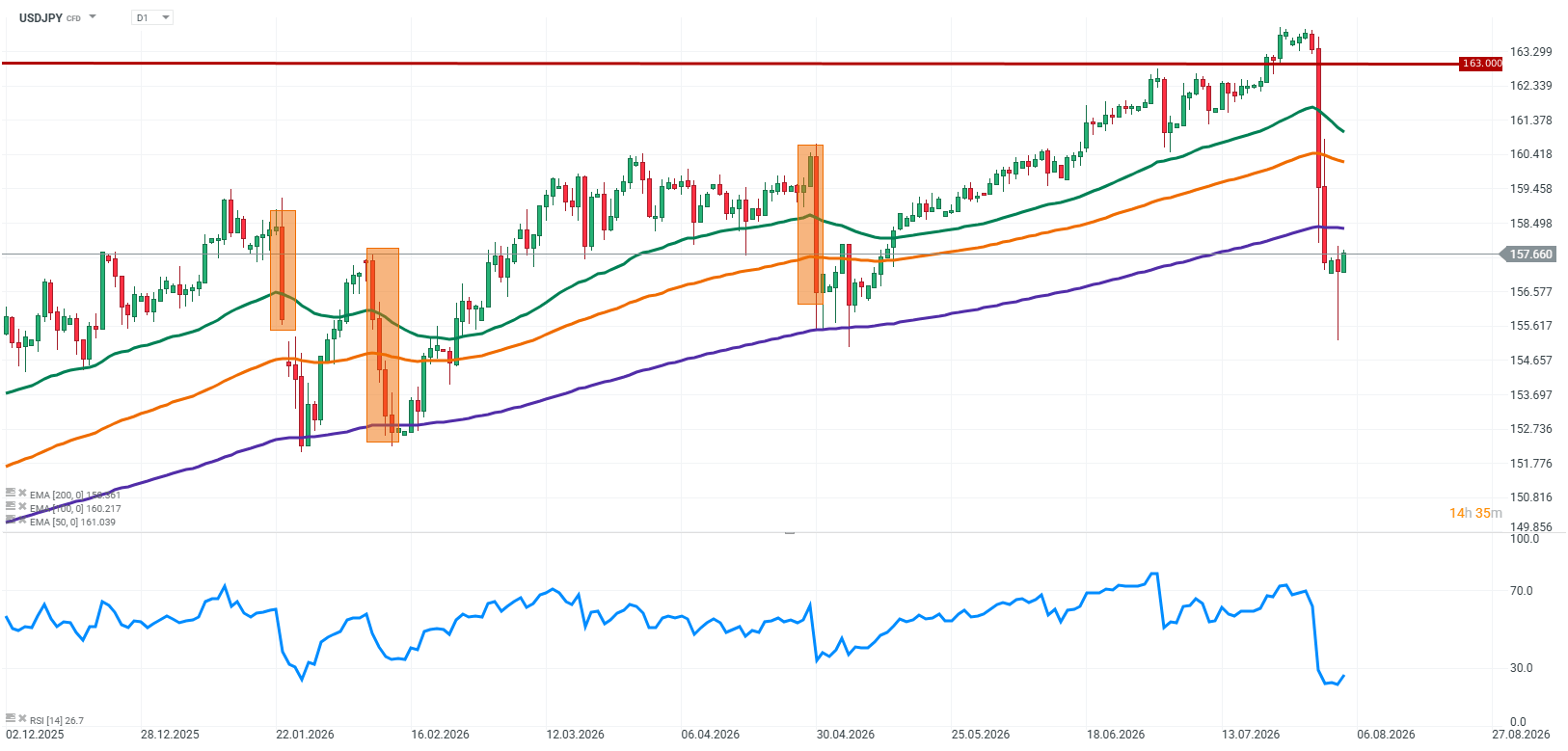
Source: xStation5
Factors Currently Shaping USDJPY
Japan’s Intervention Stopped the Move, but Did Not Solve the Yen’s Problem
The most important event of recent days was the reaction of Japanese authorities to the yen’s weakening. A move above 160 on USDJPY was considered too rapid and unfavorable, increasing pressure on households and businesses through higher import costs.
The actions taken in the foreign exchange market helped limit the scale of the yen’s depreciation and pushed USDJPY below the 160 level. The market received a clear signal that Japan is willing to intervene if currency movements become excessively rapid.
However, the problem is that intervention does not change the underlying fundamentals. If the interest rate gap between the United States and Japan remains wide, pressure on the yen may return.
Therefore, the key question is no longer whether Japan can stop USDJPY from rising, but how long it can maintain the effects of such intervention without additional support from monetary policy.
Fed and BoJ: Interest Rate Differential Still Works Against the Yen
One of the most important factors for USDJPY remains the monetary policy stance of both central banks.
At its latest meeting, the Federal Reserve kept interest rates unchanged. Markets reduced expectations for further rate hikes in the United States, but US interest rates remain at very high levels compared with Japan.
On the other side, the Bank of Japan began its rate-hiking cycle this year and has clearly indicated that the current move may not be the last. Markets are pricing in the possibility of another rate increase this year, especially if inflation and wage growth remain at appropriate levels.
Even if the BoJ decides on another rate hike, the scale of the interest rate gap between the US and Japan will remain significant. This factor has been the main argument behind selling the yen for many months and remains one of the biggest challenges facing the Japanese currency.
Bank of Japan Is Changing Its Stance, but the Yen Needs More Support
The start of a rate-hiking cycle by the Bank of Japan is an important shift after many years of ultra-loose monetary policy. Markets are increasingly focusing on the possibility of further policy normalization by the Japanese central bank.
The problem, however, remains the pace of these changes. The BoJ continues to act cautiously because Japan’s economy is significantly more sensitive to higher financing costs than the US economy.
For the yen, it will therefore be crucial not only whether the BoJ raises interest rates, but also whether markets believe the central bank is prepared to continue this process in the coming months.
If expectations for the BoJ rise faster than expectations for the Fed, the yen could receive additional support. At this stage, however, the interest rate differential remains the main challenge for the Japanese currency.
Oil and the Persian Gulf Increase Risks for the Yen
Another factor affecting USDJPY is the geopolitical situation and energy prices.
Tensions around the Persian Gulf and the risk of disruptions to oil supplies remain important market factors. Japan, as an economy heavily dependent on energy imports, is particularly vulnerable to rising oil prices.
Higher energy costs may increase inflationary pressure in Japan, while at the same time worsening the country’s trade balance through higher import expenses. Historically, such factors have often had a negative impact on the yen.
Additionally, during periods of rising geopolitical uncertainty, the US dollar often benefits as a global safe-haven currency. This means that even amid challenges facing the US economy, the dollar may remain supported against the yen.
Japan’s Fiscal Risks Are Another Challenge for the Currency
Beyond monetary policy, the market is paying increasing attention to Japan’s fiscal situation.
Plans to increase public spending and possible tax cuts are raising questions about further growth in the country’s debt burden. For the currency market, the key issue is whether fiscal policy will support economic growth or increase concerns about the sustainability of public finances.
If markets conclude that Japan will pursue a more expansionary fiscal policy without sufficient spending control, this could limit the potential for further yen appreciation.
USDJPY Ahead of Another Test
The current decline in USDJPY shows that the 160 level remains a threshold where Japanese authorities are prepared to intervene. In the short term, the pair may continue moving lower, particularly if markets further reduce expectations regarding Fed policy.
In the longer term, however, the situation remains more complicated. The yen continues to face pressure due to the large interest rate differential between the United States and Japan, and currency intervention alone does not change the fundamental market picture.
The future direction of USDJPY will depend primarily on whether the Fed begins easing monetary policy faster or whether the Bank of Japan delivers more aggressive interest rate increases.
For now, the market has received a clear signal that the area around 160 is being defended by Tokyo. The remaining question is whether this will be only a short-term correction or the beginning of a more lasting change in the yen trend.
Key Takeaways
-
Japan’s intervention pushed USDJPY below the 160 level, but the sustainability of the move remains the biggest uncertainty.
-
In the short term, the pair may move toward 157, but long-term pressure on the yen remains.
-
The Fed continues to maintain high interest rates, and the difference between US and Japanese monetary policy remains unfavorable for the yen.
-
The Bank of Japan has started a rate-hiking cycle, and markets are pricing in the possibility of another move, but the interest rate gap remains significant.
-
Oil prices and geopolitical tensions may further affect the yen through higher energy import costs and increased risk aversion.
-
The future direction of USDJPY will depend mainly on whether changing expectations regarding the Fed occur faster than further monetary policy normalization by the BoJ.



Three markets to watch next week (23.10.2026)

BREAKING: France slows down, Germany holds on. Euro falls below 1.12

Chart of the Day: Is USDJPY running out of road? Inflation forces the BoJ to act, but the Fed could spoil the Yen’s rally



Macro Calendar: Preliminary PMI Readings and Earnings Ahead
This content has been created by XTB S.A. This service is provided by XTB S.A., with its registered office in Warsaw, at Prosta 67, 00-838 Warsaw, Poland, entered in the register of entrepreneurs of the National Court Register (Krajowy Rejestr Sądowy) conducted by District Court for the Capital City of Warsaw, XII Commercial Division of the National Court Register under KRS number 0000217580, REGON number 015803782 and Tax Identification Number (NIP) 527-24-43-955, with the fully paid up share capital in the amount of PLN 5.869.181,75. XTB S.A. conducts brokerage activities on the basis of the license granted by Polish Securities and Exchange Commission on 8th November 2005 No. DDM-M-4021-57-1/2005 and is supervised by Polish Supervision Authority.