


- ICE cocoa futures have slipped back below $6,000 per tonne, pausing the sharp rally seen over the previous two trading sessions.
- Market participants are concerned that below-average rainfall and cooler weather could reduce the potential of the upcoming main cocoa crop in Ivory Coast.
- Despite cocoa arrivals in Ivory Coast rising 21.8% since the start of the current season, investors are increasingly focused on production risks for the 2026/27 crop year.

- ICE cocoa futures have slipped back below $6,000 per tonne, pausing the sharp rally seen over the previous two trading sessions.
- Market participants are concerned that below-average rainfall and cooler weather could reduce the potential of the upcoming main cocoa crop in Ivory Coast.
- Despite cocoa arrivals in Ivory Coast rising 21.8% since the start of the current season, investors are increasingly focused on production risks for the 2026/27 crop year.
ICE cocoa futures are trading slightly lower today after surging over the past two sessions, as the market pauses following a strong rally driven by growing concerns over the 2026/27 crop outlook in West Africa. Although the current season has delivered a significant improvement in supply, investors are already focusing on the next harvest, which could be negatively affected by unfavorable weather conditions.
The market is pricing in weaker harvests and rising weather risks
The main driver behind the recent rally is growing concern over future cocoa supplies from West Africa, which accounts for the majority of global cocoa production. Farmers in Ivory Coast say plantations need more sunshine after a period of below-average rainfall and cooler temperatures. If weather conditions fail to improve in the coming weeks, the September-to-February main crop could be negatively affected.
Interestingly, prices are rising despite strong supply data for the current season. Export estimates show that cocoa arrivals at ports in Ivory Coast have reached approximately 1.99 million tonnes since the season began on October 1, representing a 21.8% increase from the same period last year. This suggests that the market is looking beyond current supply and is instead pricing in the risk of weaker production during the next crop cycle.
Cocoa remains one of the most weather-sensitive agricultural commodities. Even a modest deterioration in weather conditions across Ivory Coast and Ghana can quickly translate into a higher weather risk premium in futures prices. As a result, investors are expected to closely monitor rainfall, temperatures, and crop development over the coming weeks, as these factors are likely to determine cocoa's price direction ahead of the new season.
Commitment of Traders (CoT) analysis
From a classical CoT perspective, the market structure as of July 28 remains constructive for bulls:
- Commercial producers and processors continue using higher prices to hedge future production, which is typical behavior for commercial participants.
- Managed Money remains net short in the July 28 report, indicating that speculative positioning has not yet reached euphoric levels.
- Elevated open interest suggests fresh capital is entering the market rather than the rally being driven solely by short covering.
- If weather conditions in Ivory Coast and Ghana continue to deteriorate, hedge funds could be forced to aggressively cover short positions, providing additional upside momentum.
This creates one of the more interesting setups in the commodities market: fundamentals are becoming increasingly bullish, while speculative positioning has yet to reflect full optimism.
Commercials continue hedging production at higher prices
The latest CoT report shows that producers and processors remain firmly net short, holding 55,928 long contracts versus 74,361 short contracts, equivalent to roughly 18,400 net short contracts. This is typical behavior in commodity markets, where producers lock in attractive selling prices rather than speculate on falling prices. On a weekly basis, commercial long positions increased by 1,152 contracts while short positions declined by 1,590, indicating only a modest reduction in overall hedging activity.
Managed Money still has room to fuel further gains
Managed Money continues to hold approximately 8,800 net short contracts (20,277 longs versus 29,050 shorts), suggesting the market has not yet entered a phase of speculative exuberance. If concerns over West African production intensify, hedge funds may be forced to cover these short positions, potentially accelerating the rally. Supporting the bullish case, total open interest remains above 201,000 contracts, indicating that new capital continues to enter the market.
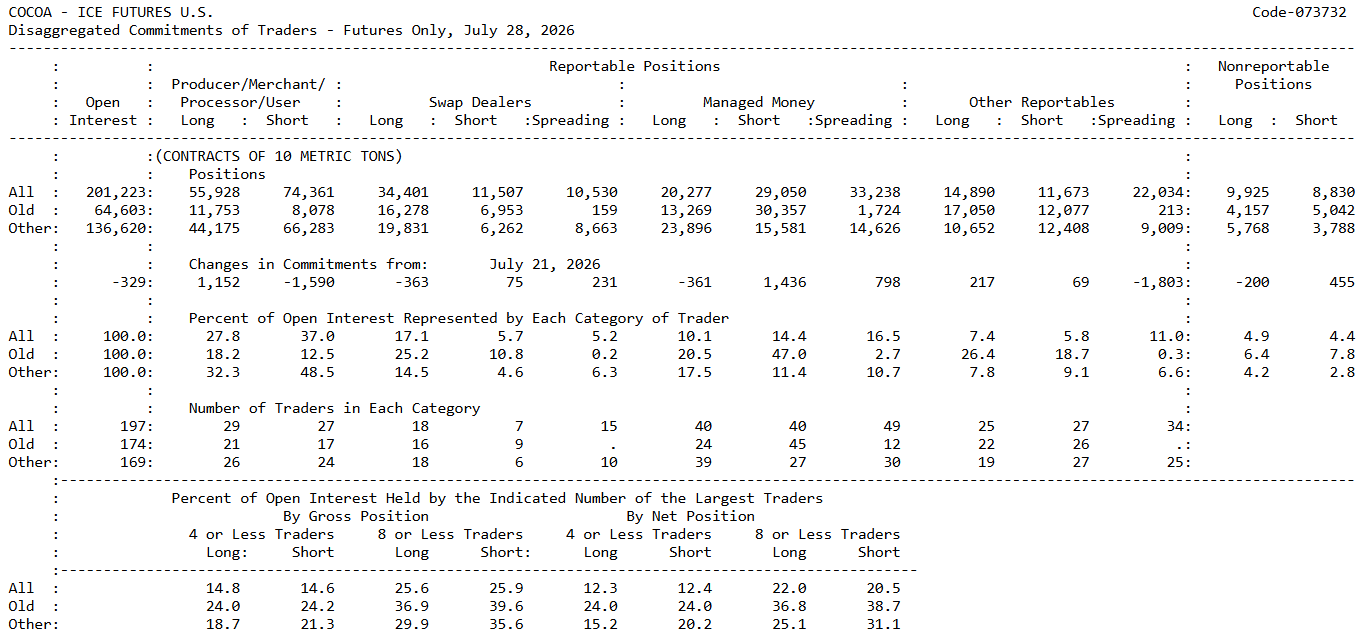
Source: CoT, Commitment of Traders
COCOA chart (D1)
Over the previous two sessions, cocoa futures rallied nearly 10%, climbing from around $5,000 to almost $6,000 per tonne. The market is now undergoing a modest pullback after this sharp advance. Key support remains near $5,000 per tonne, while major resistance is located around $6,000 and $6,500, defined by previous price reaction zones.
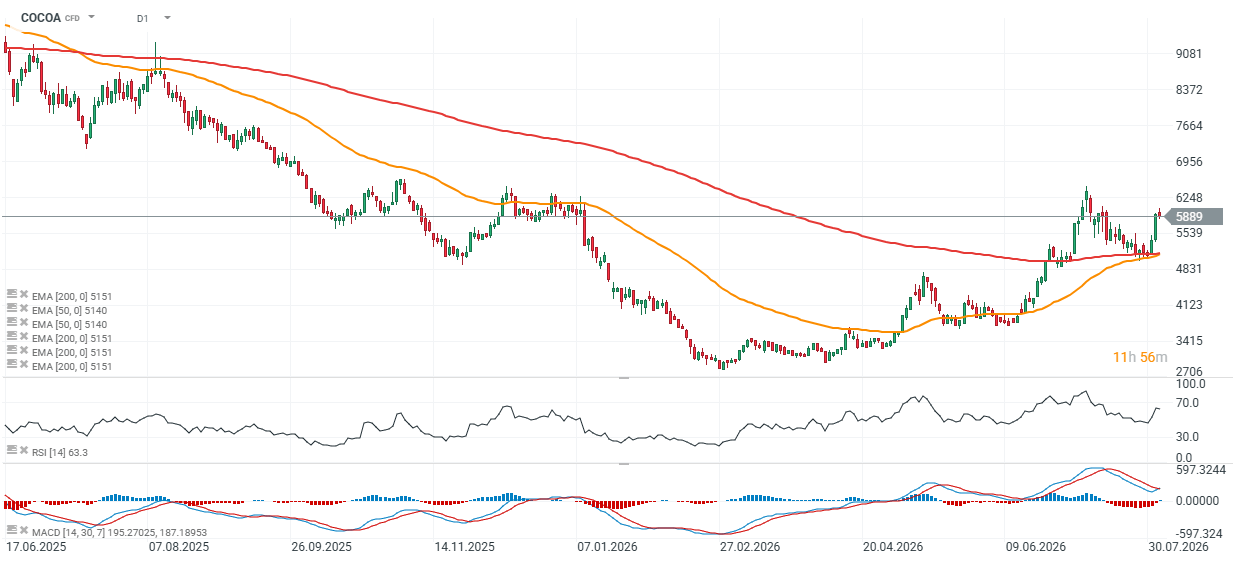
Source: xStation



Daily Summary: Oil at five-month highs, indices under pressure (23.10.2026)


US Open: Further declines on Wall Street, Brent above 111 USD, AI correction continues (14.10.2026)


Chart of the Day: Is USDJPY running out of road? Inflation forces the BoJ to act, but the Fed could spoil the Yen’s rally



Macro Calendar: Preliminary PMI Readings and Earnings Ahead
This content has been created by XTB S.A. This service is provided by XTB S.A., with its registered office in Warsaw, at Prosta 67, 00-838 Warsaw, Poland, entered in the register of entrepreneurs of the National Court Register (Krajowy Rejestr Sądowy) conducted by District Court for the Capital City of Warsaw, XII Commercial Division of the National Court Register under KRS number 0000217580, REGON number 015803782 and Tax Identification Number (NIP) 527-24-43-955, with the fully paid up share capital in the amount of PLN 5.869.181,75. XTB S.A. conducts brokerage activities on the basis of the license granted by Polish Securities and Exchange Commission on 8th November 2005 No. DDM-M-4021-57-1/2005 and is supervised by Polish Supervision Authority.