



The main drivers of market volatility were sharp spikes in U.S. Treasury yields and conflicting reports from the Middle East. Yields on 30-year U.S. Treasuries reached their highest levels since 2004, while yields on 10-year Treasuries exceeded five percent. Investors fear that a prolonged period of high interest rates will hurt corporate valuations and increase financing costs for consumers. Additionally, the growing likelihood of another rate hike by the Federal Reserve in October is keeping markets on edge.
Market attention focused on reports of a potential agreement between the United States and Iran regarding the opening of the Strait of Hormuz, which were, however, quickly denied by the Iranian side. At the same time, Israel stated that the chances of an agreement were slim. Meanwhile, a crucial meeting between President Donald Trump and Chinese leader Xi Jinping began in Washington. The two leaders agreed to extend the temporary trade truce until January 10, thereby avoiding a further escalation of tariffs for the time being. However, no breakthrough agreements on issues such as artificial intelligence or geopolitical security have been reached at this time.
The recently released economic indicators for the United States showed surprising resilience in the industrial and service sectors. However, the strong economic data is causing concern among investors, as it could fuel inflationary pressures and force further monetary tightening. Federal Reserve officials are emphasizing the need to bring inflation back to target, suggesting the possibility of further interest rate hikes. As a result, the market is currently pricing in a higher probability of a rate hike at the U.S. central bank’s next meeting.
U.S. indices ended the day without a clear direction, showing significant volatility during the session. The S&P 500 held steady around its benchmark level, while the Dow Jones posted a noticeable decline. European stock markets mostly closed lower due to pressure from rising energy prices and higher bond yields in the eurozone. The STOXX 600 index lost nearly one percent.
On the stock market, attention was drawn to sharp declines and gains in individual technology and consumer stocks. Oracle shares plummeted following reports that the company had invoked force majeure regarding a data center project, which in turn led to a decline in Bloom Energy shares. Among consumer companies, PepsiCo saw its stock fall in response to reports of planned price increases for its products at the end of the year. Meta Platforms stood out positively thanks to optimism surrounding new artificial intelligence solutions, as did GoDaddy following news of a potential takeover bid. In Europe, shares of the Swedish apparel company H&M lost value despite strong financial results.
The U.S. dollar strengthened slightly against a basket of major currencies, driven by rising Treasury yields. The EUR/USD exchange rate remained close to its benchmark level, showing very limited volatility. The Polish zloty weakened slightly against both the U.S. dollar and the euro. The Japanese yen lost value amid persistent global interest rate differentials.
Crude oil prices were highly volatile, initially falling in response to reports of talks with Iran and then rebounding after those reports were corrected. A barrel of Brent crude remained above the $100 level, serving as a key inflationary factor (the different reaction in WTI and OIL stems from the rollover of the OIL (Brent) futures contract). Gold prices continued their downward trend, reaching their lowest levels since mid-September, driven by a strong dollar and rising yields. Natural gas was the clear leader among gainers, with prices jumping by nearly 10 percent, though this was largely a reaction to the futures contract rollover.
The digital asset market has shown exceptional stability amid high volatility in traditional stock markets. The price of Bitcoin recorded a slight increase and remained at a high level above eighty-four thousand dollars. Investors in this market adopted a wait-and-see approach, focusing primarily on developments surrounding U.S. bonds and the technology sector.
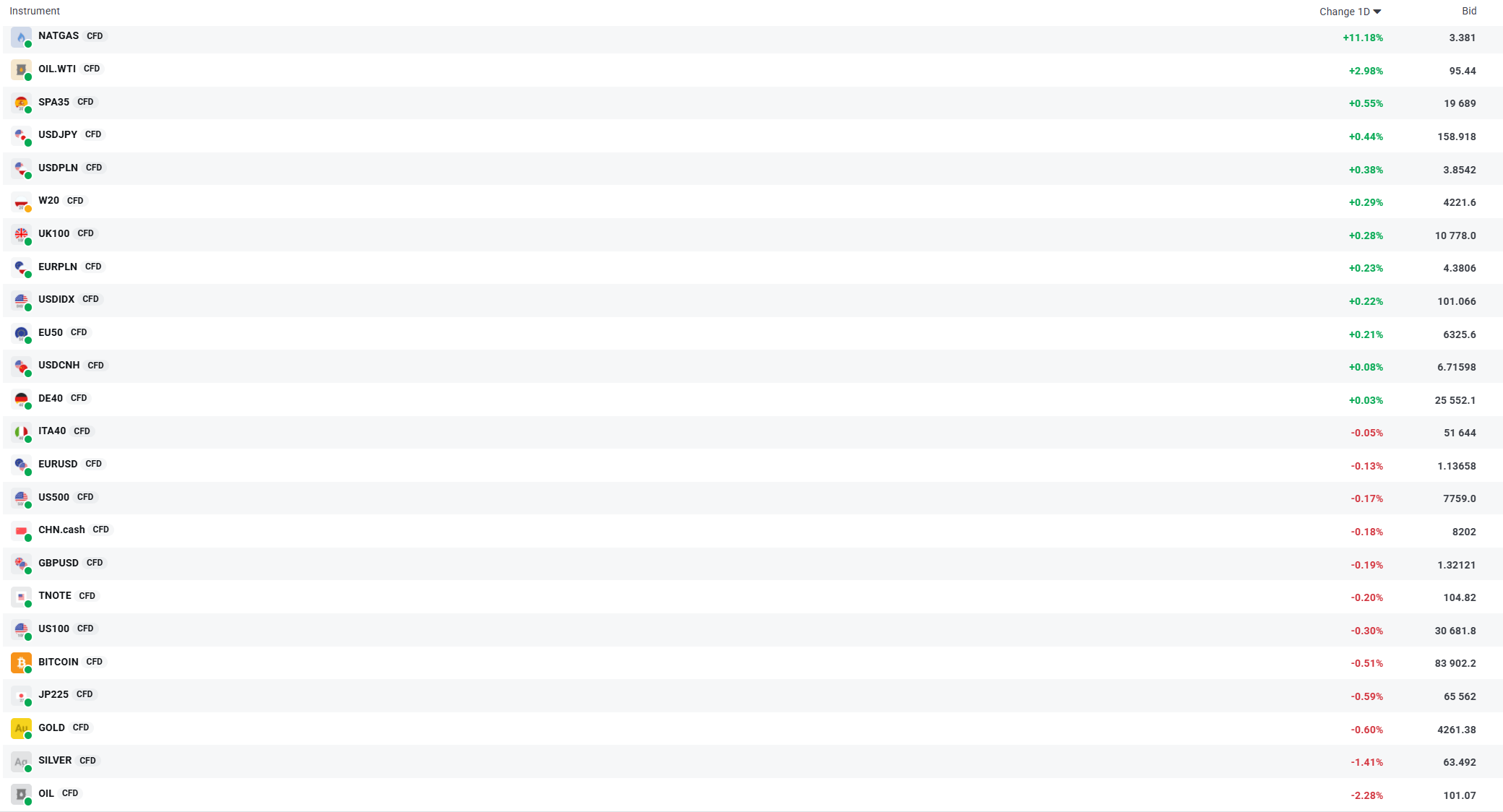
Volatility at the end of the trading session was evident across major financial instruments. Source: XTB



Daily Summary: Rising inflation weighs on markets, semiconductors suffer most (14.10.2026)


US Open: CPI reading weighs on American indices (14.10.2026)



Inflation data causes market havoc
US inflation concerns rise
This content has been created by XTB S.A. This service is provided by XTB S.A., with its registered office in Warsaw, at Prosta 67, 00-838 Warsaw, Poland, entered in the register of entrepreneurs of the National Court Register (Krajowy Rejestr Sądowy) conducted by District Court for the Capital City of Warsaw, XII Commercial Division of the National Court Register under KRS number 0000217580, REGON number 015803782 and Tax Identification Number (NIP) 527-24-43-955, with the fully paid up share capital in the amount of PLN 5.869.181,75. XTB S.A. conducts brokerage activities on the basis of the license granted by Polish Securities and Exchange Commission on 8th November 2005 No. DDM-M-4021-57-1/2005 and is supervised by Polish Supervision Authority.