

- Goldman Sachs has lowered its year-end gold price forecast to $4,900 per ounce amid expectations that the Federal Reserve will not cut interest rates.
- The bank had previously expected gold to end the year at $5,300 per ounce.
- The precious metal is extending losses that began after the Fed's policy meeting, falling to around $4,150 per ounce.

- Goldman Sachs has lowered its year-end gold price forecast to $4,900 per ounce amid expectations that the Federal Reserve will not cut interest rates.
- The bank had previously expected gold to end the year at $5,300 per ounce.
- The precious metal is extending losses that began after the Fed's policy meeting, falling to around $4,150 per ounce.
Gold prices are declining across global markets today, and Goldman Sachs' decision to lower its gold price target to $4,900 appears broadly consistent with current conditions in the metals market, where sentiment continues to cool following the speculative rally seen earlier this year. After the U.S.–Iran agreement, investors shifted their focus away from geopolitical risks and back toward Federal Reserve policy and a stronger U.S. dollar, putting gold on track for a third consecutive weekly decline.
- Investors have quickly returned to pricing in a higher-for-longer interest rate scenario in the United States. While the Federal Reserve left rates unchanged, its communication was interpreted as hawkish. Several policymakers still see room for at least one additional rate hike before year-end.
- U.S. Treasury yields moved higher, while the dollar strengthened to its highest level in more than a year. This creates a challenging environment for gold, which offers no yield and tends to become less attractive when interest-bearing assets provide higher returns.
- Markets are currently pricing in more than an 80% probability of another Fed rate increase before the end of the year, limiting investment demand for the precious metal.
- Additional uncertainty emerged after negotiations between Washington and Tehran were postponed. Although the interim agreement remains in place, questions are beginning to arise over its long-term durability.
- Oil prices rebounded on Friday, but on a weekly basis they remain under significant pressure. Expectations that shipping traffic through the Strait of Hormuz could gradually normalize have reduced the geopolitical risk premium embedded in energy prices.
- Weakness is also visible across the broader metals complex. Silver has fallen by around 2%, platinum by approximately 1.5%, while copper has also come under pressure, suggesting a more cautious investor stance toward the commodity sector as a whole.
- In the near term, gold remains largely driven by the U.S. dollar, Treasury yields, and expectations surrounding Federal Reserve policy. As long as markets continue to price in higher U.S. interest rates, the upside potential for the precious metal may remain limited.
GOLD (H1 chart)
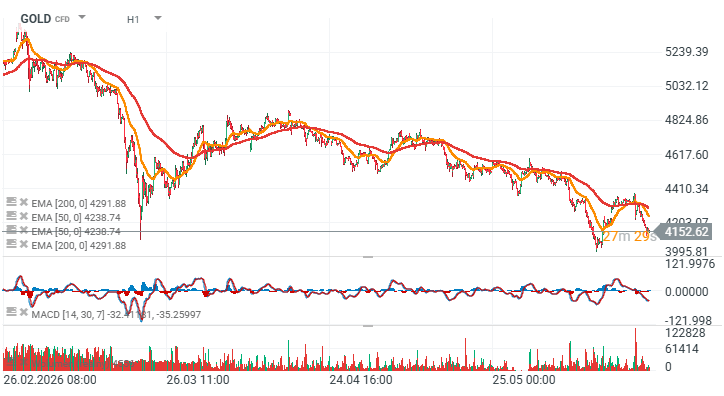
Source: xStation5


Three Markets to Watch Next Week (09.10.2026)



Daily Summary: A Shallow Rebound Ahead of Earnings Season


Strong rise in natural gas prices 📈🚨



US OPEN: Trump de-escalates, OpenAI supports Wall Street sentiment
This content has been created by XTB S.A. This service is provided by XTB S.A., with its registered office in Warsaw, at Prosta 67, 00-838 Warsaw, Poland, entered in the register of entrepreneurs of the National Court Register (Krajowy Rejestr Sądowy) conducted by District Court for the Capital City of Warsaw, XII Commercial Division of the National Court Register under KRS number 0000217580, REGON number 015803782 and Tax Identification Number (NIP) 527-24-43-955, with the fully paid up share capital in the amount of PLN 5.869.181,75. XTB S.A. conducts brokerage activities on the basis of the license granted by Polish Securities and Exchange Commission on 8th November 2005 No. DDM-M-4021-57-1/2005 and is supervised by Polish Supervision Authority.