


Iran has formalised its control over the Strait of Hormuz by establishing a new body — the Persian Gulf Strait Authority (PGSA) — which requires all passing vessels to submit an information declaration before being granted transit permission. The form contains over 40 questions regarding the vessel’s name, country of origin and destination, the nationality of the owners, operators and crew, and the type of cargo. Before the outbreak of conflict with the US and Israel in late February 2026, the strait was freely accessible to all vessels — now Iran threatens to attack any vessel passing through without IRGC permission. One-fifth of the world’s oil and liquefied natural gas supplies pass through the Strait, which means that control over it gives Tehran enormous leverage over the global economy.
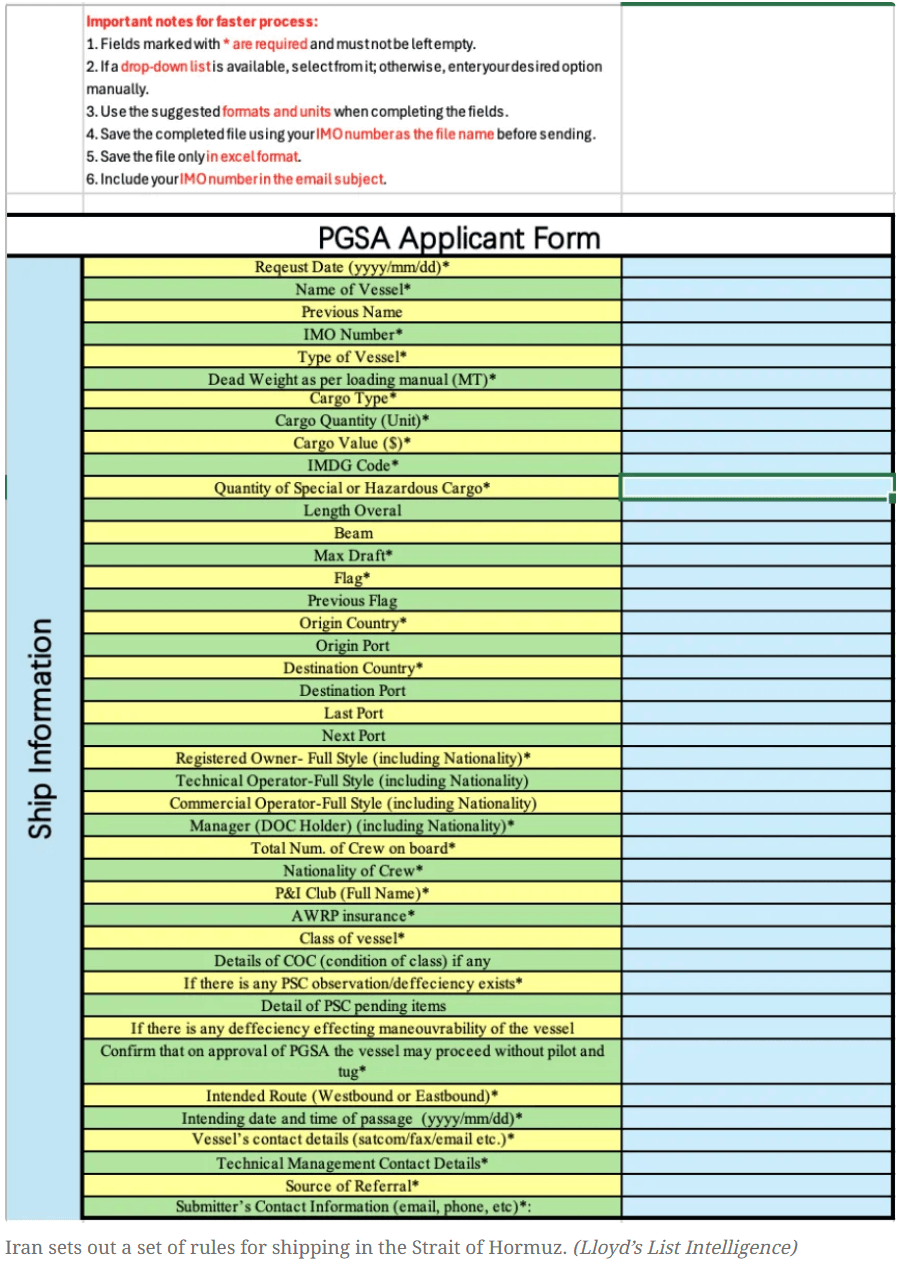
Key information that must be provided in order to transit the Strait of Hormuz with Iran’s permission. Source: CNN
The closure of the Strait of Hormuz triggered the biggest supply shock in the history of the oil market — on Wednesday, petrol prices in the US rose above $4.50 a gallon for the first time in four years. Iran’s Supreme Leader Mojtaba Khamenei called for the establishment of a “new regional and global order” based on a strong Iran, explicitly pointing to the “lever of closing the strait” as a tool for realising this vision. Iran reportedly charges up to $2 million per ship passing through, and the US Treasury Department has made it clear that no US-affiliated entity is authorised to make such payments. In the week ending 3 May, only 40 ships passed through the Strait, whereas before the war the average was 120 crossings per day, and on Thursday tanker traffic was almost non-existent. Experts at Kpler estimate that even in a scenario of long-term Iranian control, transit will not exceed 40–50% of pre-war export capacity, which would have lasting consequences for global energy markets.
Despite this, its main focus at the moment is on assessing the prospects for de-escalation of the conflict. This is evidenced by the fall in oil prices, which is accelerating for a second day in a row.
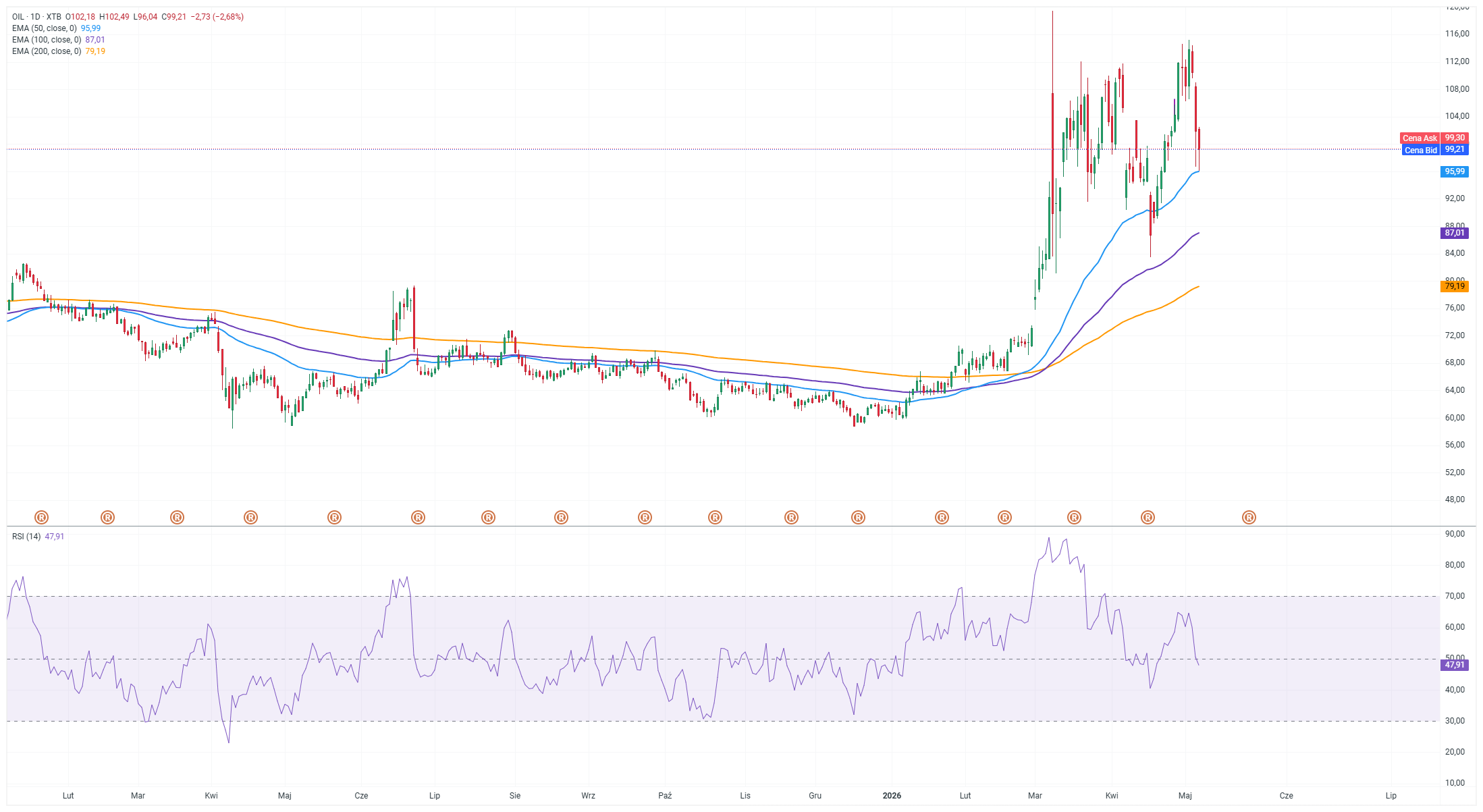
OIL tested the 50-day EMA today, a level that had not been retested since mid-April, when local declines came to a halt near this level. In the long term, however, the instrument remains in an uptrend. Source: xStation



Three Markets to Watch Next Week (09.10.2026)



Daily Summary: A Shallow Rebound Ahead of Earnings Season

Strong rise in natural gas prices 📈🚨



US OPEN: Trump de-escalates, OpenAI supports Wall Street sentiment
This content has been created by XTB S.A. This service is provided by XTB S.A., with its registered office in Warsaw, at Prosta 67, 00-838 Warsaw, Poland, entered in the register of entrepreneurs of the National Court Register (Krajowy Rejestr Sądowy) conducted by District Court for the Capital City of Warsaw, XII Commercial Division of the National Court Register under KRS number 0000217580, REGON number 015803782 and Tax Identification Number (NIP) 527-24-43-955, with the fully paid up share capital in the amount of PLN 5.869.181,75. XTB S.A. conducts brokerage activities on the basis of the license granted by Polish Securities and Exchange Commission on 8th November 2005 No. DDM-M-4021-57-1/2005 and is supervised by Polish Supervision Authority.