


Oil prices remain under strong pressure after the partial normalization of the situation around the Strait of Hormuz and the resumption of peace talks between the United States and Iran. Brent has already fallen to USD 74 per barrel, while WTI is near USD 71.
At this stage, the market appears to be pricing out any geopolitical or war-related “premium” in oil and inflation. However, the optimism may be premature.
OIL (D1)
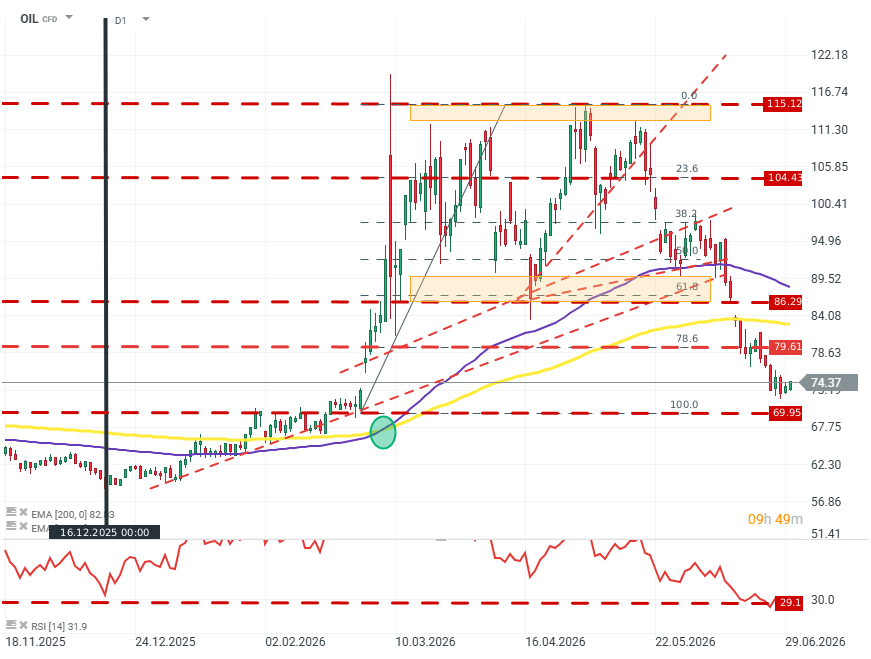
On the oil price chart, what stands out is an extremely low RSI level, which does not reflect tensions in the supply chain. Source: xStation5
UNCTAD, an official UN body, warns that even after the Strait of Hormuz is reopened (which has not happened yet), food and fuel costs could remain elevated for a prolonged period.
The problem is no longer solely the oil price itself, but the delayed effect of earlier disruptions in transport, freight costs, insurance, or fertilizer prices. This is particularly important for countries that import energy and food, where higher transport and agricultural production costs translate into consumer prices more quickly. According to UNCTAD, 61 economies remain exposed to further shocks related to imports of oil and grain.
NATGAS (D1)
Source: xStation5
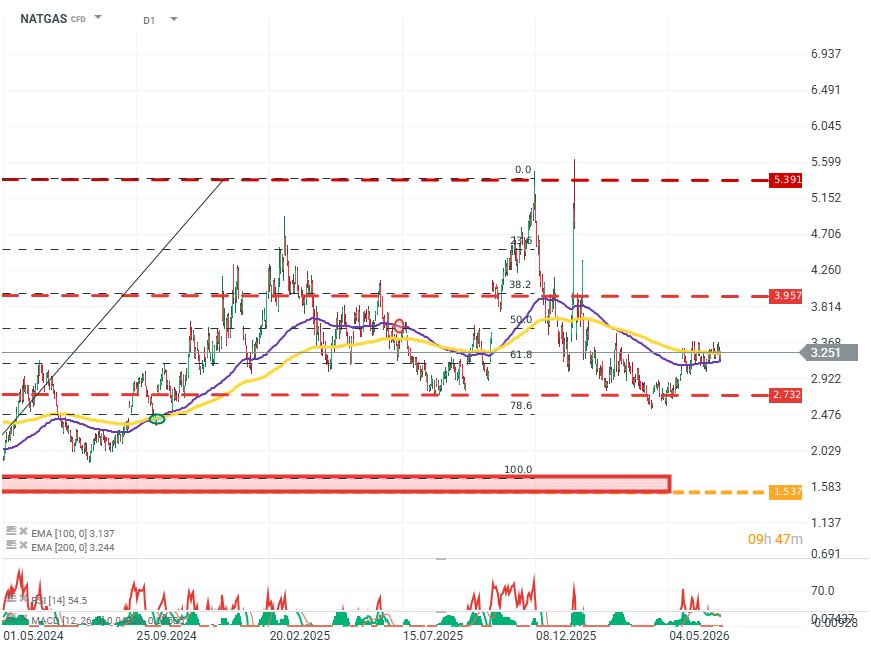
Gas remains the second channel of inflationary pressure. U.S. natural gas prices rose more strongly today than oil, and the persistent risk around LNG flows from the Persian Gulf region may limit the pace of energy-cost normalization in Europe and Asia. More expensive gas means not only higher energy bills but also pressure on fertilizer prices and, later, on food production costs. This makes the inflation impulse potentially more persistent than the drop in oil prices alone would suggest.
Partial market calm is supported by diplomatic signals. U.S. representatives were reportedly set to meet in Doha with Qatari mediators, and Pakistan had earlier pointed to the possibility of resuming talks between the United States and Iran. At the same time, Qatar emphasized that this was not a high-level meeting between Washington and Tehran.
Wild card: Russia
Many analysts pointed to far-reaching benefits for the Russian Federation from the surge in oil prices, but the campaign of “kinetic sanctions” and increasingly intensive air attacks on Russian territory raise doubts not so much about the scale of Russia’s benefits from the crisis, but about the presence of Russian products on the market.
Kremlin representatives have confirmed that they are currently seeking potential fuel suppliers who could alleviate the ongoing and worsening domestic fuel crisis. The Kremlin refused, however, to indicate which entities might undertake such deliveries. Importantly for the oil market, the shift of Russia from an exporter to an importer of fuel (not crude oil) will put additional pressure on already insufficient refining infrastructure, which means that even if oil prices fall, fuel prices may remain elevated.
What about the dollar?
USDIDX (D1)
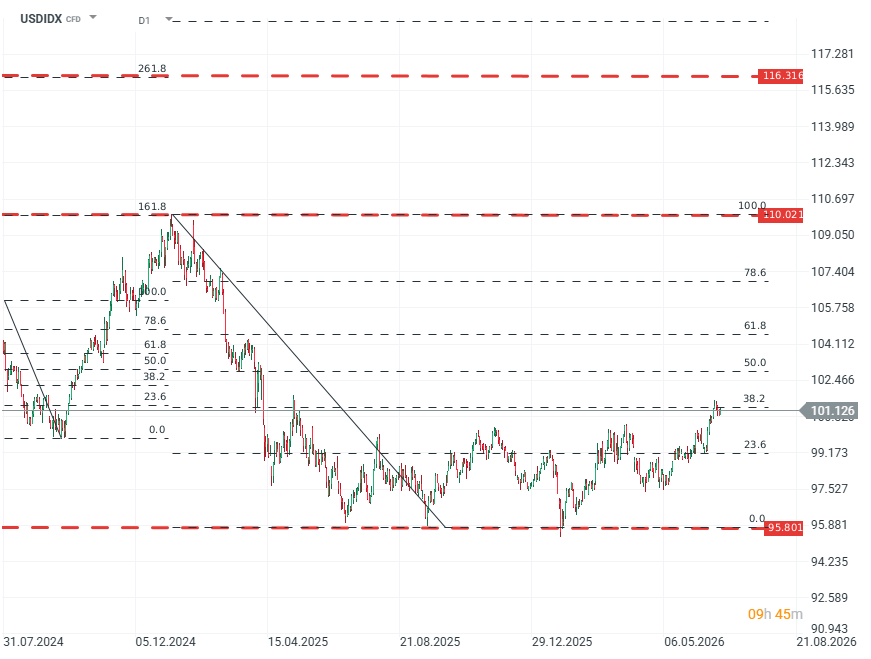
The Dollar Index remains near its lows from recent years. If the Fed turns out to be more hawkish in its rhetoric (or decisions) than expected, there is significant room for an upward correction. Source: xStation5
The dollar index is holding above 101 points, which, with commodities priced in USD, can increase cost pressure in economies that import energy and food. Even if the nominal oil price falls, a stronger dollar partly limits the positive effect for importers outside the United States. This is especially important for emerging markets such as Poland.
In the short term, the energy market is pricing in a de-escalation scenario, but the risk balance remains asymmetric. Looking at indices and commodity futures prices, investors see the end of the war not as a prospect but as a fait accompli.
The current relationship between the United States and Iran resembles a ceasefire, not peace. A ceasefire that one side breaks at least once a week. In addition, the agreement includes a number of provisions that may be very difficult to implement due to required approvals, for example from the U.S. Congress. The agreement itself is constrained by many conditions that neither side wants to meet, and both sides have until August to reach a real compromise, or to confirm the lack of one.



Daily Summary: Rising inflation weighs on markets, semiconductors suffer most (14.10.2026)


US Open: CPI reading weighs on American indices (14.10.2026)
US inflation concerns rise


Economic Calendar - Start of Wall Street Earnings Season, Hawkish RBA, and Middle East Tensions (13.10.2026)
This content has been created by XTB S.A. This service is provided by XTB S.A., with its registered office in Warsaw, at Prosta 67, 00-838 Warsaw, Poland, entered in the register of entrepreneurs of the National Court Register (Krajowy Rejestr Sądowy) conducted by District Court for the Capital City of Warsaw, XII Commercial Division of the National Court Register under KRS number 0000217580, REGON number 015803782 and Tax Identification Number (NIP) 527-24-43-955, with the fully paid up share capital in the amount of PLN 5.869.181,75. XTB S.A. conducts brokerage activities on the basis of the license granted by Polish Securities and Exchange Commission on 8th November 2005 No. DDM-M-4021-57-1/2005 and is supervised by Polish Supervision Authority.