



-
Trump administration officials adopted a clearly softer tone toward Iran, signaling less willingness for further escalation.
-
Rubio announced the end of Operation Epic Fury, while Hegseth stated that the ceasefire is holding. General Caine said that Iranian attacks had not crossed the threshold requiring the resumption of major combat operations. Markets interpreted this as a clear shift toward de-escalation.
-
Trump paused Project Freedom — the US operation designed to assist stranded ships in the Strait of Hormuz. The decision is intended to support negotiations and reduce Iranian distrust toward US intentions. The blockade itself remains in place, but ship escort operations have been temporarily suspended. The market interprets this as a tactical concession aimed at helping finalize an agreement.
-
Oil prices are falling today by 1.70% to 108.50 (OIL) and 100.90 (OIL.WTI). However, risks remain elevated because the Hormuz blockade is still formally in force.
-
Stocks across the Asia-Pacific region rose strongly as sentiment improved on hopes for peace. South Korea’s KOSPI is gaining more than 6%, Chinese indices are rising between 0.60–0.90%, the Australian index is up 0.85%, and the Japanese index is gaining 0.40%.
-
US futures also moved higher, with the Nasdaq supported by strong AMD earnings.
-
The Australian dollar reached its highest level in four years, while the New Zealand dollar climbed to its highest level in two months. The rally was driven by broad USD weakness and improving global risk-on sentiment.
-
Gold approached the 4,650 USD level, gaining nearly 2.00% due to the weaker dollar and falling oil prices.
-
The European Union called on the US to return to the agreed 15% tariffs under the Turnberry agreement. Brussels wants the core provisions of the deal restored before its first anniversary in July. Trump threatened higher tariffs on European cars, accusing the EU of failing to comply with the agreement. Both sides agreed to intensify trade talks.
-
New Zealand’s unemployment rate fell to 5.3%, beating market expectations. Employment growth slowed slightly, but labor costs rose more strongly than forecast.
-
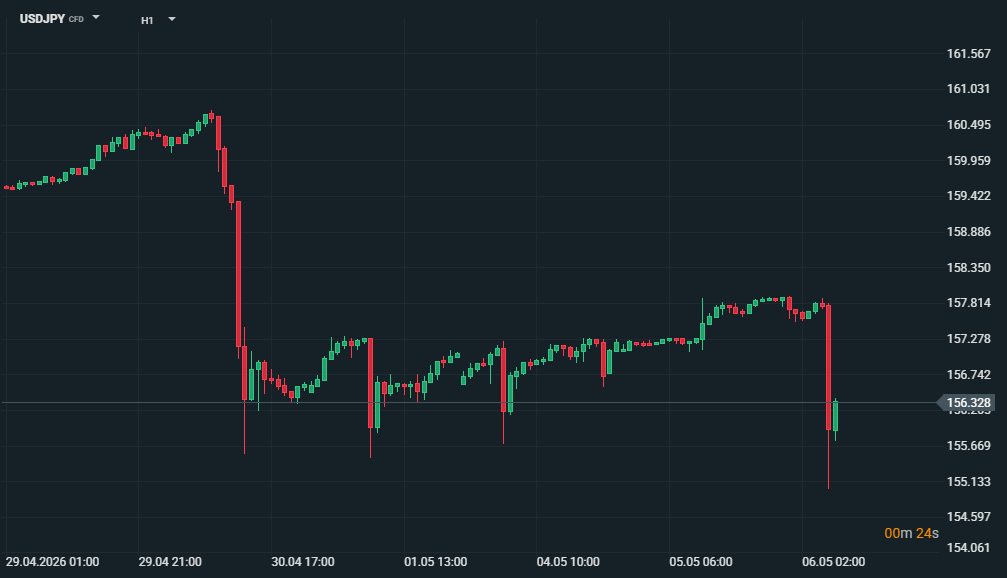
Japan’s Ministry of Finance intensified efforts against yen weakness, pushing USDJPY to its lowest level in ten weeks. Authorities are attempting to buy time until the situation in the Middle East stabilizes.
-
AMD.US beat market expectations on EPS, revenue, and operating income. The company also raised its revenue and margin guidance for the second quarter. The stock price is gaining 16.50% in after-hours trading.
-
Super Micro exceeded adjusted EPS forecasts, although revenue came in below expectations. Gross margins were significantly above forecasts, and Q4 EPS guidance exceeded consensus. The stock price is gaining 18.00% in after-hours trading.


Strong US macro data 🗽 Industrial production and prices rise


Chart of the Day: NATGAS - Are there chances for a seasonal rebound amid warm weather?


Economic Calendar - Final Eurozone CPI Inflation, US Manufacturing, and Regional Bank Earnings


Morning Briefing: Warsh's silence on interest rates. AI debt fears cooled sentiment, but a rebound is visible
This content has been created by XTB S.A. This service is provided by XTB S.A., with its registered office in Warsaw, at Prosta 67, 00-838 Warsaw, Poland, entered in the register of entrepreneurs of the National Court Register (Krajowy Rejestr Sądowy) conducted by District Court for the Capital City of Warsaw, XII Commercial Division of the National Court Register under KRS number 0000217580, REGON number 015803782 and Tax Identification Number (NIP) 527-24-43-955, with the fully paid up share capital in the amount of PLN 5.869.181,75. XTB S.A. conducts brokerage activities on the basis of the license granted by Polish Securities and Exchange Commission on 8th November 2005 No. DDM-M-4021-57-1/2005 and is supervised by Polish Supervision Authority.