


Investors are eagerly awaiting news regarding the Iran-Oman agreement. Progress in this area is significant; the agreement is currently under review by the Iranian parliament.
🛢️ Energy Commodities
Nevertheless, prices of key energy commodities are trending upwards again.
- We must pay nearly 84 dollars for a barrel of Brent crude oil, which marks an increase of approx. 7.5% relative to Wednesday's lows.
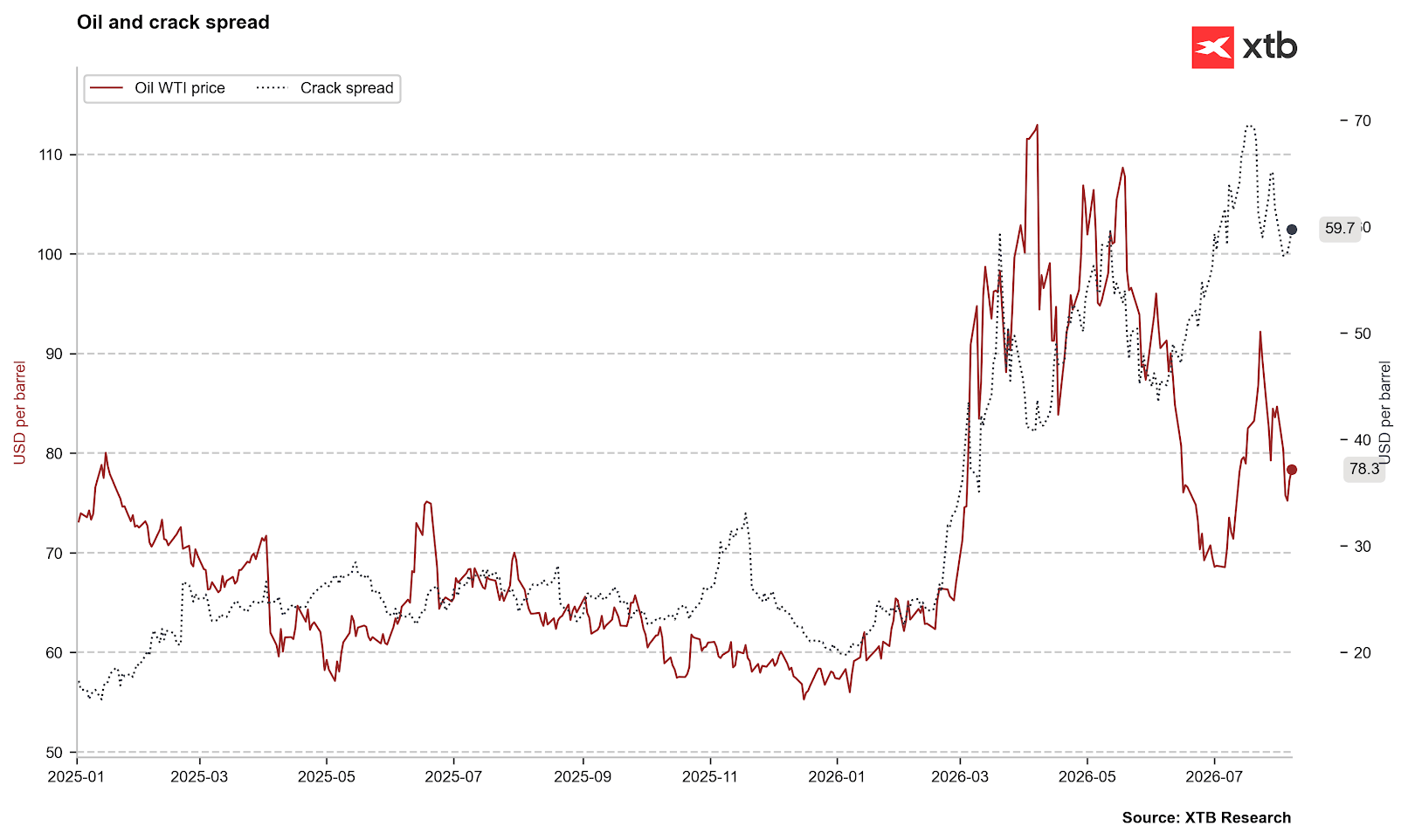
- WTI crude oil is also trending upwards, albeit slightly less dynamically (slightly above 78 dollars per barrel).
- The so-called crack spread, which is the difference between the price of crude oil and the prices of refined petroleum products (such as petrol or diesel), also remains at very high levels. For WTI crude, it reaches approx. 60 dollars, while for Brent it is just under 80.
- The price of LNG is also rising, by over 10% relative to Wednesday's lows. We currently pay approx. 58 dollars per MWh of liquefied natural gas from the Dutch TTF exchange. This information is particularly relevant for European countries, which are dealing with record-low reserve levels.
Figure 1: Price and Crack Spread for WTI Crude (2025 - 2026)
 Source: XTB Research, 07.08.2026
🌍 Geopolitics
What is behind these movements?
Within the framework of the agreement being negotiated with Oman aimed at managing the Strait of Hormuz, Iran is seeking to introduce a total ban on transit for American and Israeli ships and to implement a new fee system covering, among other things, insurance and environmental costs. Furthermore, Tehran is demanding that hostile nations pay special compensation in exchange for restoring shipping access.
We expect that these demands will meet with resistance in Washington. The United States will most likely insist on maintaining fully free transit through the Strait without the need to pay fees or obtain additional permits.
An additional obstacle to stabilising the situation in the energy commodities market is the escalation of other conflicts in the Middle East, including bloody clashes involving the Iran-backed Houthi militia in Yemen and rising tensions with the Lebanese Hezbollah.
📈 Equities
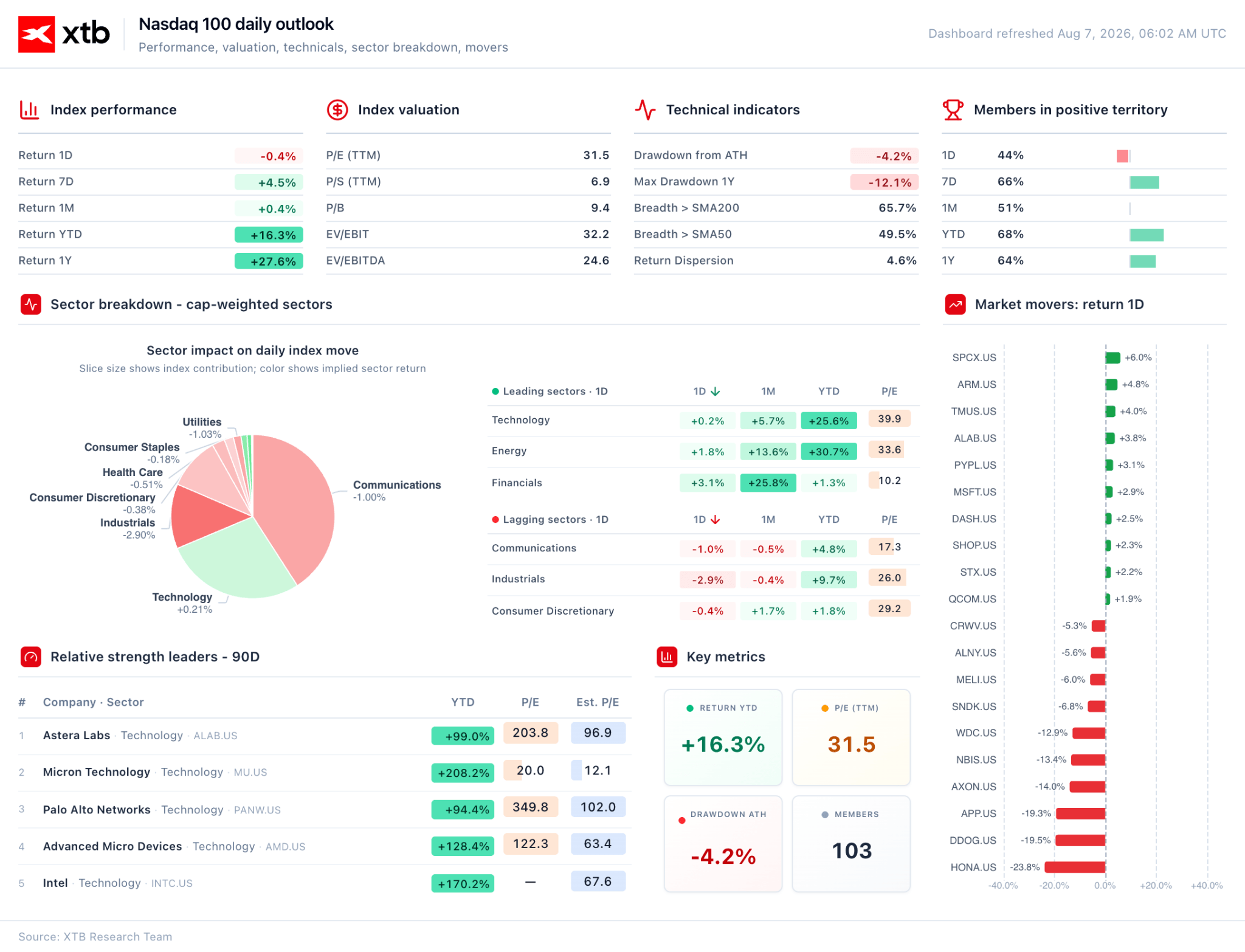
There is currently no significant reaction in the equity market. Both futures contracts for the US S&P 500 and the German DAX are oscillating around Thursday's closing levels.
Figure 2: Dashboard for Nasdaq 100 (06.08.2026)
 Source: XTB Research, 07.08.2026
Asian stock markets also lack a clear direction. The Chinese Shanghai SE Composite is strengthening (+0.8%), while the Japanese Nikkei (-0.3%) and the Korean Kospi (-0.9%) are losing ground.
Although the most important earnings releases scheduled for this week are behind us, there will still be several reports worth noting today. Before the market open, we will learn how Under Armour, Take-Two Interactive, and Wendy’s performed in Q2.
🧈 Precious Metals
Despite rising 10-year bond yields in major economies, prices of precious metals are trending upwards again.
- We must pay approx. 4,280 dollars for a troy ounce of gold, and 62.7 for silver.
It is worth mentioning in this context that capital outflows from the largest American SPDR Gold ETF were halted in June. Since the beginning of the year, they reached nearly 15 billion dollars. Investors have not yet rushed to buy back in on a massive scale, but this could be a signal suggesting a change in trend.
📈 Macroeconomic Data and Monetary Policy
Today, we are facing the most anticipated macroeconomic data release of the week. At 1:30 PM, NFP data will be released, which is the most important report from the US labour market.
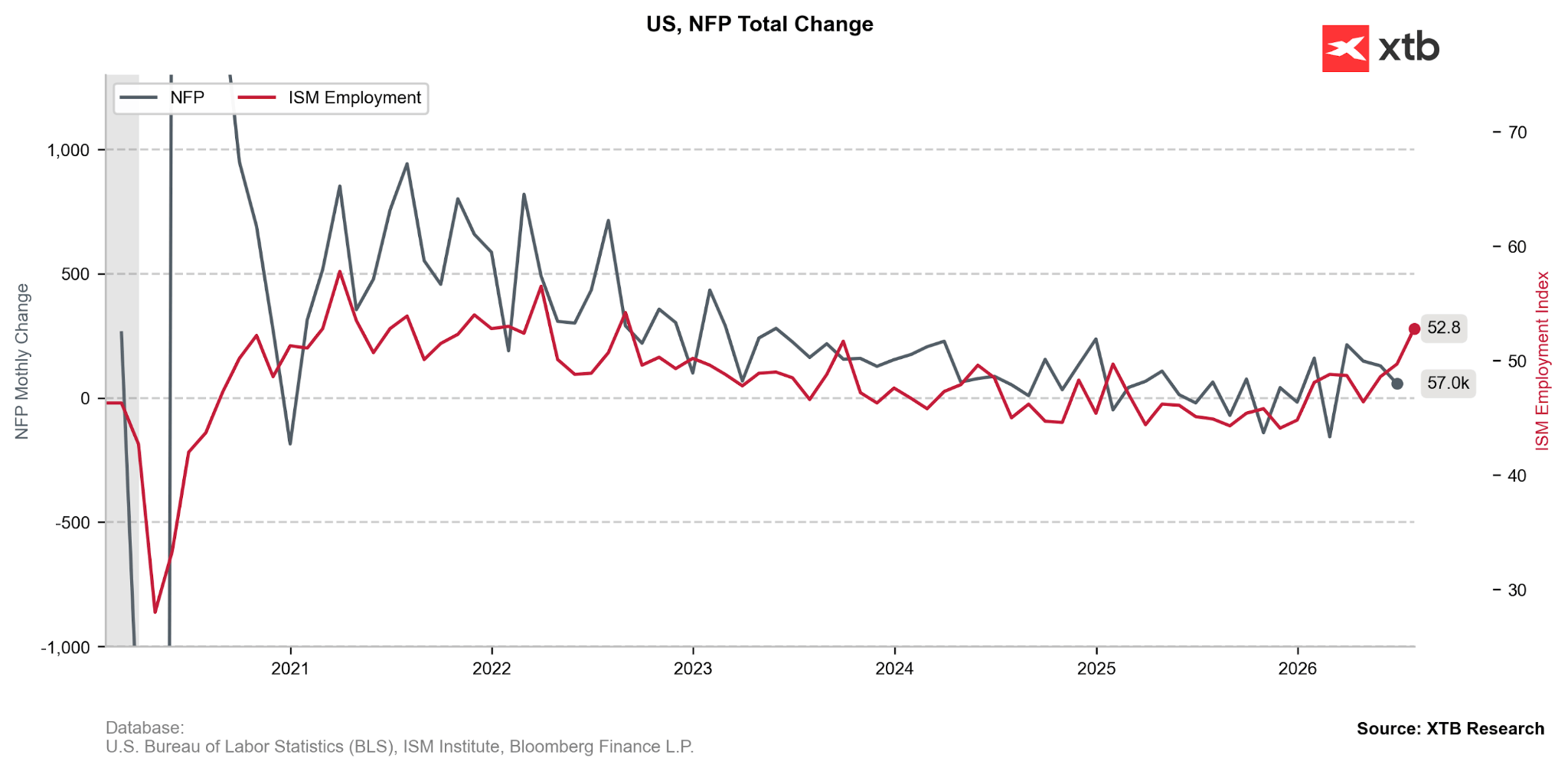
Since the Fed must care for both price stability and maximum employment, signals of cooling in the US labour market could lead to a further dovish revision regarding the expected path of interest rates in the US. This is to some extent indicated by ADP and JOLTS data published this week – both readings came in below market expectations. However, these are either data that are secondary under standard conditions (like ADP) or significantly delayed (like JOLTS). Moreover, their correlation with the NFP reading has been relatively small in recent years.
Figure 3: NFP and ISM Employment Index (2020 - 2026)
 Source: XTB Research, 07.08.2026
Economists have tended to underestimate the number of new jobs in non-farm sectors in recent years. The NFP reading was ultimately better than expectations in 35 out of the last 50 months. Moreover, despite a weak reading in June (57k), the 3-month moving average remains at a healthy level (111k).
💱 Currencies
In recent days, we have observed a dynamic upward movement of the EURUSD pair, behind which, in our opinion, lay two key factors:
- 1) The lack of a July rate hike by the Fed and the lack of clarity regarding the committee's further actions from Kevin Warsh;
- 2) A decline in oil and gas prices resulting from an improved sentiment regarding the situation in the Middle East.
The situation in the energy commodities market has changed somewhat, which yesterday brought the EURUSD pair to around the 1.152 level (a decline of 0.2%). The development of the situation in the Middle East remains fundamental for the FX market, especially in the face of a potential signing of an agreement between Iran and Oman. If this happens, investors will be closely watching the US reaction.
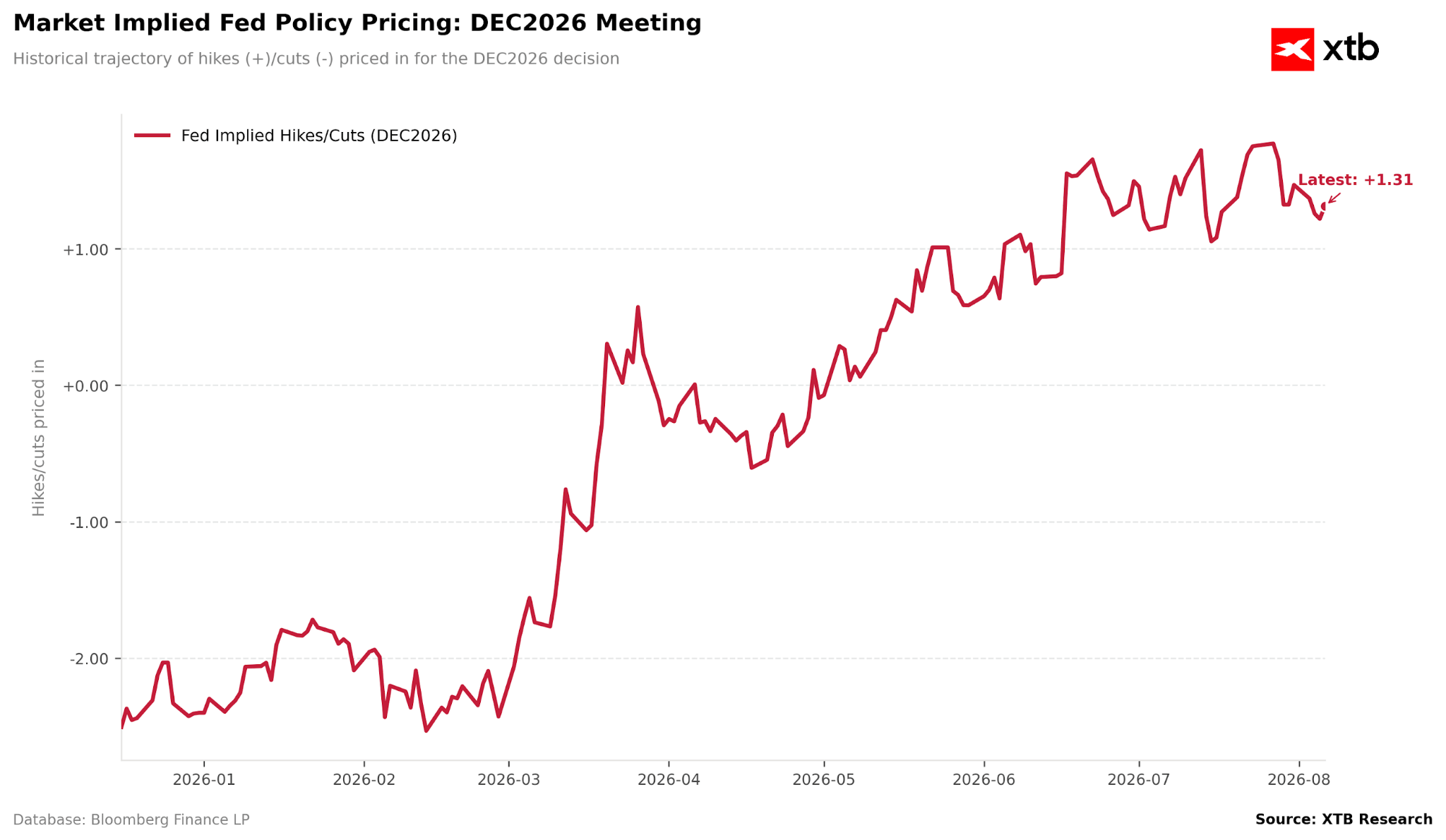
Today, however, NFP data will take centre stage, especially in the face of the recent dovish repricing regarding market expectations for the Fed's interest rate path.
Figure 4: Change in Market Implied Fed Policy Pricing for the DEC2026 Meeting (2025 - 2026)
 Source: XTB Research, 07.08.2026
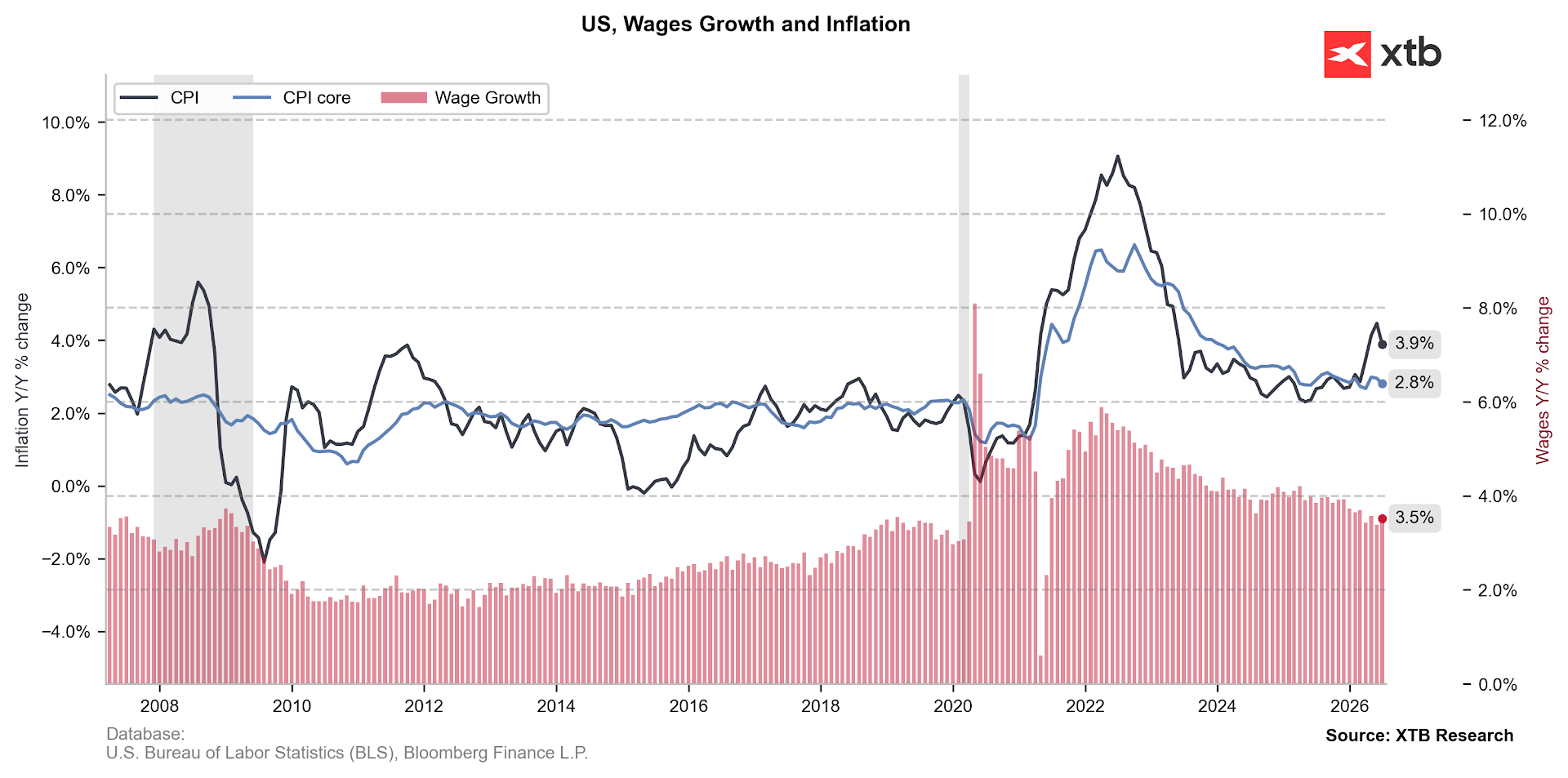
Macroeconomic data justify a hike to some extent. Wage growth is accelerating (4.3% in June), and one-year inflation expectations are also rising (according to the New York Fed survey, they reached their highest level since 2023 in June, at 3.7%). Retail sales are also growing dynamically (6.7% in June). All of these factors could lead to the occurrence of so-called second-round effects, which central bankers have been regularly mentioning in recent months.
Figure 5: US CPI Inflation and Wage Growth (2007 - 2026)
 Source: XTB Research, 07.08.2026
Importantly, however, the momentum of core inflation, which is currently key for the committee, is slowing (0.0% m/m in June, 0.2% m/m in May). Oil and gas prices have also been heading downwards in recent days.
₿ Cryptocurrencies
There have been no major changes in the cryptocurrency market.
- Since Monday, the price of Bitcoin has been maintaining a stable level around 64,000–64,500 dollars. It is currently closer to the upper bound of this range.
- We are also observing a small upward movement in Ethereum, which has strengthened by just over 1% since the beginning of the week to around 1,900 dollars.



Market Wrap: Renewed confidence in AI drives stock market recovery (27.10.2026)



📈Daily Summary: Falling Oil Prices and Anthropic Prospectus Drive Markets


Chart of the day: European gas ever closer to 100 EURMWh


Economic Calendar - German Ifo index, Middle East escalation, and Wall Street giants' earnings
This content has been created by XTB S.A. This service is provided by XTB S.A., with its registered office in Warsaw, at Prosta 67, 00-838 Warsaw, Poland, entered in the register of entrepreneurs of the National Court Register (Krajowy Rejestr Sądowy) conducted by District Court for the Capital City of Warsaw, XII Commercial Division of the National Court Register under KRS number 0000217580, REGON number 015803782 and Tax Identification Number (NIP) 527-24-43-955, with the fully paid up share capital in the amount of PLN 5.869.181,75. XTB S.A. conducts brokerage activities on the basis of the license granted by Polish Securities and Exchange Commission on 8th November 2005 No. DDM-M-4021-57-1/2005 and is supervised by Polish Supervision Authority.