



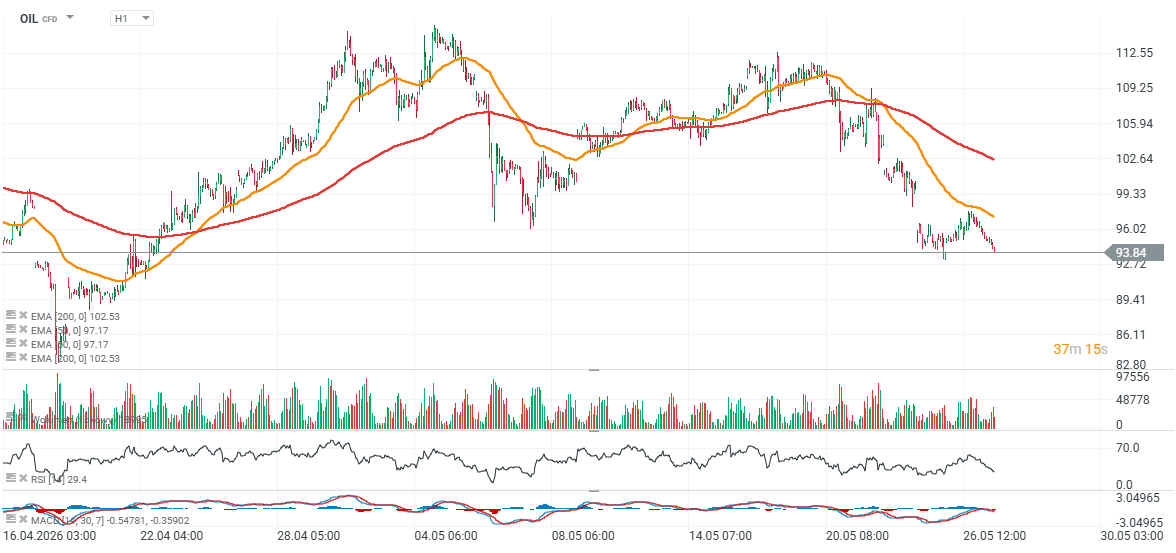
Brent crude (OIL) is down nearly 3% today, trading around $93 per barrel and extending a clearly bearish short-term trend in which supply-side pressure continues to dominate despite ongoing uncertainty surrounding the Strait of Hormuz. At the same time, some research desks, including Piper Sandler, are increasingly positioning themselves in the “prolonged crisis” camp rather than expecting a rapid de-escalation around Hormuz. According to the bank, the market may be interpreting signals of a potential Iran deal too optimistically, while the actual shipping situation in the region remains highly fragile.
Piper Sandler bets on higher oil prices
In its latest note, Piper Sandler argues that the Strait of Hormuz could remain effectively partially closed for several more months. That would imply continued disruption to crude oil and LNG flows from the Middle East to Asia, increasing pressure on the physical oil market.
- The key issue is not necessarily a formal “closure” of Hormuz, but the dramatic decline in commercial tanker traffic. According to Piper Sandler, the chances of shipping volumes recovering even to 50% of pre-crisis levels appear low — not only over the next few weeks, but potentially over the coming months as well.
- Markets have received mixed signals in recent days. On one hand, Donald Trump has suggested that an agreement with Iran is largely negotiated. On the other hand, the Pentagon confirmed additional strikes on Iranian military installations and vessels deploying mines near the Strait. These developments suggest that military tensions are still escalating rather than fading.
- Piper Sandler believes Washington is reluctant to pursue a full-scale confrontation, as a broader Iranian retaliation could destabilize the region and further disrupt global supply chains. At the same time, Tehran appears convinced it still holds significant negotiating leverage, reducing the probability of a quick compromise.
- All of this leads the bank to a fairly aggressive conclusion: oil prices could still reach new yearly highs later this summer.
That view is difficult to dismiss. Until recently, roughly one-fifth of global seaborne oil trade passed through the Strait of Hormuz. If tanker traffic remains constrained for an extended period, the issue shifts from futures market volatility to the physical availability of crude - particularly for Asia.
U.S. strategic reserves are heading east
The United States is now sending a rare cargo of crude oil from its Strategic Petroleum Reserve to Asia, highlighting how deeply the Hormuz crisis is reshaping global energy flows. According to shipping data cited by Reuters, a tanker carrying oil from the U.S. SPR has departed the Gulf of Mexico bound for the Philippines. This marks the first shipment of U.S. strategic crude to Asia since late 2022.
- The move is unusual, but strategically logical. The disruption of normal tanker traffic through Hormuz has severely impacted traditional supply routes from the Middle East to Asia. Before the crisis, Asian economies imported around 80% of their crude from the Middle East, while the Philippines relied heavily on Saudi Arabia, Iraq and the UAE.
- For example, the Greek VLCC Arosa is currently transporting around 616,000 barrels of U.S. sour crude from the SPR alongside another 700,000 barrels of a separate U.S. sour blend. This shows that Washington is not only redirecting crude toward Europe, but is increasingly attempting to offset shortages in Asia as well.
- The problem is that the scale of potential Middle Eastern supply disruption remains enormous. Estimates suggest that between 14 and 15 million barrels per day of production could be affected by ongoing tensions. Even a broad coordinated release from IEA member states may prove insufficient if the Hormuz crisis drags on.
Despite the recent pullback in oil prices, the global crude market is entering a phase of forced reorganization. Asia - the region most dependent on Middle Eastern energy supplies is likely to bear the highest logistical and pricing costs. Meanwhile, the United States is increasingly acting as an emergency supplier not only for Europe, but also for Asian buyers.
OIL (D1 chart)
WTI crude initially surged toward $120 per barrel before retreating below the $100 level. However, according to Piper Sandler, the market may be pricing in normalization too early. If the crisis persists, renewed supply pressure could once again push oil prices sharply higher, potentially weighing on both global economic growth and the recent rebound in equity markets.
Source: xStation5


Daily Summary: Oil at five-month highs, indices under pressure (23.10.2026)


US Open: Further declines on Wall Street, Brent above 111 USD, AI correction continues (14.10.2026)


Chart of the Day: Is USDJPY running out of road? Inflation forces the BoJ to act, but the Fed could spoil the Yen’s rally



Macro Calendar: Preliminary PMI Readings and Earnings Ahead
This content has been created by XTB S.A. This service is provided by XTB S.A., with its registered office in Warsaw, at Prosta 67, 00-838 Warsaw, Poland, entered in the register of entrepreneurs of the National Court Register (Krajowy Rejestr Sądowy) conducted by District Court for the Capital City of Warsaw, XII Commercial Division of the National Court Register under KRS number 0000217580, REGON number 015803782 and Tax Identification Number (NIP) 527-24-43-955, with the fully paid up share capital in the amount of PLN 5.869.181,75. XTB S.A. conducts brokerage activities on the basis of the license granted by Polish Securities and Exchange Commission on 8th November 2005 No. DDM-M-4021-57-1/2005 and is supervised by Polish Supervision Authority.