


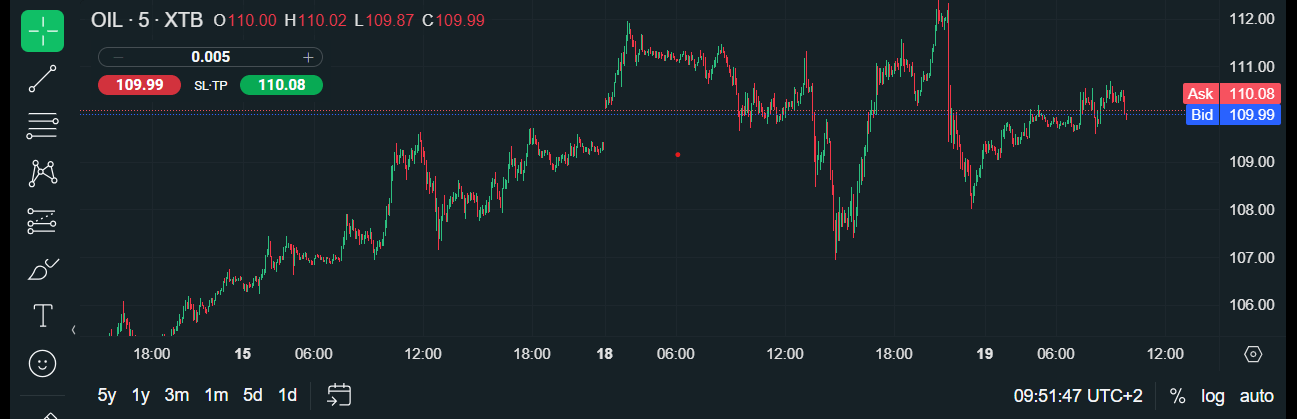
Risk sentiment is mixed on Tuesday, as investors weigh up the costs of the war in the Middle East. Although the oil price initially fell on the back of comments from Donald Trump that the US would not strike Iran and break the ceasefire today, the President’s impact on the oil price did not last for long. Brent crude is reversing earlier losses and is now back above $110.40 at the European market open. There is a sense of frustration that there has been no break in the impasse between the US and Iran and no clear path to a deal to end the war.
Europe’s lack of tech boosting resilience for now
European stocks have opened higher, following on from Monday’s rally, and the top performers include IG Group, Diageo and BAE Systems. Europe’s small tech exposure is providing some resilience to the tech-led sell off in US stocks. However, sentiment is expected to remain fragile, as bond yields are rising moderately this morning at the open. European yields are following US yields higher after the 10-year Treasury yield broke back above 4.6% on Monday. This is supporting the dollar on Tuesday, which is higher across the board. GBP/USD has lost the $1.34 handle this morning, and EUR/USD is down 30 pips at $1.3330.
Soft UK labour market data could limit yield upside, for now
The UK 10-year yield, which fell on Monday, is marginally higher by 2bp on Tuesday. This is a small move, but the risk is that inflation concerns and a global selloff in yields weighs heavily on Gilts, which are already the worst performers in the G10. In the short term, upside for Gilts could be capped on Tuesday, after the UK’s latest jobs data suggested that the UK labor market remains soft. The unemployment rate rose back to 5% and the vacancy rate is at its lowest level for 5 years and now stands at 705,000.
Banks start to shed jobs as AI uptake increases
Regular wage growth slowed further, and the number of payrolled employees also fell in the 3 months to March. There were 28,000 fewer payrolled employees in March compared to February. After a spate of tech sector layoffs linked to AI, the financial sector could be next in line. Standard Chartered, the UK based bank, said that it would cut 15% of its back-office roles by 2030 due to the adoption of AI. While most job losses are expected to come from India, China and Poland, the risk is that other companies follow suit. As agentic AI gets more advanced, roles that are closer to the front office could also be at risk in the banking sector, although we do not expect that to happen in the near to medium term.
AI job cuts do not provide a boost for share prices
Interestingly, tech firms that have already announced AI-related layoffs have not seen share price gains. Snap’s share price is lower by 30% YTD, and Salesforce’s share price is down 32%. Standard Chartered’s share price is down 0.75% on Tuesday, suggesting that AI-related cost savings do not directly translate to stock market gains.
BOE likely to remain on hold in the near term
The soft labour market continues to cloud the outlook for the BOE. Although interest rate expectations are pointing to 3 rate hikes this year, we remain unconvinced, and we do not expect a rate hike at next month’s BOE meeting. Although other UK data has been trending higher, for example GDP, the outlook for the UK economy remains weak, and the recent surge in UK Gilts has already done the bulk of tightening for the Bank. Thus, it is unsurprising that the pound is weakening, even though Gilt yields remain elevated.
The war in the Middle East weighs on tech
With the oil price above $110 per barrel, it is tough for stocks to continue to rally. US stocks slipped on Monday as the energy crisis threatens the AI trade. Investors are now starting to price in what a prolonged conflict, and elevated energy prices for the long term would do for semiconductors and other tech stocks. The Iran war is threatening supply chains that are crucial to produce semiconductors that power the AI revolution. Costs are rising for precious metals and helium, which is vital for the production of semiconductors.
For now, the disruption caused by the war is having a limited effect on chip manufacturers, such as Infineon and TSMC, and there has not been a wave of negative earnings revisions which could weigh on stock prices. However, if the conflict is prolonged, then it could have deeper effects, for example on the economics of running data centres. This could ultimately lead to a scaling back of AI investment, which is crucial for the US stock market as well as the US economy. This is not a concern yet, but it could be a big risk for stock market bulls in the months to come.
All eyes on Nvidia
Ahead today, all eyes will be on the tech sector. Micron and SanDisk both fell more than 5% at the start of the week. Nvidia also fell 1.7%. We could see US tech stocks drift on Tuesday as we wait for Wednesday’s earnings report from Nvidia. The chip giant’s outlook for sales and its assessment of the uptake of enterprise AI will be vital for the next stage of the tech trade. For now, US stocks futures are lower, with a 0.5% decline expected for the Nasdaq at the US open later today.
Chart 1: Brent crude oil hovers around $110 per barrel
Source: XTB



Daily Summary: Wall Street Rises Ahead of Tomorrow's Fed Meeting💡



The US100 gets back on track and gains 1%📈



Market Wrap: Renewed confidence in AI drives stock market recovery (27.10.2026)



Gold Falls Below $4,000
This content has been created by XTB S.A. This service is provided by XTB S.A., with its registered office in Warsaw, at Prosta 67, 00-838 Warsaw, Poland, entered in the register of entrepreneurs of the National Court Register (Krajowy Rejestr Sądowy) conducted by District Court for the Capital City of Warsaw, XII Commercial Division of the National Court Register under KRS number 0000217580, REGON number 015803782 and Tax Identification Number (NIP) 527-24-43-955, with the fully paid up share capital in the amount of PLN 5.869.181,75. XTB S.A. conducts brokerage activities on the basis of the license granted by Polish Securities and Exchange Commission on 8th November 2005 No. DDM-M-4021-57-1/2005 and is supervised by Polish Supervision Authority.