


- Public sector wage boost compared to private sector continues
- Upbeat market mood as oil retreats
- Tim Cook to step down at Apple
- Investors reluctant to price in the worst case scenario for US/ Iran

- Public sector wage boost compared to private sector continues
- Upbeat market mood as oil retreats
- Tim Cook to step down at Apple
- Investors reluctant to price in the worst case scenario for US/ Iran
There was some good news from the UK’s labour market. The unemployment rate fell back sharply in the three months to February and stands at 4.9%, down from 5.2%. Although job vacancies were at their lowest level in 5 years, the fall in unemployed people means that the vacancy rate stayed broadly stable. The ONS said that the hiring picture remained weak, and the number of payrolled employees fell by 9,000 in the three months to February. The number of people claiming unemployment benefit rose in February but fell compared to a year ago.
Divergence between public and private sector wage growth
Average earnings were slightly stronger than expected but are below the 4% handle. However, there continues to be a large divergence between public sector and private sector wage growth. Wage growth in the public sector rose 5.2% in the three months to February but is only 3.2% for the private sector. The ONS continues to think that public sector wages will converge with the private sector in the coming months. When adjusted for inflation, wage growth is barely in positive territory. The inactivity rate also rose in the three months to February and stands at 21%.
Overall, a drop in the unemployment rate is good news for the UK economy, but today’s data has not moved the dial for the pound and GBP/USD remains comfortably above $1.35. The ONS have said that the labour market survey remains subject to revision, and there could be revisions, so the market is likely to take today’s data with a pinch of salt, even though the data is another sign that the UK economy strengthened just before the energy price shock.
Upbeat market mood as oil retreats
The market mood on Tuesday is upbeat considering the US and Iran have not agreed an extension of the current ceasefire that expires tomorrow. The oil price is lower, and Asian stocks rallied, with South Korea’s Kospi reaching a fresh record high. Brent crude is down more than 1% and is back below $95 per barrel. The fall in the oil price continues to be central to the market mood, and it is boosting equity market futures in the US and the UK.
Apple in the post-Cook era
The biggest news on Monday was not the latest developments in the Iran/ US ceasefire, but news that Apple boss Tim Cook was stepping down and will be replaced by Apple insider John Ternus. He will become CEO on September 1st, with Cook transitioning to the role of executive chairman at the same time. This is the first switch in CEO since Cook replaced Steve Jobs in 2011.
Cook leaves a big boots to fill, the company’s market cap rose four-fold under Tim Cook, and Apple’s market capitalization surged to $4 trillion. The stock price fell 0.9% in post-market trading after the news broke. Ternus is not an unexpected choice, and he has a pedigree in hardware engineering, which will be critical for Apple’s future foray into AI. Of all the Magnificent 7 companies, Apple is seen as being the laggard when it comes to AI capabilities and it has taken a cautious approach when it comes to AI investment in comparison to Amazon, Meta, Google and Microsoft.
Investors want to know if Ternus will engage in the AI race, or if he will follow Cook’s lead. There is also anticipation of new Apple products to boost their offering, and there is some expectation that Ternus could move fast to put his own stamp on the company. The external environment will be challenging for the new CEO, tariffs, war and supply chain concerns need to be factored into his growth plans. The mild selloff in the stock on the back of this news suggests that the market may withhold judgment until they hear more about Cook’s departure and Ternus’s future during Apple’s next earnings call on 30th April.
Software stocks still in recovery mode
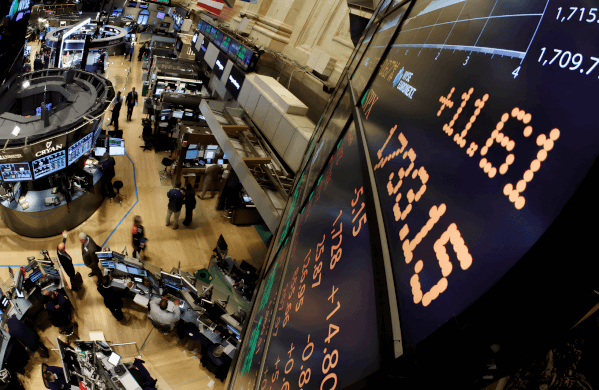
US stocks held up fairly well on Monday considering tensions between Iran and the US appear to have escalated, the Strait of Hormuz remains shut, and the original ceasefire will expire on Wednesday. US stocks were mildly lower, the S&P 500 closed down 0.2% and the Nasdaq fell 0.3%. Software stocks climbed once more, and there are a growing number of stocks reaching 12-month highs, including Target, eBay and State Street. Dell and Texas Instruments both rallied to fresh all-time highs at the start of this week.
The fact that software stocks are in recovery mode, and consumer stocks are rallying suggests that concerns about the conflict in the Middle East are very much in the rearview mirror right now.
Investors reluctant to price in the worst case scenario
There is a reluctance for investors to price in the worst-case scenario for the conflict in the Middle East, and there is optimism within the market that the US/ Iran ceasefire will be extended beyond Wednesday. There are some who argue that investors are too quick to dismiss the risks from the conflict. Price action suggests that investors see the inflationary impact from the energy price shock as temporary, but if the situation does not deescalate soon, then inflation risks may come back and bite market participants.
The details around the latest peace talks are patchy. The President has said that the delegation from Washington will go to Pakistan, which suggests that negotiations to extend the ceasefire will go to the wire. He also said that the ceasefire will not be extended if a deal is not agreed in the next 24 hours. Added to this, Israel used drones to strike Lebanon on Monday, which makes it unlikely that Iran will reopen the Strait of Hormuz in the short term. The good news is that Israel and Lebanon are expected to hold a second round of talks on Thursday.
This backdrop of geopolitical uncertainty is not troubling financial markets, there is no rush to the safety of the dollar, and the oil price remains comfortably below $100 per barrel, with Brent crude trading below the $95 per barrel mark.
Until we see all options for negotiations get exhausted and it is inevitable that the ceasefire will end without an extension, we could see stock markets continue to show resilience and retrained oil prices on Tuesday.


Tesla was supposed to burn $5 billion, but posted a positive result. Will Tesla still be a car company in a year?


Record-breaking Meta, though with a cash loss. Investors (for now) are buying Zuckerberg's plan anyway


Daily Summary: SpaceX and the tech sector drive Wall Street, oil retreats sharply below $97


📉NATGAS loses 6% ahead of rollover
This content has been created by XTB S.A. This service is provided by XTB S.A., with its registered office in Warsaw, at Prosta 67, 00-838 Warsaw, Poland, entered in the register of entrepreneurs of the National Court Register (Krajowy Rejestr Sądowy) conducted by District Court for the Capital City of Warsaw, XII Commercial Division of the National Court Register under KRS number 0000217580, REGON number 015803782 and Tax Identification Number (NIP) 527-24-43-955, with the fully paid up share capital in the amount of PLN 5.869.181,75. XTB S.A. conducts brokerage activities on the basis of the license granted by Polish Securities and Exchange Commission on 8th November 2005 No. DDM-M-4021-57-1/2005 and is supervised by Polish Supervision Authority.