


- Quarterly EPS came in at $4.11, compared with analysts’ expectations of $2.33.
- Revenue reached $26.54 billion, versus consensus of approximately $26.13–26.14 billion.
- Target expects full-year net sales growth of around 5%, compared with previous guidance of around 4%.
- Full-year EPS guidance including the tariff refund is $9.90–10.90, versus analysts’ consensus of $8.47.
- EPS guidance excluding the tariff refund is $8.25–9.25, compared with the previous range of $7.50–8.50.

- Quarterly EPS came in at $4.11, compared with analysts’ expectations of $2.33.
- Revenue reached $26.54 billion, versus consensus of approximately $26.13–26.14 billion.
- Target expects full-year net sales growth of around 5%, compared with previous guidance of around 4%.
- Full-year EPS guidance including the tariff refund is $9.90–10.90, versus analysts’ consensus of $8.47.
- EPS guidance excluding the tariff refund is $8.25–9.25, compared with the previous range of $7.50–8.50.
One of the largest retailers in the US, Target (TGT.US), ended the second quarter with higher sales and earnings per share significantly above analysts’ expectations. The strong results appear to confirm the solid condition of the US consumer. Revenue came in at $26.54 billion, while comparable sales increased by 3.8%. At the same time, the company’s financial results were boosted by a one-off tariff refund, which increased net income by $752 million. Following the release, the home and consumer goods retail giant raised its full-year guidance, although management stressed that the business turnaround still requires further improvement. Target is closely watched by analysts because the scale of its business and the sector in which it operates can provide useful insight into the condition of US households.
Key takeaways
- Target reported EPS of $4.11 ($2.46 excluding the tariff refund), compared with analysts’ expectations of $2.33, beating the consensus by $1.78.
- Revenue came in at $26.54 billion versus market expectations of approximately $26.13–26.14 billion.
- Net income reached $1.88 billion, although $752 million came from the one-off tariff refund.
- Target raised its EPS guidance to $9.90–10.90, compared with analysts’ consensus of $8.47.
Target’s second-quarter results
Target showed a clear improvement in sales in the second quarter. Revenue reached $26.54 billion, exceeding analysts’ consensus of approximately $26.13–26.14 billion. Net sales increased by 5.3% year over year.
An even more important signal for the health of the underlying business was the 3.8% increase in comparable sales. The market had expected growth of around 2.4%, meaning the result came in clearly above forecasts.
Target also reported earnings per share of $4.11 versus analysts’ expectations of $2.33. This represented a $1.78 beat versus consensus. However, the significant impact of the one-off tariff refund needs to be taken into account when interpreting this difference.
The company also said that sales growth was broad-based and covered all six of its major product categories. Food and beauty were the strongest segments, while apparel and home continued to lag behind other categories.
Example: Target changed around 75% of its decorative home accessories assortment. According to management, the new products have already started to support comparable sales growth in this category, although a full recovery is expected to take several years.
Tariff refund provides a major boost to Target’s earnings
Target’s reported earnings were significantly boosted by a one-off settlement related to tariff refunds. Net income amounted to $1.88 billion, or $4.11 per share, compared with $935 million, or $2.05 per share, a year earlier.
Of this amount, $752 million, or $1.65 per share, came from the tariff refund. At the gross margin and operating income level, the company recognized a pre-tax benefit of $994 million.
This is also important when comparing the reported result with market expectations. Reported EPS of $4.11 was $1.78 above analysts’ forecast of $2.33, but a significant part of that difference can be linked to the one-off tariff refund.
Target raises full-year guidance
Following the stronger quarter, Target raised its expectations for both sales and earnings. The company now expects net sales growth of around 5%, which is 1 percentage point higher than previously forecast.
Target expects full-year EPS of between $9.90 and $10.90 including the tariff refund. The midpoint of this range is $10.40, well above analysts’ consensus estimate of $8.47.
Excluding the one-off impact of the tariff refund, EPS guidance stands at $8.25–9.25 per share. The company had previously expected $7.50–8.50, meaning the guidance increase is not solely attributable to the one-off settlement.
Digital sales and same-day delivery support growth
Digital remains one of the key drivers of Target’s improving performance. Digital comparable sales increased by 8.7% in the second quarter. Same-day delivery grew even faster, rising by more than 25%. This is important because Target is seeking to combine its extensive physical store network with services that allow customers to receive or collect orders more quickly.
The company is also continuing to invest in traditional retail. Target opened 17 new stores in the second quarter. It has also cut prices on more than 10,000 products and plans further reductions. These measures are intended to support store traffic at a time when some households remain cautious about spending.
Do the results signal a sustainable recovery at Target?
Two consecutive stronger quarters suggest an improvement in operating trends, but they do not yet confirm a sustainable return to growth. In the previous quarter, Target reported its first positive comparable sales figure in five quarters, with growth of 5.6%. The latest quarter confirms that the improvement was not an isolated event. Sales increased again, comparable sales beat expectations, and the digital channel maintained strong momentum.
CEO Michael Fiddelke remains cautious, however. Management stresses that the objective is not simply to deliver a few strong quarters, but to achieve sustainable growth in both revenue and earnings over the longer term. The biggest challenge remains improving performance in weaker categories, particularly apparel and home. At the same time, the consumer environment may continue to limit the pace of the recovery, as some customers remain under pressure from the cost of living and are managing their spending more cautiously.
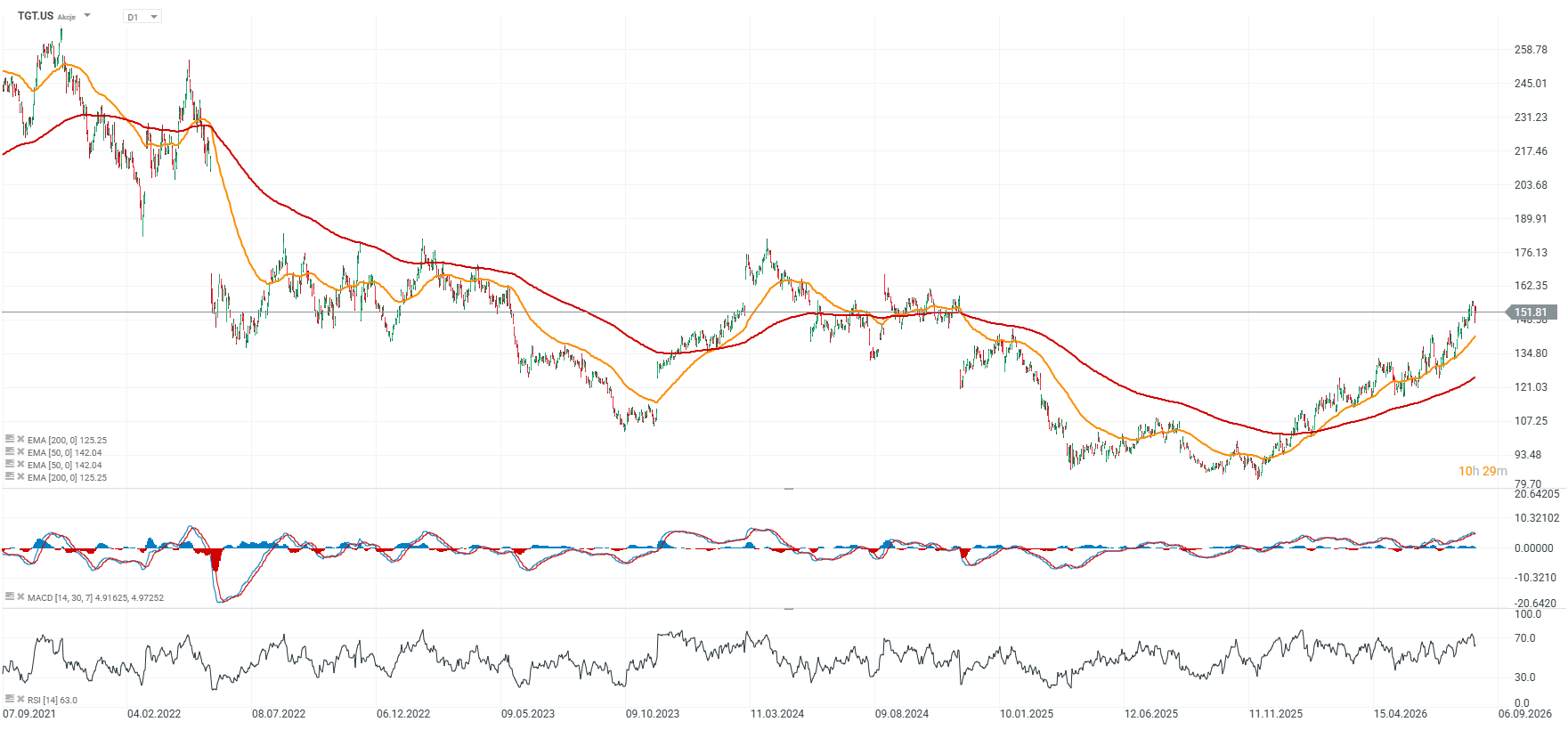
Target shares (TGT.US, D1 interval)
Ahead of the earnings release, Target shares had already experienced a strong period of gains. The closing price stood at $152.5, representing an increase of more than 20% over the previous three months and 54% over the past 12 months.
Despite better-than-expected results, the shares fell by around 4% in pre-market trading following the release. This shows that market reaction does not depend solely on whether a company beats revenue or EPS expectations.
One factor investors may have taken into account was the significant impact of the one-off tariff refund on reported earnings. Looking ahead, the sustainability of comparable sales growth, improvement in underlying profitability, and the performance of weaker product categories may prove more important.
After a sharp decline in previous quarters, Target has gradually returned to growth, with the shares trading nearly 25% above the 200-session EMA200 moving average (red line), although they still remain around 50% below their historical peak.
 Source: xStation5
Valuation and business growth indicators
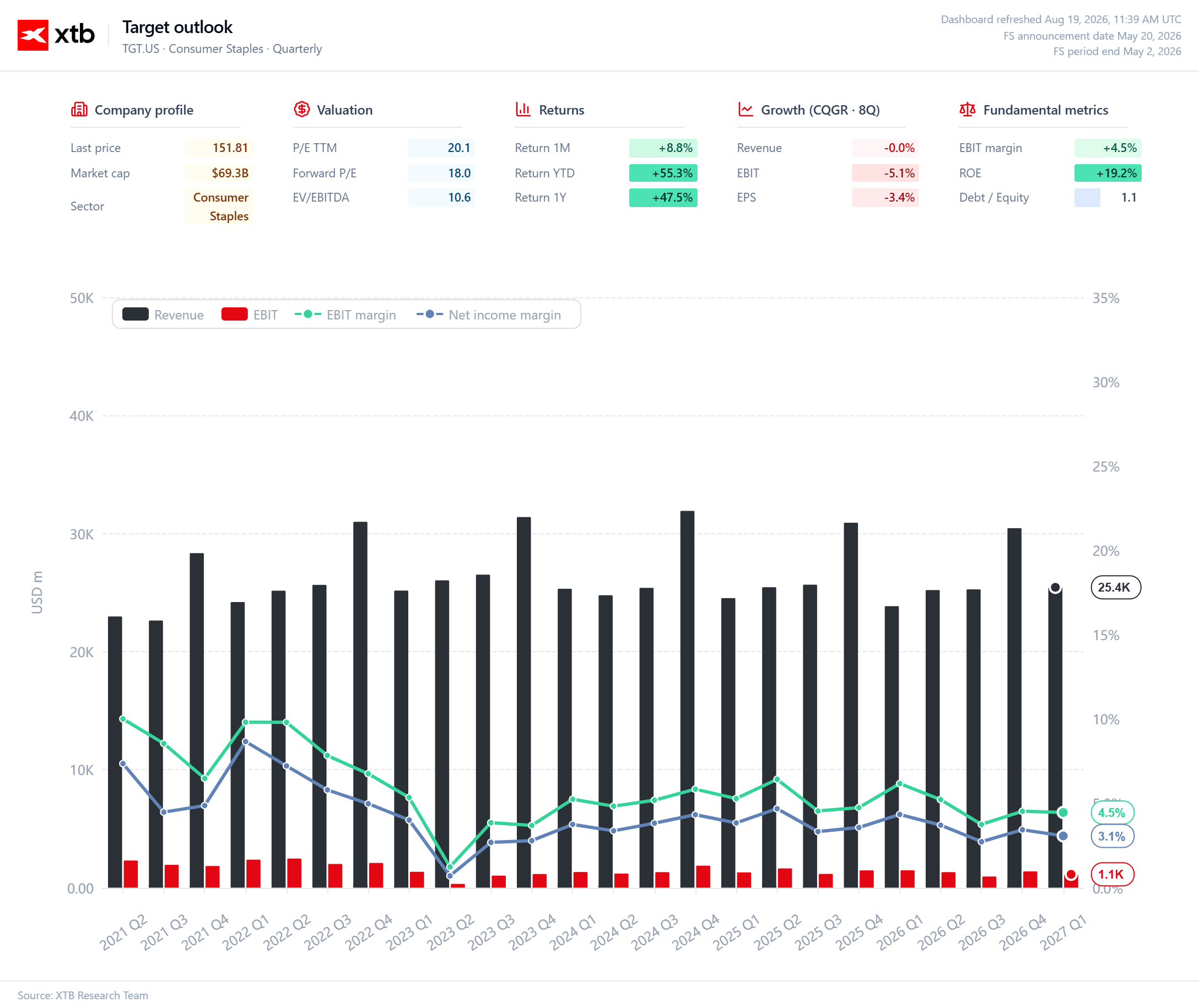
Target’s revenue has remained relatively stable over recent years, with clear seasonality and quarterly peaks above $30 billion, highlighting the mature nature of the business and its limited organic growth dynamics. The latest revenue level stands at approximately $25.4 billion, while the absence of a sustained upward trend confirms that the company’s main challenge is currently not scale, but a visible improvement in efficiency.
EBIT in the latest quarter stands at around $1.1 billion, while the EBIT margin is 4.5%, indicating an improvement compared with weaker periods. Even so, the margin still provides only a relatively narrow buffer, which is typical for the retail sector.
A net margin of around 3.1% shows that Target has recovered part of the profitability lost in 2023, although it remains below the strongest readings seen at the beginning of the period under review. It is also worth noting that margins fluctuate much more than revenue, suggesting that operating costs, product mix, promotions, and inventory management remain the key drivers of earnings.
From a fundamental perspective, improving margins alongside stable revenue are a positive signal because they suggest that part of the earnings growth may be generated through internal efficiency improvements rather than sales growth alone. However, there is still no clear evidence of a lasting breakthrough, so the company’s future performance should be assessed primarily in terms of whether Target can maintain its EBIT margin around current levels while also reaccelerating revenue growth.
Source: XTB Research
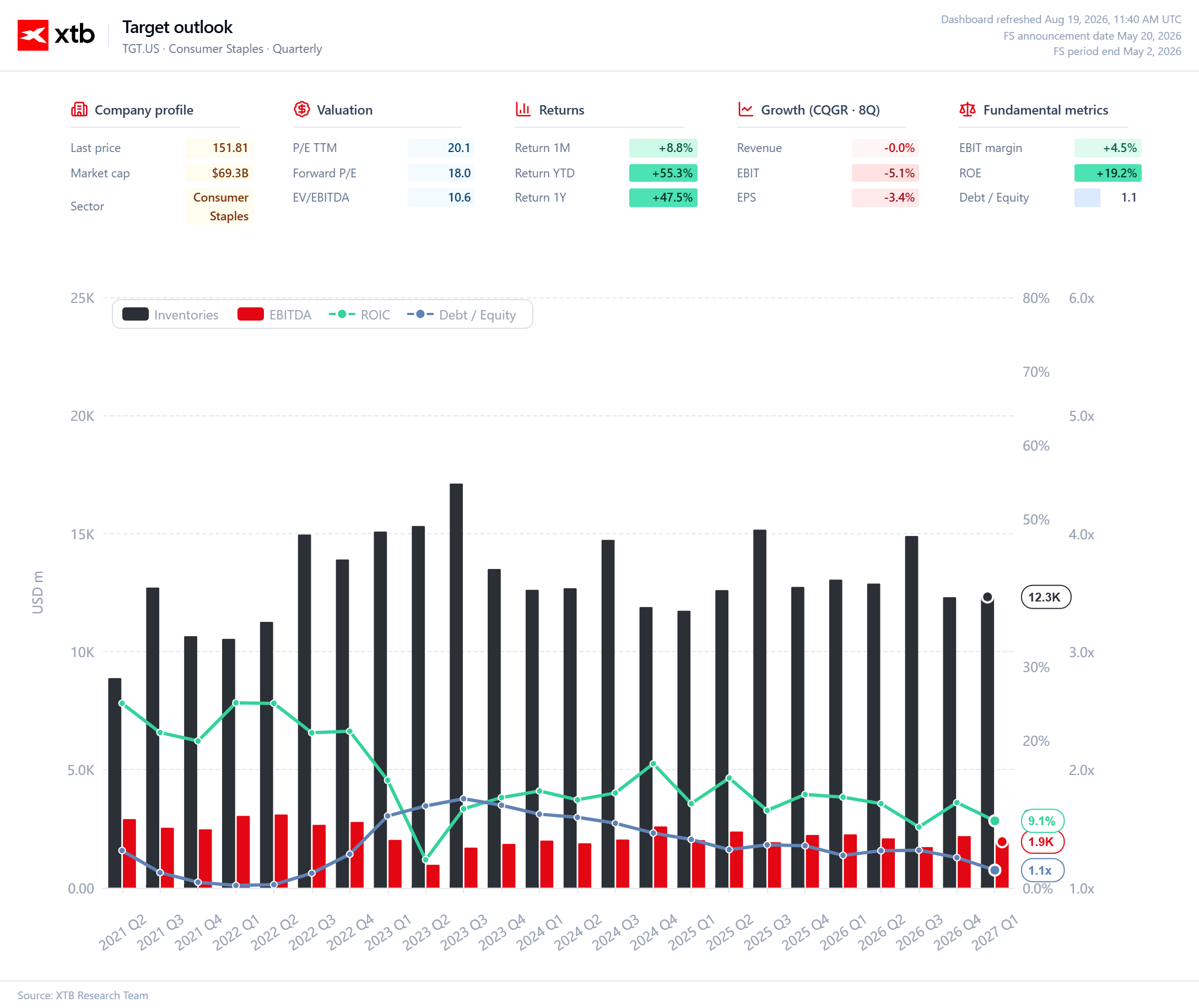
Target’s inventory levels remain relatively high, but after the peaks observed in 2023 and 2025, greater stabilization is visible, suggesting that inventory is becoming better aligned with the pace of sales. EBITDA has remained within a relatively narrow range in recent quarters, with the latest reading at around $1.9 billion, indicating no clear acceleration in operating profitability.
The most important qualitative signal is the decline in ROIC to around 9.1%, showing that the company is generating a lower return on invested capital than during the strongest periods of previous years. At the same time, the Debt/Equity ratio stands at around 1.1x, well below the levels seen in 2023–2024, indicating an improvement in the financing structure and lower pressure from leverage.
From a fundamental perspective, the reduction in financial leverage is therefore positive, although it has not yet been accompanied by an equally strong improvement in capital efficiency. Inventory stabilization could support margins in the coming periods if the company avoids excessive discounting and further inventory accumulation. Overall, the chart shows a business with an improving balance-sheet profile, but still only moderate returns on capital and no clear signal of sustained EBITDA growth.
Target is valued at a P/E ratio of 20.1x, meaning the market is paying around $20 for every $1 of earnings generated over the past 12 months. The forward P/E ratio stands at 18x, below the trailing multiple, suggesting that consensus expectations point to earnings growth in the coming periods. Meanwhile, an EV/EBITDA multiple of 10.6x indicates a moderate valuation of the enterprise relative to the EBITDA it generates.
Source: XTB Research



Three markets to watch next week (23.10.2026)



Daily Summary: Oil at five-month highs, indices under pressure (23.10.2026)

US Open: Further declines on Wall Street, Brent above 111 USD, AI correction continues (14.10.2026)



Morning Wrap: AI profitability concerns spark market Sell-Off
This content has been created by XTB S.A. This service is provided by XTB S.A., with its registered office in Warsaw, at Prosta 67, 00-838 Warsaw, Poland, entered in the register of entrepreneurs of the National Court Register (Krajowy Rejestr Sądowy) conducted by District Court for the Capital City of Warsaw, XII Commercial Division of the National Court Register under KRS number 0000217580, REGON number 015803782 and Tax Identification Number (NIP) 527-24-43-955, with the fully paid up share capital in the amount of PLN 5.869.181,75. XTB S.A. conducts brokerage activities on the basis of the license granted by Polish Securities and Exchange Commission on 8th November 2005 No. DDM-M-4021-57-1/2005 and is supervised by Polish Supervision Authority.