


- Silver slump: a rare tail event, as sell off continues in precious metals
- Stock futures drop as risk aversion takes hold
- February seasonality update
- The end of the dollar debasement trade?
- Market doesn’t expect Warsh to be under the thumb of Trump
- Tech update
- Partial US government shutdown expected to be temporary
- 3 events to watch

- Silver slump: a rare tail event, as sell off continues in precious metals
- Stock futures drop as risk aversion takes hold
- February seasonality update
- The end of the dollar debasement trade?
- Market doesn’t expect Warsh to be under the thumb of Trump
- Tech update
- Partial US government shutdown expected to be temporary
- 3 events to watch
Risk aversion grips markets at the start of February
Risk aversion is gripping financial markets this morning, as the gold and silver sell off deepens. The gold price is lower by 7% and silver is down another 12%. If the sell off continues, then gold and silver are at risk of eroding their losses for the year so far. The historic move lower in silver prices has not stemmed a fall at the start of this week. Traders have not yet found a level that they are happy to buy the dips, and the timing of Chinese Lunar New Year in mid-February could accelerate the sell off, as Chinese traders reduce risk ahead of the holiday.
Although Friday’s sell off was exacerbated by President Trump’s choice of Kevin Warsh as his pick for the next Fed chairman role, the continued selling pressure is a sign of an extremely crowded trade that is unwinding, and it may take time to return to normal. Silver has been defying gravity in recent months, and the record highs it was delivering on a near daily basis were divorced from reality. Some analysts believe that silver’s fair value lies in the $60’s handle, which suggests that the sell off may persist.
The sell off in gold and silver is weighing on other financial markets as we start a new week. There has been a flight to safety. Stock futures are pointing to large losses for US stocks, with Dow Jones futures pointing to a 400 point loss later today. European stock futures are also lower, with a 0.8% loss expected for the FTSE 100. Europe’s tech sector could come under pressure this morning, after Nvidia CEO Jensen Huang, said that Nvidia would not invest big $100bn into OpenAI. Comments like this could weigh on the AI trade today, as markets remain jittery and prone to steep sell offs.
UK-listed miners are also in the crosshairs of the precious metals sell off, and there Glencore, Endeavour and Antofagasta will be watched closely to see whether they follow gold and silver with steep moves to the downside.
The breakdown in the silver trade
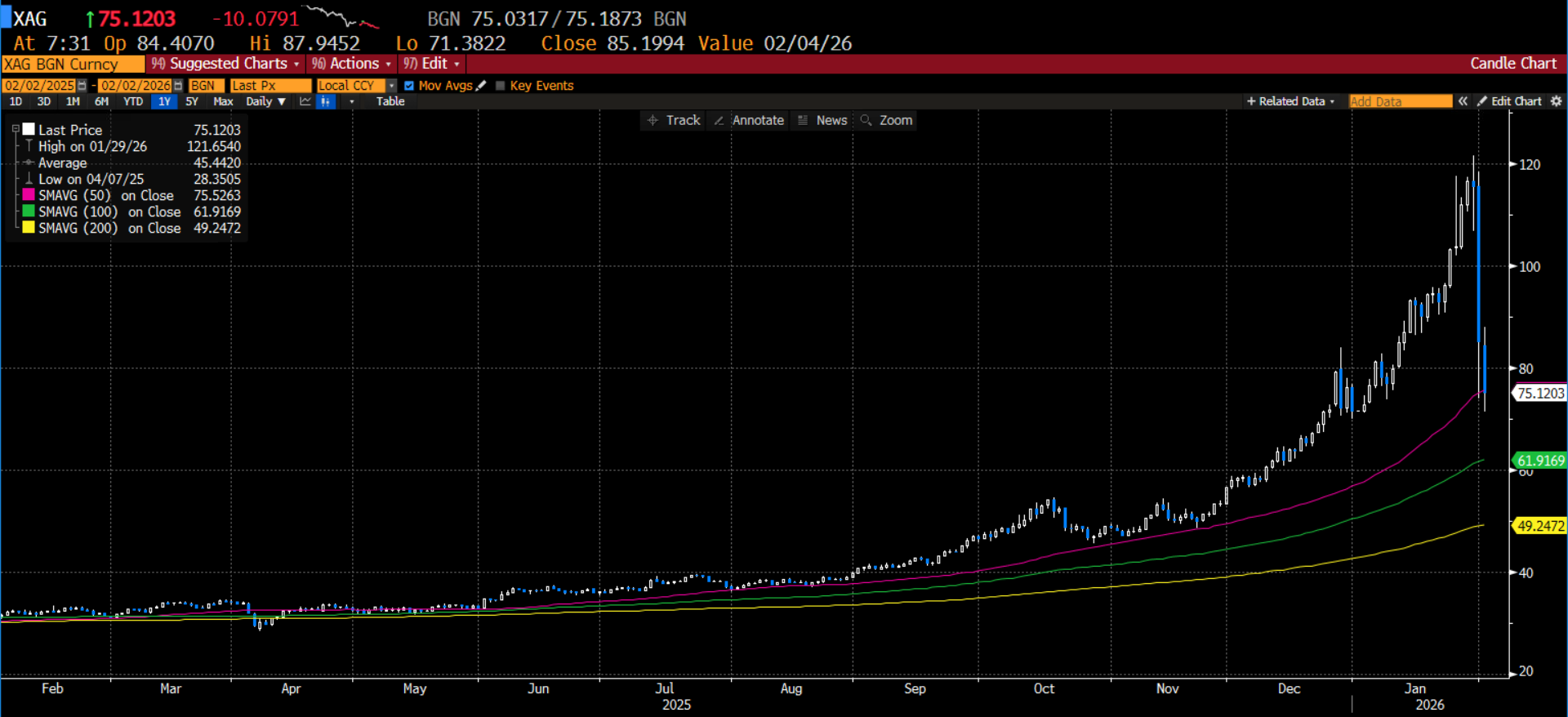
It’s been a wild start to the year for financial markets. Although stocks and commodities have registered year-to-date gains, this belies some truly historic market moves. The flash crash in the silver price on Friday, which saw it drop 26%, was the largest drop since 1980 for the precious metal. After a parabolic rise, liquidity evaporated in the silver market last week, and broke one of the hottest trades so far this year.
Silver slump: a rare tail event
Friday’s sell off in silver was a 5-standard deviation move, it was a rare tail event, so the fact that the sell off has extended into Monday, suggests that the correction in silver will be brutal. We had mentioned last week how trading volumes in silver had surpassed many of the US’s biggest stocks, and turnover on the main silver ETF was a whopping $41bn on Friday. The question as we start a new month is whether there are any sellers left? While there may be some dip-buying, those hoping that the precious metals market will mean revert after historic downside moves in recent days, could be waiting for some time.
Chart 1: Silver price: a historic move, but the sell off continues
Source: XTB and Bloomberg
Stock market volatility remains stable as commodities get riskier
An interesting dynamic is occurring in financial markets. Volatility is concentrated in commodity markets and not equity markets. The Vix index, which measures volatility on the S&P 500, ticked up slightly to 17.4 on Friday, but remains below the 12-month average of 18.8. We expect this to pick up, but we still expect stocks to remain less volatile than other asset classes in the short term.
February seasonality update
As we move into February, it is worth noting that there is no clear seasonal direction for US stocks. The 5-year average move in the S&P 500 is a mere 0.1%. However, the monthly performance of the S&P 500 has been mixed, in 2025 the index fell 1.4%, while it rose more than 5% in 2024.
There is a stronger positive bias for European stocks in February. The average move in the Eurostoxx index in the last 5 years is 1.7%, and 0.8% for the FTSE 100. Thus, if history is a guide, Europe may be primed to outperform the US in the coming weeks.
The end of the dollar debasement trade?
Interestingly, forced liquidation of silver positions in the US, which exacerbated Friday’s sell off, led to a rebound in the dollar, which was the top performing currency in the G10 FX space at the end of last week. The dollar is higher again on Monday, but it is lagging the safe havens like the yen and the swissie. So much for the dollar debasement trade.
Precious metals were the biggest benefactor of the dollar debasement trade this year. The fact that gold and silver sold off sharply at the same time as the dollar rallied, picks holes in the argument that the dollar and US assets are being shunned. While US policy risk is adding a political risk premium to the dollar, there could be a newfound demand for dollars, especially after Kevin Warsh was announced as the President’s choice for Fed chair from May, when Jerome Powell’s term ends.
Market doesn’t expect Warsh to be under the thumb of Trump
Although there are still obstacles to Warsh becoming Fed chair, including getting approved by the Senate Banking Committee, the market is not expecting Warsh to be particularly dovish, or swayed by President Trump’s preference for rate cuts. The interest rate futures market is still expecting the first rate cut from the Fed in the middle of the year, and a broad continuation of Powell’s term as chair. This could be premature, as Warsh has sounded more dovish in the past 12 months, however, for now, Warsh is not seen as a threat to stocks, and may help the dollar to recover after it reached a 4-year low last week. The economic data so far this year is supporting the Fed’s current policy stance, and we do not expect this week’s NFP report to shift the dial for US interest rates.
Tech update
Tech was one of the weaker sectors on the S&P 500 last week, as a divergence between the Magnificent 7’s performance continues. Meta’s shares rallied 11% last week, on the back of well received earnings, while Microsoft’s shares fell more than 5% as its earnings report failed to entice investors. There has been a reordering of the tech stock hierarchy this year. Sandisk, the memory chip maker, continues to power ahead and was the top performer on the S&P 500 last week. This compares with Microsoft and Palantir, who were some of the weakest performers.
Tech has fallen out of fashion with traders as the backdrop has become more uncertain. The key factors driving the US stock market right now include low volatility stocks, dividend payers and value stocks. This is the opposite of the tech trade, suggesting that earnings season so far has not done much to boost the tech sector, even if there is some outperformance for individual names.
Partial US government shutdown expected to be temporary
The markets will also have to contend with another US government shutdown. This is only a partial shutdown and will not have as big an impact on the broader economy as the shutdown of last October. We expect it to be temporary, however, the House Speaker has said that it will extend beyond Monday, as Congress rushes to pass a Budget. Hopes are high that the shutdown will end on Tuesday and cause little to no disruption to economic data releases.
Below, we look at three events that could dictate price action this week.
1, ECB and Bank of England meetings
The ECB is not expected to change rates at this week’s meeting and there is only a 17% chance of a cut. However, it is the surge in the euro in recent weeks that will loom large over this meeting. Although the euro pulled back from the $1.20 level late last week on a bout of dollar strength, it is probably too close to this level for comfort for the ECB right now.
The Eurozone’s December CPI rate fell below 2% to 1.9%, and the risk is that a strong euro could depress inflation further. CPI is expected to dip to 1.7% in January when it is released on Wednesday. Although the ECB expects inflation to return to target over time without any further changes in interest rates, if the euro continues to power ahead, then debate could shift to rate cuts later this year.
In the UK, the BOE is also expected to keep rates on hold when they meet on Thursday. This meeting will also include the first Monetary Policy Report of the year, and the BOE’s updated economic forecasts. Investor’s will be watching for any change in forecasts, especially around wage growth and unemployment. It will be worth watching any comments from Andrew Bailey about the uptick in UK CPI last month to 3.4% in December. This is likely to solidify the BOE’s resolve to keep rates on hold, with no rate cut expected until April, when inflation is expected to have moderated, and wage pressure is also expected to start to wane. Overall, the pound could get a boost from a hawkish sounding GBP, although the main driver of the FX market now remains USD weakness.
2, NFP
This is a data-heavy week, and the key release will be the US labour market report due on Friday. Analysts expect a reading of 68k for last month, up from 50k in December. The unemployment rate is expected to remain steady at 4.4%.
Overall, a low NFP number does not mean that the US economy is slowing. We do not think that this week’s report will give us a definitive signal due to seasonal adjustments in the data, which could make it extra noisy. Thus, investors may look through this report, especially if there are other drivers of price action, as we expect.
3, Earnings reports
It’s another big week for earnings reports. There has been a mixed performance in AI stocks in recent weeks, and investors are scrutinizing earnings reports in a way that they haven’t in recent years. The AMD results on 3rd Feb will be worth watching closely. Its Q4 results are expected to show revenues of $9.64bn and net income of $2.17bn. The risks are to the upside due to strong CPU demand.
AMD’s shares sunk nearly 10% last week, although it has out-performed the broader tech sector so far this year and is still higher by 8%. Even with last week’s decline, AMD’s share price is reflecting a healthy amount of optimism about this week’s earnings report, so the future direction of the stock will depend on its outlook for 2026. The risk is that 2026 could see a slowdown in growth, which may last until major AI projects scale up. Cost pressures will also be watched closely.
Amazon will also release results on 5th Feb. Cloud growth at Amazon Web Services will be the focus. AWS is expected to show growth of 21% for last quarter, and investors will want an update on supply constraints that could threaten future growth.
Amazon shares have mostly gone sideways over the past 12 months and are higher by less than 1%. Although valuation concerns are easing, the AI driven phase of cloud computing expansion could slow down from here. Thus, returns may not be as attractive in the future, and extra costs may also pressure margins. Thus, the outlook for Amazon’s cloud computing business will be crucial for investors.



Daily summary: Wall Street sentiment weakens amid hawkish Fed remarks 🚩 USDIDX at its highest level since July 24


Cocoa Falls 4% 📉 Are High Inventories Weighing on Prices?

Stock Market Commentary: Trump Signals a Major Drop in Oil Prices. Will U.S. Stocks Surge?


US Open: Nasdaq tries to recover loses 🗽 Fair Isaac shares in panic
This content has been created by XTB S.A. This service is provided by XTB S.A., with its registered office in Warsaw, at Prosta 67, 00-838 Warsaw, Poland, entered in the register of entrepreneurs of the National Court Register (Krajowy Rejestr Sądowy) conducted by District Court for the Capital City of Warsaw, XII Commercial Division of the National Court Register under KRS number 0000217580, REGON number 015803782 and Tax Identification Number (NIP) 527-24-43-955, with the fully paid up share capital in the amount of PLN 5.869.181,75. XTB S.A. conducts brokerage activities on the basis of the license granted by Polish Securities and Exchange Commission on 8th November 2005 No. DDM-M-4021-57-1/2005 and is supervised by Polish Supervision Authority.