


- Gold’s demise continues
- Strait of Hormuz in focus as crisis escalates once more
- Pivotal week for conflict
- The energy crisis hits this week as Qatari LNG exports dry up
- Economic outlooks get updated
- Gold fails to draw safe haven flows
- The underperformance of bonds vs. equities
- No snap-back recovery for stocks
- Eco week: what to watch

- Gold’s demise continues
- Strait of Hormuz in focus as crisis escalates once more
- Pivotal week for conflict
- The energy crisis hits this week as Qatari LNG exports dry up
- Economic outlooks get updated
- Gold fails to draw safe haven flows
- The underperformance of bonds vs. equities
- No snap-back recovery for stocks
- Eco week: what to watch
The oil price continues to set the tone for financial markets. Brent crude is back above $113 per barrel at the start of the week, there are steep losses expected for European equities after stocks across Asia sold off sharply. The Nikkei is down more than 3%, while the Hang Seng is lower by more than 4%. The sell off is broad based, but energy, tech, materials and real estate are leading the Japanese index lower, and we expect it to be a similar story in Europe.
Gold’s demise continues
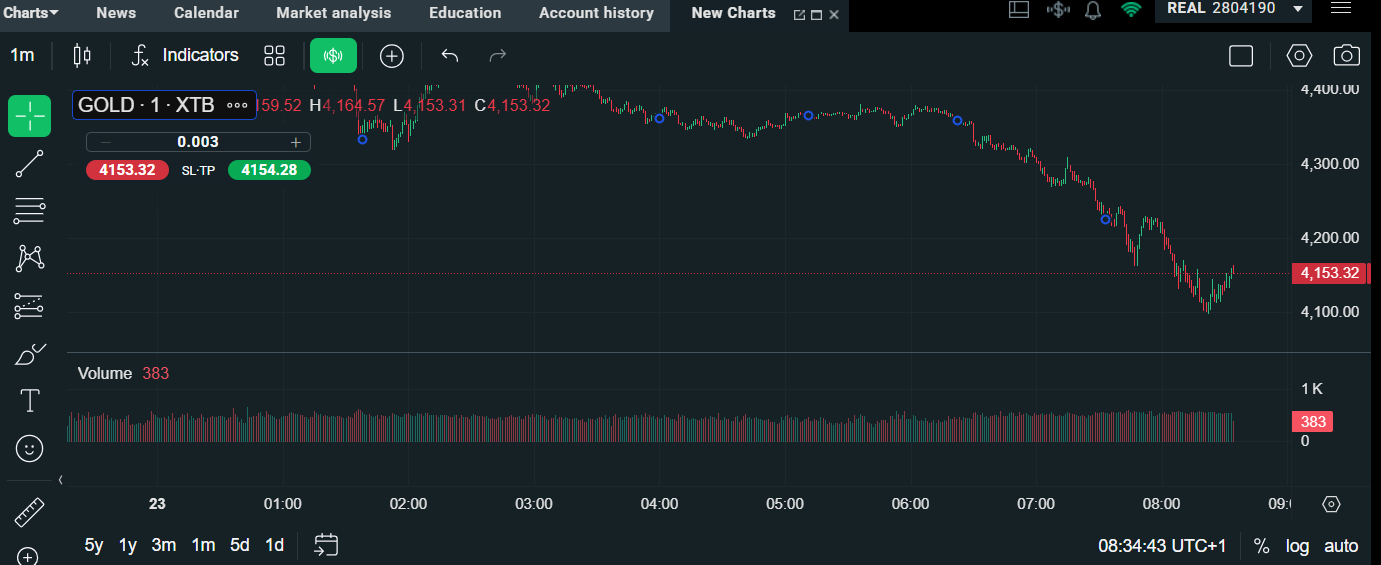
The gold price is falling off a cliff. It is lower by 7% today, silver is down 8%. The yellow metal is now trading around the $4,150 per ounce mark. Last week, the gold price lost the $5,000 handle, this week the $4,000 handle looks like it is at risk. This means another bruising day could be on the cards for UK equities, after heavy losses for the UK-listed gold miners last week, Antofagasta and Fresnillo both saw their stock prices drop 10%. Aside from oil majors and a trickle of well-received corporate news, there are few hiding places for stock investors at this stage of the conflict.
Chart 1: the gold price
Source: XTB
Strait of Hormuz in focus as crisis escalates once more
We are entering the fourth week of the Middle Eastern conflict and there is still no end in sight. The stakes were raised last week after both sides attacked energy infrastructure. Now we are entering a new escalatory phase for this war: Donald Trump has given the Iranian regime 48 hours to reopen the Strait of Hormuz or face a bombardment of their power plants.
Iran has hit back and said that it will completely close the Strait if its power plants are hit. Since Iran has consistently defied expectations and launched almost continuous drone and missile strikes against its neighbors, Trump may find that his ultimatum will fall on deaf ears.
Pivotal week for conflict
This could be a pivotal week for the conflict, and we could see who blinks first. All eyes are on the Strait of Hormuz, which is the epicenter for financial markets. If the Strait is reopened then the oil price could sink, however, if Iran does not adhere to Trump’s ultimatum, then it could seriously weaken the President’s hand, with untold consequences for global markets.
The energy crisis hits this week as Qatari LNG exports dry up
This war looks far from over, and that should keep energy prices buoyant. The price of Brent has surged above WTI in the past week, and weekly gains for the oil price since the start of this conflict are at historic highs. The flow of liquified natural gas (LNG) from the Middle East, will stop this week, as tankers that set off before the strikes on Iran arrive at their destinations. These mostly came from Qatar, which have shut off exports and now faces a decline of nearly 20% of output due to drone damage to the Ras Laffan gas field. This means that many countries now face a cliff edge, especially in Asia, with LNG exports running dry. Spot LNG prices are soaring, which means that LNG importers will see a major dent to their finances in the coming weeks and months. In the last 3 weeks we have spent a lot of time talking about the incoming energy crisis, this week we could see what it means in practice.
Economic outlooks get updated
There has been a rush of analysts and central banks who have updated their forecasts for global growth and inflation in the wake of the war. Unsurprisingly, growth is getting revised lower and inflation is expected to rise. The US and China are expected to have the most resilient economies, while the UK is expected to have one of the weakest growth rates in the G7, although the picture is not too rosy for the Eurozone or Japan. Headline inflation has also been revised higher, with both the US and the UK expected to see CPI above the 3% handle for the majority of this year. Interestingly, most analysts, at this stage, do not foresee a recession or a 2022-style inflation spike to double figures. If the conflict persists then this could change.
These forecasts are all subject to change, the most damaging scenario would be a long-term conflict. Although Israel has said that they will continue with attacks throughout Passover, which starts in April, developments around the Strait of Hormuz this week will be pivotal for the future trajectory of this war.
Stocks eroded early gains last week, and sentiment seeped from global equity markets after major central banks sounded concerned about the inflation outlook, which caused a major selloff in global bonds and a repricing of interest rate expectations. As the conflict escalated into the weekend, with both the US and Iran dismissing the idea of a ceasefire, US stocks sold off.
Gold fails to draw safe haven flows
European stocks continue to underperform vs. their US counterparts, and although the FTSE 100 benefits from a large energy sector, it was also weighed down by the gold miners after precious metals sold off sharply. The gold price fell by 10% last week, the largest weekly decline since the sell off in precious metals at the end of January. Anyone who expected gold to outperform in the current environment was left sorely disappointed, especially now that central bankers are expected to hike interest rates this year as they talk tough about the inflationary impact from this conflict.
The underperformance of bonds vs. equities
So far, the biggest financial victim of this conflict has been the bond market. Concerns over global inflation have led to a sharp repricing of the front end of the yield curve around the world, especially in the UK. UK 2-year yields rose 46bps last week and are higher by more than 100bps since the onset of the war. 2-year Gilt yields are up by a fifth in the past month, this compares with an 8.5% decline in the FTSE 100 in sterling terms, and a 10% drop in the FTSE 250. The underperformance of bonds vs equities tells us two things: firstly, bonds are much more sensitive to interest rate changes than equities, and secondly, sovereign debt is no longer considered a safe haven.
Why UK Gilts get targeted every time
The sharp rise in Gilt yields in the UK vs. other countries that are also exposed to the energy price shock emphasizes the UK’s vulnerable position as a high inflation economy with weak public finances. It cannot afford its current welfare bill let alone to bail out households and businesses during this energy price spike, which makes for an uncomfortable period for the UK economy. Expect a wave of growth downgrades for the UK in the coming weeks, especially if the BOE sticks to its hawkish mantra.
No snap-back recovery for stocks
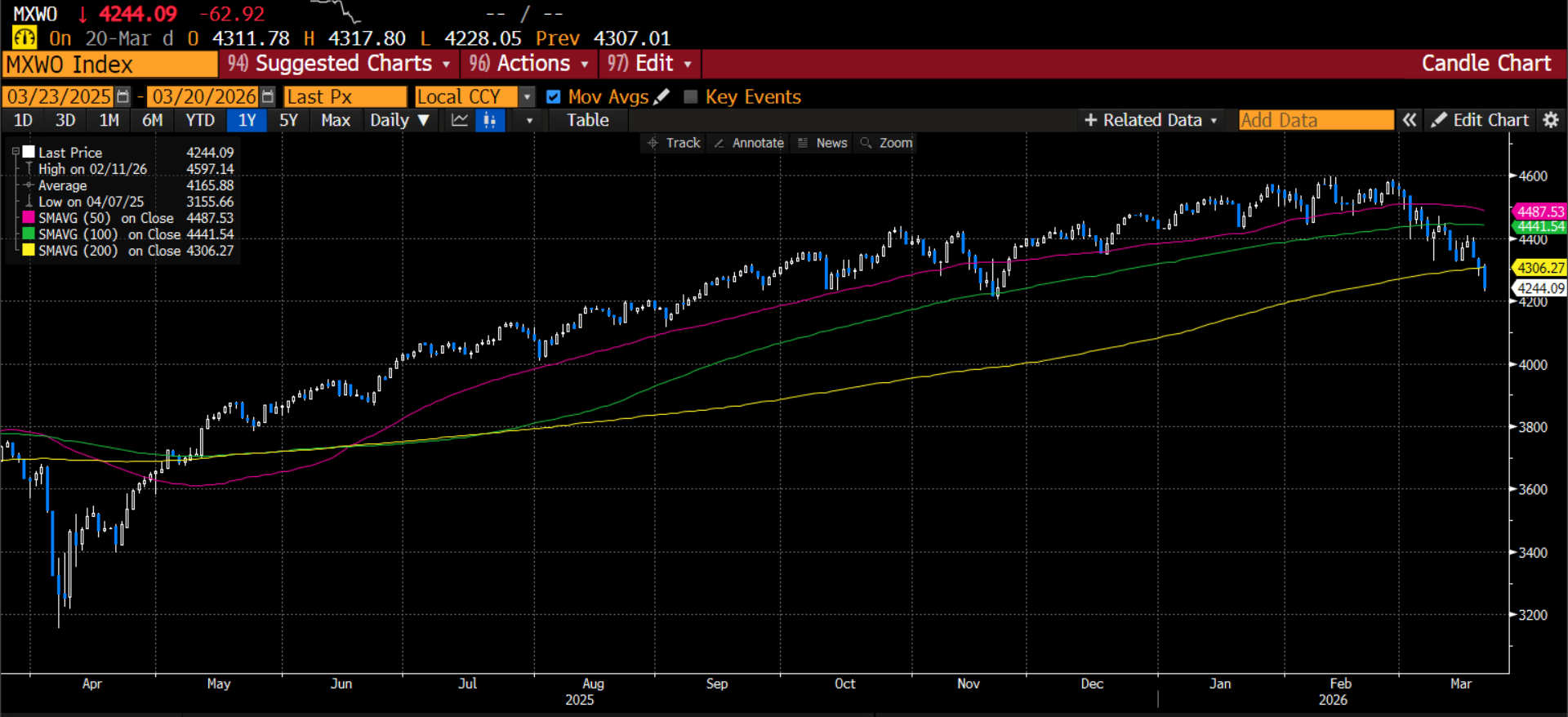
From an asset price perspective, there are a few things that are worth noting. UK Gilt yields had their worst weekly performance in 4 years, while equities have also been dragged lower by this conflict, the MSCI world index has seen a fairly orderly sell off, considering the escalation in the conflict last week. Although the performance of the MSCI world index has been fairly resilient compared to the sell-off last April, it has dropped through its 200-day sma, which suggests that longer term momentum is now to the downside. The is that stocks grind lower as this conflict drags on, and unlike last April there may be no quick recovery.
Chart 1: MSCI World Index, below its 200-day sma
Source: XTB and Bloomberg
Overall, the Middle East is likely to dominate market sentiment, especially as we lead up to President Trump’s deadline for Iran to reopen the Strait of Hormuz by late Monday evening.
What to watch:
The economic data releases this week will likely feel woefully out of date after the recent volatility in energy markets, particularly UK CPI and the global March PMI reports. However, they are still worth watching to see what the baseline growth and inflation rate was before this energy price shock
Global PMIs
The PMI reports across Europe and the US come at an interesting time, when the war in the Middle East is causing major shockwaves for the global economy. This week’s data may give us an early indication of the extent of the fallout. The March data will capture the start of the war and the initial spike in energy prices, although last week’s jump above $110 was too late to be captured in this survey. Economists expect the UK’s composite PMI to fall sharply from 53.7 in Feb to 52.9, the risks are obviously to the downside. If these expectations are correct, then it would suggest a more resilient private sector in the UK, which could temporarily ease fears about the UK’s growth outlook, which may give some respite to the Gilt market sell off.
A decline is also expected in the Eurozone composite PMI to 51 from 51.9 in February, so far no one is expecting the PMI’s to signal an imminent drop to contraction territory. If this were to happen, expect a knee jerk reaction lower in risk assets and the euro.
UK CPI
While it may be tempting to think that the UK CPI report will be ignored this week, we think that it will be used as a baseline. If inflation is stronger than the 3% forecast for February headline CPI then it could lead to another wave of panic in the UK bond market that the fallout from the energy price shock will be even worse than expected. However, a weaker reading could have the opposite effect.
There are also a raft of BOE speakers this week, including Megan Greene and Huw Pill. They can clarify their comments about how the conflict in the Middle East will impact the UK’s economy. If they sound concerned only about inflation without assessing the impact on growth and demand, then we expect Gilts to remain in the doldrums. However, after such a sharp sell off last week, the greater risk is for a recovery. If Greene and Pill add some balance to the debate about how another energy price shock will weaken household finances and the economy, then we could see yields stage a short-term recovery. Due to this, it is worth listening carefully to what MPC members have to say in the coming days. The pound was mostly flat last week, and managed to eke out a gain vs, the USD as yields surged. If we see UK Gilt yields fall back this week, then the pound could follow.


Daily summary: Wall Street sentiment weakens amid hawkish Fed remarks 🚩 USDIDX at its highest level since July 24


Cocoa Falls 4% 📉 Are High Inventories Weighing on Prices?

Stock Market Commentary: Trump Signals a Major Drop in Oil Prices. Will U.S. Stocks Surge?


US Open: Nasdaq tries to recover loses 🗽 Fair Isaac shares in panic
This content has been created by XTB S.A. This service is provided by XTB S.A., with its registered office in Warsaw, at Prosta 67, 00-838 Warsaw, Poland, entered in the register of entrepreneurs of the National Court Register (Krajowy Rejestr Sądowy) conducted by District Court for the Capital City of Warsaw, XII Commercial Division of the National Court Register under KRS number 0000217580, REGON number 015803782 and Tax Identification Number (NIP) 527-24-43-955, with the fully paid up share capital in the amount of PLN 5.869.181,75. XTB S.A. conducts brokerage activities on the basis of the license granted by Polish Securities and Exchange Commission on 8th November 2005 No. DDM-M-4021-57-1/2005 and is supervised by Polish Supervision Authority.