

- Oil prices rise at the start of the week, and stock futures drop but there is some hope for the UK bond market
- Burnham in ‘hock’ to bond market to prevent a Liz Truss moment
- Why Rachel Reeves’s fiscal rules are safe for now
- UK yields could stage a recovery along with stocks on Monday, as banks and defense get a boost
- Starmer’s flurry of activity to see off leadership challengers
- Soaring US Treasury yields start to concern investors
- Can US stocks maintain their record highs?
- Oil price in focus, as inflation threat continues
- Why it doesn’t pay to replace workers with AI
- What to watch: Wall Street vs. Main Street
- Earnings watch list: Nvidia in focus

- Oil prices rise at the start of the week, and stock futures drop but there is some hope for the UK bond market
- Burnham in ‘hock’ to bond market to prevent a Liz Truss moment
- Why Rachel Reeves’s fiscal rules are safe for now
- UK yields could stage a recovery along with stocks on Monday, as banks and defense get a boost
- Starmer’s flurry of activity to see off leadership challengers
- Soaring US Treasury yields start to concern investors
- Can US stocks maintain their record highs?
- Oil price in focus, as inflation threat continues
- Why it doesn’t pay to replace workers with AI
- What to watch: Wall Street vs. Main Street
- Earnings watch list: Nvidia in focus
Risk sentiment remains weak on Monday. The souring of sentiment corresponded with an increase in the oil price, Brent crude is above $111 per barrel, as tensions remain high in the Middle East. Stock futures in Europe are pointing to a mildly lower open, while index futures in the US are also in the red. However, there is some underlying hope that the UK bond market may stabilise at the start of the week, after the man of the moment, Andy Burnham’s comments about the UK’s fiscal rules.
It turns out that Andy Burnham might be in hock to the bond markets after all. UK yields could stage a recovery later today after Burnham retreated from some of his controversial remarks regarding the UK’s Gilt market. In an interview over the weekend, Burnham, the Manchester Mayor who is vying to be the next Prime Minister, committed to sticking to Rachel Reeves’ fiscal rules in an effort to reduce bond market jitters. UK asset prices took fright at the prospect of Burnham as PM, and the 10-yeat UK Gilt yield surged 14 bps on Friday, rising to its highest level since 2008, while sterling slumped to a 5-week low.
Burnham in ‘hock’ to bond market to prevent a Liz Truss moment
Burnham stated clearly that he now supports fiscal rules and agreed that the UK needs a plan to reduce its debt burden. The markets might be skeptical of Burnham, however, his comments tell us two things: 1, the bond market holds significant sway over UK politicians, and 2, if he does manage to replace Starmer, and it is a big if, he could commit to keeping Rachel Reeves in place, and UK fiscal policy may not differ too much from what we already have.
Why Rachel Reeves’s fiscal rules are safe for now
For now, the only cabinet member who looks like their job is secure is Rachel Reeves, who has had the bond market on her side since Labour won the election in 2024. This is not the only development this weekend. The fight to replace Keir Starmer looks like it will reopen Brexit wounds. Streeting, the former health secretary, is pinning his leadership run on the UK rejoining the EU, which he called an economic mistake, while Burnham, who has been pro-EU in the past, said he would not commit to the UK rejoining the EU. This leadership battle is not just about the soul of the Labour party, but also about a new economic direction for the UK. However, compared to Friday, the economic vision of the leftist Burnham looks slightly more centrist as we start a new week, which could dampen down the volatility that has recently afflicted UK asset prices.
In the same interview, Burnham hinged his economic vision around gaining greater control of public services, such as utilities, energy, housing and water services. He did not mention anything about more tax rises or greater welfare spending, which is toxic for majority of voters, according to recent polls. Instead he said that he wants to build an enhanced growth plan for the UK on a bedrock of fiscal stability. This sounds more like Reeves’ playbook compared to his prior comments.
UK yields could stage a recovery along with stocks on Monday, as banks and defense get a boost
If bond markets think they have tamed Burnham from his high spending ways, then we could see UK yields attempt a retreat on Monday. The pound has opened down slightly but is holding on to the $1.33 level vs. the USD, as the dollar makes a comeback. The key test for UK markets will be whether the 10-year yield can fall below the 5% level, and if the 30-year yield is trusting enough of Burnham to back away from 1998- level highs. Starmer’s pledge to ditch the planned fuel duty hike that was due to come into effect in September, could cost the Treasury more than £3.5bn by the end of this parliament. This could feed some concerns that a leadership battle will dent the UK’s finances even more as all candidates pledge greater levels of public sector spending. After the announcement about fuel duty, the leadership challenge to Starmer looks like it is already boosting spending, as the PM tries to bolster his popularity ahead of a leadership battle. This could limit any recovery in UK yields in the short term.
Although FTSE 100 futures are lower at the start of this week, some sectors could catch a break after a bruising few days. The FTSE 100 slipped 0.8% last week, however, there were some hefty losses for UK banks and financial firms, as well as UK defense firms. Rolls Royce, BAE Systems and Babcock, all fell 8%, 7% and 12% respectively last week. However, these stocks could be in for a recovery at the start of a new week.
Starmer’s flurry of activity to see off leadership challengers
Over the weekend, the Prime Minister appeared to put to bed fears that a protracted leadership battle would cause policy stasis in Westminster. Over the weekend he announced a £18bn boost to defense spending, with ministers saying that they hoped most of this extra spending would stay in the UK. There was more activity, reports suggest that a trade deal between the UK and Gulf states is reaching its final stages. This would add to the good news for defense firms, the luxury car sector and financial services.
There is also an expectation that the Chancellor will announce a relaxation of banking rules that were put in place in 2008. A pledge to loosen ring-fencing rules was included in the King’s speech, and if this is announced it could boost the UK’s banking sector, which has come under pressure in recent weeks. Lloyds Banking Group has seen its share price slip 8% in the past month, while Barclays is down 4%. There could be a bigger boost to sentiment, as this flurry of activity suggests that Starmer will not allow the work of government to grind to a halt during any future leadership contest. This is quite the power move from Keir Starmer, and one that UK asset prices might approve of.
Soaring Treasury yields start to concern investors
Elsewhere, global stock markets took a hammering at the end of last week. There was a clear divide between tech-heavy indices and everything else. The top global performers included the South Korean Kospi, the S&P 500 and the Nasdaq. They all managed to post a weekly gain, even though tech sold off sharply at the end of last week. In contrast, UK and European indices slipped.
The S&P 500 backed away from record highs at the end of last week, at one point the index was above 7,500 for the first time. The question now is, is this a correction, or something longer lasting? The US stock market has taken off without much participation from its base. A handful of tech companies have driven the index to its highest ever level and this concerns some investors. Stocks ripped higher after a burst of enthusiasm around the AI trade, but this sharp rebound in US stocks could be coming to an end after a 6% gain for the S&P 500 index in the past month, and a 7.7% gain YTD.
Can US stocks maintain their record highs?
There is a concern that the breadth of companies participating in the rally is narrow, which does not give the index a wide margin for error. Added to this, US indices are starting to look expensive. The price to earnings ratio for the S&P 500 is now 21.3 times 12-month forward earnings, compared to the long-term average of 16 times. When stocks are expensive and global bond yields are rising, the 30-year US Treasury yield rose above 5% last week, while the 10-year yield climbed above 4.5%, this could change the picture for investors.
There is a paradox within financial markets right now. The rally in US stocks is justified by an exceptionally strong earnings season for Q1. Profits were significantly higher than expected, rising by 28% YoY for the S&P 500, the biggest jump since 2021. However, concerns are starting to rise that earnings will not be able to maintain this pace as inflation becomes more embedded into the global economy. The cost of borrowing has surged, the oil price is firmly above $100 per barrel, and Brent crude is starting this week above $111 per barrel.
Oil price in focus, as inflation threat continues
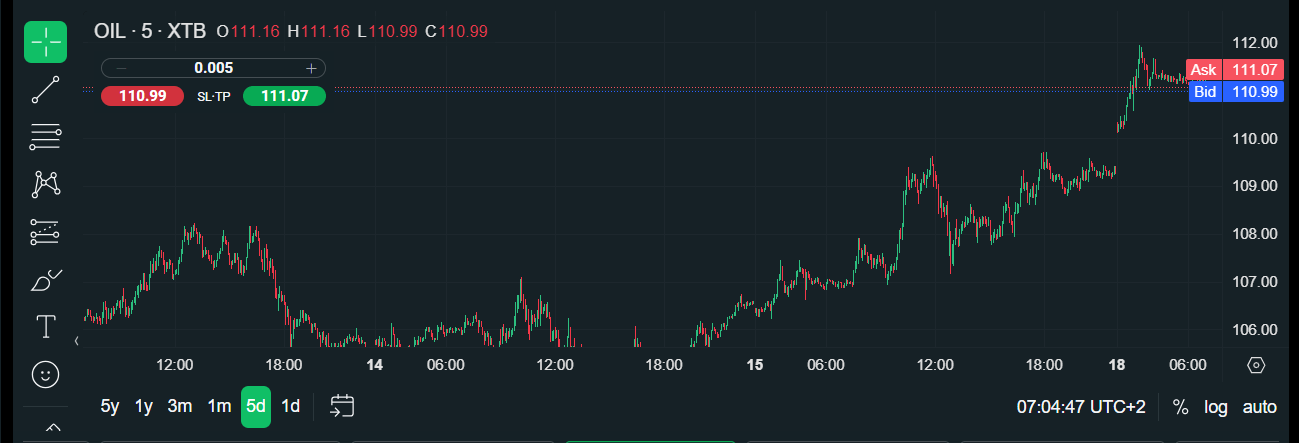
There could be more upside to come for the oil price at the start of this week, after further cracks appeared in the ceasefire in the Middle East. There was a drone attack at a nuclear facility in the UAE, which suggests that the situation could escalate in the coming days. The Strait of Hormuz remains closed, and the US and Iran are no closer to a peace deal. For all of President Trump’s harsh rhetoric, this has failed to break the deadlock and force Iran to end the war. This means that the biggest oil supply crisis in history carries on for another week.
It is also worth noting that investors are not yet ready to fully price in a bearish scenario while there is still a possibility of the Strait of Hormuz reopening. The ceasefire is still formally in place, even if there have been breaches of its terms. Ultimately, this means that the market is not positioned for an extreme scenario in the Iran war, which could leave risky assets vulnerable to a deeper sell off.
Chart 1: Brent crude oil
Source: XTB
Why it doesn’t pay to replace workers with AI
As we start a new week, companies who are planning to fire staff and replace them with AI might want to think twice. Research by CNBC found that out of the 23 companies listed on the S&P 500 who have announced mass layoffs due to AI, 56% of them have seen their share prices decline. The average loss was a whopping 25%. This includes Snap, its share price is lower by more than 30% YTD, Nike and Salesforce, its share price is also lower by 34% so far this year. Using AI to cut labour costs is not the stock price boon that executives thought it would be.
What to watch: Wall Street vs. Main Street
This week, it will be a battle of Main Street vs. Wall Street. There is some key economic data releases including global preliminary PMI reports for May, which should give us a better idea about how private sector growth has been impacted by inflation concerns and weak consumer sentiment. Added to this, the UK will also get the latest labour market data and CPI data for April. Both could show deterioration, which may add to fears that Q1’s strong pace of growth will not be repeated in Q2.
Nvidia’s results crucial to the AI trade
The highlight of the week will be Nvidia’s latest earnings report, which is scheduled for release on Wednesday 20th May after US markets close. This earnings report will be critical to the AI trade, especially after tech stocks slumped on Friday, Nvidia fell 4%, after recently reaching record highs. The numbers that matter the most from this earnings report include quarterly revenue of $78bn, forward guidance for this quarter’s revenues of $87bn.
Nvidia has a habit of surpassing estimates, and if the company fails to do so then this would be seen as a disappointment. There are no indications that they won’t beat expectations for another quarter. The company is transitioning away from its Blackwell architecture towards its new Vera Rubin system. Signs are that this is going well, and the new architecture is more expensive, which could keep revenues buoyant for the coming quarters.
Added to this, several of the hyperscalers have raised their capital expenditure plans for this year, including Meta, Microsoft and Google. Some of this will flow through to Nvidia, although Meta and Microsoft are also investing in custom-made chips from other suppliers.
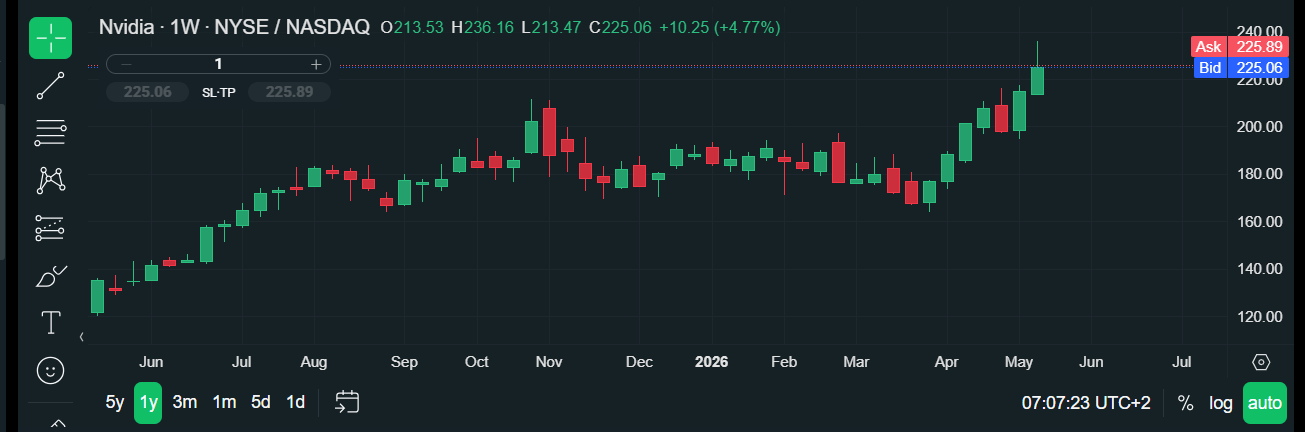
The stock price set up is less than ideal, leading into this earnings report. Although the stock price has lagged its peers and has a decent P/E ratio for a tech giant, at 25 times future earnings, Nvidia’s share price is still close to record highs and the company’s market capitalization is closing in on $6 trillion, which no other company has reached before. Thus, there could be some hesitation to push the stock price higher on the back of this earnings report.
What CEO Jensen Huang says is also worth watching. Any disappointment could hit the entire AI trade, just as some of them have been skyrocketing. Investors will want to hear Huang say a few things: 1, larger agentic AI enterprise adoption, which can sustain future product development and revenue, and 2, a broadening customer base beyond the traditional hyperscalers.
If Nvidia can deliver this, then the sell off in US tech stocks may be short lived.
Chart 2: Nvidia, close to the peak as we lead up to its earnings report
Source: XTB



Daily Summary: Wall Street Rises Ahead of Tomorrow's Fed Meeting💡



The US100 gets back on track and gains 1%📈



Market Wrap: Renewed confidence in AI drives stock market recovery (27.10.2026)



Gold Falls Below $4,000
This content has been created by XTB S.A. This service is provided by XTB S.A., with its registered office in Warsaw, at Prosta 67, 00-838 Warsaw, Poland, entered in the register of entrepreneurs of the National Court Register (Krajowy Rejestr Sądowy) conducted by District Court for the Capital City of Warsaw, XII Commercial Division of the National Court Register under KRS number 0000217580, REGON number 015803782 and Tax Identification Number (NIP) 527-24-43-955, with the fully paid up share capital in the amount of PLN 5.869.181,75. XTB S.A. conducts brokerage activities on the basis of the license granted by Polish Securities and Exchange Commission on 8th November 2005 No. DDM-M-4021-57-1/2005 and is supervised by Polish Supervision Authority.