



Wall Street opened Wednesday’s session without a clear direction. The S&P 500 is trading close to flat, while the Nasdaq is edging lower and the Dow Jones is outperforming, supported by healthcare stocks. Oil futures are pulling back today from around $96 to $93 per barrel, but the bigger headwind for equities appears to be the rise in the U.S. 10-year Treasury yield to its highest level since November 2023, which increases the discount rate and reduces the relative appeal of highly valued growth stocks. The market therefore remains in a relatively uncomfortable setup, where weakening labor-market data is colliding with higher energy prices and rising financing costs. Even so, companies have recently delivered strong growth in both earnings and revenue, which appears to be supporting investor interest in equities and underlying fundamentals despite elevated yields.
- The S&P 500 is up around 0.1%, the Nasdaq Composite is down roughly 0.1%, while the Dow Jones is gaining about 0.4%.
- Dell shares are up nearly 5% after the company raised its full-year revenue outlook. The stronger guidance is being driven mainly by robust demand for servers used in AI infrastructure.
- Hewlett Packard Enterprise is also reacting positively to Dell’s results, with shares gaining around 3%.
- Cybersecurity giant Palo Alto Networks is down around 8% after earnings, while GitLab is surging by as much as 15%.
- Gains in the Dow Jones are being supported by companies including Johnson & Johnson, Merck and Amgen, highlighting a visible rotation toward more defensive sectors.
- The yield on the benchmark U.S. 10-year Treasury climbed to 4.814% during the session, the highest level since November 2023.
- Higher yields are particularly challenging for stocks trading at elevated valuation multiples, as they raise the cost of capital and reduce the present value of future earnings.
- Pressure in bond markets is not limited to the U.S. Yields are also rising in the U.K., Germany and France, while Japanese government bond yields remain near multi-year highs.
- Oil remains a key source of inflation concerns. WTI is trading around $90 per barrel, while Brent remains above $94.
- Higher crude prices are linked to further U.S. strikes on Iran and the growing risk of renewed escalation in the Middle East.
- ADP data showed that U.S. private-sector employment increased by 38,000 in August, below expectations of 47,000 and down from an upwardly revised 46,000 in July.
- It was the weakest monthly employment gain since January, with job creation heavily concentrated in a small number of industries, particularly healthcare.
- A softer labor market would normally strengthen expectations for a more dovish Fed, but that effect is being partly offset by higher energy prices and rising bond yields.
- Commerce Secretary Howard Lutnick played down the recent increase in yields and expects market rates to stabilize and then begin to decline over roughly the next six months.
- Uber shares are up more than 1.5% after the company announced plans to cut around 10% of its workforce, or about 3,300 jobs, while reducing the number of managerial positions by 20%.
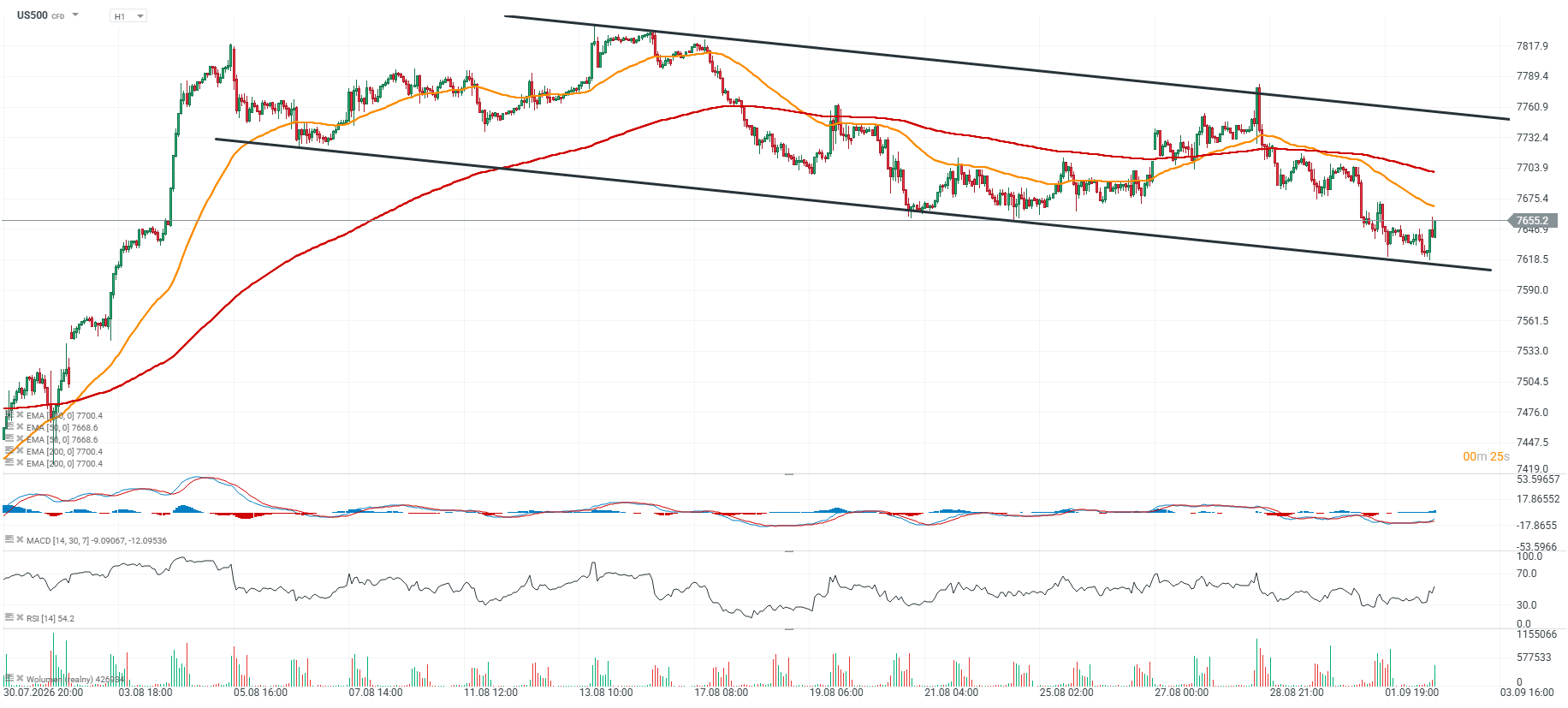
US500 chart, H1 interval
The SPX contract is trading within a bullish flag formation, although US500 has entered what may be a short-term descending channel. As long as the contract remains below the area around 7,730 points, which marks the upper boundary of the channel, downside pressure may continue to dominate. For the equity market, the key question now is whether the rise in yields proves temporary. If the U.S. 10-year yield remains clearly above 4.8%, pressure on technology-sector valuations could intensify.
Source: xStation5
Strong Dell results and outlook lift the shares
Dell reported quarterly results well above Wall Street expectations, with AI infrastructure once again emerging as the main growth engine. The company raised its fiscal 2027 outlook and now expects sales of AI-optimized servers to triple year over year, compared with its expectation just six months ago that the business would slightly more than double. The market reacted strongly, with Dell shares rising by as much as around 9% in after-hours trading following the release. The scale of the positive surprise shows that Dell is increasingly being viewed not simply as a PC manufacturer, but as one of the key beneficiaries of the global buildout in data-center infrastructure. At the same time, the stock’s exceptionally strong performance means that future quarters will need to confirm not only continued revenue growth, but also the durability of margins and demand for AI servers. Dell now expects $74 billion in AI-optimized server revenue for the full fiscal year, representing 200% year-over-year growth. Just six months ago, the company had forecast growth of 103% for this business.
Key takeaways from Dell’s results
- Dell reported adjusted earnings per share of $7.04 for the fiscal second quarter of 2027, compared with $4.92 expected by the market.
- Revenue came in at $46.97 billion versus the LSEG consensus of $44.92 billion, exceeding every analyst estimate.
- Sales rose by around 58% year over year, while net income increased to $4.13 billion, or $6.34 per share, from $1.16 billion, or $1.70 per share, a year earlier.
- For the fiscal third quarter, Dell expects $49.0 billion in revenue and adjusted EPS of $6.50. That level of revenue would imply growth of 81% year over year.
- The LSEG consensus had previously called for $41.42 billion in revenue and EPS of $4.49, meaning Dell’s guidance came in well above expectations.
- Dell also raised its full-year fiscal 2027 outlook to $192 billion in revenue and adjusted EPS of $25.50.
- Analysts surveyed by LSEG had expected $172.67 billion in revenue and EPS of $18.92.
- As recently as May, Dell had guided for revenue of $165-169 billion and adjusted EPS of $17.90.
- Chief Operating Officer Jeff Clarke said part of the higher revenue outlook also reflects price increases introduced to offset rising component and other input costs.
- The company’s most important division remains Infrastructure Solutions Group, which covers data-center hardware. Revenue in the segment rose 89% to $31.78 billion, ahead of the StreetAccount consensus of $29.61 billion.
- Revenue from AI-optimized servers alone reached $16.40 billion, compared with the StreetAccount consensus of $16.07 billion.
- Storage revenue increased by almost 26% to $4.85 billion.
- Traditional servers and networking equipment generated $10.53 billion in revenue, representing a 122% year-over-year increase.
- Clarke noted that the growth of AI applications and so-called agentic workflows is also increasing demand for traditional CPU compute capacity. In other words, the AI boom is supporting not only GPU-accelerated systems but also more conventional server infrastructure.
- Dell’s Client Solutions Group, which includes PCs and accessories for consumers and commercial customers, generated $15.03 billion in revenue.
- Sales in the division increased by 20% year over year but came in slightly below the StreetAccount consensus of $15.08 billion.
- Management said it had already seen signs earlier in the year that the PC market could soften in the second half, prompting the company to direct more of its available resources toward the infrastructure business.
- Dell received a $9.7 billion contract during the quarter to provide software to the U.S. military.
- Iren, an AI-focused cloud infrastructure operator, also agreed to purchase $1.6 billion of Dell hardware, including servers equipped with Nvidia chips.
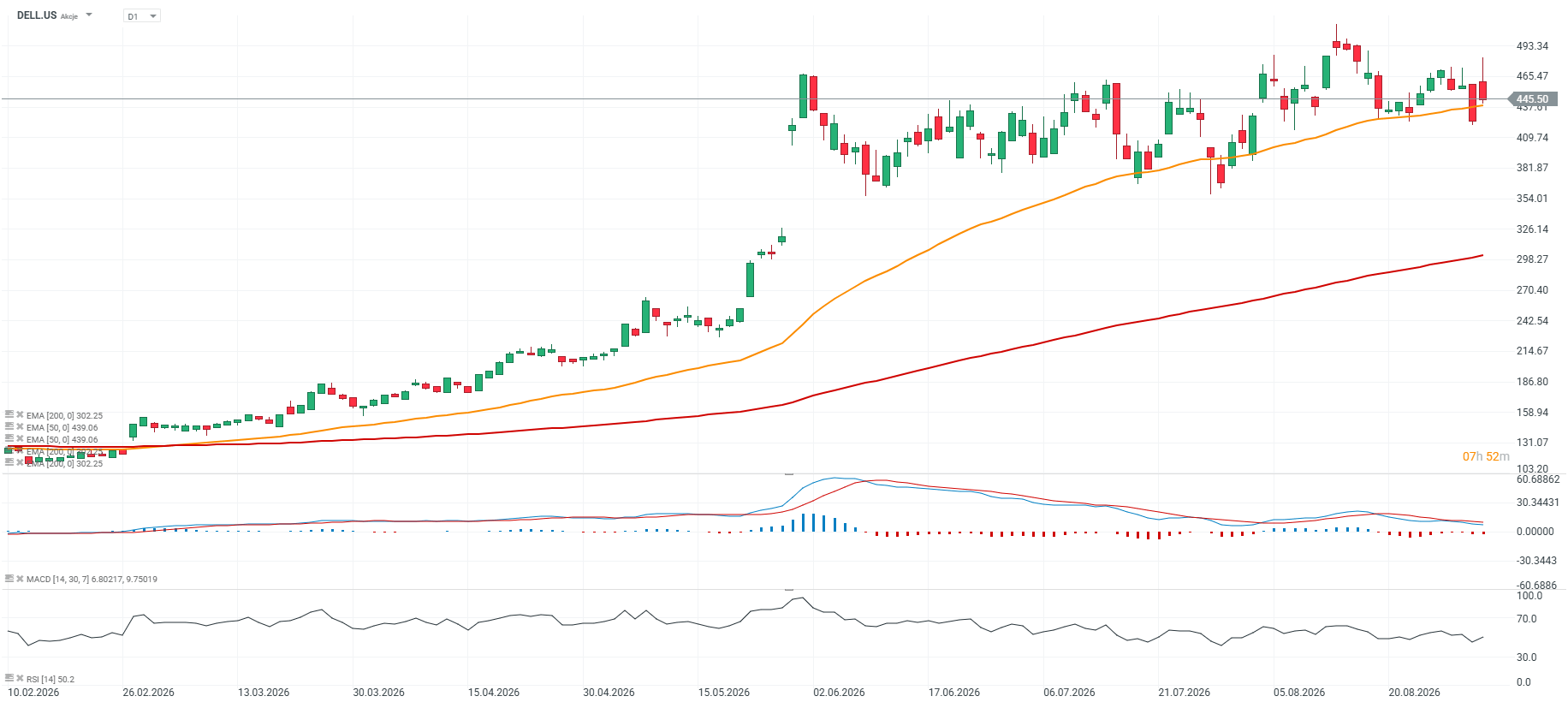
Dell is currently benefiting from two overlapping trends: rapidly expanding spending on AI servers and growing demand for the traditional infrastructure required to support those deployments. The main risk, however, is the enormous level of expectations already embedded in the share price after a gain of more than 200% since the start of the year. As of Tuesday’s close, Dell shares had risen 236% year to date, compared with an 11% gain for the S&P 500 over the same period. That gap shows how strongly the market has begun to value Dell as an AI infrastructure company rather than merely a PC manufacturer. Donald Trump, who has purchased Dell shares since returning to office, again publicly suggested buying Dell computers in July.
Dell Technologies (DELL.US) chart, D1 interval
Source: xStation5


Daily Summary: Earnings Season Kicks Off on Wall Street Amid Mixed Sentiment


SpaceX Wants to Fly Starship Almost Every Day. Musk’s Business Empire Is Betting on It

Micron Expands Share Buybacks to $35 Billion!


US Open: Earnings season kicks off on a high note (13.10.2026)
This content has been created by XTB S.A. This service is provided by XTB S.A., with its registered office in Warsaw, at Prosta 67, 00-838 Warsaw, Poland, entered in the register of entrepreneurs of the National Court Register (Krajowy Rejestr Sądowy) conducted by District Court for the Capital City of Warsaw, XII Commercial Division of the National Court Register under KRS number 0000217580, REGON number 015803782 and Tax Identification Number (NIP) 527-24-43-955, with the fully paid up share capital in the amount of PLN 5.869.181,75. XTB S.A. conducts brokerage activities on the basis of the license granted by Polish Securities and Exchange Commission on 8th November 2005 No. DDM-M-4021-57-1/2005 and is supervised by Polish Supervision Authority.