



Wall Street started the week with strong gains following news of an agreement reached between the United States and Iran. Although the formal signing is scheduled for June 19 and the deal itself only establishes a 60-day ceasefire alongside continued negotiations, investors reacted positively to the clear de-escalation of tensions in the Middle East.
Just a few days earlier, markets had been pricing in scenarios of further escalation, potential disruptions to oil supply, and rising inflationary pressures. Today’s situation looks entirely different. Investors have begun to price in a reduction in geopolitical risk, which immediately boosted risk appetite and drove capital back into U.S. equities.
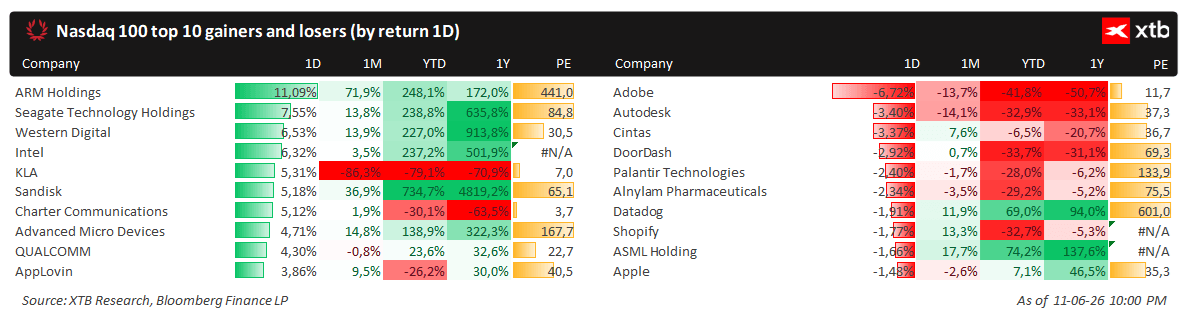
The technology sector is the main beneficiary of this shift in sentiment. Companies related to artificial intelligence, semiconductors, and data center infrastructure are leading the gains. For the market, this is a classic “risk-on” signal, where investors reduce defensive positions and refocus on high-growth assets.
The oil market reaction is also crucial. The prospect of continued openness of the Strait of Hormuz and reduced supply disruption risk has triggered a sharp decline in crude prices. For Wall Street, however, this is not only about oil itself. Lower energy prices mean reduced cost pressure for companies, more stable inflation expectations, and potentially more favorable conditions for the U.S. economy in the second half of the year.
This is arguably the most important element for investors today. After months of concerns about inflation, energy prices, and the impact of geopolitical conflicts on global growth, the market has received a strong argument for a more optimistic macroeconomic outlook. As a result, not only large technology firms are rising, but also the broader market represented by the S&P 500 and Nasdaq.
It is worth noting that the current rally is primarily sentiment-driven. Investors are not yet reacting to concrete economic effects of the agreement, but rather to a shift in expectations. The market is pricing in a more stable geopolitical environment, lower energy volatility, and reduced risk of new inflationary shocks.
However, not all risks have disappeared. Both sides still face difficult negotiations regarding Iran’s nuclear program, future sanctions, and long-term security guarantees. Any failure in talks could quickly reverse part of the current optimism and increase risk aversion again.
For now, Wall Street is sending a clear message. Investors view the Washington–Tehran agreement as a factor reducing one of the world’s key sources of uncertainty. Falling oil prices, rising technology stocks, and a broad inflow into equities indicate that the market sees this development as positive for both the economy and future corporate earnings in the United States.
Souce: XTB Research
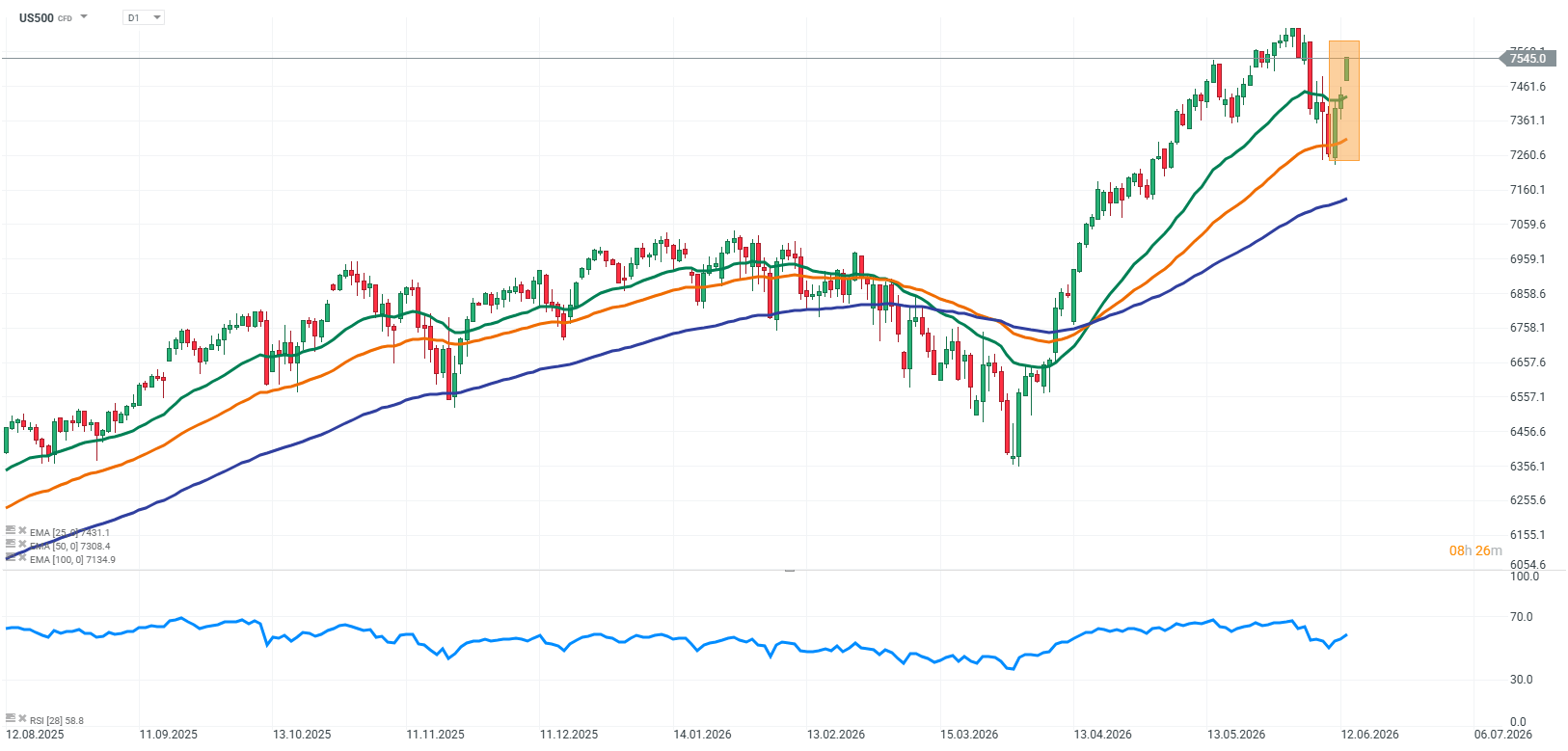
S&P 500 futures are rising strongly as investors react positively to confirmation of the U.S.–Iran agreement. The market interprets this as a significant reduction in geopolitical risk, boosting risk appetite and driving capital back into U.S. equities. Additional support comes from falling oil prices, which may ease inflation pressures and improve the U.S. economic outlook. As a result, Wall Street is set for a strong opening, with most futures trading in the green.
Source: xStation5
Company News
Shares of SpaceX (SPCX.US) are up more than 6% today, extending an impressive rally after a record Nasdaq debut, during which the stock surged 19% on its first trading day. Investors are focusing on the company’s long-term potential in space services, satellite communications, and AI-related infrastructure. Additional momentum comes from Elon Musk’s ambitious forecast of reaching $1 trillion in annual revenue by 2030.
Semiconductor stocks are also rising sharply following the breakthrough in U.S.–Iran negotiations. Among the leaders are ARM (ARM.US), Nvidia (NVDA.US), AMD (AMD.US), and Intel (INTC.US), benefiting both from improved market sentiment and continued enthusiasm around artificial intelligence. Lower geopolitical tension and declining oil prices reduce inflation concerns, encouraging investors to increase exposure to high-growth technology names.
Strong gains are also recorded by KLA (KLAC.US), Applied Materials (AMAT.US), and Lam Research (LRCX.US), companies that supply critical equipment for advanced semiconductor manufacturing. Investors view them as indirect beneficiaries of the AI boom, as rising demand for AI chips drives multi-billion-dollar investments in new fabs and production capacity.



Daily Summary: Nasdaq and AI Stocks Rebound Ahead of Big Tech Earnings 🚀
Wall Street rebounds🚨



Market Wrap: Rebound in China and Falling Oil Prices, France Leads EU Declines

Chart of the Day: What’s next for tech stocks after the deepest sell-off since April 2025? (19.10.2026)
This content has been created by XTB S.A. This service is provided by XTB S.A., with its registered office in Warsaw, at Prosta 67, 00-838 Warsaw, Poland, entered in the register of entrepreneurs of the National Court Register (Krajowy Rejestr Sądowy) conducted by District Court for the Capital City of Warsaw, XII Commercial Division of the National Court Register under KRS number 0000217580, REGON number 015803782 and Tax Identification Number (NIP) 527-24-43-955, with the fully paid up share capital in the amount of PLN 5.869.181,75. XTB S.A. conducts brokerage activities on the basis of the license granted by Polish Securities and Exchange Commission on 8th November 2005 No. DDM-M-4021-57-1/2005 and is supervised by Polish Supervision Authority.