


As war rages on in the Middle East there is a growing sense that equities are too calm and are not pricing in the full geopolitical and economic risks from the conflict. Although Brent crude oil is higher by more than 17% in the past 5 trading sessions, and the 10-year UK Gilt yield is up 12bps, the Eurostoxx 50 index is down 0.7% on a USD basis, the FTSE 100 is lower by just over 1%, even though global supply chains have been disrupted like never before.
US stock markets start to underperform
European stocks are also outperforming their US peers in the second week of this conflict, a reversal compared to last week, when US stocks were perceived to be a haven compared to European equities. Added to this, US Treasuries are also underperforming European bonds, even beleaguered UK Gilt yields.
At this point it is worth asking two questions: 1, why have equities not aligned with bonds and sold off more sharply during this crisis? and 2, why are US equities starting to come under more pressure?
The biggest drivers weighing on stocks in the past week include heightened volatility, a preference to sell growth stocks and a sizable increase in short interest. Since US stock indices have a large tech exposure, a preference to sell growth stocks will hurt US indices more than Europe.
Interestingly, earnings revisions are only having a mild impact on stocks right now. While the sharp spike in oil and energy prices could be damaging to the global economy, it is too early to assess what the effect will be. For example, if the crisis is resolved in the next two to three weeks, then the inflation spike may be temporary, and interest rate cuts from the world’s major central banks could still take place, albeit in the second half of the year.
Earnings downgrades a key risk for equities
For now, analysts are not downwardly revising future earnings due to this crisis. In January and February, analysts revised down their earnings per share expectations for Q1 by 1.5% for the S&P 500. This is the first downward revision in quarterly forecasts for 9 months, according to FactSet, however this was smaller than the 5-year and 10-year average for downward revisions to Q1 EPS growth for US stocks.
Interestingly, the downgrade happened before the outbreak of this crisis and the spike in the oil price. Analysts may wait for Q1 earnings season to see how companies assess their own prospects on the back of the oil supply crunch, and how this impacts their forward guidance for future earnings. This increases the chance of volatility around Q1 earnings season, and if earnings forecasts are revised lower, then this could be a key driver of weaker stock prices. In the past year, positive earnings revisions have been a key driver of stock prices, so if this reverses and we get a wave of earnings downgrades then the stock market selloff could gather pace.
There is still hope in the equity market that the oil price spike will be temporary, but as the conflict drags on, or if it escalates, then equity investors will not be able to ignore the risks.
Tech acts as a drag on US equities compared to European peers
One reason why US stocks are underperforming this week could be due to the tech sector. Last week, the S&P 500 software sector was in recovery mode, and it was one of the top performing sectors. This week the top 6 best performing sectors on the main US index are commodity based, including chemicals, fertilizer and agriculture, food retail and oil and gas. This suggests that the Middle East conflict is starting to determine the direction of the S&P 500.
The tech sector makes up just under 30% of the S&P 500, so if it comes under pressure it acts as a major drag on the entire index. Thus, the 2.8% decline in the Magnificent 7 this week is a sign that US stocks will struggle if tech joins the sell off.
Fed rate cut hopes dashed
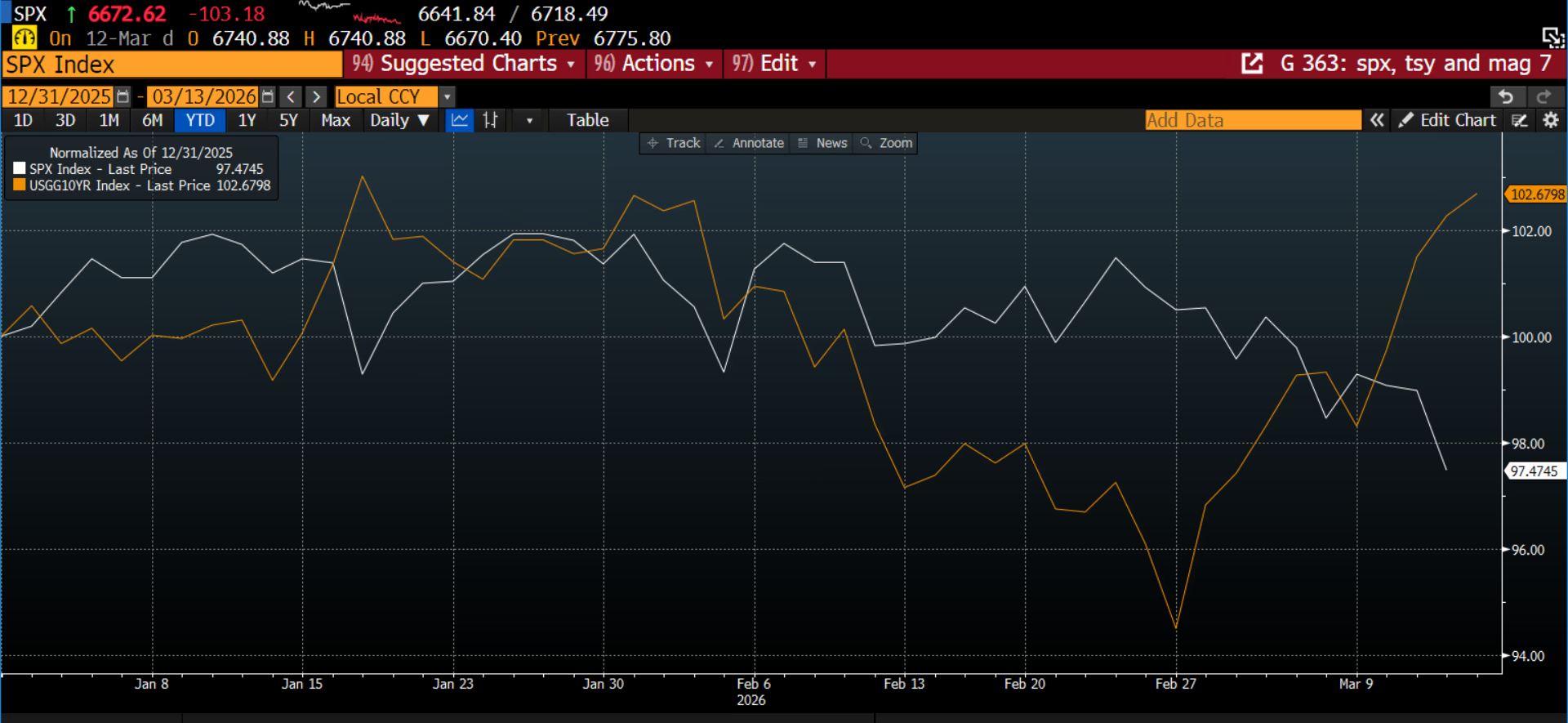
The tech sector is coming under pressure from rising US Treasury yields in recent days. The interest rate futures market is now pricing in less than one rate cut from the Fed this year, as rising oil prices persist. There was a delayed reaction in the recalibration of US rate cut expectations, and now stocks and Treasuries are playing catch up and coming under intense downward pressure this week.
US specific geopolitical risks
Also, if the US has started a long-term war, demand for US-based assets could get eroded, and earlier reports that Iranian drones could hit California may also lead to a souring of sentiment towards US stocks.
April could be a risky month for equities
Risk aversion is King right now. Global equities may not have been as impacted by the crisis as major sovereign bonds, however, there could be a delayed impact for stocks as analysts assess the impact of a long-term rise in the oil price on future corporate earnings. If the crisis persists into April and beyond, that is when the damage could hit earnings expectations and cause a bigger sell-off in stocks. For now, we expect stocks to oscillate based on news flow.
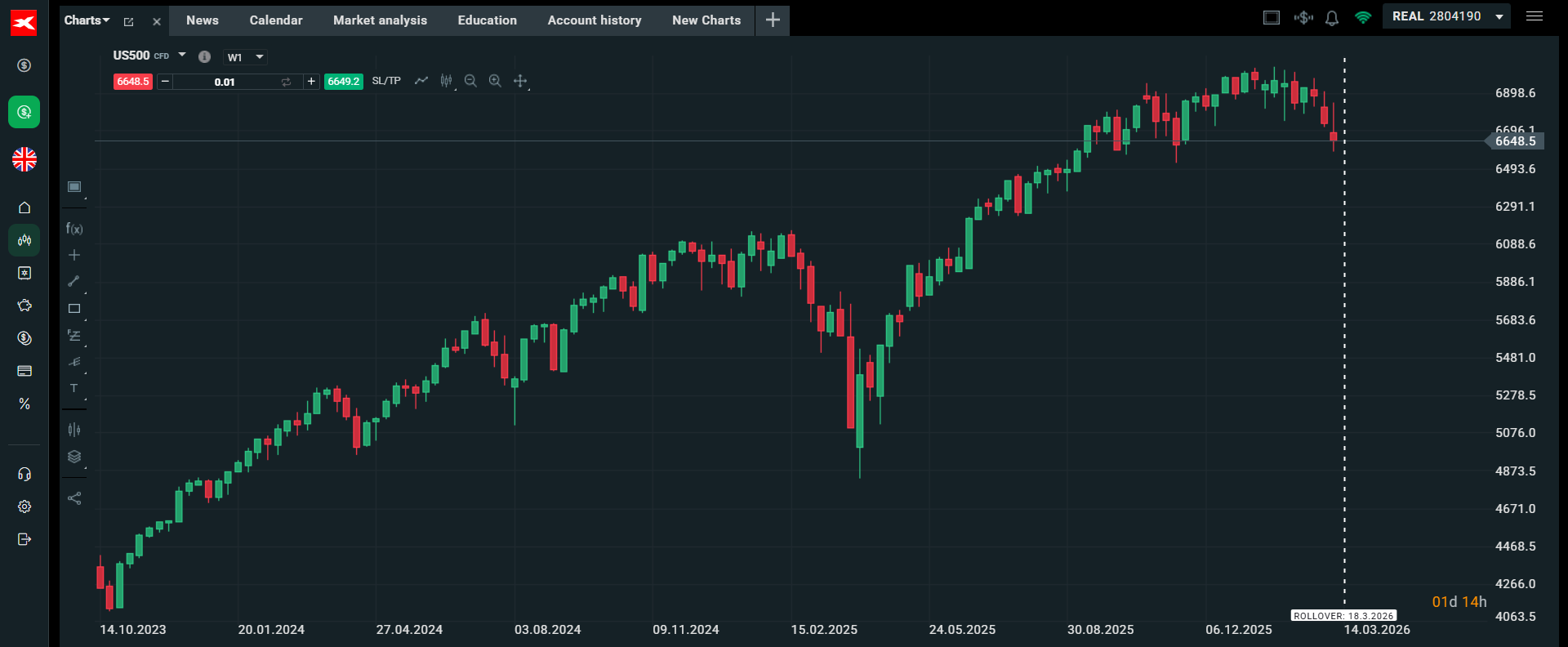
Chart 1: S&P 500
Source: XTB
Chart 2: US stocks and the Treasury yield, normalized to show hjow they move together.
Source: XTB and Bloomberg



Daily summary: Wall Street sentiment weakens amid hawkish Fed remarks 🚩 USDIDX at its highest level since July 24


Cocoa Falls 4% 📉 Are High Inventories Weighing on Prices?

Stock Market Commentary: Trump Signals a Major Drop in Oil Prices. Will U.S. Stocks Surge?


US Open: Nasdaq tries to recover loses 🗽 Fair Isaac shares in panic
This content has been created by XTB S.A. This service is provided by XTB S.A., with its registered office in Warsaw, at Prosta 67, 00-838 Warsaw, Poland, entered in the register of entrepreneurs of the National Court Register (Krajowy Rejestr Sądowy) conducted by District Court for the Capital City of Warsaw, XII Commercial Division of the National Court Register under KRS number 0000217580, REGON number 015803782 and Tax Identification Number (NIP) 527-24-43-955, with the fully paid up share capital in the amount of PLN 5.869.181,75. XTB S.A. conducts brokerage activities on the basis of the license granted by Polish Securities and Exchange Commission on 8th November 2005 No. DDM-M-4021-57-1/2005 and is supervised by Polish Supervision Authority.