

- A weaker dollar is here to stay
- Why investors need to be aware of FX market volatility
- FTSE 100 revenues exposed to a weak greenback
- UK demand for US stocks a risk factor when dollar is falling
- XTB clients mildly moderating exposure to US equities and indices

- A weaker dollar is here to stay
- Why investors need to be aware of FX market volatility
- FTSE 100 revenues exposed to a weak greenback
- UK demand for US stocks a risk factor when dollar is falling
- XTB clients mildly moderating exposure to US equities and indices
The sell-off in the dollar may have slowed on Wednesday, however, the ramifications of this move in the greenback could still be felt for some time.
The dollar has been under pressure for most of this year and is the weakest currency in the G10 FX space. The recent bout of FX market volatility in recent days that started with the yen, is a further sign that we are entering an unusual period of uncertainty for the FX market. This could lead to structural changes, and it could affect investor behavior.
A weaker dollar is here to stay
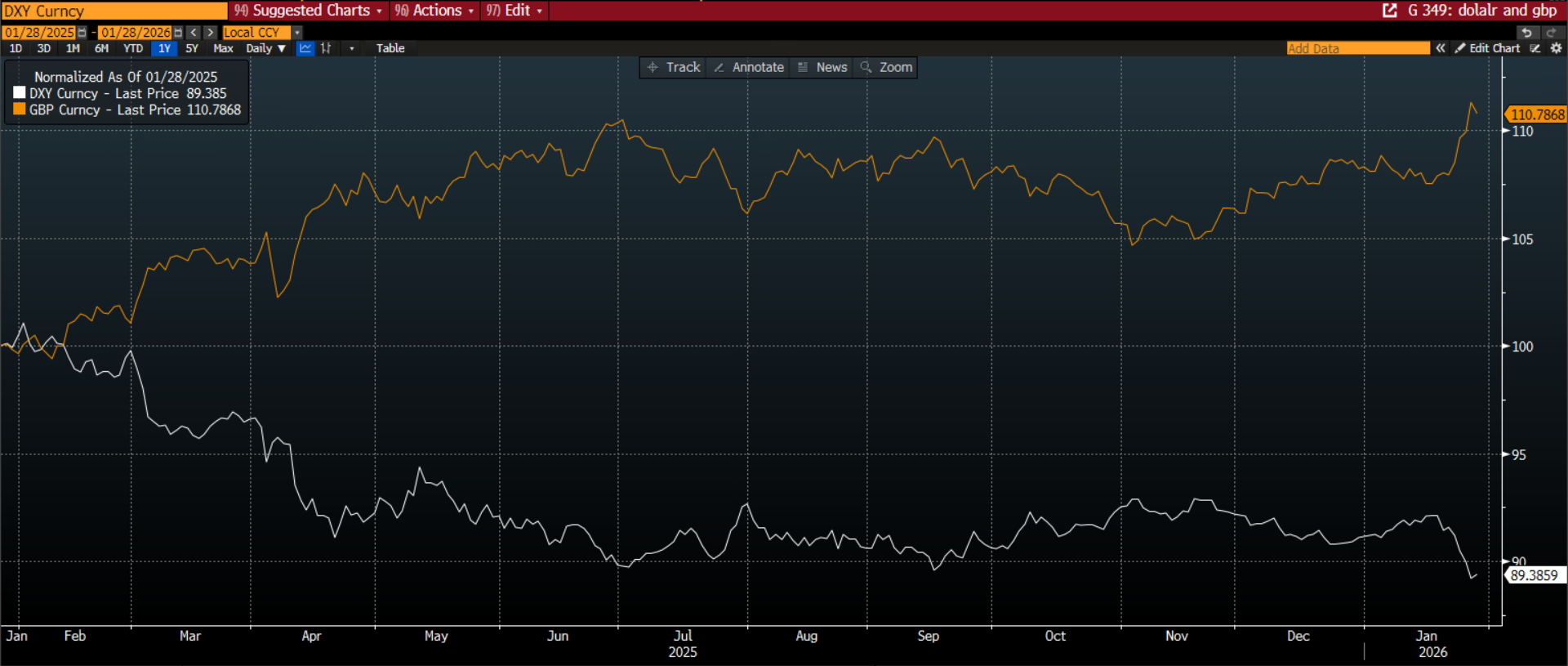
The multilateral intervention between Japan and the US to stem yen weakness, along with Donald Trump’s assertion last night that he likes a weaker dollar, suggests that a lower greenback is here to stay. We did not need Donald Trump to tell us this. The President has never hid the fact that he wants a weaker USD to pursue a policy that promotes US manufacturing and exports. Trump has got his wish: since last year’s inauguration, the dollar has been the weakest currency in the G10 FX space. EUR/USD has jumped nearly 15%, and the pound has risen more than 11% vs. the USD in the last 12 months.
Why investors need to be aware of FX market volatility
While exporters in Europe and the UK are rightly worried about competitiveness, should investors also worry about FX volatility and a weaker dollar?
FTSE 100 revenues exposed to a weaker dollar
A weaker dollar can have a big impact on investors who hold stocks and indices, in two ways. Firstly, FTSE 100 companies are acutely exposed to the US. Based on recent data, the FTSE 100 derives nearly 30% of its revenues from the US, making the US the single largest geographic market for FTSE 100 companies. When dollar revenues are converted into pounds, there is an FX effect. When the dollar is weak and the pound is strong, it means that these revenues will be lower.
Thus, in time, we could see the FX impact act as a drag on profits in the UK index, which could hurt its overall returns. The FTSE 100 has had a strong run in the past 12 months, and is higher by 32% on a currency adjusted basis. We are yet to see a meaningful decline in the FTSE 100 due to a weaker pound, however, as we move through the year, this is something to watch.
UK demand for US stocks a risk factor when dollar is falling
A weak dollar could also hurt UK investors who hold positions in US stocks and indices. In recent years there has been a surge in demand from investors in the UK to hold US stocks. Allocations to overseas equities have surged dramatically in recent years. In 2008 it was 28%, by 2023 it had climbed to 42%. In 2024 alone, UK investors put £19.5bn into US equity funds, the largest ever allocation to US equities. This data suggests that a substantial proportion of UK investors have exposure to US funds and indices. A weaker dollar will erode gains in these positions, so investors need to be aware of FX market risks.
XTB clients moderating exposure to US equities and indices
As the ‘dollar debasement trade’ takes off, we could see investors become less fond of US equity positions compared to recent years. This is unlikely to happen rapidly, after all, the US is still the world’s largest economy, and its companies are some of the biggest in the world. This will always make them attractive. However, at XTB, we have seen a slight decline in US positions among our clients in the UK, so far this year.
For example, in January, 58% of trades put on by UK clients were on US stocks and indices. This compares with 67% in Q4 2025. This is not an exact comparison, and we are only a few weeks into the year, however, if this continues, then it would suggest that investors may be choosing other markets outside of the US, for example European equities and commodities, to avoid the impact of a weaker dollar. In share trading only, 41% of all UK trades were in US equities, compared with 54% in Q4.
This data does not suggest a stampede out of US assets, but it is worth watching. A rapidly declining dollar could be causing a slow leak in flows to US equity markets, with ramifications for the future performance of the S&P 500 and the Nasdaq.
Chart 1: Dollar index and GBP/USD, as the dollar has weakened, the pound has benefited.
Source: XTB and Bloomberg



Daily Summary: Rising inflation weighs on markets, semiconductors suffer most (14.10.2026)


US Open: CPI reading weighs on American indices (14.10.2026)



Inflation data causes market havoc
US inflation concerns rise
This content has been created by XTB S.A. This service is provided by XTB S.A., with its registered office in Warsaw, at Prosta 67, 00-838 Warsaw, Poland, entered in the register of entrepreneurs of the National Court Register (Krajowy Rejestr Sądowy) conducted by District Court for the Capital City of Warsaw, XII Commercial Division of the National Court Register under KRS number 0000217580, REGON number 015803782 and Tax Identification Number (NIP) 527-24-43-955, with the fully paid up share capital in the amount of PLN 5.869.181,75. XTB S.A. conducts brokerage activities on the basis of the license granted by Polish Securities and Exchange Commission on 8th November 2005 No. DDM-M-4021-57-1/2005 and is supervised by Polish Supervision Authority.