


$15 billion. That is how much Intel plans to raise through a new share offering. For any company, that would be an enormous amount, and in Intel’s case, it is difficult to overlook. Such a large issuance means dilution for existing shareholders and could put pressure on the stock price. However, it does not automatically mean that the company has a financing problem. The key question is why Intel needs so much capital and what it plans to use it for.
Intel is in a situation where the scale of its planned investments exceeds its ability to finance them solely through current cash flows. That does not necessarily indicate weakness. It may simply be the price of trying to rebuild its technological and manufacturing position at a time when demand for semiconductors, particularly those linked to AI and data centers, is growing rapidly.
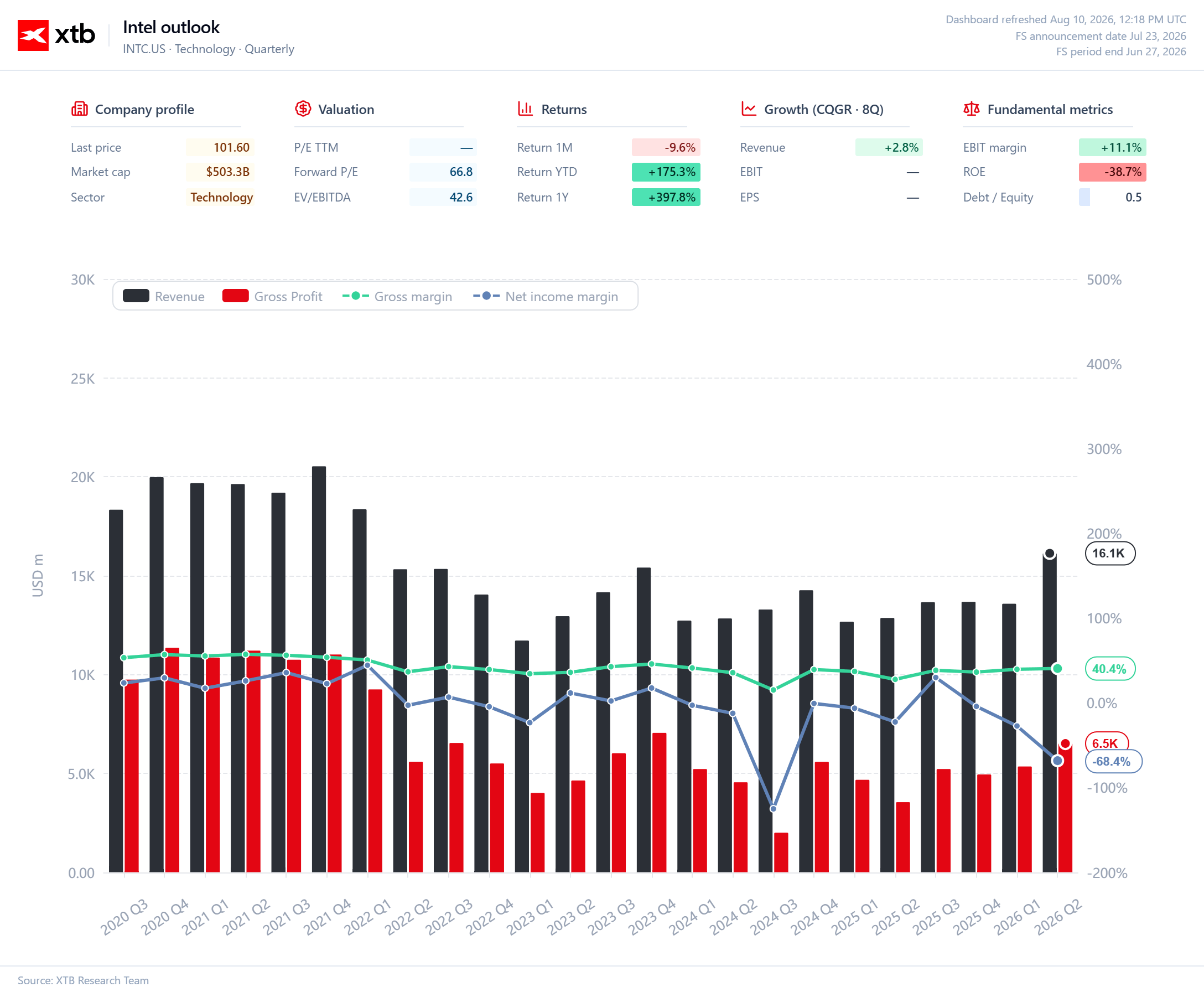
The company is not using the capital to finance an ordinary factory modernization program. Intel wants to expand its own manufacturing capacity, invest in new technologies, and grow its foundry business.
And this is where the most important question for investors arises. It is not simply about how much Intel is spending, but, above all, what it will get in return for those billions. The $15 billion raised from the market is an enormous amount, but given the scale of Intel’s current investments, it should not necessarily be viewed as capital needed for survival. It is capital needed to execute an ambitious growth strategy.
That does not, of course, mean there is no risk. Shareholders are paying for this expansion through dilution, while Intel is taking on the risk that its massive investments will not translate into higher profitability quickly enough. In semiconductor manufacturing, building factories is not enough. Intel must also ramp production, achieve adequate yields, attract customers, and generate margins that provide an attractive return on capital.
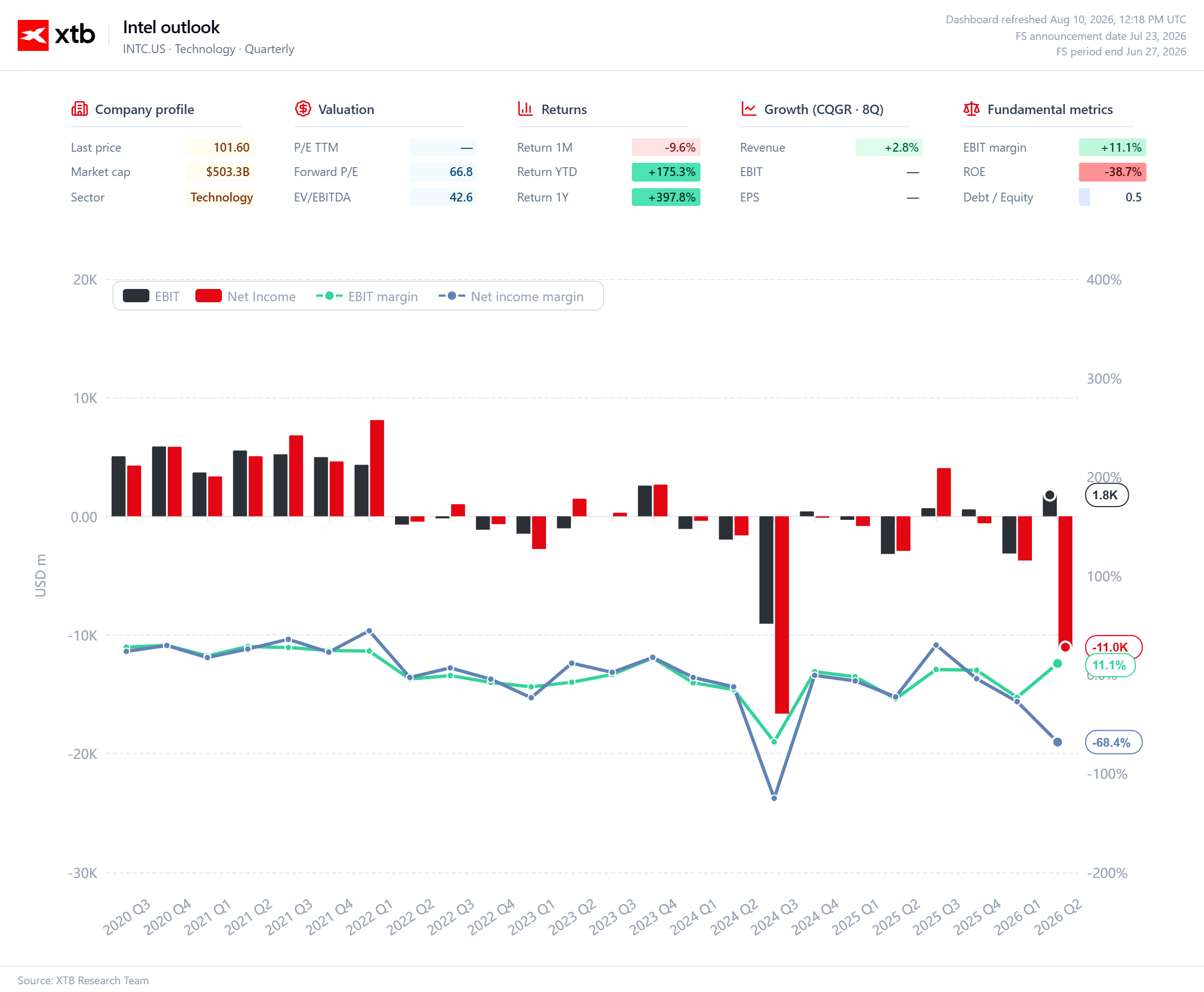
Intel is therefore part of a broader trend across the semiconductor industry. SK Hynix is investing tens of billions of dollars to increase memory production, Intel is investing in its own manufacturing capabilities and foundry business, and the entire industry is preparing for continued growth in demand driven by AI infrastructure. The AI revolution is generating enormous demand, but it also requires enormous investment. One of the biggest challenges facing companies in this sector is increasingly not finding customers, but financing the production capacity needed to meet growing demand.
For that reason, Intel’s share issuance can be viewed more as a signal of the scale of its planned expansion than as a sign of financial distress. Short-term pressure on the stock price is a real risk, but from a long-term perspective, what matters far more is whether Intel can turn the capital it raises into new production capacity, customers, higher revenue, and growing cash flows.
Intel needs to demonstrate that it can turn this $15 billion into significantly greater future cash flow. The share issuance itself does not create value for shareholders. Value will only be created when the invested capital begins to generate a sufficiently high return.
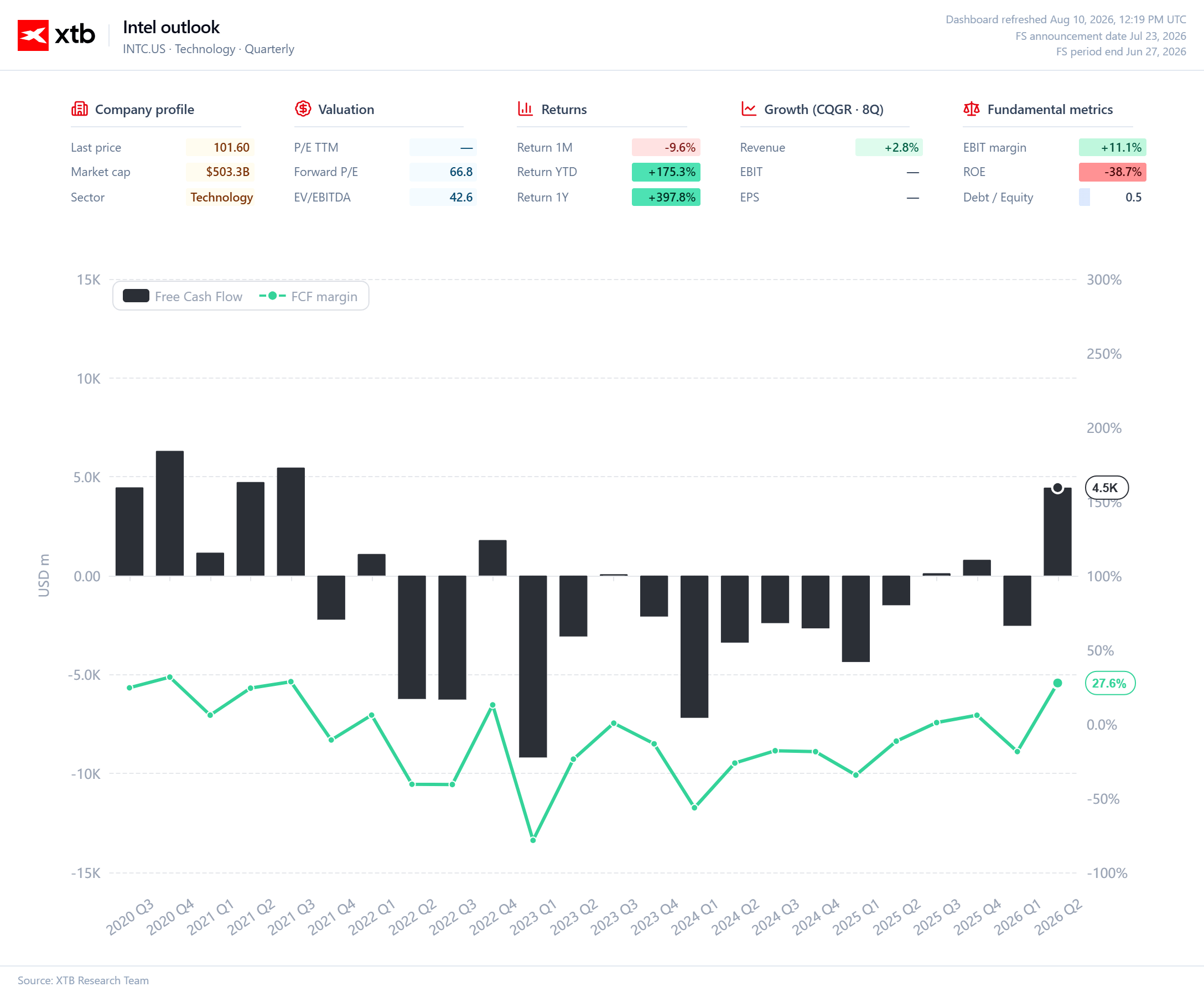
Building semiconductor fabs is a long-term and extremely capital-intensive process. If demand for semiconductors and AI infrastructure continues to grow, Intel could find itself in a very strong position. If, however, the AI investment cycle begins to slow, generating an attractive return on such enormous capital expenditures could prove much more difficult.
Ultimately, the most important question is not why Intel is issuing shares, but whether those $15 billion will enable the company to build a business that, several years from now, generates significantly greater cash flows than it does today. If so, today’s dilution could prove to be the price Intel had to pay to rebuild its position. If not, the share issuance will remain, above all, a costly dilution for existing shareholders.



Morning Wrap: Oil cheaper despite attacks on Saudi Arabia, markets await CPI (12.10.2026)



Daily Summary: A Shallow Rebound Ahead of Earnings Season

Lumentum: Demand for AI infrastructure exceeds capacity



US OPEN: Trump de-escalates, OpenAI supports Wall Street sentiment
The content of this report has been created by XTB S.A., with its registered office in Warsaw, at Prosta 67, 00-838 Warsaw, Poland, (KRS number 0000217580) and supervised by Polish Supervision Authority ( No. DDM-M-4021-57-1/2005). This material is a marketing communication within the meaning of Art. 24 (3) of Directive 2014/65/EU of the European Parliament and of the Council of 15 May 2014 on markets in financial instruments and amending Directive 2002/92/EC and Directive 2011/61/EU (MiFID II). Marketing communication is not an investment recommendation or information recommending or suggesting an investment strategy within the meaning of Regulation (EU) No 596/2014 of the European Parliament and of the Council of 16 April 2014 on market abuse (market abuse regulation) and repealing Directive 2003/6/EC of the European Parliament and of the Council and Commission Directives 2003/124/EC, 2003/125/EC and 2004/72/EC and Commission Delegated Regulation (EU) 2016/958 of 9 March 2016 supplementing Regulation (EU) No 596/2014 of the European Parliament and of the Council with regard to regulatory technical standards for the technical arrangements for objective presentation of investment recommendations or other information recommending or suggesting an investment strategy and for disclosure of particular interests or indications of conflicts of interest or any other advice, including in the area of investment advisory, within the meaning of the Trading in Financial Instruments Act of 29 July 2005 (i.e. Journal of Laws 2019, item 875, as amended). The marketing communication is prepared with the highest diligence, objectivity, presents the facts known to the author on the date of preparation and is devoid of any evaluation elements. The marketing communication is prepared without considering the client’s needs, his individual financial situation and does not present any investment strategy in any way. The marketing communication does not constitute an offer of sale, offering, subscription, invitation to purchase, advertisement or promotion of any financial instruments. XTB S.A. is not liable for any client’s actions or omissions, in particular for the acquisition or disposal of financial instruments, undertaken on the basis of the information contained in this marketing communication. In the event that the marketing communication contains any information about any results regarding the financial instruments indicated therein, these do not constitute any guarantee or forecast regarding the future results.