


The partnership between NVIDIA and Marvell Technology, along with a two‑billion‑dollar investment, is one of the most significant events in the AI market this year. This is not just another typical deal in the semiconductor industry. It is a signal that the way we build technological infrastructure is changing before our eyes.
For many years, data centers and servers were built in a fairly straightforward way. Companies would purchase processors, graphics cards, and networking solutions from various manufacturers and assemble them into general-purpose machines. In the world of traditional computing, this approach worked quite well. AI, however, has started to demand a new logic. Models are becoming increasingly large, data is becoming more demanding, and throughput and coordination between components are critical to overall system performance. In this context, a single, best-performing chip is no longer enough. What matters is the cohesion and smooth operation of the entire ecosystem.
This is where NVLink Fusion, NVIDIA’s technology, comes into play. It allows different components to function as a single, integrated system. It is not just about faster communication between chips. It enables the design of entire infrastructures tailored to specific AI workloads, rather than trying to fit intensive tasks into general-purpose servers. This represents a significant step toward infrastructure built to meet the challenges of modern artificial intelligence.
Marvell’s role in this setup is crucial. The company has long specialized in networking solutions and custom chip design. Through collaboration with NVIDIA, its technologies can become an integral part of the next generation of computing systems, where data flow, memory, and processing power are designed together from the ground up. This demonstrates that true innovation in AI is not just about the models themselves but also about how infrastructure supports their operation.
From a market perspective, this is also a very smart strategic move. While NVIDIA opens its platform to partners, it still controls the key elements, including software and overall system architecture. This increases the attractiveness of its ecosystem while making it more difficult for competitors to build comparable solutions. In practice, a network effect emerges. The more companies join NVIDIA’s ecosystem, the harder it becomes to develop alternatives outside it.
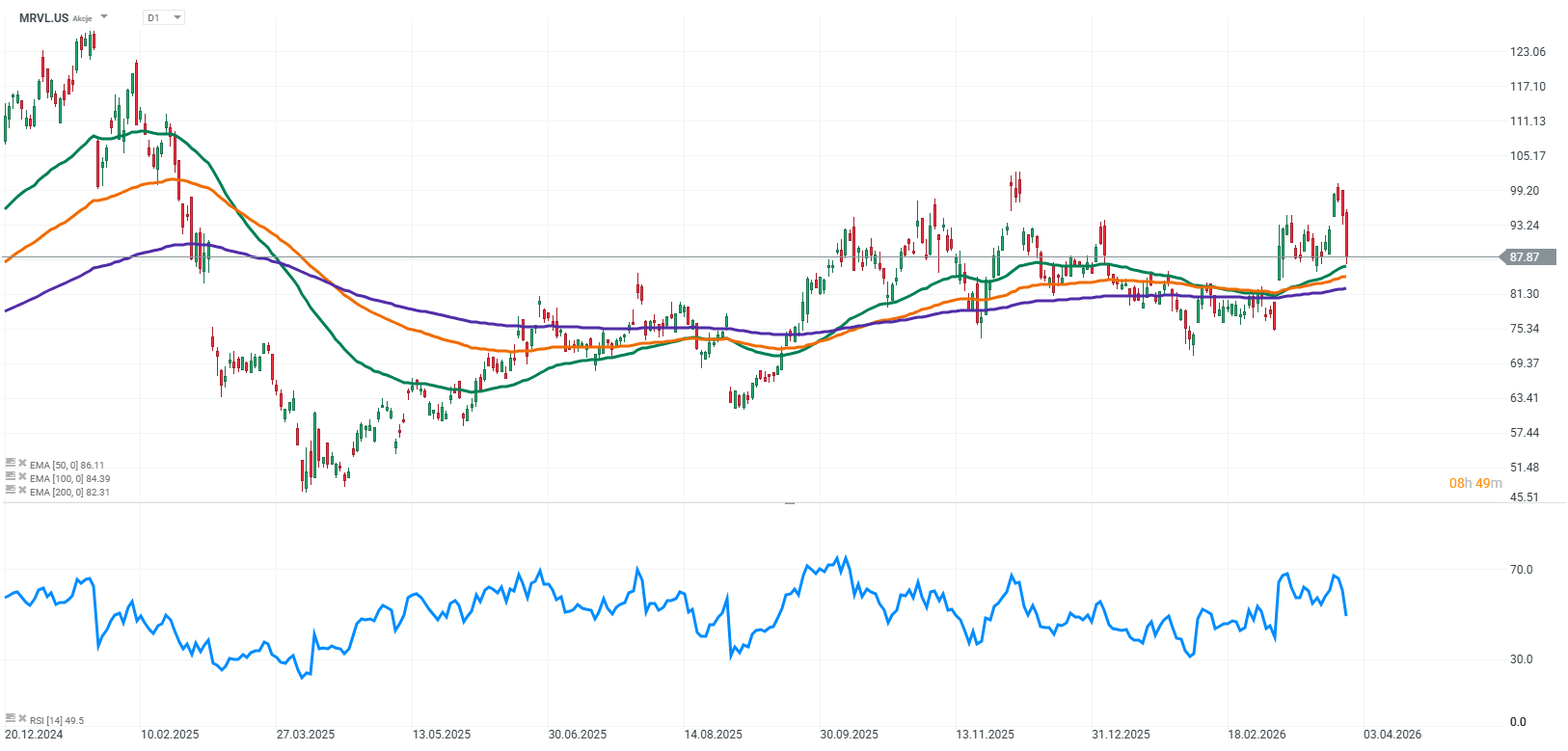
For customers, this means greater flexibility and the ability to design systems perfectly suited to their needs. For investors, it signals that traditional chip sales are gradually giving way to an era of integrated, comprehensive infrastructure solutions. Marvell’s stock has already seen a significant rise following the announcement of the partnership, and investors view it as an opportunity to participate in the growth of one of the key AI ecosystems.
In a broader context, the NVIDIA‑Marvell partnership illustrates the direction in which the entire artificial intelligence market is heading. Victory no longer belongs to the company that produces the best single chip but to the one that can build a system in which all components work together most effectively. This shift in thinking could define the development of AI infrastructure for years to come. In this world, the most important factors are not only processing power but also the ability to integrate, coordinate, and leverage the entire ecosystem as efficiently as possible.
Source: xStation5


Daily summary 📈 Precious metals and stock indices rebound as Treasury yields fall


US Open: Nasdaq 100 extends losses 🚩 AI stocks under pressure, CoreWeave falls 8%



Market Wrap: Tech Sell-Off Hits Europe, Gold Shines Again


TSMC breaks records once again driven by the AI boom
The content of this report has been created by XTB S.A., with its registered office in Warsaw, at Prosta 67, 00-838 Warsaw, Poland, (KRS number 0000217580) and supervised by Polish Supervision Authority ( No. DDM-M-4021-57-1/2005). This material is a marketing communication within the meaning of Art. 24 (3) of Directive 2014/65/EU of the European Parliament and of the Council of 15 May 2014 on markets in financial instruments and amending Directive 2002/92/EC and Directive 2011/61/EU (MiFID II). Marketing communication is not an investment recommendation or information recommending or suggesting an investment strategy within the meaning of Regulation (EU) No 596/2014 of the European Parliament and of the Council of 16 April 2014 on market abuse (market abuse regulation) and repealing Directive 2003/6/EC of the European Parliament and of the Council and Commission Directives 2003/124/EC, 2003/125/EC and 2004/72/EC and Commission Delegated Regulation (EU) 2016/958 of 9 March 2016 supplementing Regulation (EU) No 596/2014 of the European Parliament and of the Council with regard to regulatory technical standards for the technical arrangements for objective presentation of investment recommendations or other information recommending or suggesting an investment strategy and for disclosure of particular interests or indications of conflicts of interest or any other advice, including in the area of investment advisory, within the meaning of the Trading in Financial Instruments Act of 29 July 2005 (i.e. Journal of Laws 2019, item 875, as amended). The marketing communication is prepared with the highest diligence, objectivity, presents the facts known to the author on the date of preparation and is devoid of any evaluation elements. The marketing communication is prepared without considering the client’s needs, his individual financial situation and does not present any investment strategy in any way. The marketing communication does not constitute an offer of sale, offering, subscription, invitation to purchase, advertisement or promotion of any financial instruments. XTB S.A. is not liable for any client’s actions or omissions, in particular for the acquisition or disposal of financial instruments, undertaken on the basis of the information contained in this marketing communication. In the event that the marketing communication contains any information about any results regarding the financial instruments indicated therein, these do not constitute any guarantee or forecast regarding the future results.