



Microsoft will report its results for the fourth quarter of fiscal year 2026 today after the market closes. The company remains one of the most important technology companies in the world and one of the main beneficiaries of the development of artificial intelligence. This time, however, its position as an AI leader may not be enough to convince investors.
The market is no longer expecting only solid results, a beat of consensus estimates or continued strong revenue growth. Microsoft must demonstrate that its massive investments in data centres, cloud infrastructure and computing capacity are beginning to translate into clearly accelerating AI monetisation.
Today’s report will therefore primarily serve as a test of investment returns. The question is no longer whether demand for artificial intelligence exists. The question the market will be asking is whether the growth rate of revenue from Azure and AI products is high enough to justify further aggressive CapEx expansion.
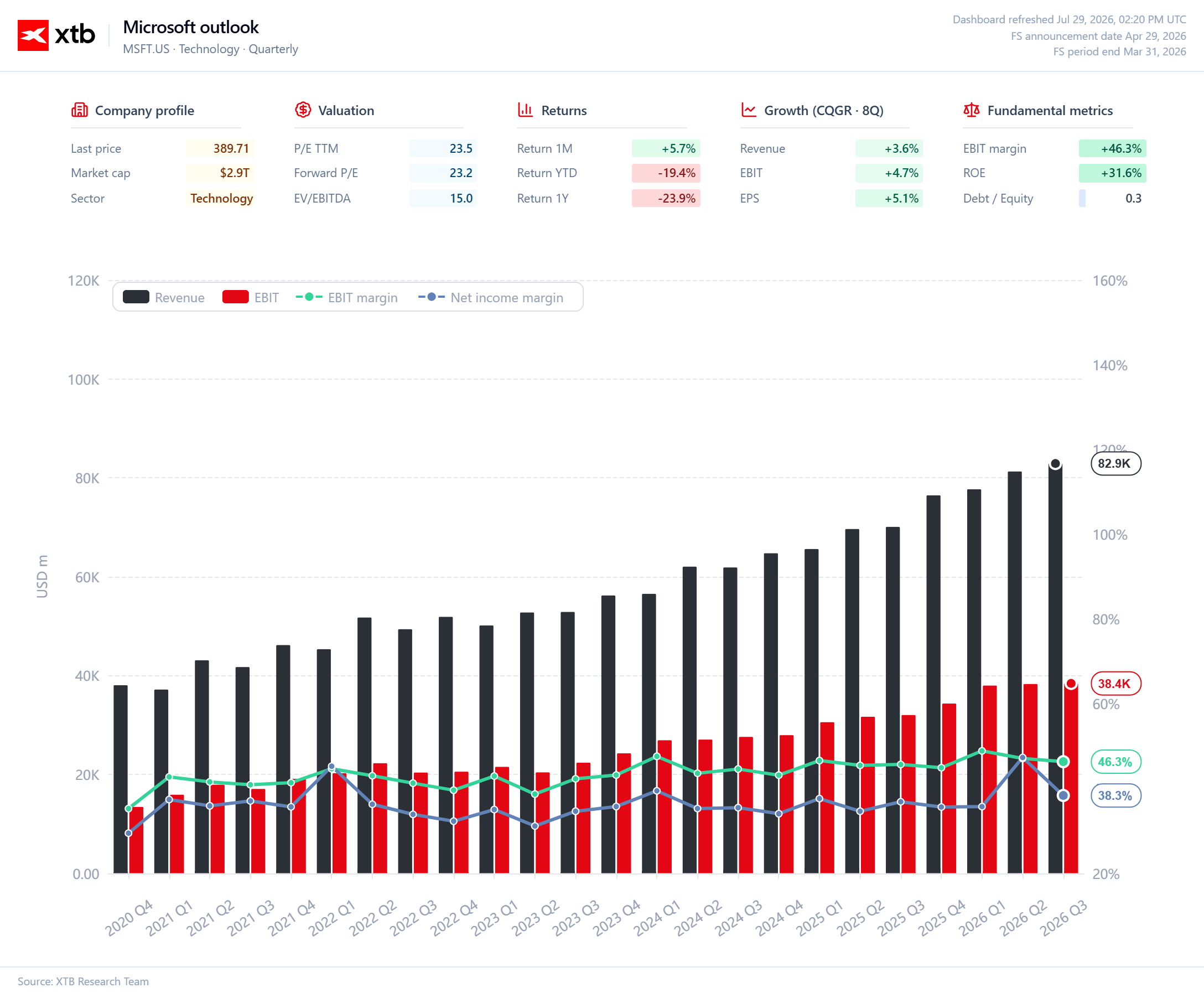
Source: XTB Resaerch
Key Financial Expectations
- Revenue: $87.72 billion, representing growth of approximately 15% year on year
- Microsoft Cloud revenue: $58.71 billion
- Intelligent Cloud segment revenue: $38.17 billion
- Productivity and Business Processes segment revenue: $37.27 billion
- More Personal Computing segment revenue: $12.17 billion
- EPS: $4.25
- Operating income: $39.04 billion
- Growth in Azure and other cloud services revenue: approximately 39.6% year on year at constant currency
- Estimated AI contribution to Azure’s growth rate: approximately 24.6 percentage points
- CapEx: $35.22 billion
- Estimated CapEx in the next quarter: $45.04 billion
- Estimated CapEx including finance leases in the next quarter: $55.79 billion
Consensus Points to a Strong Quarter
According to market consensus, Microsoft is expected to generate approximately $87.7 billion in revenue, representing growth of around 15% year on year. Expected EPS stands at $4.25, while revenue in the Intelligent Cloud segment is projected to rise to approximately $38.2 billion.
The most important metric, however, will remain Azure. Consensus estimates point to growth of approximately 40% year on year in Azure and other cloud services revenue.
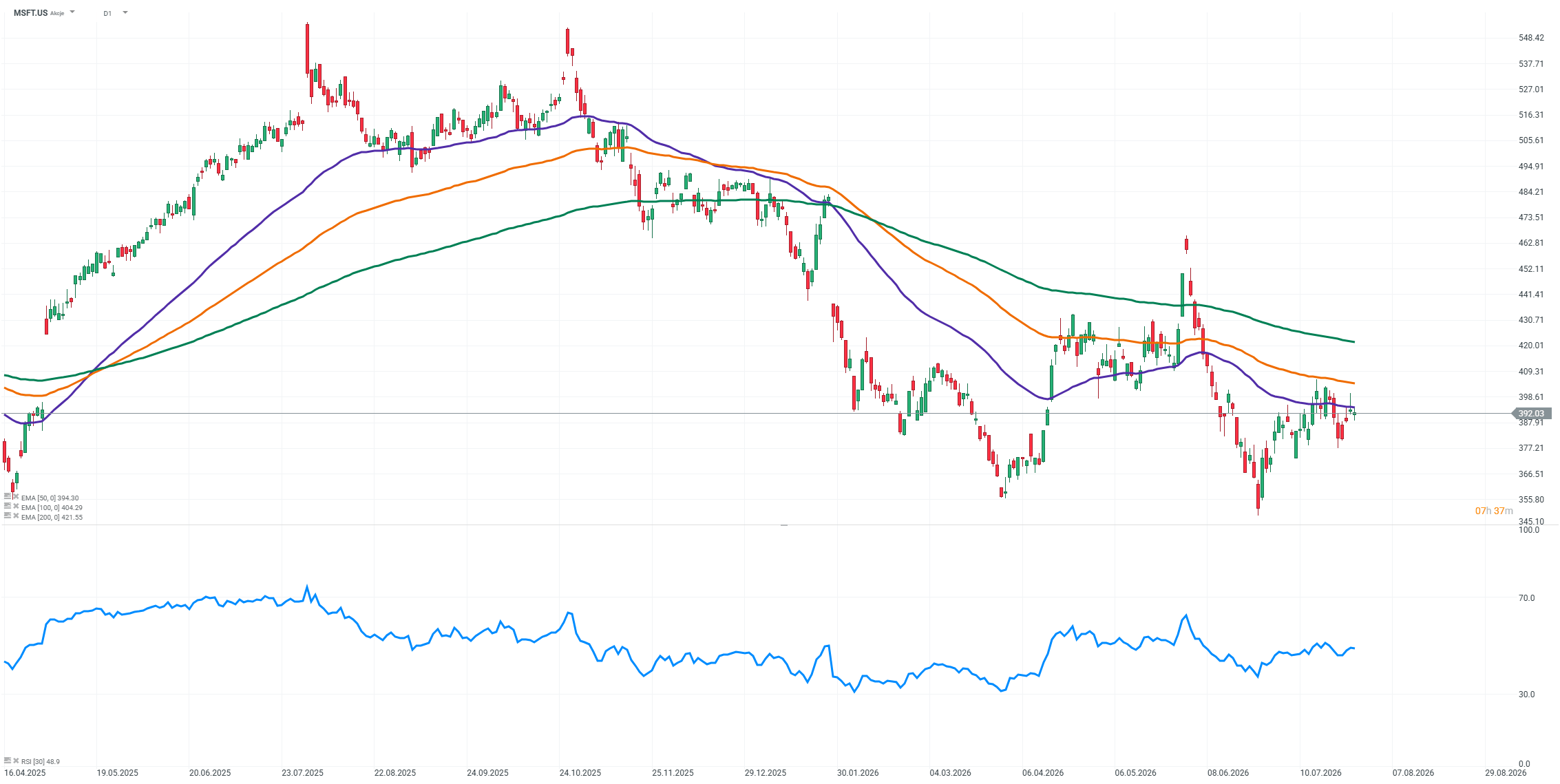
On paper, these are very strong figures. The problem is that the market already knows them and has largely priced them in. Simply meeting consensus expectations may therefore be viewed as insufficient, and even a solid beat may not automatically trigger a strong positive share price reaction.
Microsoft is currently in a position where expectations concern not only the results themselves but also the scale of the positive surprise. Markets will be looking for a clear signal that Azure growth is accelerating alongside the expansion of available computing capacity and that the growing use of AI is beginning to generate increasingly significant revenue.
Azure and AI Must Deliver More
Azure remains the most important part of Microsoft’s investment story. This is where a large share of demand for AI infrastructure, computing services and solutions used by corporate customers is concentrated.
However, strong Azure growth on its own will not be enough. The market will analyse how much of that growth comes from traditional cloud services and how much is directly related to the development of artificial intelligence.
Data on the commercialisation of AI products, particularly Microsoft 365 Copilot, will also be crucial. Strong growth in demand for AI products would demonstrate whether they are genuinely finding practical applications within businesses. However, markets will focus primarily on management’s comments regarding the current and future monetisation of Microsoft’s products.
Microsoft must therefore demonstrate not only a growing number of users but also increasing economic value generated by AI. The market will want to see that artificial intelligence is no longer merely a factor driving demand for infrastructure but is becoming a significant source of revenue growth and future profits.
CapEx Could Once Again Dominate the Market Reaction
The biggest risk remains capital expenditure.
According to market consensus, Microsoft’s CapEx in the fourth quarter could reach approximately $35.2 billion. Including so called assets acquired under finance leases, the value of investment could rise to approximately $42.1 billion.
The outlook for the next quarter is attracting even greater attention. Consensus estimates suggest that investment spending could increase to approximately $55.8 billion.
Such a large scale of spending shows that Microsoft remains in a phase of aggressive infrastructure expansion. The company is investing in data centres, servers, computing chips and capacity required both to meet growing demand from Azure customers and to develop its own AI based products.
The problem is that CapEx has a direct impact on cash flows. Even with strong revenue growth, further increases in investment could limit the company’s ability to generate free cash flow. This is why the market is focusing less on the absolute level of spending and increasingly on the relationship between CapEx and revenue growth.
Higher investment spending may be accepted if Microsoft demonstrates that infrastructure expansion is leading to a clear acceleration in Azure growth and increasing AI related revenue. However, if CapEx rises faster than the growth of the cloud business, investors may conclude that the investment payback period is becoming longer and that pressure on free cash flow will persist for longer.
Alphabet Demonstrated How the Market Reacts to Rising Investment
Alphabet’s example shows that even relatively strong operating results do not guarantee a positive market reaction.
Alphabet raised its capital expenditure forecast to as much as $205 billion, compared with previous expectations of approximately $190 billion. Rising spending on AI infrastructure increased investor concerns about the scale of future cash flows and the time required to achieve an adequate return on investment.
Microsoft could find itself in a similar situation today. The market is probably already prepared for higher CapEx guidance and further data centre expansion. An increase in spending does not necessarily have to be negative. The decisive factor will be whether the company also demonstrates sufficiently strong Azure growth and increasingly clear AI monetisation.
Investors may accept higher CapEx, but they expect every additional increase in investment to be accompanied by stronger revenue growth.
Microsoft Must Surprise
Today’s results could create three main scenarios.
The first, positive scenario assumes a clear beat of consensus expectations, Azure growth above forecasts and strong data regarding the adoption and monetisation of Copilot. In such a case, even higher CapEx could be viewed as confirmation that Microsoft is investing in response to genuine demand rather than simply building infrastructure ahead of demand.
The second scenario assumes solid results in line with expectations but without a clear acceleration in Azure growth and without new evidence of increasing returns on AI investment. Such a report may prove insufficient, particularly if management simultaneously raises its capital expenditure forecasts.
The third, negative scenario includes weaker Azure growth, disappointing data regarding AI products and a further increase in CapEx. This would be a particularly unfavourable combination because it would increase concerns that the costs of infrastructure expansion are growing faster than the revenue generated by AI.
The Results Will Be a True Test of AI Monetisation
Microsoft is no longer being evaluated solely as a software company. The market views the company as one of the most important tests of the entire investment model built around artificial intelligence.
Infrastructure spending is increasing across the technology sector, while expectations regarding future investment by hyperscalers continue to move higher. Microsoft must therefore demonstrate that rising CapEx is not merely the cost of maintaining its position in the technology race but an investment that is generating increasingly significant revenue.
-
Today’s report will answer several key questions:
-
Is Azure growth accelerating as available computing capacity increases?
-
How quickly is revenue directly related to AI growing?
-
Is Microsoft 365 Copilot expanding the scale of commercial adoption?
-
Is higher capital expenditure clearly justified by growing demand?
-
How long will pressure on free cash flow continue to limit growth potential?
Microsoft may report very strong results today. However, to trigger a decisively positive market reaction, it will probably have to deliver something more: a clear acceleration in Azure growth, strong evidence of increasing AI monetisation and a convincing justification for the next wave of investment.
In the current environment, beating consensus expectations may not be enough. The market wants to see that massive spending on AI is beginning to generate results that are as impressive as the scale of the investment.
Source: XTB Resaerch



Three markets to watch next week (23.10.2026)



Daily Summary: Oil at five-month highs, indices under pressure (23.10.2026)

US Open: Further declines on Wall Street, Brent above 111 USD, AI correction continues (14.10.2026)



Morning Wrap: AI profitability concerns spark market Sell-Off
The content of this report has been created by XTB S.A., with its registered office in Warsaw, at Prosta 67, 00-838 Warsaw, Poland, (KRS number 0000217580) and supervised by Polish Supervision Authority ( No. DDM-M-4021-57-1/2005). This material is a marketing communication within the meaning of Art. 24 (3) of Directive 2014/65/EU of the European Parliament and of the Council of 15 May 2014 on markets in financial instruments and amending Directive 2002/92/EC and Directive 2011/61/EU (MiFID II). Marketing communication is not an investment recommendation or information recommending or suggesting an investment strategy within the meaning of Regulation (EU) No 596/2014 of the European Parliament and of the Council of 16 April 2014 on market abuse (market abuse regulation) and repealing Directive 2003/6/EC of the European Parliament and of the Council and Commission Directives 2003/124/EC, 2003/125/EC and 2004/72/EC and Commission Delegated Regulation (EU) 2016/958 of 9 March 2016 supplementing Regulation (EU) No 596/2014 of the European Parliament and of the Council with regard to regulatory technical standards for the technical arrangements for objective presentation of investment recommendations or other information recommending or suggesting an investment strategy and for disclosure of particular interests or indications of conflicts of interest or any other advice, including in the area of investment advisory, within the meaning of the Trading in Financial Instruments Act of 29 July 2005 (i.e. Journal of Laws 2019, item 875, as amended). The marketing communication is prepared with the highest diligence, objectivity, presents the facts known to the author on the date of preparation and is devoid of any evaluation elements. The marketing communication is prepared without considering the client’s needs, his individual financial situation and does not present any investment strategy in any way. The marketing communication does not constitute an offer of sale, offering, subscription, invitation to purchase, advertisement or promotion of any financial instruments. XTB S.A. is not liable for any client’s actions or omissions, in particular for the acquisition or disposal of financial instruments, undertaken on the basis of the information contained in this marketing communication. In the event that the marketing communication contains any information about any results regarding the financial instruments indicated therein, these do not constitute any guarantee or forecast regarding the future results.