



The launch of the new Intel Xeon 600 line is primarily a strategic event, which the market interprets as a signal that Intel wants to be an active player in the professional computing solutions segment again. Although the announcement of the new processors will not immediately translate into revenue, it reinforces the narrative of rebuilding the company's position in areas key to the development of the technology market, including infrastructure for artificial intelligence.
This positive product narrative has been further reinforced by the latest collaboration with Japan's SoftBank and its subsidiary SAIMEMORY on the development of a new generation of Z-Angle Memory, designed for data centers supporting artificial intelligence. The partners aim to create high-capacity, high-bandwidth, and lower-power solutions to meet the growing demand for efficient memory in AI and professional computing environments. Although commercialization is not planned until 2029, the markets reacted positively, with Intel shares rising at the opening of trading.
From an investor perspective, it is important that Intel is no longer seen solely through the prism of the personal computer market, which remains weaker and more cyclical. The return to the professional and corporate segments is an attempt to diversify revenue sources and improve the margin structure in the longer term. The market interprets this as a step in the right direction, although with the caveat that the real effects of projects such as Z-Angle Memory will only be seen in a few years' time, and memory remains an area of strong competition from the current leaders.
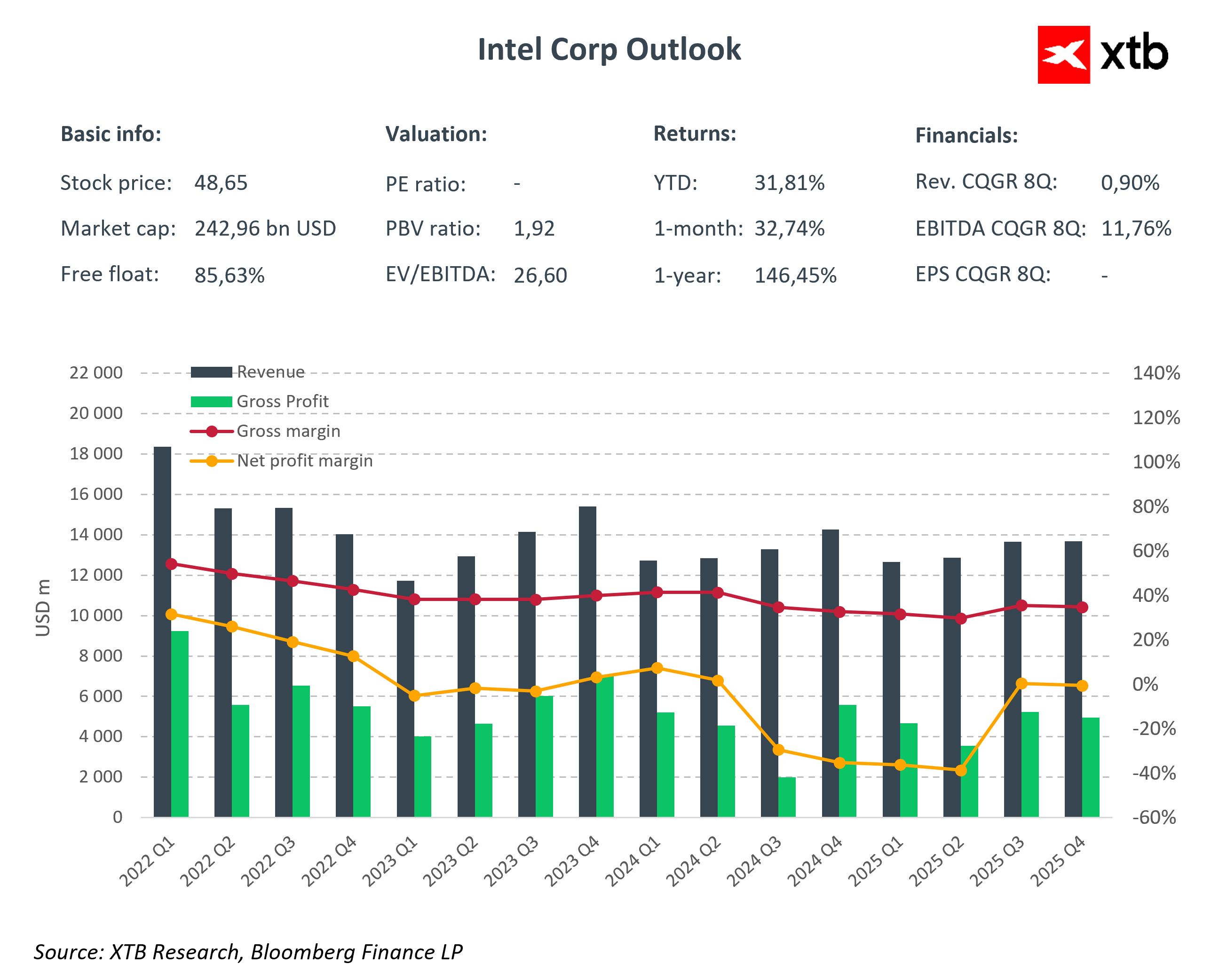
Nevertheless, Intel's latest quarterly results paint a mixed picture of the company's condition. On the one hand, the company surprised positively, exceeding analysts' expectations in terms of both revenue and profits, which suggests operational improvement in selected segments and the effectiveness of restructuring measures. On the other hand, management decided to lower its full-year forecasts, indicating that competitive pressure and demand uncertainty remain a serious challenge. It is the lowered guidance, rather than the results themselves, that is dampening investor enthusiasm and limiting short-term optimism about the stock.
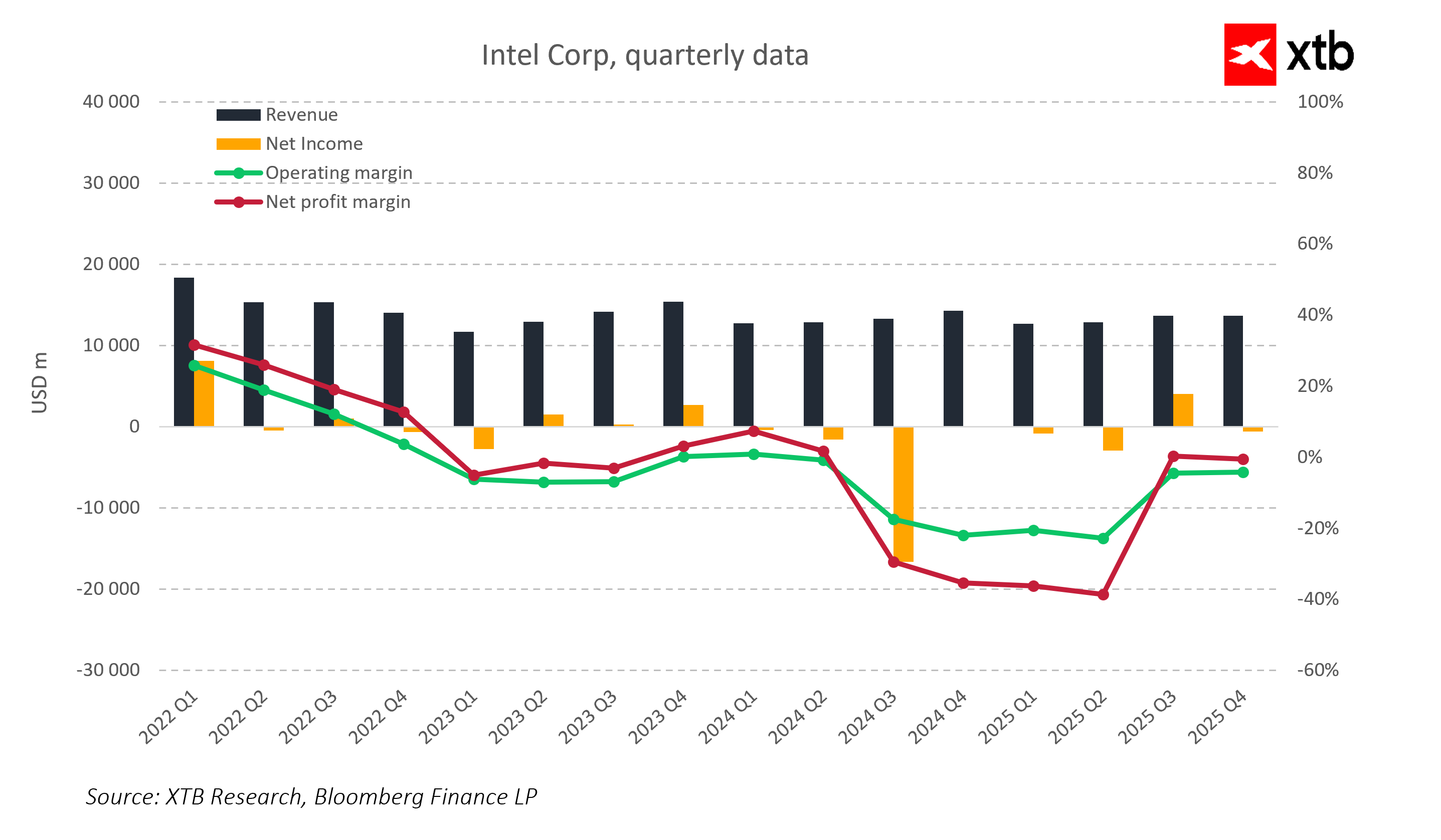
Current events show the company undergoing a phase of thorough restructuring and strategic investments. On the one hand, there are positive signs in the form of new products and better-than-expected quarterly results, but on the other hand, lowered forecasts and the long-term nature of key initiatives, such as the partnership with SoftBank, clearly indicate that Intel is still struggling with market uncertainty. For investors, this means a period requiring careful observation. The key will be the pace at which the company manages to translate new product initiatives and strategic partnerships into sustainable revenue growth and improved margins, which could ultimately translate into a more stable stock valuation.


Tesla was supposed to burn $5 billion, but posted a positive result. Will Tesla still be a car company in a year?

Record-breaking Meta, though with a cash loss. Investors (for now) are buying Zuckerberg's plan anyway


US OPEN: Preparations for Tesla's mega-merger with SpaceX. Diplomatic stalemate with Iran cools Wall Street's enthusiasm
Meta Preview: Billions in AI spending, but when will the investments start paying off?
The content of this report has been created by XTB S.A., with its registered office in Warsaw, at Prosta 67, 00-838 Warsaw, Poland, (KRS number 0000217580) and supervised by Polish Supervision Authority ( No. DDM-M-4021-57-1/2005). This material is a marketing communication within the meaning of Art. 24 (3) of Directive 2014/65/EU of the European Parliament and of the Council of 15 May 2014 on markets in financial instruments and amending Directive 2002/92/EC and Directive 2011/61/EU (MiFID II). Marketing communication is not an investment recommendation or information recommending or suggesting an investment strategy within the meaning of Regulation (EU) No 596/2014 of the European Parliament and of the Council of 16 April 2014 on market abuse (market abuse regulation) and repealing Directive 2003/6/EC of the European Parliament and of the Council and Commission Directives 2003/124/EC, 2003/125/EC and 2004/72/EC and Commission Delegated Regulation (EU) 2016/958 of 9 March 2016 supplementing Regulation (EU) No 596/2014 of the European Parliament and of the Council with regard to regulatory technical standards for the technical arrangements for objective presentation of investment recommendations or other information recommending or suggesting an investment strategy and for disclosure of particular interests or indications of conflicts of interest or any other advice, including in the area of investment advisory, within the meaning of the Trading in Financial Instruments Act of 29 July 2005 (i.e. Journal of Laws 2019, item 875, as amended). The marketing communication is prepared with the highest diligence, objectivity, presents the facts known to the author on the date of preparation and is devoid of any evaluation elements. The marketing communication is prepared without considering the client’s needs, his individual financial situation and does not present any investment strategy in any way. The marketing communication does not constitute an offer of sale, offering, subscription, invitation to purchase, advertisement or promotion of any financial instruments. XTB S.A. is not liable for any client’s actions or omissions, in particular for the acquisition or disposal of financial instruments, undertaken on the basis of the information contained in this marketing communication. In the event that the marketing communication contains any information about any results regarding the financial instruments indicated therein, these do not constitute any guarantee or forecast regarding the future results.