


CFD trading allows you to speculate on price movements of assets like stocks, forex, or commodities without owning them - using leverage and a regulated broker account as your entry point to the market. The mechanics are straightforward to learn, but the practical side involves costs, risk parameters, and decision habits that go well beyond simply opening a position. This guide covers what beginners need to understand before placing their first trade - and what most of them get wrong.
CFD trading allows you to speculate on price movements of assets like stocks, forex, or commodities without owning them - using leverage and a regulated broker account as your entry point to the market. The mechanics are straightforward to learn, but the practical side involves costs, risk parameters, and decision habits that go well beyond simply opening a position. This guide covers what beginners need to understand before placing their first trade - and what most of them get wrong.
This article focuses on how to open and manage a CFD trade. If you are new to the concept entirely, we recommend starting with the basics first: What Is a CFD? A Beginner's Guide to Contracts for Difference covers what CFDs are and how they work before you get into the mechanics of trading them.
What Is CFD Trading and How Do You Place a Trade?
Placing a CFD trade follows a defined sequence: analyse the market, choose an asset and direction, set your position size and risk parameters, then confirm the order on the platform. For readers arriving here directly, what CFD trading is in practice is best understood as a sequence of decisions made on a trading platform, not a single action.
The process typically begins with analysing the market to form a directional view. A trader may look at price charts, recent trends, or economic context to decide whether an asset is more likely to rise or fall. This step is where users begin learning CFD trading, as it connects market observation with a potential position.
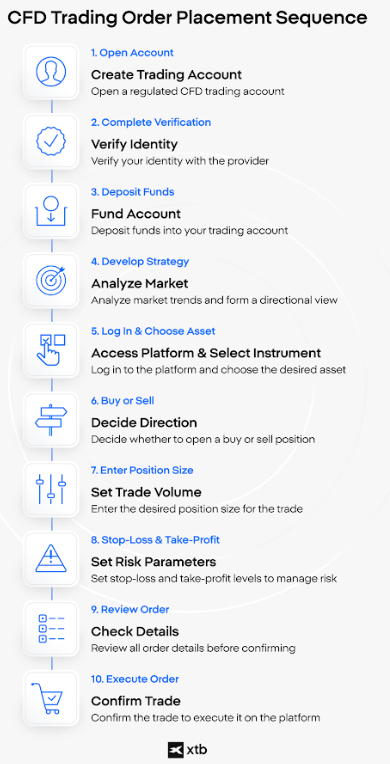
Next comes choosing the instrument and direction. The trader selects a specific asset and decides whether to open a position expecting the price to increase or decrease. This is a core step in understanding how to trade CFD, as every position reflects a defined market view. Placing a trade usually follows a short sequence on the platform:
- open a trading account with a regulated provider
- complete the verification process
- deposit funds into the account
- analyze the market and prepare a strategy or investment thesis
- log in to the platform and choose the asset
- decide whether to open a buy or sell position
- enter the position size
- set a stop-loss and, if needed, a take-profit level
- review the order details
- confirm the trade
What Happens After the Trade Is Confirmed
This is the point where preparation turns into execution. The platform may make the process look simple, but each step affects how the position will behave once it is open. Before entering the trade, CFD trading strategies and key parameters are set. The trader defines the position size and selects a stop-loss level to limit potential loss if the market moves against expectations. These decisions determine the level of exposure before the trade is even opened, which is a fundamental part of CFD trading know-how.
Once the position is active, its value changes continuously with the market price. Monitoring involves checking whether the original idea still applies and how price movement affects the current result. For those exploring CFDs, this stage is about observation rather than constant adjustment.
The final step is closing the position. This may happen automatically if predefined levels are reached, or manually if market conditions change. In CFD trading, this completes the cycle: from analysis to execution and exit. The process itself is simple, but definitely not easy.
Financial leverage is risky: the Archegos Capital collapse
The collapse of Bill Hwang’s Archegos Capital Management in 2021 highlights the risk of leveraged, concentrated trading. The family office lost over $20 billion in just 2 days and caused over $10 billion in losses for its prime broker banks by using high leverage (approx. 5:1 to 10:1) to take concentrated bets on stocks like ViacomCBC and Discovery, which stock sell-off triggered the massive margin call and investment collapse. Always do your own research and avoid cognitive biases before the trade.
Sometimes, things happening in the leverage market trade are canaries in cold mine for financial institutions or banks. Credit Suisse lost $5.5 billion because of the Archegos and fell in 2023. According to the cited by London Bayes Business School, Matthias Arnsdorf, Global Head of Traded Risk Modelling at J.P Morgan, the Archegos case highlighted 3 drivers of counterparty risk for banks. The concentration risk, liquidity risk, and wrong-way risk.
What Do You Need to Start Trading CFDs?
To start with CFD trading, you need four practical elements: access to a regulated broker, a verified account, available funds, and a working understanding of the trading platform. For anyone exploring what CFD is in real conditions, these steps define how access to the market actually works.
The first decision is choosing a regulated provider. Before you choose, you should read users' opinions and open a free demo account to explore the trading platform capabilities and brokers’ offer. Read about investment-related costs (commision, swap points for holding the position etc.) and other fees related to brokerage account. Lower trading costs are important not only to beginners, but also experienced traders.
After selecting a broker, the process usually involves opening an account, completing identity and address verification, funding the account, and becoming familiar with the trading platform. These steps are standard in regulated financial services and create the framework in which CFD trading takes place. The deposit determines how much exposure the account can support, but it does not affect the direction of the market itself. At the same time, using a demo or live platform helps show how orders appear, how positions are displayed, and how price movements affect results, which makes the platform an important part of understanding CFDs in practice rather than only in theory.
What Does It Mean to Go Long and Short on a CFD?
In CFD trading, going long means opening a position expecting the price to rise, while going short means opening one expecting it to fall. These are the two basic directions every beginner should understand.
A long position is used when the trader believes the market may move higher. If the price rises after entry, the trade gains value; if it falls, the position loses value. This logic feels familiar to most beginners - it resembles buying an asset in the hope it appreciates over time.
A short position gains value when the price falls and loses value when it rises. This is one of the clearest differences between CFDs and direct asset ownership: with CFDs, a trader can take a view on falling prices without owning the asset itself.
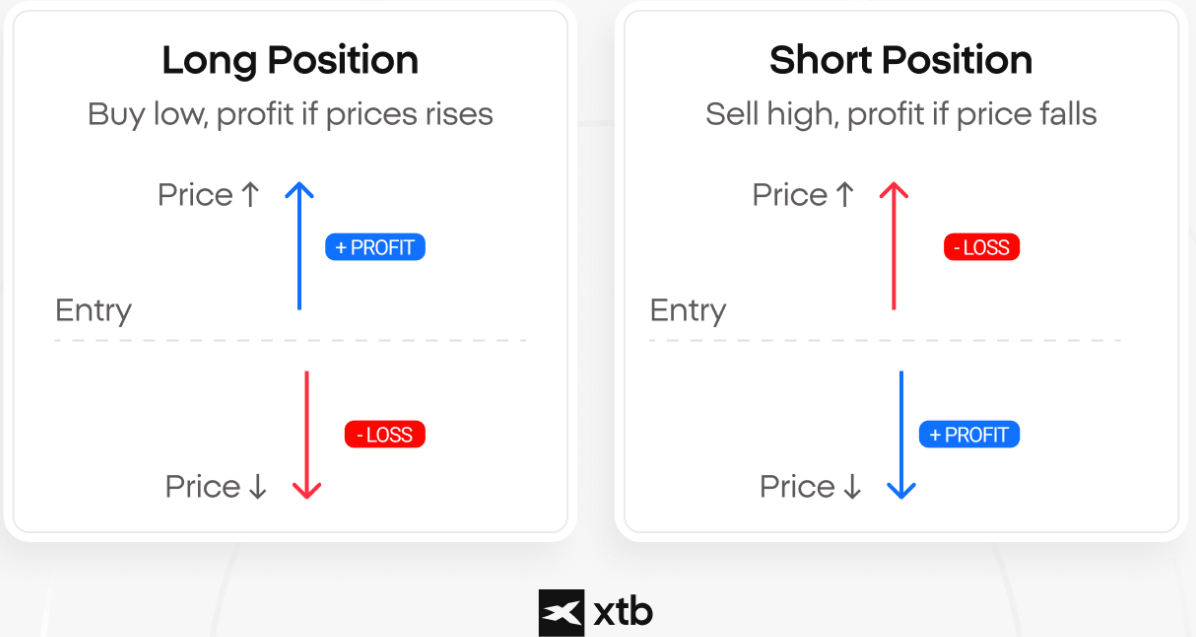
A simple example illustrates both. An asset is priced at 100. A trader expecting a rise opens a long position - if the price moves to 110, the trade reflects that gain. A trader expecting a decline opens a short at the same level - if the price falls to 90, the trade reflects that instead.
In both cases, the outcome depends on whether the market moved in the anticipated direction. The ability to go both long and short is one of the features that makes CFDs structurally different from many traditional forms of investing.
DID YOU KNOW❓
Speculators made and lost a fortune on financial markets - even 100 years ago
Famous speculators such as Arthur Cutten made fortunes through trading, sometimes starting with almost nothing. According to the Guelph Historical Society, Cutten arrived in Chicago in 1890 with 90 dollars in his pocket and a high-wheeled bicycle. In the 1900s, he made a modest fortune by speculating on Midwest wheat, and in the 1920s he became one of the world’s largest grain speculators.
But the market is not only a success story. Another famous trader, Jesse Livermore, lost and rebuilt his fortune multiple times; in 1915, he filed for bankruptcy, but 14 years later he made a fortune - approximately $100 million during the 1929 stock market crash. Despite this win, Livermore went bankrupt 5 years later, with just $84k in assets and more than $2.5 million in debt.
How Do Costs Affect Your CFD Trades in Practice?
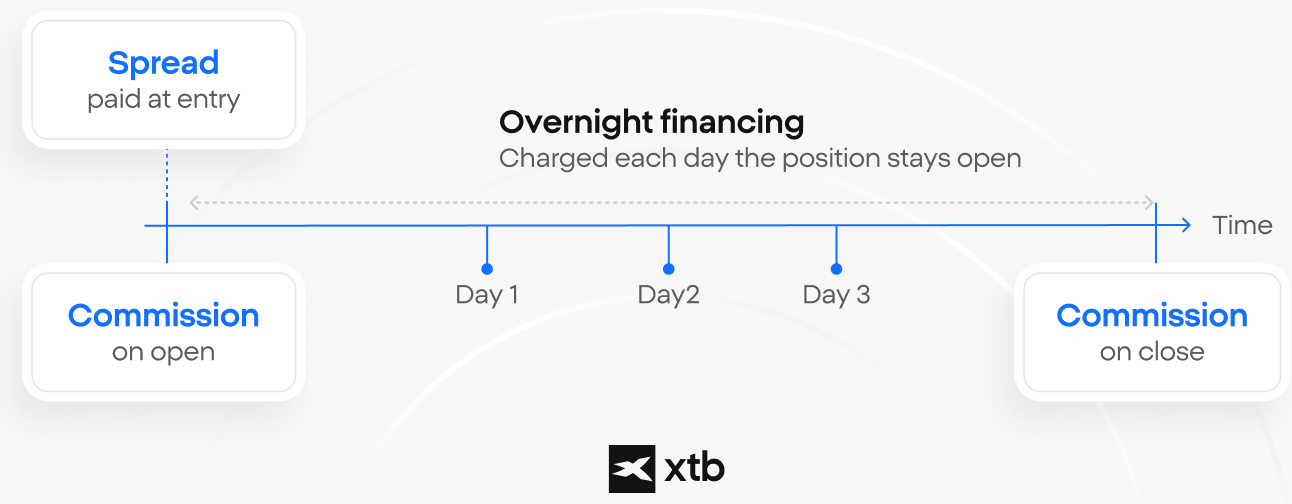
CFD positions typically involve three main costs:
- Spread - the difference between the buy and sell price, built into every trade
- Commission - a fee charged on opening and closing a position, where applicable
- Overnight financing - a daily cost applied to positions held beyond a single trading day
Spread is the first cost a trader encounters. When you open a CFD position, you are already slightly in the red. The spread is the difference between the bid and ask price - the gap you pay just to enter the trade. Even if the market doesn't move at all, closing immediately would result in a small loss. The price needs to move in your direction first just to reach break-even.
Commission applies on some instruments and platforms. It is charged twice - once when the position is opened and once when it is closed. Unlike the spread, it is a explicit, separate fee rather than a cost built into the price.
Overnight financing accumulates for every day the position remains open past the end of the trading session. The longer the position is held, the more this cost builds up - which makes it particularly relevant for trades held over days or weeks rather than closed within a single session.
📌Example
Mark opens a CFD position on gold
Mark believes the price of gold will rise. He opens a long CFD position of 1 unit at an ask price of $2,000, with a bid price of $1,998. The spread is $2.
His broker also charges a commission of $3 per side.
At entry:
Spread cost: $2 (built into the price - he buys at $2,000 but could only sell immediately at $1,998)
Commission: $3
Mark holds the position for three days. Overnight financing is $1.50 per day.
The price rises to $2,020. Mark closes the position at the bid price of $2,020.
At exit:
Commission: $3
Result:
Gross gain: $20
Spread: −$2
Commission (open + close): −$6
Overnight financing (3 days): −$4.50
20 - 2 - 6 - 4.60 = $7.50 net profit
Even though the market moved $20 in Mark's favour, the actual profit was $7.50 - because costs were already working against him from the moment the trade opened.
How Can You Manage Risk When Trading CFDs?
Managing risk in CFD trading starts before a position is opened. The first question is not how much to trade, but whether the opportunity is worth the risk at all. Every trade carries the possibility of loss, so the setup needs to offer a reasonable balance between what could be gained and what could be lost - this is the core idea behind risk-to-reward. Not every market idea deserves to become a trade.
To judge that balance, traders typically draw on more than one source of information. Each input helps assess whether an opportunity is structured or random. Good risk management habits in practice usually include:
- Checking whether the potential reward justifies the possible loss before opening the trade
- Using more than one analytical input, such as charts, news, and economic data, instead of relying on a single signal
- Avoiding trades during unstable conditions, including sharp news-driven volatility or low-liquidity periods, where slippage may cause the actual execution price to differ from the expected one
- Setting a stop-loss and defining the exit plan in advance, rather than improvising after the position is active
- Keeping position size proportionate to account balance so that one trade does not dominate the overall result
- Accepting that stepping back is sometimes the better decision when the setup is unclear or market conditions change
📌 EXAMPLE
Risk management practices before entering a trade
Julia is preparing for CFD trading, identifies an asset trading at 100 and expects a price increase. Instead of entering immediately, she first defines the structure of the trade.
She may set a stop-loss at 95, meaning the position will close automatically if the market moves against them by 5 units. They also may set a take-profit at 110, based on their initial expectation of upward movement.
Next, Julia chose a position size that represents only a small portion of their total account, ensuring that even if the stop-loss is reached, the overall balance is not significantly affected. Before entering, she accepts that the predefined loss is part of the trade outcome.
If the price rises toward 110, the position reflects that movement. If it falls to 95, the trade closes automatically, limiting further exposure. It may be only a part of the full analysis, reflecting historical patterns, broader market sentiments, which clarify the trader’s opinion.
Some speculators prefer a more natural and spontaneous approach, but wild market moves make this approach very risky - also because of the so-called margin call mechanism.
Strategic approach and the importance of defence orders
Market conditions matter. A setup that appears attractive in a calm environment may look very different during fast-moving news, low-liquidity hours, or sharp price swings. In these situations, the issue is not only whether the direction is right, but whether the market may become too unstable for the original plan to make sense. People who learn to trade often discover that risk management sometimes means strategic stepping back rather than forcing an entry.
Seen this way, risk management is not only about what happens after a trade is opened. It starts much earlier and even after the trade. Judging the quality of the opportunity, the size of the possible loss, and the realism of the potential reward. That is one of the clearest ways to understand how to trade CFD responsibly.
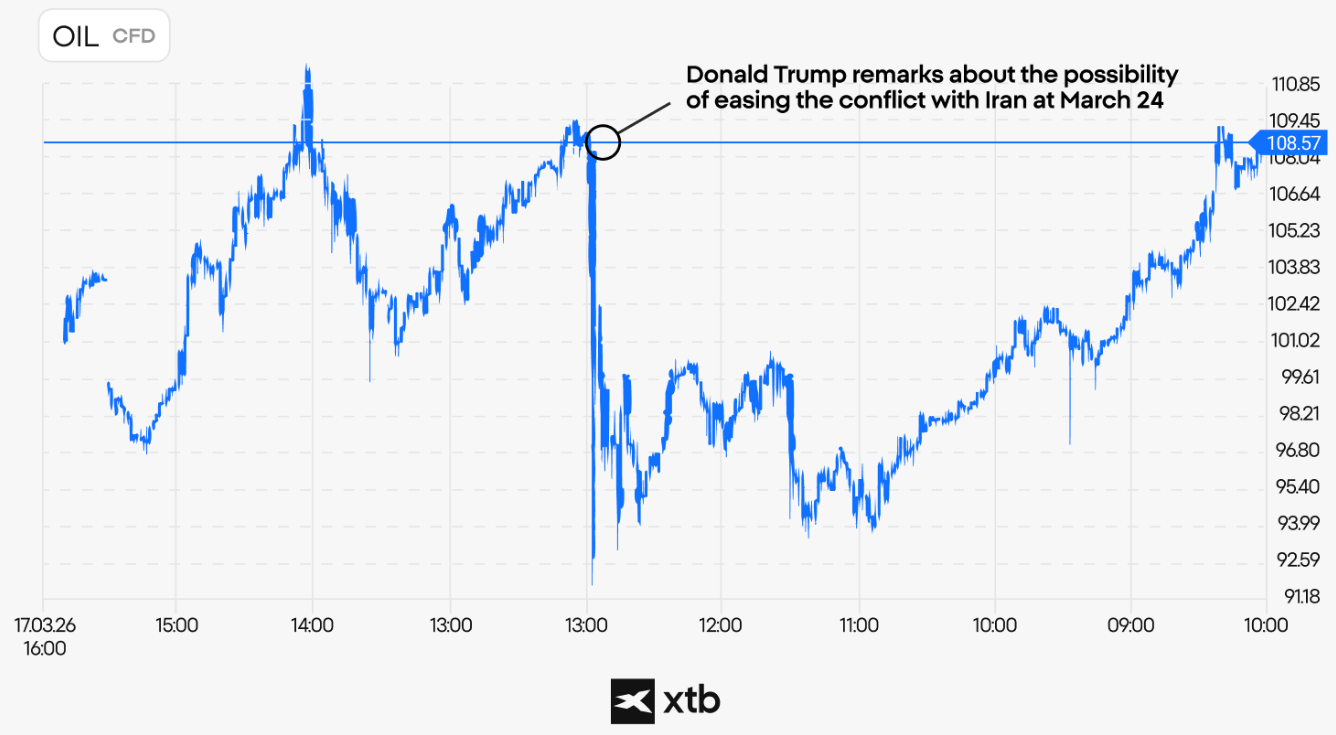
The wild volatility may enter even very liquid assets such as oil futures. Below we can see how OIL declined from almost 109 to 92 in March 24, 2026, in minutes after an unpredictable Trump post on Truth Social, related to the conflict with Iran and the Strait of Hormuz. If a trader had a long position before the tweet (even if fundamentally justified), this event led to substantial losses. That’s why setting a stop-loss and taking profit is very important.
Another example of volatility risk is the 15 January 2015, when the Swiss National Bank abandoned its exchange-rate ceiling against the euro. According to the 2025 CEPR analysis, the EUR/CHF pair surged more than 20% during the day of policy change. The event sent shockwaves through FX markets. Those example show how quickly prices can move when a major policy decision surprises the market.
What Are the Most Common Mistakes Beginners Make with Trading CFDs?
The most common mistakes in CFD trading result from misunderstanding how exposure, time, and expectations interact within a position. For those entering CFD trading for beginners, these errors tend to follow predictable patterns, especially when users are still learning how to trade CFD in live market conditions. In practice, most issues do not come from the market itself, but from how decisions are structured before and during a trade. This is why developing a solid CFD knowledge base focuses on process rather than outcomes.
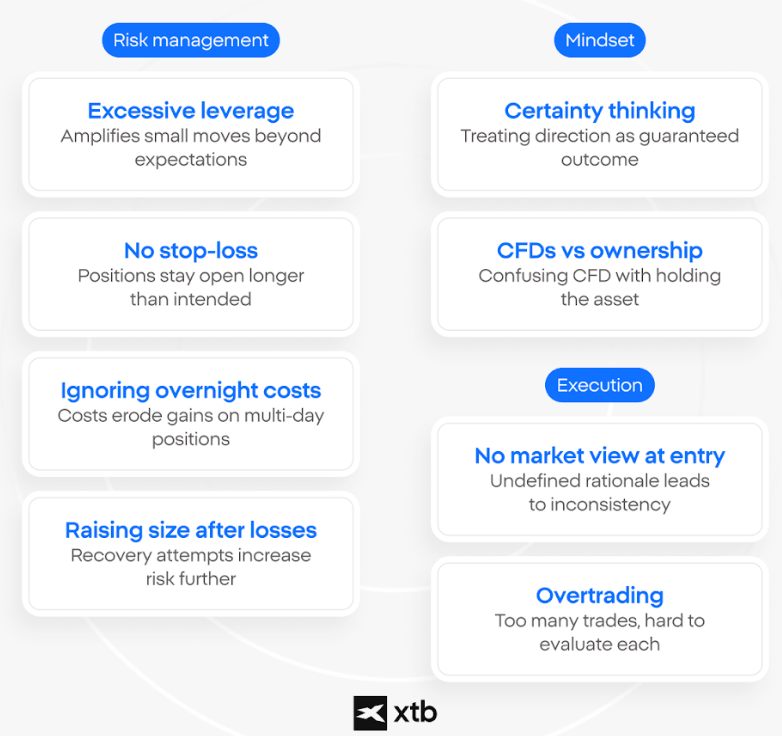
8 Most Common CFD Trading Mistakes
Using excessive leverage relative to account size. Large positions amplify small market movements, making results more sensitive than expected. This is one of the most frequent issues when learning how to CFD trade.
Trading without a predefined stop-loss. Without a clear exit level, positions remain open longer than intended, increasing exposure to unpredictable market changes.
Ignoring overnight costs on longer-held positions. Holding trades for multiple days without accounting for accumulated costs can reduce or offset results, even when the market moves in the expected direction.
Treating CFD trading as a guaranteed outcome. Some beginners approach CFD trading as if price direction can be predicted with certainty, rather than understood as a probability-based process.
Opening positions without a clear market view. Entering trades without a defined rationale often leads to inconsistent decisions and difficulty evaluating outcomes when you learn CFD trading.
Overtrading without a structured approach. Placing too many trades in a short time increases exposure and reduces the ability to assess individual decisions effectively.
Increasing position size after losses. Attempting to recover losses by increasing exposure often leads to greater risk rather than improved outcomes.
Confusing CFDs with direct asset ownership. For example, beginners may treat a CFD on gold as equivalent to physically investing in gold, even though the structure, ownership, and long-term implications are different. This misunderstanding is common when first exploring what CFD trading is.
Key Takeaways
- To start CFD trading, traders need a verified trading account, deposited funds, and trading platform access, but learning how to trade is key.
- Costs such as commission, spreads, and overnight financing affect results over time, especially when positions are held longer, making time horizon and choosing the right broker are important factors.
- Leverage is a central feature of CFD trading, increasing both potential gains and potential losses, which makes avoiding common traps very important.
FAQ
CFD trading means speculating on price movements without owning the underlying asset. You open a position based on whether you expect the price to rise or fall, and the result depends on the difference between the entry and exit prices. The asset itself is never purchased.
To start CFD trading, you need a regulated broker, a verified account, deposited funds, and access to a trading platform. The process includes choosing an asset, selecting a direction (buy or sell), setting position size, and defining risk parameters like stop-loss. Learning how the platform works is essential before placing real trades.
No, but the amount of capital affects position size and risk exposure. CFDs use leverage, meaning even a small deposit can control a larger position. However, this increases both potential gains and potential losses, so capital should be managed carefully.
Leverage allows you to open larger positions than your account balance would normally permit. While it can amplify returns, it also increases losses proportionally. This makes risk management critical, especially for beginners.
Going long means opening a trade expecting the price to rise, while going short means expecting it to fall. CFDs allow both directions, unlike traditional investing, where profits typically depend on price increases. The outcome depends entirely on whether the market moves as expected.
The main costs include spreads (the difference between the buy and sell prices), commissions (if charged), and overnight financing for positions held longer. These costs directly affect results and can reduce profitability over time. Understanding them is part of practical CFD trading knowledge.
A trade typically starts slightly negative due to the spread between bid and ask prices. The market must move in your favor enough to cover this gap before reaching break-even. This is a structural feature of CFD pricing.
In regulated environments like the EU, negative balance protection prevents losing more than your account balance. However, losses can still be significant and occur quickly due to leverage. Risk control remains essential.
One of the most common mistakes is using excessive leverage without proper risk control. Other frequent issues include not setting stop-loss orders, overtrading, and ignoring trading costs. These mistakes often come from misunderstanding how exposure and risk interact.
A stop-loss is a key risk management tool that automatically closes a position at a predefined loss level. It helps limit downside risk and prevents emotional decision-making during volatile market moves. Many beginners underestimate its importance.
If a position is held overnight, financing costs accumulate daily. This means longer trades require larger price movements to remain profitable. Time horizon is therefore an important factor in trading decisions.
CFD trading can be accessible to beginners, but it requires an understanding of risk, costs, and market mechanics. Without this foundation, the risk of losses increases significantly. A structured learning approach is essential before trading with real funds.
With CFDs, you speculate on price changes without owning the asset. When owning assets like stocks, you hold the actual investment and may receive dividends or long-term value. CFDs are typically used for shorter-term strategies and involve different risks.
Risk management includes setting stop-loss levels, controlling position size, and evaluating risk-to-reward before entering a trade. It also involves avoiding unstable market conditions and not overexposing your account. Consistency in decision-making is more important than individual trade outcomes.
No, even a correct market direction does not guarantee profit. Costs such as spreads and overnight swaps, as well as timing and execution, affect the final result. CFD trading outcomes depend on multiple factors, not just price direction.

Keir Starmer Resigns: What It Means for GBP, Gilts and UK Markets

CFDs vs Spread Betting UK: What's the Difference?

CFD Costs and Fees Explained
This content has been created by XTB S.A. This service is provided by XTB S.A., with its registered office in Warsaw, at Prosta 67, 00-838 Warsaw, Poland, entered in the register of entrepreneurs of the National Court Register (Krajowy Rejestr Sądowy) conducted by District Court for the Capital City of Warsaw, XII Commercial Division of the National Court Register under KRS number 0000217580, REGON number 015803782 and Tax Identification Number (NIP) 527-24-43-955, with the fully paid up share capital in the amount of PLN 5.869.181,75. XTB S.A. conducts brokerage activities on the basis of the license granted by Polish Securities and Exchange Commission on 8th November 2005 No. DDM-M-4021-57-1/2005 and is supervised by Polish Supervision Authority.