


Investors can choose from four primary methods to gain exposure to precious metals: physical gold, gold ETFs and ETCs, mining stocks, and CFDs on gold. Each option provides a distinct way to access the gold price, allowing you to align your strategy with your specific time horizon, risk appetite, and available capital. Gold typically plays a strategic role in diversified portfolios, with its primary function being to preserve purchasing power over time and provide long-term protection against inflation.
Investors can choose from four primary methods to gain exposure to precious metals: physical gold, gold ETFs and ETCs, mining stocks, and CFDs on gold. Each option provides a distinct way to access the gold price, allowing you to align your strategy with your specific time horizon, risk appetite, and available capital. Gold typically plays a strategic role in diversified portfolios, with its primary function being to preserve purchasing power over time and provide long-term protection against inflation.
Key Takeaways
- Physical gold offers direct ownership of the metal, though it requires secure storage and insurance arrangements.
- Gold ETFs provide liquid, exchange-traded exposure to the gold price without the need for physical delivery.
- Mining stocks offer unique exposure — through company performance linked to the scale of production and current gold prices.
- Gold CFDs allow investors to speculate on rising or falling gold prices using leverage without owning the underlying metal - significantly increasing both potential gains and losses.
What Are the Ways to Invest in Gold?
Investors looking to invest in gold have four distinct pathways, ranging from holding the tangible metal to speculating on market movements. You can choose between:
- physical gold
- gold ETFs
- mining stocks
- Gold CFDs
Every method carries a unique risk profile, cost structure, and time horizon, meaning the best way to invest in gold depends entirely on whether you seek long-term stability or short-term trading opportunities.
Method 1: Physical Gold — Coins, Bars and What Comes With Them
Investors access physical gold directly by purchasing coins or bars from reputable bullion dealers, mints, or banks, treating it as a tangible hedge. The process requires careful consideration of storage and insurance, as these ongoing costs reduce net returns over time, and liquidity is lower compared to digital financial instruments. Because you hold the asset, you face no counterparty risk, but you are responsible for the physical security and transportation of your investment.
At a gold price of around $4,000 per ounce, a $1,000 allocation would buy roughly 0.25 oz, or about 7.8 grams of gold. A $10,000 allocation would buy approximately 2.5 oz, or around 78 grams. These figures are simplified and exclude dealer premiums, spreads, taxes, delivery, storage, and insurance costs.
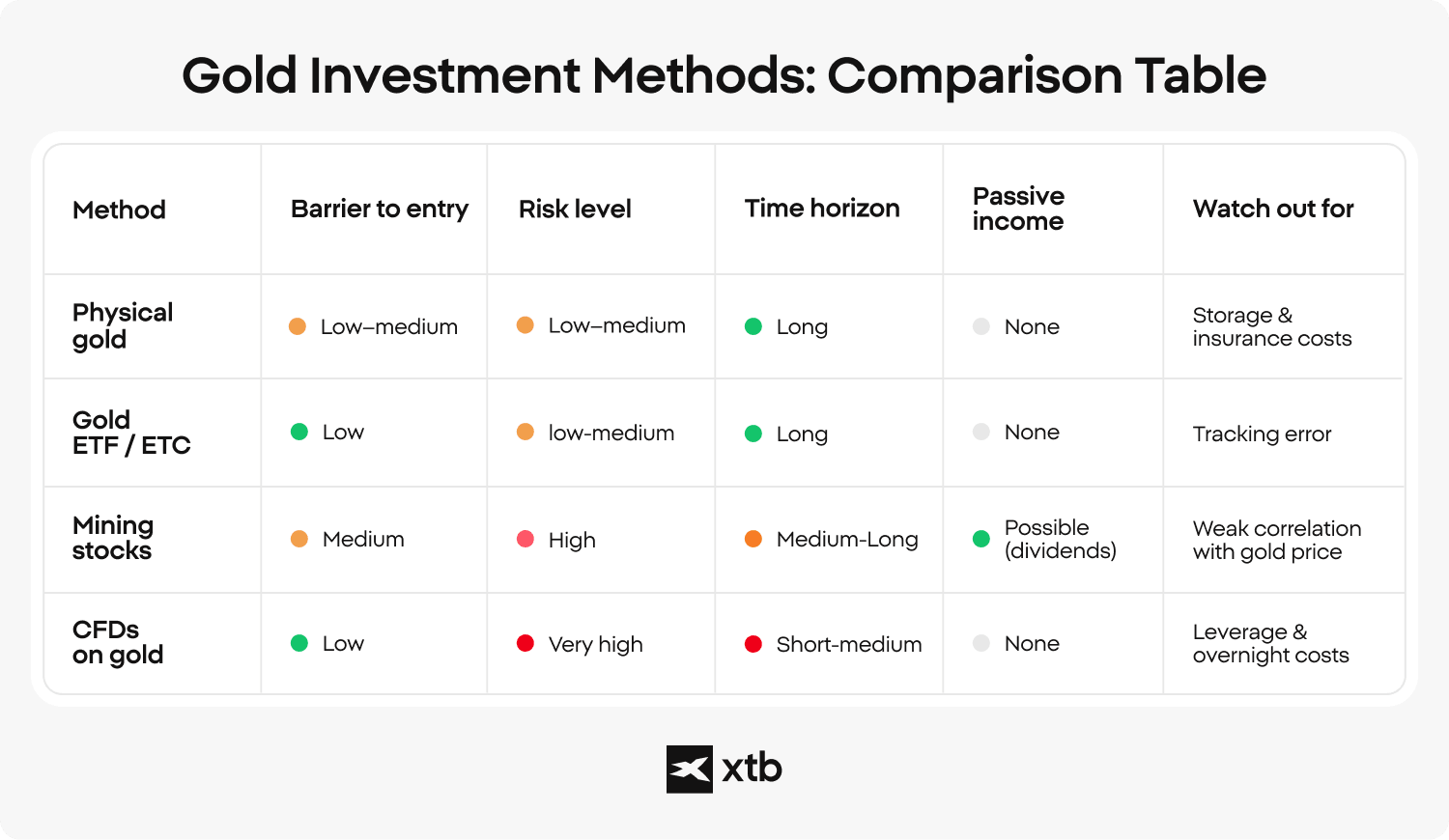
- Barrier to entry: low to medium - small coins are available from a few hundred euros, while a 1 oz gold bar would require roughly $4,000 at the assumed gold price.
- Risk level: low to medium - the value of physical gold follows the spot gold price directly, although the final purchase and resale price may differ because of premiums and bid-ask spreads.
- Time horizon - suited to long-term holding, usually years to decades.
- Passive income: none - returns are generated entirely from price appreciation.
Watch out for: ongoing storage and insurance costs that gradually reduce net returns. Also, selling physical gold privately often results in a transaction price below the market spot price.
- Ownership: Direct ownership: no counterparty risk
- Barrier to entry: Low to medium
- Risk level: Low to medium
- Time Horizon: Long term
- Passive income: None
- Watch out for: Storage, insurance and resale discounts
What Can Go Wrong When You Own Gold Directly?
The primary risks specific to owning physical gold include the potential for bullion market scams, high liquidity costs when selling, and the erosion of returns, for example, due to storage and insurance fees. Furthermore, while the gold price remains volatile, physical owners must also contend with the logistical burden of verifying purity and protecting the physical asset from theft or damage over long periods.
Method 2: Gold ETFs and ETCs - Investing in Gold Through a Brokerage Account
Gold ETFs and ETCs allow investors to gain exposure to the gold price without the complexities of physical delivery, as these products are traded on stock exchanges like standard shares. While some gold ETFs are backed by the actual metal stored in vaults, others use financial derivatives like futures contracts to track the price, which may behave differently during market shifts. This method is often the preferred starting point for those researching how to invest in gold for beginners due to its high liquidity and ease of use through a brokerage account.
- Accessibility: high - easy to buy through a brokerage account
- Barrier to entry: low - purchasable through any standard brokerage account, often from small amounts.
- Risk level: low to medium - these products track the gold price closely, with minor deviation.
- Time horizon: suited to long-term portfolio holding.
- Passive income: none - returns come from gold price movement.
- Watch out for: tracking error, as some gold ETFs may not perfectly mirror the spot gold price, especially in futures-based products.
What Should You Watch Out for With Gold ETFs?
Investors using gold ETFs face risks such as counterparty issues where the issuer might fail to fulfil obligations and varying tax treatments depending on the specific fund structure. Additionally, it is important to note that most of these instruments do not offer the ability to redeem shares for physical gold, which distinguishes them from direct ownership. Also, ETFs are not “fee-free” due to the so-called Expense Ratio.
By choosing active investment funds, you accept manager risk, as active allocation decisions may underperform the broad gold price if the manager's strategy fails. Investors interested in precious metals as a hedge or important part of the strategic portfolio usually prefer direct exposure to gold through dedicated, physically-backed ETFs.
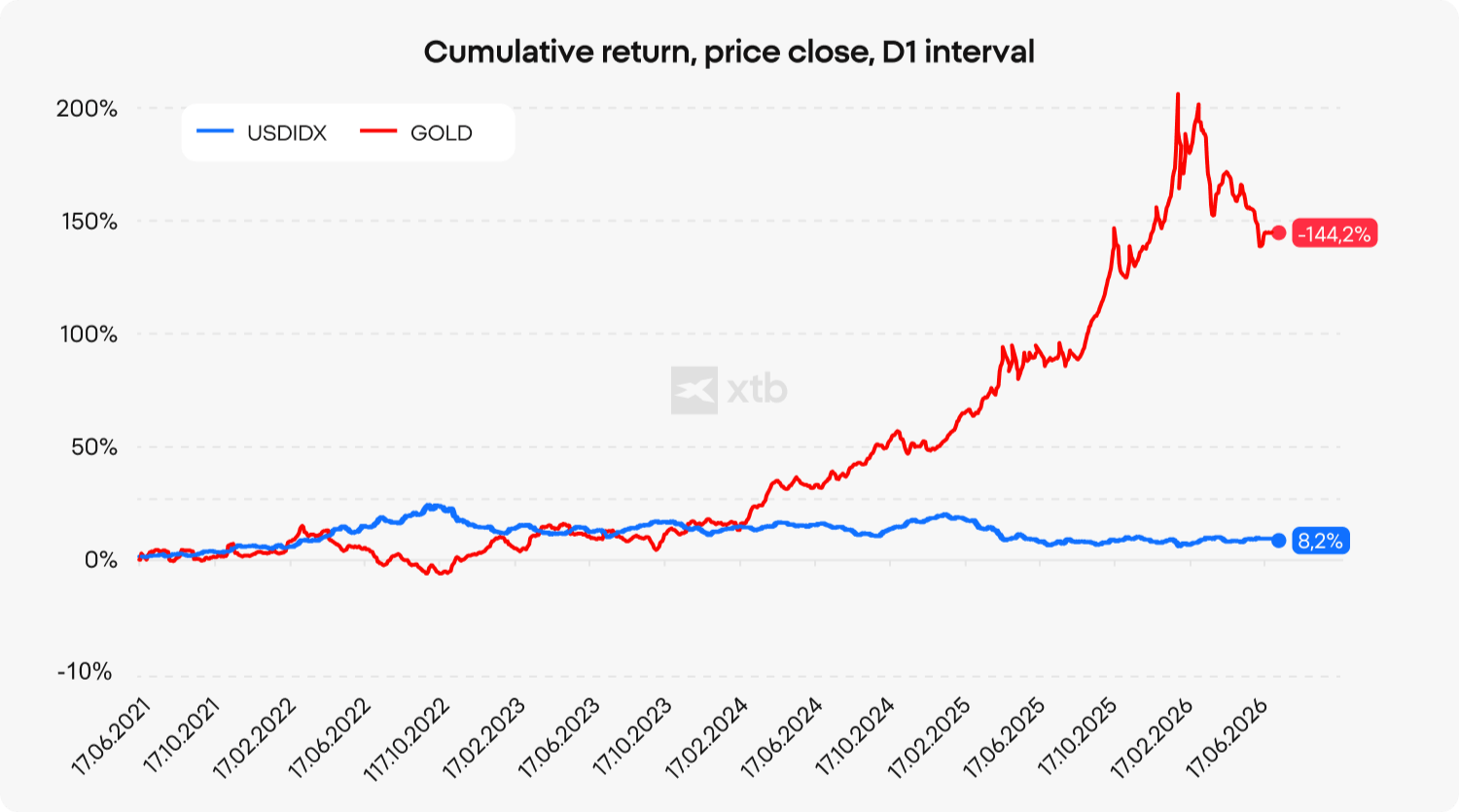
During the 5 years between 17.06.2021 and 17.06.2026 gold price increased by 144% vs the small 8.2% rise of the US Dollar index (measured by the US dollar futures index, USDIDX). Remember, past performance is not an indicator of future results.
Source: XTB Research, Bloomberg Finance L.P.
Method 3: Gold Mining Stocks — Investing in the Companies Behind the Gold
Gold Mining stocks provide indirect exposure to the gold price, as the profitability and share value of gold mining companies typically rise when the metal becomes more valuable. Unlike direct ownership, mining stocks carry operational, regulatory, and geopolitical risks, meaning these equities can sometimes move independently of the underlying commodity. For many, this method is attractive because it offers the possibility of dividend income, which is not available when you own bullion or standard ETFs.
- Barrier to entry: medium - requires a brokerage account and some understanding of equity investing.
- Risk level: high - combines gold price risk with company-specific and sector-wide volatility.
- Time horizon: medium to long - suitable for investors comfortable with equity market fluctuations.
- Passive income: possible - some companies behind mining stocks pay dividends to shareholders.
Watch out for weak or inconsistent correlation with the gold price, as mining stocks can fall due to internal company issues even if gold rises.
|
|
What Are the Risks of Investing in Gold Mining Stocks?
The specific risks of mining stocks include operational failures, such as mine accidents, production delays, cost inflation, or supply chain disruptions, as well as political instability in countries where mines are located. This is why gold-mining equities often behave differently from the gold price itself.
Indices such as the NYSE Arca Gold Miners Index track listed mining companies rather than physical gold, so their performance depends not only on bullion prices but also on margins, management quality, reserves, debt levels, and jurisdictional risk. Additionally, some miners use hedging strategies that may limit their upside if gold prices rise rapidly.
Method 4: Gold CFDs — Trading Price Movements Without Owning the Metal
CFDs on gold are derivative products that allow you to speculate on the price direction-either long or short-using leverage without owning the underlying asset. Because this is a tool for active price speculation rather than long-term wealth preservation,understanding how gold trading works is essential before opening a position. You can find more detail on the mechanics of these instruments in our guide to CFD trading for beginners.
- Barrier to entry: low - accessible through platforms with no requirement to purchase a full unit of gold.
- Risk level: very high - leverage amplifies both potential gains and losses.
- Time horizon: short to medium - overnight financing costs make long-term holding expensive.
- Passive income: none.
- Watch out for: leverage, where a small price move can result in a large loss relative to your margin, and daily overnight financing costs.
What Are the Risks of Trading Gold CFDs?
Trading CFDs on gold carries the significant risk of losing more than your initial deposit if you do not use risk management tools like stop-loss orders. You must also account for overnight financing costs, which accumulate daily and can quickly eat into your capital if a position is held over the long term. For more on the dangers of high-volatility instruments, review our resources on levage trading.
|
|
Which Gold Investment Method Might Be Right for You?
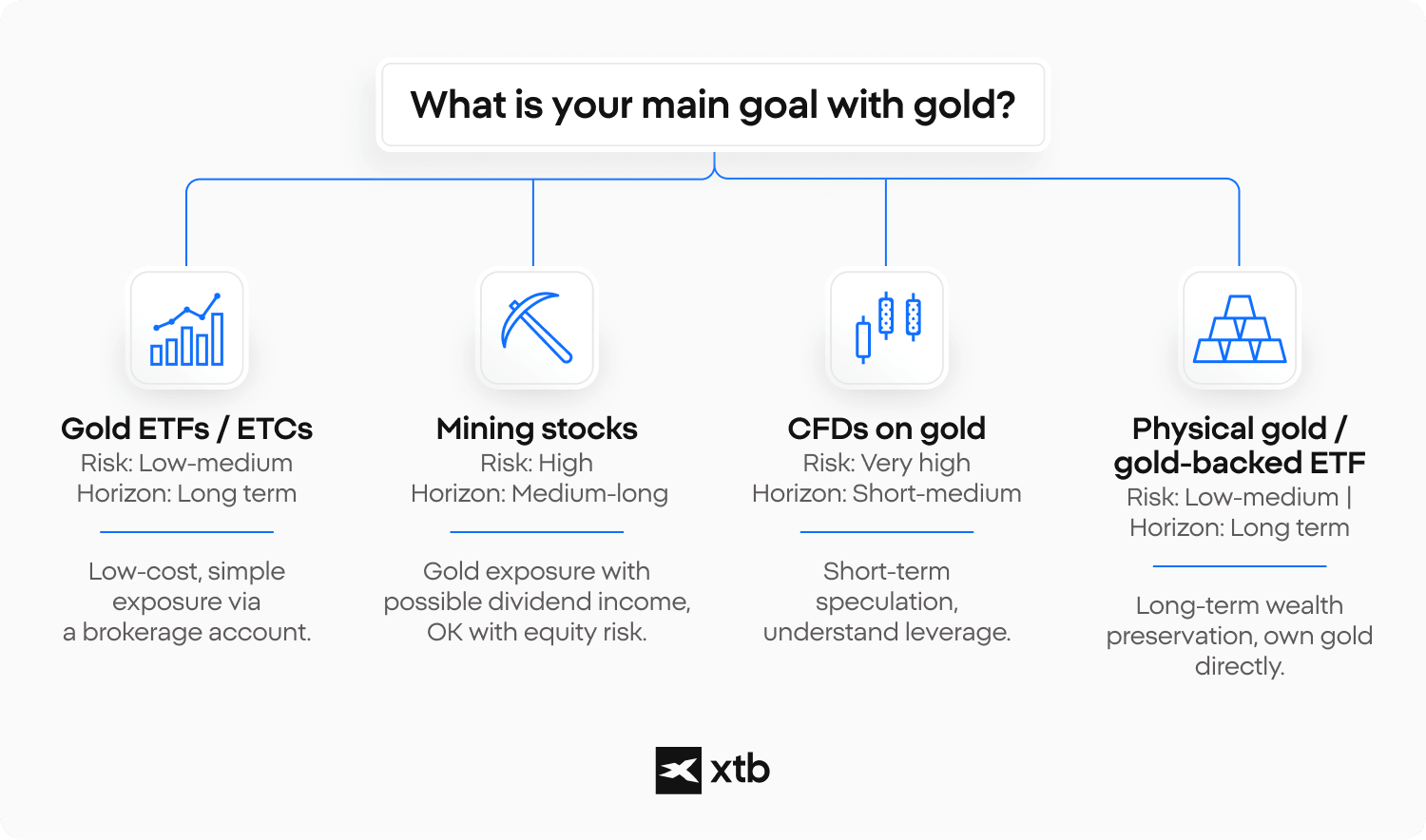
Choosing the right approach depends on your personal financial objectives and your risk tolerance. If your priority is long-term wealth preservation and you want to own gold directly, consider physical gold or a gold-backed ETF.
If you want low-cost, simple exposure to the gold price through a standard brokerage account, physical gold ETFs such as iShares Physical Gold or Wisdom Tree Physical Gold are often the most popular choice.
On the other hand, if you want exposure to gold with potential dividend income and are comfortable with equity risk, mining stocks provide a unique alternative. However, if you want to speculate on short-term market movements and understand the mechanics of leverage, CFDs on gold are designed for that specific purpose.
Ultimately, no single method is universally best; the right choice depends on your time horizon, risk tolerance, and how much involvement you want in managing your investment. Before considering whether gold is a good investment, it is important to understand the catalysts and risks linked to the bullion and each investment method.
How Do You Start Investing in Gold?
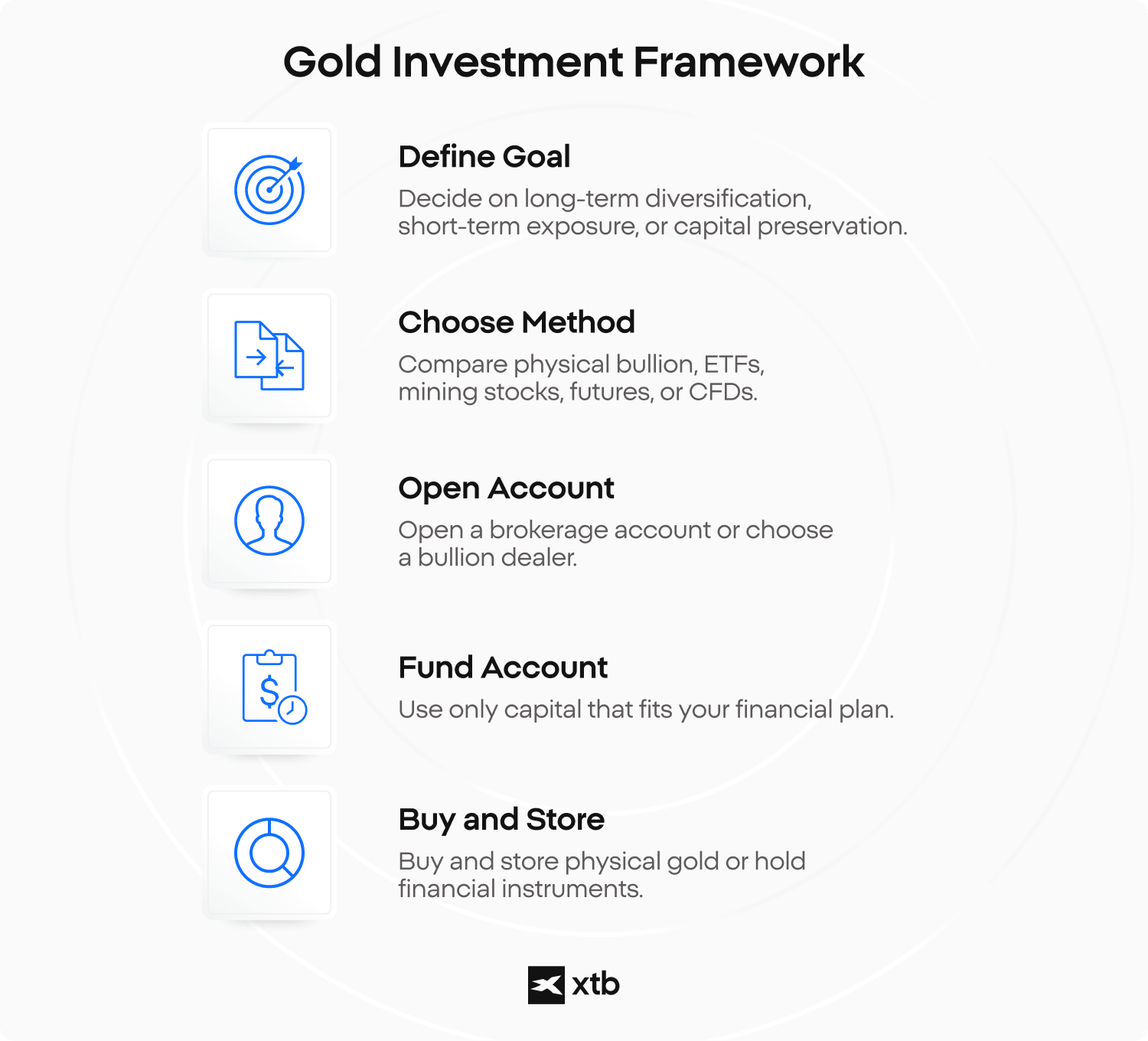
Starting to invest in gold usually means choosing how much exposure to the metal fits your financial situation, risk tolerance, and time horizon. Gold can play different roles depending on the investor: for some, it is a long-term store of value; for others, it is a tactical asset linked to inflation, interest rates, the U.S. dollar, and geopolitical risk. A simple starting framework may look like this:
- Define your goal and investment horizon - decide whether gold is meant for long-term diversification, short-term market exposure, or capital preservation.
- Choose a method - compare physical bullion, gold ETFs, mining stocks, futures, or CFDs, as each carries different risks and costs.
- Open a brokerage account or choose a bullion dealer - the right access point depends on whether you prefer financial instruments or physical ownership.
- Fund the account - use only capital that fits your broader financial plan and risk profile.
- Buy and store or hold - physical gold requires secure storage, while financial instruments are held through a trading or investment account.
CFDs are complex instruments and come with a high risk of losing money rapidly due to leverage. 74% of retail investor accounts lose money when trading CFDs with this provider. You should consider whether you understand how CFDs work and whether you can afford to take the high risk of losing your money.
FAQ
Beginners can invest in gold through physical gold (coins or bars), gold ETFs, gold ETCs, gold mutual funds, or gold mining stocks. Many first-time investors choose gold ETFs because they can be purchased through a standard brokerage account and provide exposure to the gold price without storing the metal
Owning gold means holding the physical metal, usually in the form of bullion bars or coins. Gold price exposure comes from financial products such as ETFs, ETCs, funds, or mining stocks that track or are linked to the gold market. This difference affects storage requirements, costs, liquidity, and ownership rights.
Gold is most commonly used as a long-term investment and portfolio diversification tool. Physical gold, gold ETFs, and gold funds are often held for years, while products such as CFDs may be used for shorter-term market exposure. The appropriate time horizon depends on the investment method and individual objectives.
Yes, gold prices can rise and fall over time, meaning losses are possible. Factors such as interest rates, inflation expectations, currency movements, and changes in investor demand can affect the gold price. Neither physical gold nor gold-linked financial products are protected from market declines.
Different gold investments have different structures and sources of risk. Physical gold, gold ETFs, and gold ETCs generally follow the gold price closely, while gold mining stocks are also influenced by company performance, operating costs, and broader stock market conditions. As a result, returns can vary even when all investments are linked to gold.
Gold itself does not generate income because it does not pay interest, dividends, or coupons. Returns from physical gold and most gold ETFs depend primarily on changes in the gold price. Income may be available through certain gold mining stocks or funds that distribute dividends, but this income comes from the underlying businesses rather than gold itself.
Gold prices are commonly influenced by interest rates, inflation expectations, US dollar strength, central bank purchases, and investor demand during periods of economic uncertainty. Because several factors can affect the market simultaneously, gold prices do not move according to a single predictable pattern.
Neither option is universally better, as each serves a different purpose. Physical gold provides direct ownership of the metal, while gold ETFs offer convenience, liquidity, and easier portfolio management through a brokerage account. The choice depends on factors such as storage preferences, costs, accessibility, and investment goals.

Economic Calendar: How to use it in your strategy

ETFs: A complete guide to choosing the best

How to Start Investing With Any Budget: A UK Guide
This content has been created by XTB S.A. This service is provided by XTB S.A., with its registered office in Warsaw, at Prosta 67, 00-838 Warsaw, Poland, entered in the register of entrepreneurs of the National Court Register (Krajowy Rejestr Sądowy) conducted by District Court for the Capital City of Warsaw, XII Commercial Division of the National Court Register under KRS number 0000217580, REGON number 015803782 and Tax Identification Number (NIP) 527-24-43-955, with the fully paid up share capital in the amount of PLN 5.869.181,75. XTB S.A. conducts brokerage activities on the basis of the license granted by Polish Securities and Exchange Commission on 8th November 2005 No. DDM-M-4021-57-1/2005 and is supervised by Polish Supervision Authority.