

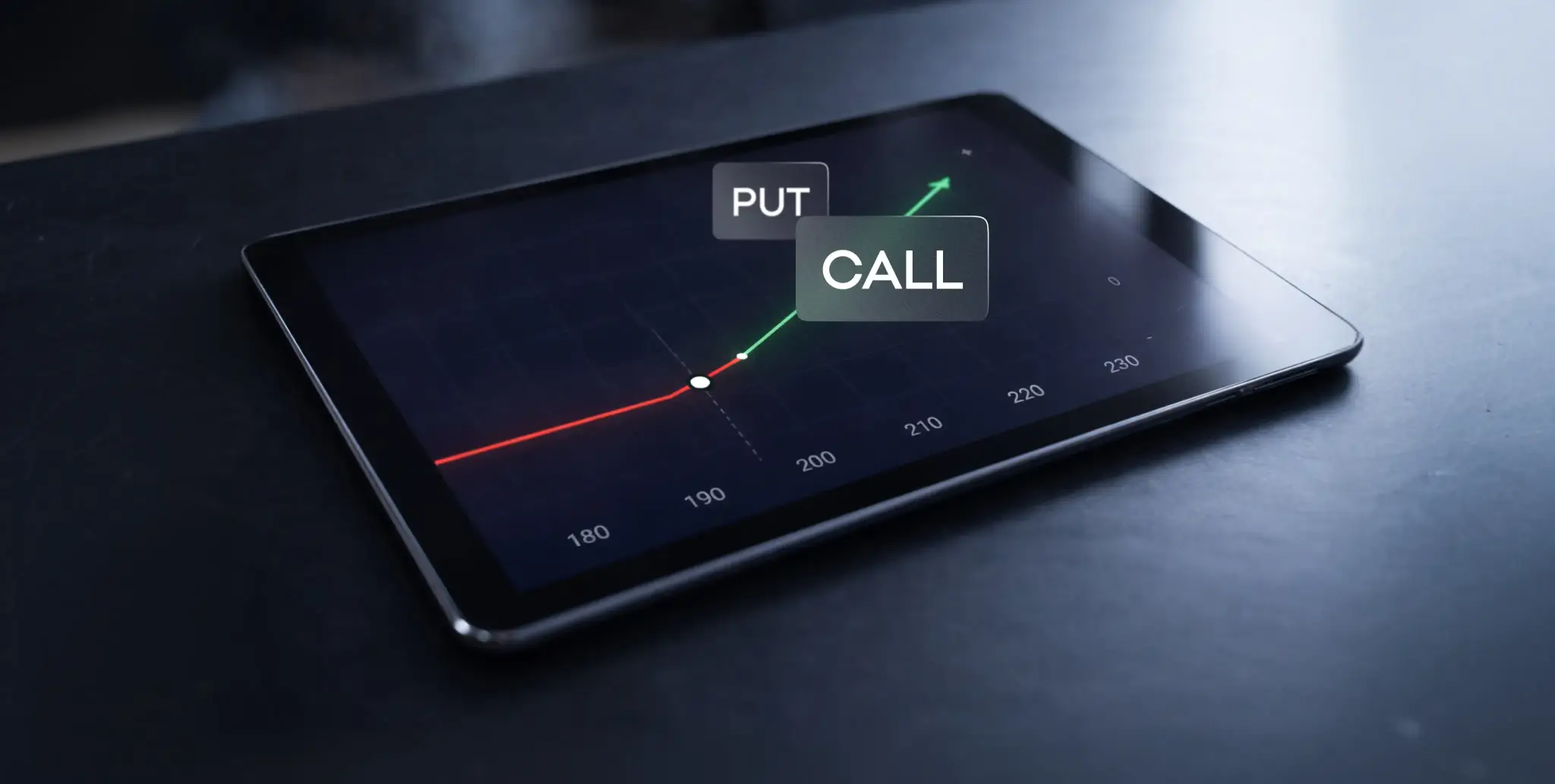
Ever wish you could take a position in a stock, crypto, or index without actually buying it outright… and still profit if your market view plays out? That’s the core idea behind options trading. Think of an option as a time-limited ticket: it gives you the right to buy or sell an asset at a set price, offering flexibility, strategic leverage, and yes… a few twists that make this market so fascinating.
Ever wish you could take a position in a stock, crypto, or index without actually buying it outright… and still profit if your market view plays out? That’s the core idea behind options trading. Think of an option as a time-limited ticket: it gives you the right to buy or sell an asset at a set price, offering flexibility, strategic leverage, and yes… a few twists that make this market so fascinating.
“Options are derivatives contracts that let you manage risk, generate income, or express a market view with defined parameters.”
At first, options can feel like stepping into a world where the same chart suddenly has extra layers. It’s not just about up or down. It’s about when, how fast, and how much uncertainty the market prices in. That’s why beginners often find options confusing: you’re no longer trading only price. You’re trading probability, volatility, and time itself.
In this guide, I’ll walk you through what options are, how they work, and why they matter in financial markets, using real-world examples and just enough humor to keep things human. Whether you’re brand new to trading or simply curious about what makes options so powerful, you’ll finish with a clear mental model, not a foggy spreadsheet and a headache.
Understanding Options Trading: The Basics
Options trading often sounds scarier than it really is. People imagine a room full of flashing screens, endless shouting, and chaos. But in reality, options are simply a structured way to express a market view with clearer rules than most people expect.
The key difference is this: with options, you’re not only trading direction, but also time and volatility. In other words, it’s not just “will it go up or down?” It’s also:
- How fast?
- By when?
- How wild will the price swings be?
That’s why options can feel confusing at first. But once you understand the mechanics, they start to feel less like magic and more like a toolkit: protective gear, leverage, and probability-driven positioning.
What Are Options?
At its core, options trading is about speculating not only on future assets prices but also on timing, volatility and the probability of different market outcomes. Buying a call is an alternative to buying an underlying asset whereas buying a put is an alternative to selling the underlying asset.
✅ Call options
A call option gives you the right to buy an asset at a certain price (strike price) before a certain date (expiration).
Imagine a rare sneaker drop: the price is $200 next month, but you’re worried the resale price could jump to $500. You pay $20 today for a ticket that locks in your right to buy at $200, no matter what happens. That’s basically a call option.
You’re paying for the possibility and the asymmetric payoff.
✅ Put options
A put option gives you the right to sell an asset at a certain price before expiration.
Now flip the sneaker story: you already own the sneakers and want protection. You pay a fee to lock in the ability to sell at a minimum price if the market collapses. That’s a put option. It’s some kind of insurance with a price tag.
So instead of owning the asset, you’re either:
- positioning for a price move, or
- protecting an existing position, or
- collecting premium by taking the other side.
How Options Work: A Simple Example
Imagine you have $1,000 and you see a stock trading at $50. You believe it could rise in the next month, but you don’t want to spend $5,000 to buy 100 shares.
So you buy 1 call option contract (which typically represents 100 shares) with:
- Strike price: $50
- Premium paid: $200
- Expiration: one month
Scenario A: The stock rises to $60
Your call option becomes valuable because it lets you buy at $50 while the market is at $60.
That’s $10 of intrinsic value per share, or:
- $10 × 100 shares = $1,000 intrinsic value
- minus the premium paid ($200) = $800 profit (ignoring fees)
So you turned a $200 outlay into exposure similar to 100 shares, with a defined cost and strong upside potential.
Scenario B: The stock falls or stays below $50
Your option may expire worthless, and your loss is capped at the $200 premium you paid. That’s one reason options can be attractive: your maximum loss (as a buyer) is known upfront.
In crypto, it works the same way. Imagine paying a small premium for the right to buy Bitcoin at $30,000 next month. If Bitcoin rallies to $35,000, your call gains value. If it drops, your maximum loss is the premium.
This is why traders like options: it’s leverage without full ownership, closer to renting a Ferrari than buying one. 🏎️ But remember: the rent isn’t free, and time is always ticking.
Why the Options Market Exists
The options market wasn’t created for adrenaline. It exists because real investors and real businesses needed a smarter way to manage uncertainty. Options are basically financial tools for controlling outcomes, not magic buttons for instant profit.
Here are the three main reasons options exist:
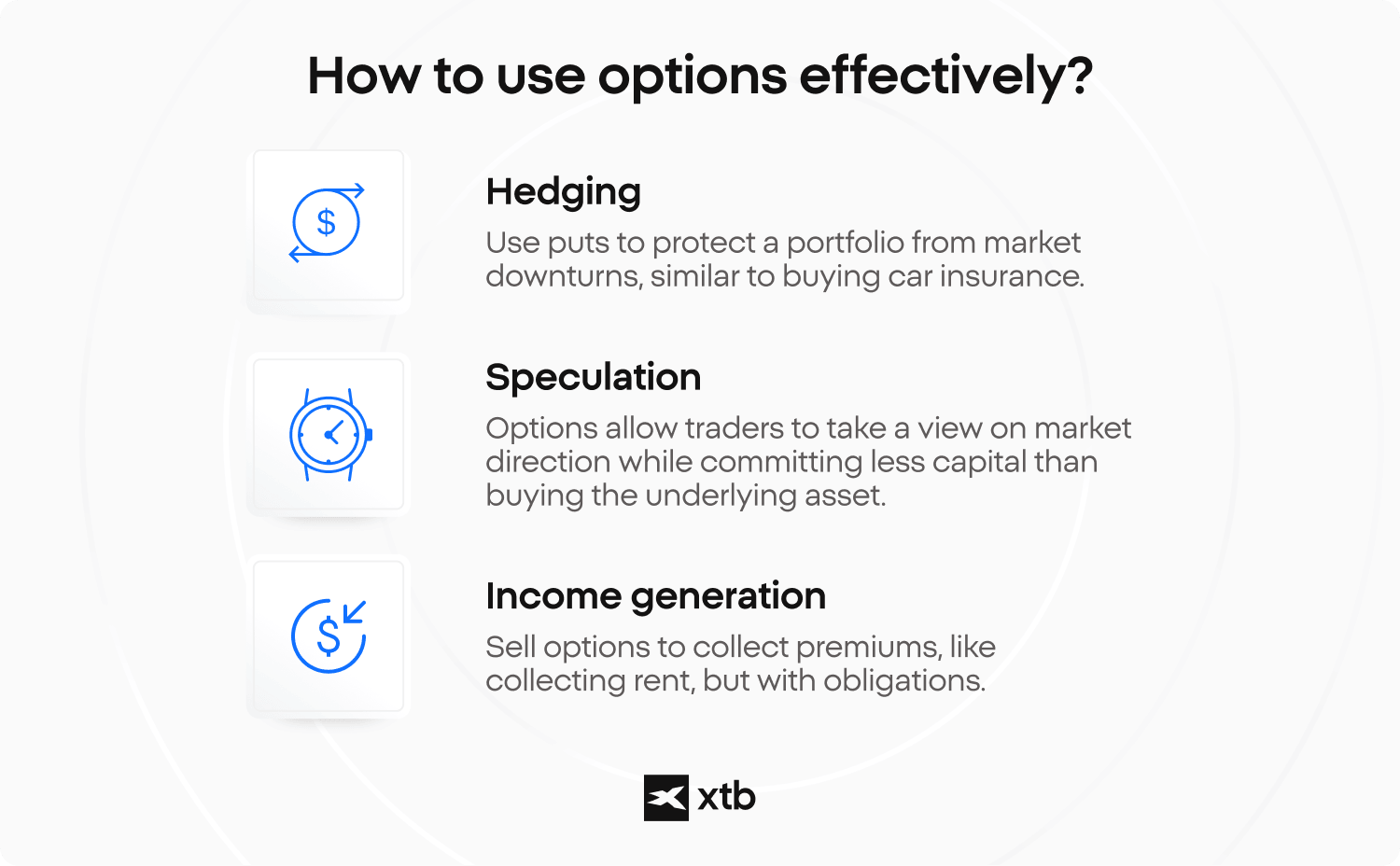
🛡️ Hedging
Options help protect existing investments from downside risk. Owning a put option on a stock you already hold is like taking out insurance on something valuable. Investors hope they will never need it, but if the position is really big, they sleep better knowing it’s there.
You can use market to hedge against bad weather (protection).
🎯 Speculation (without owning the underlying)
Options allow traders to express a market view on rising or falling prices without buying the asset itself. Instead of committing full capital, you pay a premium to rent exposure for a defined period.
You can speculate on crop prices (directional view).
A Short Guide to Trading Options
Options reward structure and punish improvisation. They’re not complicated once you understand the rules, but they don’t forgive sloppy risk management. Here are the foundations beginners usually benefit from internalizing early:
- Start small: Even small amount is enough to learn. In options, your first job is not to “win.” It’s to understand how pricing behaves, and how you react to it.
- Stick to simple structures at first: Calls and puts are the building blocks. Spreads, straddles, and condors can be powerful, but they are harder to understand because they involve multiple legs, volatility assumptions, and complex payoff curves.
- Respect expiration dates: Time is not neutral in options. Options are “perishable.” If nothing happens, the premium tends to decay. That’s why timing matters - even being right can be unprofitable if you’re late.
- Keep leverage realistic: Options can magnify outcomes, which is why position sizing matters more than in spot trading. The biggest mistakes usually happen when traders treat premium as “cheap,” even though risk is very real.
Mini-trader tip: Trading options without understanding strike price and expiration is like surfing without reading the waves. You might catch one, but the wipeout is often quicker than expected.
Strategic Insights into Options Trading
Options trading isn’t only about charts and contracts. It’s a blend of timing, strategy, and psychology and the market doesn’t just price direction. It prices uncertainty, expectations, and fear.
If stocks are about “what is happening,” stocks options are often about what the market thinks might happen, and how much it is willing to pay to protect against it.
In practice, option prices reflect three key dimensions at once:
- direction (where price may go),
- time (how long that move has to happen),
- uncertainty (how big that move could be).
This means being “right” on direction is not always enough. A trade can still lose value if the move is too small, too late, or if market expectations were already priced in. At a deeper level, options markets function as a real-time measure of sentiment. Rising premiums often signal growing uncertainty or demand for protection. Falling volatility can indicate confidence - or complacency. Understanding this layer helps explain why options are not just trading tools, but also a lens into how markets perceive risk.
Exploring the option strategies
Options strategies help structure risk and avoid random decision-making. They allow you to define outcomes more precisely than spot trading, but leverage and volatility mean results can vary significantly across markets.
🛡️ Protective puts act as insurance: you keep upside while limiting downside for a cost (premium).
🎢 Straddles / strangles are volatility strategies: they benefit from large moves, but lose value if the market stays flat due to time decay.
🪂 Tail risk hedging focuses on rare events: small, consistent costs in exchange for potential large payoffs during market crashes.
Much more about the option strategies you can find in another article: Options Trading Strategies – How to Choose the Best One?
⚠️ The Big Risks People Underestimate
Options are powerful, but they reflect market reality with brutal efficiency. Here are the risks beginners often meet sooner than expected:
⏳ Time decay (theta)
Options generally lose time value as expiration approaches. That can happen even if the underlying price moves slightly in your direction. It’s like holding a coupon that expires tomorrow. It still has value today, but not for long.
🔥 Leverage risk
Buying options can mean limited loss (premium paid), but it can still lead to repeated losses if trades are poorly timed. Options are like power tools: useful, efficient, and dangerous in the wrong hands.
💸 Losing the premium
When you buy an option, the premium is the price of admission, and that money is at risk from the start. If the market does not move far enough, fast enough, or in the right direction before expiration, the option can expire worthless. In that case, you lose 100% of the premium paid. It may feel like a “small, defined risk,” but small losses can stack up quickly when repeated.
Example: You buy a call option for 100 EUR premium, expecting the stock to rise. The stock moves only slightly higher. But not enough to outweigh time decay and the cost of the contract. At expiration, the option has no value, and you lose the full 100 EUR premium. The loss was limited, but it was still total.
Complexity trap
Spreads, s–called straddles, and multi-leg strategies can look “advanced,” but they can punish beginners because the outcome depends on more than direction. Volatility and time can work against you in surprising ways.
Volatility traps
High volatility inflates option premiums. That means you may be paying more than you realize for the same strike and expiration. Volatility can also collapse quickly, causing the option to lose value even if the price moves the way you expected.
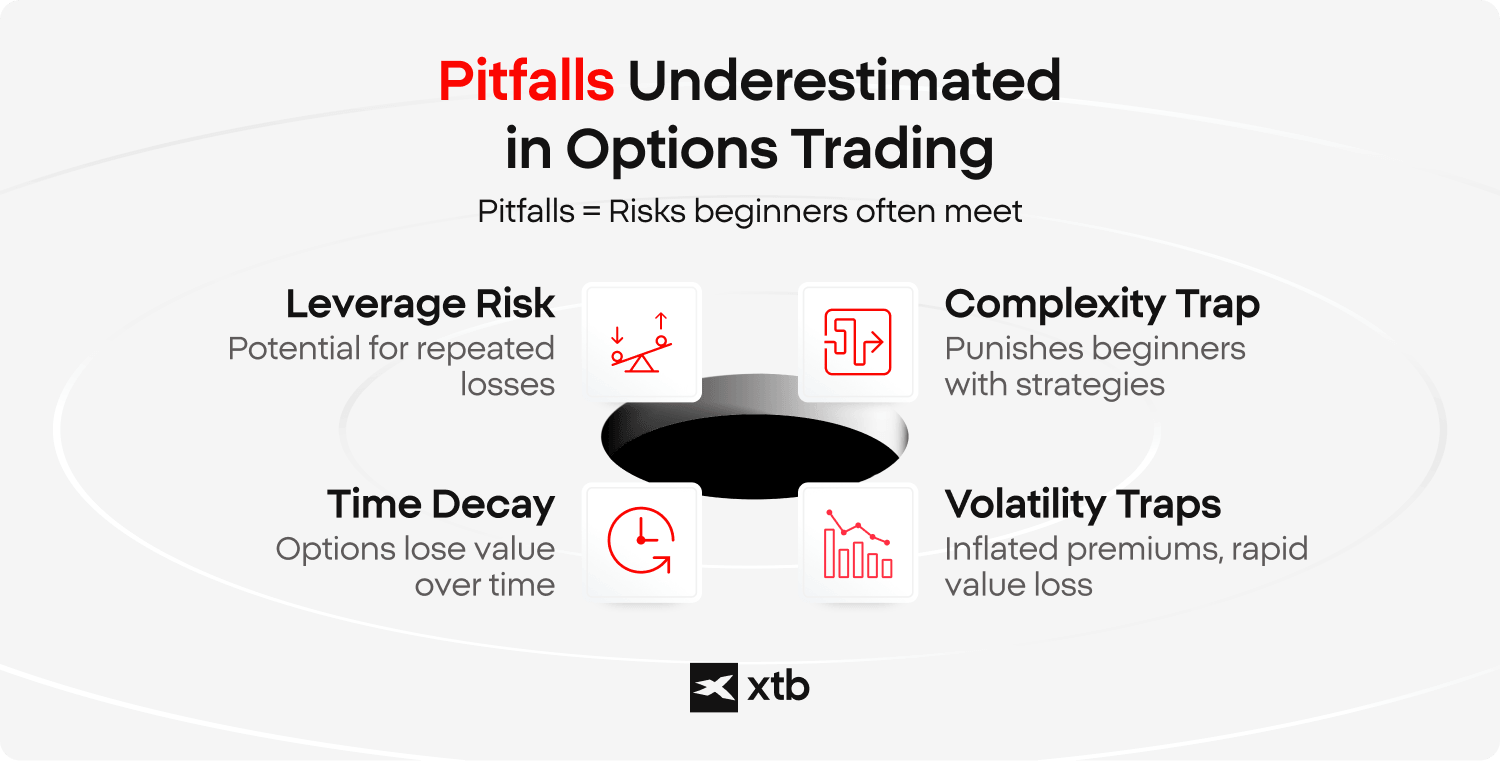
XTB infographic highlighting underestimated pitfalls in options trading, including leverage risk, time decay, complexity trap, and volatility traps that beginners commonly face.
Who Options May Be Interesting For
Options tend to be most useful for people who understand that they are risk tools and positioning tools.
They can be attractive for:
- Active traders who monitor markets and use short-term tactical strategies.
- Investors who want hedging tools to protect long-term holdings.
- Speculators with smaller capital who want defined-risk exposure.
- Curious learners who want to understand market pricing faster, especially volatility and risk perception.
They are often less suitable for:
- people who cannot monitor positions,
- anyone uncomfortable with the idea of losing the money,
- investors with low risk tolerance,
- or those in financially unstable situations where volatility can create stress.
When to Consider Options (And When to Avoid Them)
This isn’t about what you “should” do. It’s about when options make sense as a tool.
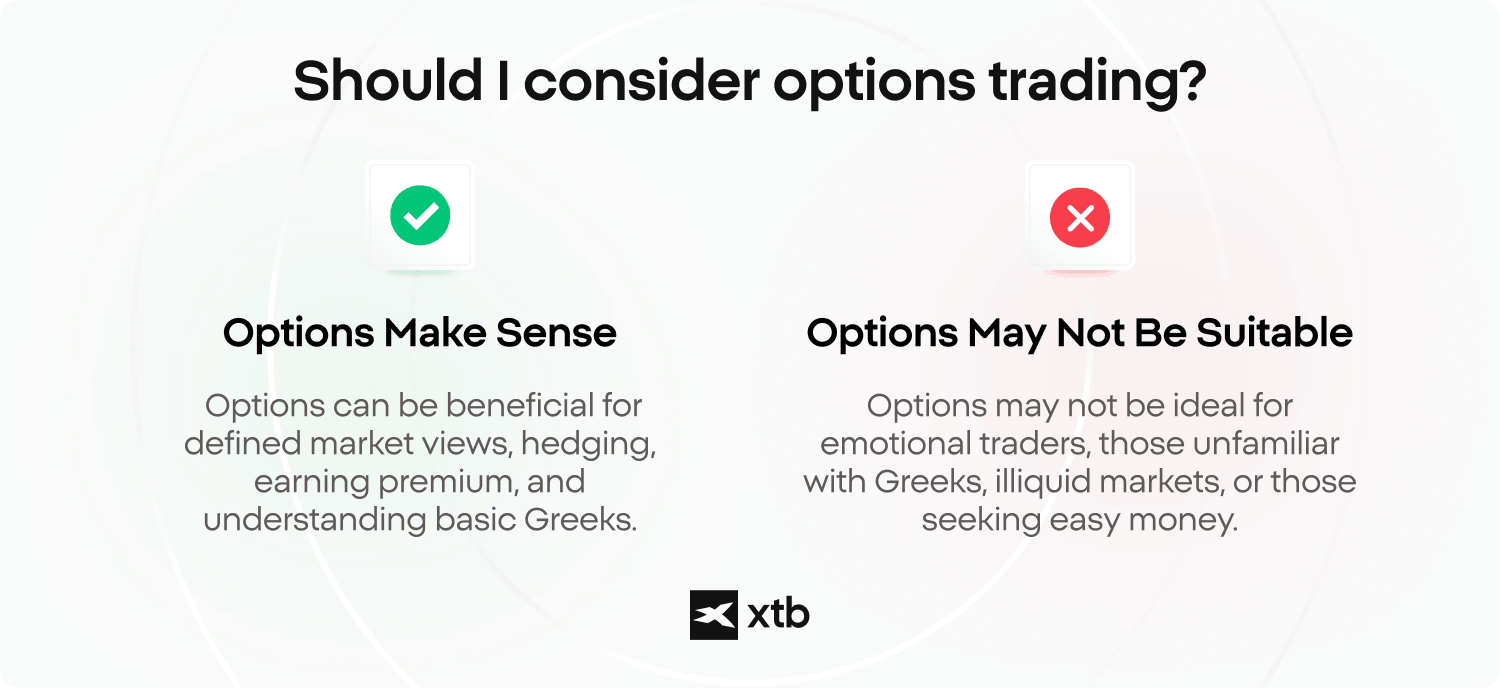
Options can make sense when:
- you have a defined market view and want defined risk,
- you want to hedge a volatile position,
- you want to earn premium on an existing holding,
- you understand how options market works, and want to practice.
Options may not be suitable when:
- you are emotionally reactive to price swings,
- you don’t understand strike price, expiration, and basic rules of options market
- the market is illiquid and spreads are wide,
- you are looking for “easy money.”
Pro tip: Options are like seasoning a dish. A small amount can improve the entire portfolio’s flavor. Too much can ruin the meal.
Mini Metaphors for Traders
- Buying a call = reserving a seat at a sold-out concert, hoping ticket prices explode.
- Buying a put = insurance on a gadget you just bought, protection if value collapses.
- Expiration = cake in the oven: miss the right timing, and it’s burnt.
- Implied volatility = paying more for insurance when the weather forecast looks scary.
Summary
- Options are contracts, not ownership: You get the right, not the obligation, to buy or sell an asset at a set price.
- Calls vs. puts: Calls benefit from rising prices, puts benefit from falling prices or offer protection.
- Flexibility and leverage: Options let small capital control larger exposure, but timing and risk management matter.
- Hedging and income: Options are not only speculative. They can protect a portfolio and generate premium under certain strategies.
- Time and volatility are the hidden forces: Even when direction is right, time decay or volatility shifts can change outcomes.
FAQ
Options trading is the practice of buying and selling financial contracts that give you the right, but not the obligation, to buy (call) or sell (put) an underlying asset at a predetermined price (strike price) before a set expiration date.
Think of it like reserving the right to buy a concert ticket for $100 today, even if the ticket skyrockets to $200 next week. You don’t have to buy it, but the opportunity is yours.
In financial markets, these contracts exist for stocks, ETFs, crypto, commodities, and indexes, making options trading a versatile tool for speculation, hedging, or income generation. It’s not owning the asset outright - it’s owning flexible financial potential.
Start small and simple. Focus on buying basic call and put options first before exploring complex strategies like spreads or straddles.
- Learn strike prices: the predetermined price you can buy/sell at.
- Track expiration dates: options lose value over time (theta).
- Keep a trading journal: note your reasoning, outcomes, and emotions.
For example, buying a call on Apple at $150 with a $5 premium allows you to control 100 shares without buying the full $15,000 worth of stock. Beginners should treat this as a learning lab, not a fast-money scheme.
Options can magnify both profits and losses, making risk management essential:
- Premium loss: The upfront cost is at risk if the option expires worthless.
- Time decay (theta): Value erodes as expiration approaches, even if the underlying moves favorably.
- Volatility swings: Sudden market moves can cause drastic price shifts.
- Leverage risk: Small capital controls large positions, increasing potential losses.
A good rule: treat options like high-performance tools, powerful but unforgiving if misused.
Options trading offers unique advantages over simply buying stocks or crypto:
- Leverage: Small capital can control larger positions.
- Hedging: Protect a portfolio against downside risk.
- Volatility: Buy put and call using long straddle strategy to profit from wild volatility spikes (up or down).
- Speculative opportunities: Place tactical trades on short-term price movements - on both sell and buy side.
It’s like having a Swiss Army knife for your portfolio - different tools for different scenarios.
Not everyone thrives in the options market. It might be suitable for:
- Active traders who monitor positions daily.
- Portfolio managers seeking hedging opportunities.
- Speculators looking for high-risk/high-reward strategies.
Avoid options if you:
- Dislike volatility or emotional swings.
- Cannot monitor positions regularly.
- Prefer long-term buy-and-hold investing without tactical trades.
A call option gives you the right to buy an asset at a specific strike price before expiration. You profit if the asset’s price rises above the strike price plus the premium paid.
Example: Buy a call on Tesla at $200 for a $10 premium. If Tesla rises to $230, you can buy at $200, sell at $230, and pocket $20 per share minus the premium.
Calls are useful for bullish market strategies, leveraged exposure, or speculative plays.
A put option gives you the right to sell an asset at a specific strike price before expiration. You profit if the asset’s price falls below the strike price minus the premium paid.
Example: Buy a put on Bitcoin at $30,000 for $500. If Bitcoin drops to $25,000, you can sell at $30,000, netting the difference minus the premium.
Puts are often used for bearish bets or portfolio protection, acting as insurance against falling prices.
Options are time-sensitive instruments. As expiration approaches:
- Out-of-the-money options lose value rapidly.
- In-the-money options retain value but still experience theta decay.
- Timing matters: Enter too early or too late, and even correct predictions can result in a loss.
Think of options like a melting ice cub. The longer you wait, the less value remains, even if the flavor (market move) is right.
Yes. Hedging with options is like buying insurance for your portfolio: buying puts can protect stocks or ETFs from downside risk.
For example, if you own 100 shares of Amazon at $3,000, buying a put at $2,900 limits your potential loss if the stock drops, while allowing gains if it rises.
Income strategies include so-called cash-secured puts. The strategy collects premiums while setting aside cash to potentially buy assets at lower prices.
It’s a way to monetize positions you already hold or plan to hold, like renting out a spare room in your house. You keep control but earn passive income.

Women In Trading: Is Trading Still A Male Dominated Industry?

Best Stock Broker - How to Choose the Best UK Broker

5 financial mistakes to avoid when investing online
This content has been created by XTB S.A. This service is provided by XTB S.A., with its registered office in Warsaw, at Prosta 67, 00-838 Warsaw, Poland, entered in the register of entrepreneurs of the National Court Register (Krajowy Rejestr Sądowy) conducted by District Court for the Capital City of Warsaw, XII Commercial Division of the National Court Register under KRS number 0000217580, REGON number 015803782 and Tax Identification Number (NIP) 527-24-43-955, with the fully paid up share capital in the amount of PLN 5.869.181,75. XTB S.A. conducts brokerage activities on the basis of the license granted by Polish Securities and Exchange Commission on 8th November 2005 No. DDM-M-4021-57-1/2005 and is supervised by Polish Supervision Authority.